Thank you for visiting SNEWPapers!
Sign up free
Portland Gazette, And Maine Advertiser
Portland, Cumberland County, Maine
What is this article about?
William Eaton's 1807 deposition before the Circuit Court details his conversations with Aaron Burr in Washington, D.C., in early 1807, revealing Burr's plans for a secret expedition to conquer Spanish territories, separate the western U.S. from the Union, establish a monarchy with himself as sovereign, and potentially overthrow the federal government. Eaton feigned interest but warned authorities.
Clipping
OCR Quality
Full Text
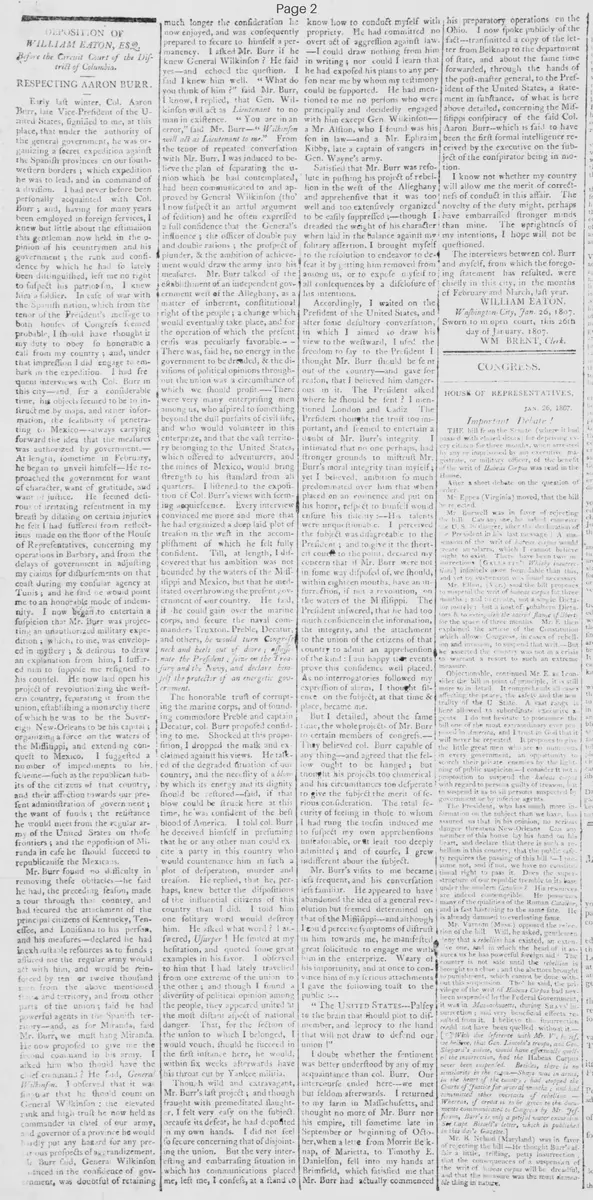
WILLIAM EATON, ESQ
Before the Circuit Court of the District of Columbia.
RESPECTING AARON BURR.
Early last winter, Col. Aaron Burr, late Vice-President of the United States, signified to me, at this place, that under the authority of the general government, he was organizing a secret expedition against the Spanish provinces on our south-western borders; which expedition he was to lead, and in command of a division. I had never before been personally acquainted with Col. Burr; and, having for many years been employed in foreign services, I knew but little about the estimation this gentleman now held in the opinion of his countrymen and his government; the rank and confidence by which he had so lately been distinguished, left me no right to suspect his patriotism, I knew him a soldier. In case of war with the Spanish nation, which from the tenor of the President's message to both houses of Congress seemed probable, I should have thought it my duty to obey so honorable a call from my country; and, under that impression I did engage to embark in the expedition. I had frequent interviews with Col. Burr in this city—and for a considerable time, his objects seemed to be to instruct me by maps, and other information, the feasibility of penetrating to Mexico—always carrying forward the idea that the measures was authorized by government.—
At length, sometime in February, he began to unveil himself—He reproached the government for want of character, want of gratitude, and want of justice. He seemed desirous of irritating resentment in my breast by dilating on certain injuries he felt I had suffered from reflections made on the floor of the House of Representatives, concerning my operations in Barbary, and from the delays of government in adjusting my claims for disbursements on that coast during my consular agency at Tunis; and he said he would point me to an honorable mode of indemnity. I now began to entertain a suspicion that Mr. Burr was projecting an unauthorized military expedition; which, to me, was enveloped in mystery; & desirous to draw an explanation from him, I suffered him to suppose me resigned to his counsel. He now laid open his project of revolutionizing the western country, separating it from the union, establishing a monarchy there of which he was to be the Sovereign—New-Orleans to be his capital; organizing a force on the waters of the Mississippi, and extending conquest to Mexico, I suggested a number of impediments to his scheme—such as the republican habits of the citizens of that country, and their affection towards our present administration of government; the want of funds; the resistance he would meet from the regular army of the United States on those frontiers; and the opposition of Miranda in case he should succeed to republicanize the Mexicans.
Mr. Burr found no difficulty in removing these obstacles—he said he had, the preceding season, made a tour through that country, and had secured the attachment of the principal citizens of Kentucky, Tennessee, and Louisiana to his person, and his measures—declared he had inexhaustible resources as to funds: assured me the regular army would act with him, and would be reinforced by ten or twelve thousand men from the above mentioned states and territory, and from other parts of the union; said he had powerful agents in the Spanish territory—and, as for Miranda, said Mr. Burr, we must hang Miranda.
He now proposed to give me the second command in his army. I asked him who should have the chief command? He said, General Wilkinson. I observed that it was so far that he should count on General Wilkinson: the elevated rank and high trust he now held as commander in chief of our army, and governor of a province he would hardly put any hazard for any private prospects of aggrandizement. Mr Burr said, General Wilkinson advanced in the confidence of government, was doubtful of retaining much longer the consideration he now enjoyed, and was consequently prepared to secure to himself a permanency. I asked Mr. Burr if he knew General Wilkinson? He said yes—and echoed the question. I said I knew him well. "What do you think of him?" said Mr. Burr I know, I replied, that Gen. Wilkinson will act as Lieutenant to no man in existence. "You are in an error," said Mr. Burr—"Wilkinson will act as Lieutenant to me." From the tenor of repeated conversation with Mr. Burr, I was induced to believe the plan of separating the union which he had contemplated, had been communicated to and approved by General Wilkinson (tho I now suspect it an artful argument of seduction) and he often expressed a full confidence that the General's influence; the officer of double pay and double rations; the prospect of plunder, & the ambition of achievement would draw the army into his measures. Mr. Burr talked of the establishment of an independent government west of the Alleghany, as a matter of inherent, constitutional right of the people; a change which would eventually take place, and for the operation of which the present crisis was peculiarly favorable.—There was, said he, no energy in the government to be dreaded, & the divisions of political opinions throughout the union was a circumstance of which we should profit.---There were very many enterprising men among us, who aspired to something beyond the dull pursuits of civil life, and who would volunteer in this enterprize, and that the vast territory belonging to the United States, which offered to adventurers, and the mines of Mexico, would bring strength to his standard from all quarters. I listened to the exposition of Col. Burr's views with seeming acquiescence. Every interview convinced me more and more that he had organized a deep laid plot of treason in the west in the accomplishment of which he felt fully confident. Till, at length, I discovered that his ambition was not bounded by the waters of the Mississippi and Mexico, but that he meditated overthrowing the present government of our country. He said, if he could gain over the marine corps, and secure the naval commanders Truxton, Preble, Decatur, and others, he would turn Congress neck and heels out of doors; assassinate the President: seize on the treasury and the Navy, and declare himself the protector of an energetic government.
The honorable trust of corrupting the marine corps, and of sounding commodore Preble and captain Decatur, col. Burr proposed confiding to me. Shocked at this proposition, I dropped the mask and exclaimed against his views. He talked of the degraded situation of our country, and the necessity of a blow by which its energy and its dignity should be restored—said, if that blow could be struck here at this time, he was confident of the best blood of America. I told col. Burr he deceived himself in presuming that he or any other man could excite a party in this country who would countenance him in such a plot of desperation, murder and treason. He replied, that he, perhaps, knew better the dispositions of the influential citizens of this country than I did. I told him one solitary word would destroy him. He asked what word? I answered, Usurper! He smiled at my hesitation, and quoted some great examples in his favor. I observed to him that I had lately travelled from one extreme of the union to the other; and though I found a diversity of political opinion among the people, they appeared united at the most distant aspect of national danger. That, for the section of the union to which I belonged, I would vouch, should be succeed in the first instance here, he would, within six weeks afterwards have his throat cut by Yankee militia. Though wild and extravagant, Mr. Burr's last project; and though fraught with premeditated slaughter, I felt very easy on the subject because its defeat, he had deposited in my own hands. I did not feel so secure concerning that of disjointing the union, But the very interesting and embarrassing situation in which his communications placed me, left me, I confess, at a stand to know how to conduct myself with propriety. He had committed no overt act of aggression against law.--I could draw nothing from him in writing; nor could I learn that he had exposed his plans to any person near me by whom my testimony could be supported. He had mentioned to me no persons who were principally and decidedly engaged with him except Gen. Wilkinson—a Mr Alston, who I found was his son in law—and a Mr. Ephraim Kirby, late a captain of rangers in Gen. Wayne's army.
Satisfied that Mr. Burr was resolute in pushing his project of rebellion in the west of the Alleghany and apprehensive that it was too well and too extensively organized to be easily suppressed ;--though I dreaded the weight of his character when laid in the balance against my solitary assertion, I brought myself to the resolution to endeavor to defeat it by getting him removed from among us, or to expose myself to all consequences by a disclosure of his intentions.
Accordingly, I waited on the President of the United States, and after some desultory conversation, in which I aimed to draw his view to the westward, I used the freedom to say to the President I thought Mr. Burr should be sent out of the country—and gave for reason, that I believed him dangerous in it. The President asked where he should be sent? I mentioned London and Cadiz The President thought the trust too important, and seemed to entertain a doubt of Mr. Burr's integrity. I intimated that no one perhaps, had stronger grounds to mistrust Mr. Burr's moral integrity than myself; yet I believed, ambition so much predominated over him that when placed on an eminence and put on his honor, respect to himself would ensure his fidelity :--His talents were unquestionable. I perceived the subject was disagreeable to the President ; and to give it the shortest course to the point, declared my concern that if Mr. Burr were not in some way disposed of, we should, within eighteen months, have an insurrection, if not a revolution, on the waters of the Mississippi. The President answered, that he had too much confidence in the information, the integrity, and the attachment to the union of the citizens of that country to admit an apprehension of the kind : I am happy that events prove this confidence well placed.
As no interrogatories followed my expression of alarm, I thought silence on the subject, at that time & place, became me.
But I detailed, about the same time, the whole projects of Mr. Burr to certain members of congress.--They believed col. Burr capable of any thing--and agreed that the fellow ought to be hanged; but thought his projects too chimerical and his circumstances too desperate to give the subject the merit of serious consideration. The total security of feeling in those to whom I had rung the tocsin induced me to suspect my own apprehensions unseasonable, or at least too deeply admitted; and of course, I grew indifferent about the subject.
Mr. Burr's visits to me became less frequent, and his conversation less familiar. He appeared to have abandoned the idea of a general revolution but seemed determined on that of the Mississippi---and although I could perceive symptoms of distrust in him towards me, he manifested great solicitude to engage me with him in the enterprize. Weary of his importunity, and at once to convince him of my serious attachments I gave the following toast to the public:--
" The UNITED STATES---Palsy to the brain that should plot to dismember, and leprosy to the hand that will not draw to defend our union!"
I doubt whether the sentiment was better understood by any of my acquaintance than col. Burr. Our intercourse ended here---we met but seldom afterwards. I returned to my farm in Massachusetts, and thought no more of Mr. Burr nor his empire, till sometime late in September or beginning of October, when a letter from Morris Belknap, of Marietta, to Timothy E. Daniellson, fell into my hands at Brimfield, which satisfied me that Mr. Burr had actually commenced his preparatory operations on the Ohio. I now spoke publicly of the fact---transmitted a copy of the letter from Belknap to the department of state. and about the same time forwarded, through the hands of the post-master general, to the President of the United States, a statement in substance, of what is here above detailed, concerning the Mississippi conspiracy of the said Col. Aaron Burr--which is said to have been the first formal intelligence received by the executive on the subject of the conspirator being in motion.
I know not whether my country will allow me the merit of correctness of conduct in this affair. The novelty of the duty might, perhaps, have embarrassed stronger minds than mine. The uprightness of my intentions, I hope will not be questioned.
The interviews between col. Burr and myself, from which the foregoing statement has resulted, were chiefly in this city, in the months of February and March, last year.
WILLIAM EATON.
Washington City, Jan. 26, 1807.
Sworn to in open court, this 26th day of January, 1807.
WM BRENT. Clerk.
What sub-type of article is it?
What themes does it cover?
What keywords are associated?
What entities or persons were involved?
Where did it happen?
Story Details
Key Persons
Location
Washington City, District Of Columbia; Western Country; Mississippi River; Ohio
Event Date
Early Last Winter 1806; February And March 1806; Deposition January 26, 1807
Story Details
William Eaton recounts conversations with Aaron Burr revealing plans to lead an unauthorized expedition against Spanish provinces, separate the western U.S. from the Union to establish a monarchy with Burr as sovereign in New Orleans, conquer Mexico, and potentially overthrow the U.S. government by assassinating the President and seizing power. Eaton feigns support, warns authorities, and provides key intelligence leading to Burr's exposure.