Thank you for visiting SNEWPapers!
Sign up free
The Pioneer Express
Pembina, Pembina County, North Dakota
What is this article about?
Daily summaries of U.S. Congressional proceedings in Washington from May 10 to 16, including House vote on clerk hire allowance during recesses, Senate debates on river and harbor bill especially California deep sea harbor, passage of Indian deportation bill, pension laws, contested elections, and appropriations.
Merged-components note: The text content continues seamlessly from the first component (proceedings in Congress) to the second (river and harbor bill), forming a single coherent article on congressional activities.
Clipping
OCR Quality
Full Text
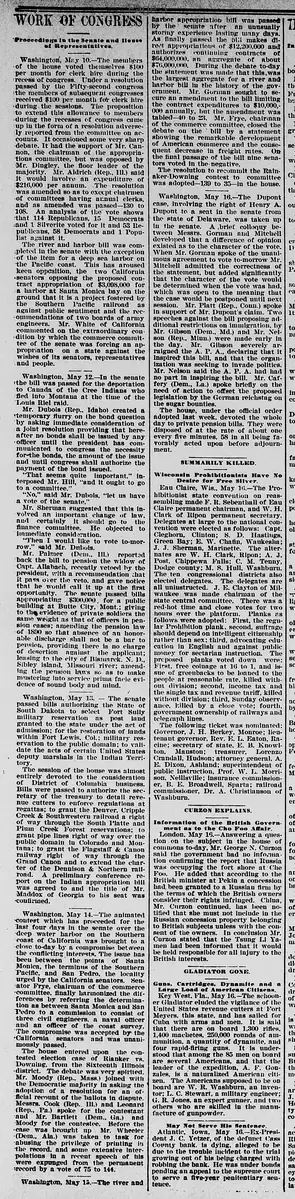
Proceedings in the Senate and House of Representatives.
Washington, May 10.—The members of the house voted themselves $100 per month for clerk hire during the recess of congress. Under a resolution passed by the Fifty-second congress the members of subsequent congresses received $100 per month for clerk hire during the sessions. The proposition to extend this allowance to members during the recesses of congress came up in the form of a resolution adversely reported from the committee on accounts. It occasioned some very sharp debate. It had the support of Mr. Cannon, the chairman of the appropriations committee, but was opposed by Mr. Dingley, the floor leader of the majority. Mr. Aldrich (Rep., Ill.) said it would involve an expenditure of $216,000 per annum. The resolution was amended so as to except chairmen of committees having annual clerks, and as amended was passed—130 to 108. An analysis of the vote shows that 114 Republicans, 15 Democrats and 1 Silverite voted for it and 53 Republicans, 58 Democrats and 1 Populist against it.
The river and harbor bill was completed in the senate with the exception of the item for a deep sea harbor on the Pacific coast. This has aroused keen opposition, the two California senators opposing the proposed contract appropriation of $3,098,000 for a harbor at Santa Monica bay on the ground that it is a project fostered by the Southern Pacific railroad as against public sentiment and the recommendations of two boards of army engineers. Mr. White of California commented on the extraordinary condition by which the commerce committee of the senate was forcing an appropriation on a state against the wishes of its senators, representatives and people.
Washington, May 12.—In the senate the bill was passed for the deportation to Canada of the Cree Indians who fled into Montana at the time of the Louis Riel raid.
Mr. Dubois (Rep., Idaho) created a temporary flurry on the bond question by asking immediate consideration of a joint resolution providing that hereafter no bonds shall be issued by any officer until the president has communicated to congress the necessity for the bonds, the amount of the issue and until congress shall authorize the payment of the bond issued.
"That seems quite important," interposed Mr. Hill, "and it ought to go to a committee."
"No," said Mr. Dubois, "let us have a vote of the senate."
Mr. Sherman suggested that this involved an important change of law, and certainly it should go to the finance committee. He objected to immediate consideration.
"Then I would like to vote to-morrow," said Mr. Dubois.
Mr. Palmer (Dem., Ill.) reported back the bill to pension the widow of Capt. Allabach, recently vetoed by the president, with a recommendation that it pass over the veto, and gave notice that he would call it up at the first opportunity. The senate passed bills appropriating $800,000 for a public building at Butte City, Mont.; giving to the evidence of private soldiers the same weight as that of officers in pension cases; amending the pension law of 1890 so that absence of an honorable discharge shall not be a bar to pension, providing there is no charge of desertion against the applicant; leasing to the city of Bismarck, N. D., Sibley island, Missouri river; amending the pension laws so as to make mustering into service prima facie evidence of sound body and mind.
Washington, May 13.—The senate passed bills authorizing the State of South Dakota to select Fort Sully military reservation as post land granted to the state under the act of admission; for the restoration of lands within Fort Lewis, Col., military reservation to the public domain; to validate the acts of certain United States deputy marshals in the Indian Territory.
The session of the house was almost entirely devoted to the consideration of District of Columbia business. Bills were passed to authorize the secretary of the treasury to detail revenue cutters to enforce regulations at regattas; to grant the Denver, Cripple Creek & Southwestern railroad a right of way through the South Platte and Plum Creek Forest reservations; to grant pipe lines right of way over the public domain in Colorado and Montana; to grant the Flagstaff & Canon railway right of way through the Grand Canon and to extend the charter of the Dennison & Northern railroad. A preliminary conference report on the Indian appropriation bill was agreed to and the title of Mr. Maddox of Georgia to his seat was confirmed.
Washington, May 14.—The animated contest which has proceeded for the last four days in the senate over the deep water harbor on the Southern coast of California was brought to a close to-day by a compromise between the conflicting interests. The issue has been between the points of Santa Monica, the terminus of the Southern Pacific, and San Pedro, the locality urged by the California senators. Senator Frye, chairman of the commerce committee, finally harmonized the differences by referring the determination as between Santa Monica and San Pedro to a commission to consist of three civil engineers, a naval officer and an officer of the coast survey. The compromise was accepted by the California senators and was unanimously passed.
The house entered upon the contested election case of Rianker vs. Downing, from the Sixteenth Illinois district. The debate was very spirited. Mr. Moody (Rep. Mass.) joined with the Democratic majority in asking the adoption of a resolution for an official recount of the ballots in dispute. Messrs. Cook (Rep., Ill.) and Leonard (Rep., Pa.) spoke for the contestant and Mr. Bartlett (Dem., Ga.) and Moody for the contestee. Before the case was brought up Mr. Wheeler (Dem., Ala.) was taken to task for abusing the privilege of printing in the record, and some extensive interpolations in a recent speech of his were expunged from the permanent record by a vote of 75 to 144.
Washington, May 15.—The river and
harbor appropriation bill was passed by the senate after an unusually stormy experience lasting many days. As finally passed the bill makes direct appropriations of $12,200,000 and authorizes continuing contracts of $64,000,000, an aggregate of about $76,000,000. During the debate to-day the statement was made that this was the largest aggregate for a river and harbor bill in the history of the government. Mr. Gorman sought to secure an amendment to the bill limiting the contract expenditures to $10,000,000 annually, but the amendment was tabled 40 to 23. Mr. Frye, chairman of the commerce committee, closed the debate on the bill by a statement showing the remarkable development of American commerce and the consequent decrease in freight rates. On the final passage of the bill nine senators voted in the negative.
The resolution to recommit the Rianker-Downing contest to committee was adopted—139 to 35—in the house.
Washington, May 16.—The Dupont case, involving the right of Henry A. Dupont to a seat in the senate from the state of Delaware, was taken up in the senate. A brief colloquy between Messrs. Gorman and Mitchell developed that a difference of opinion existed as to the character of the vote. When Mr. Gorman spoke of the unanimous agreement to vote to-morrow Mr. Mitchell admitted the correctness of the statement, but added significantly that the character of the vote would be determined when the vote was had, which was open to the meaning that the case would be postponed until next session. Mr. Platt (Rep., Conn.) spoke in support of Mr. Dupont's claim. Two speeches against the bill proposing additional restrictions on immigration, by Mr. Gibson (Dem., Md.) and Mr. Nelson (Rep., Minn.) were made early in the day. Mr. Gibson severely arraigned the A. P. A. declaring that it inspired this bill, and that the organization was seeking to invade politics. Mr. Nelson said the A. P. A. had had no part in inspiring the bill. Mr. Caffery (Dem., La.) spoke briefly on the need of action to offset the proposed legislation by the German reichstag on the sugar bounties.
The house, under the official order adopted last week, devoted the whole day to private pension bills. They were disposed of at the rate of about one every five minutes, 58 in all being favorably acted upon before adjournment.
What sub-type of article is it?
What themes does it cover?
What keywords are associated?
What entities or persons were involved?
Where did it happen?
Story Details
Key Persons
Location
Washington
Event Date
May 10 16
Story Details
Congressional proceedings including House approval of clerk hire during recesses, Senate debates and compromise on California harbor in river and harbor bill totaling $76M, passage of Cree Indian deportation, pension reforms, land grants, railroad rights-of-way, contested elections like Rianker vs. Downing and Dupont case, immigration bill opposition, and private pension bills.