Thank you for visiting SNEWPapers!
Sign up free
The Salt Lake Herald
Salt Lake City, Salt Lake County, Utah
What is this article about?
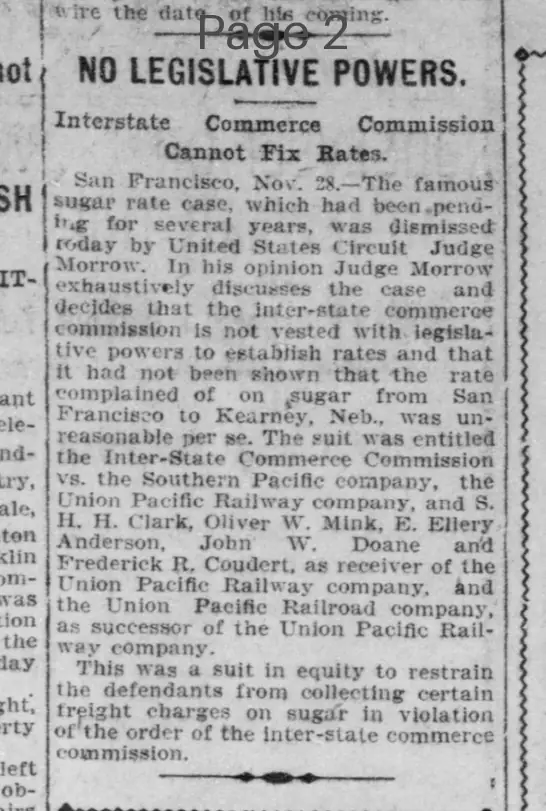
In San Francisco on Nov. 28, U.S. Circuit Judge Morrow dismissed the long-pending sugar rate case brought by the Interstate Commerce Commission against Southern Pacific and Union Pacific railroads, ruling the commission lacks legislative power to fix rates and the sugar freight rate to Kearney, Neb., was not shown unreasonable.
Clipping
OCR Quality
Full Text
Interstate Commerce Commission Cannot Fix Rates.
San Francisco, Nov. 28.-The famous sugar rate case, which had been pending for several years, was dismissed today by United States Circuit Judge Morrow. In his opinion Judge Morrow exhaustively discusses the case and decides that the inter-state commerce commission is not vested with legislative powers to establish rates and that it had not been shown that the rate complained of on sugar from San Francisco to Kearney, Neb., was unreasonable per se. The suit was entitled the Inter-State Commerce Commission vs. the Southern Pacific company, the Union Pacific Railway company, and S. H. H. Clark, Oliver W. Mink, E. Ellery Anderson, John W. Doane and Frederick R. Coudert, as receiver of the Union Pacific Railway company, and the Union Pacific Railroad company, as successor of the Union Pacific Railway company.
This was a suit in equity to restrain the defendants from collecting certain freight charges on sugar in violation of the order of the inter-state commerce commission.
What sub-type of article is it?
What themes does it cover?
What keywords are associated?
What entities or persons were involved?
Where did it happen?
Story Details
Key Persons
Location
San Francisco
Event Date
Nov. 28
Story Details
The Interstate Commerce Commission sued Southern Pacific and Union Pacific companies to restrain collection of allegedly unreasonable sugar freight rates from San Francisco to Kearney, Neb., violating commission orders. Judge Morrow dismissed the case after years, ruling the commission lacks legislative powers to establish rates and unreasonableness was not proven.