Thank you for visiting SNEWPapers!
Sign up free
Gazette Of The United States
New York, New York County, New York
What is this article about?
The Secretary of the Treasury submits a report to the House of Representatives on establishing a national mint, addressing the need for a uniform U.S. money unit, issues with depreciated foreign coins like the dollar, and principles for coinage of gold and silver to stabilize trade, property values, and economy.
Clipping
OCR Quality
Full Text
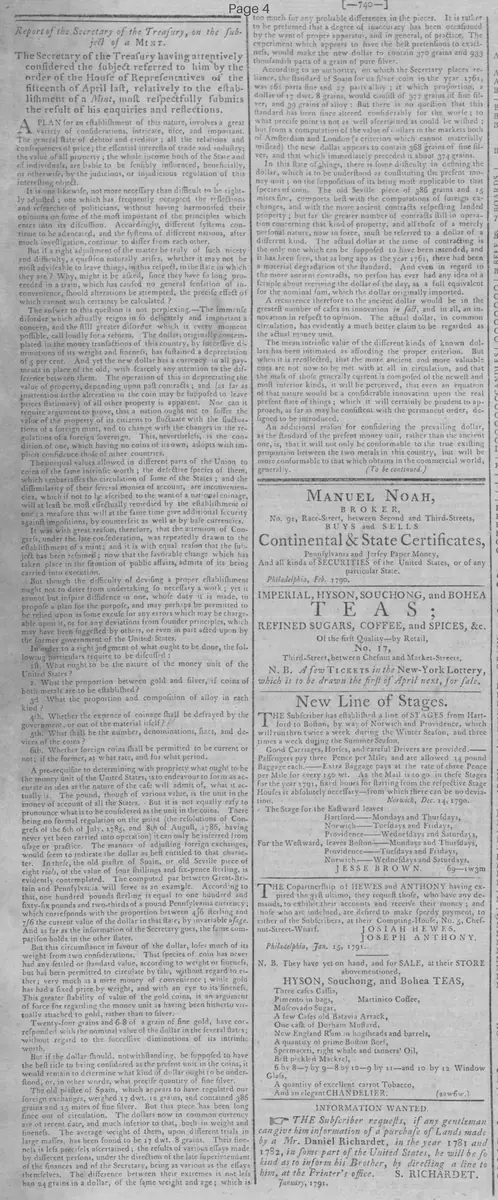
The Secretary of the Treasury having attentively considered the subject referred to him by the order of the House of Representatives of the fifteenth of April last, relatively to the establishment of a Mint, most respectfully submits the result of his enquiries and reflections.
A variety of considerations, intricate, nice, and important plan for an establishment of this nature, involves a great [deal]. The general state of debtor and creditor; all the relations and consequences of price; the essential interests of trade and industry; the value of all property; the whole income both of the State and of individuals, are liable to be sensibly influenced, beneficially, or otherwise, by the judicious, or injudicious regulation of this interesting object.
It is one likewise, not more necessary than difficult to be rightly adjusted; one which has frequently occupied the reflections and researches of politicians, without having harmonised their opinions on some of the most important of the principles which enter into its discussion. Accordingly, different systems continue to be advocated, and the systems of different nations, after much investigation, continue to differ from each other.
But if a right adjustment of the matter be truly of such nicety and difficulty, a question naturally arises, whether it may not be most advisable to leave things, in this respect, in the state in which they are? Why, might it be asked, since they have so long proceeded in a train, which has caused no general sensation of inconvenience, should alterations be attempted, the precise effect of which cannot with certainty be calculated?
The answer to this question is not perplexing. The immense disorder which actually reigns in so delicately and important a concern, and the still greater disorder which is every moment possible, call loudly for a reform. The dollar, originally contemplated in the money transactions of this country, by successive diminutions of its weight and fineness, has sustained a depreciation of 5 per cent. And yet the new dollar has a currency in all payments in place of the old, with scarcely any attention to the difference between them. The operation of this in depreciating the value of property, depending upon past contracts; and (as far as inattention to the alteration in the coin may be supposed to leave prices stationary) of all other property is apparent. Nor can it require argument to prove, that a nation ought not to suffer the value of the property of its citizens to fluctuate with the fluctuations of a foreign mint, and to change with the changes in the regulations of a foreign sovereign. This, nevertheless, is the condition of one, which having no coins of its own, adopts with implicit confidence those of other countries.
The unequal values allowed in different parts of the Union to coins of the same intrinsic worth; the defective species of them, which embarrasses the circulation of some of the States; and the dissimilarity of their several monies of account, are inconveniencies, which if not to be ascribed to the want of a national coinage, will at least be most effectually remedied by the establishment of one; a measure that will at the same time give additional security against impositions, by counterfeit as well as by base currencies.
It was with great reason, therefore, that the attention of Congress, under the late confederation, was repeatedly drawn to the establishment of a mint; and it is with equal reason that the subject has been resumed; now that the favorable change which has taken place in the situation of public affairs, admits of its being carried into execution.
But though the difficulty of devising a proper establishment ought not to deter from undertaking so necessary a work; yet it cannot but inspire diffidence in one, whose duty it is made, to propose a plan for the purpose, and may perhaps be permitted to be relied upon as some excuse for any errors which may be chargeable upon it, or for any deviations from sounder principles, which may have been suggested by others, or even in part acted upon by the former government of the United States.
In order to a right judgment of what ought to be done, the following particulars require to be discussed:
1st. What ought to be the nature of the money unit of the United States?
2. What the proportion between gold and silver, if coins of both metals are to be established?
3d. What the proportion and composition of alloy in each kind?
4th. Whether the expense of coinage shall be defrayed by the government, or out of the material itself?
5th. What shall be the number, denominations, sizes, and devices of the coins?
6th. Whether foreign coins shall be permitted to be current or not; if the former, at what rate, and for what period.
A prerequisite to determining with propriety what ought to be the money unit of the United States, is to endeavour to form as accurate an idea as the nature of the case will admit of, what it actually is. The pound, though of various value, is the unit in the money of account of all the States. But it is not equally easy to pronounce what is to be considered as the unit in the coins. There being no formal regulation on the point (the resolutions of Congress of the 6th of July, 1785, and 8th of August, 1786, having never yet been carried into operation) it can only be inferred from usage or practice. The manner of adjusting foreign exchanges, would seem to indicate the dollar as best entitled to that character. In these, the old piastre of Spain, or old Seville piece of eight rials, or the value of four shillings and six-pence sterling, is evidently contemplated. The computed par between Great-Britain and Pennsylvania will serve as an example. According to that, one hundred pounds sterling is equal to one hundred and sixty-six pounds and two-thirds of a pound Pennsylvania currency; which corresponds with the proportion between 46 sterling and 7/6 the current value of the dollar in that state, by invariable usage. And as far as the information of the Secretary goes, the same comparison holds in the other states.
But this circumstance in favour of the dollar, loses much of its weight from two considerations. That species of coin has never had any settled or standard value, according to weight or fineness, but has been permitted to circulate by tale, without regard to either; very much as a mere money of convenience; while gold has had a fixed price by weight, and with an eye to its fineness. This greater stability of value of the gold coins, is an argument of force for regarding the money unit as having been hitherto virtually attached to gold, rather than to silver.
Twenty-four grains and 6/8 of a grain of fine gold, have corresponded with the nominal value of the dollar in the several states; without regard to the successive diminutions of its intrinsic worth.
But if the dollar should, notwithstanding, be supposed to have the best title to being considered as the present unit in the coins, it would remain to determine what kind of dollar ought to be understood, or, in other words, what precise quantity of fine silver. The old piastre of Spain, which appears to have regulated our foreign exchanges, weighed 17 dwt. 12 grains, and contained 386 grains and 15 mites of fine silver. But this piece has been long since out of circulation. The dollars now in common currency are of recent date, and much inferior to that, both in weight and fineness. The average weight of them, upon different trials in large masses, has been found to be 17 dwt. 8 grains. Their fineness is less precisely ascertained; the results of various essays made by different persons, under the direction of the late superintendent of the finances and of the Secretary, being as various as the essays themselves. The difference between their extremes is not less than 24 grains in a dollar, of the same weight and age; which is too much for any probable differences in the pieces. It is rather to be presumed that a degree of inaccuracy has been occasioned by the want of proper apparatus, and in general, of practice. The experiment which appears to have the best pretensions to exactness, would make the new dollar to contain 370 grains and 933 thousandth parts of a grain of pure silver.
According to an authority, on which the Secretary places reliance, the standard of Spain for its silver coin in the year 1761, was 261 parts fine and 27 parts alloy; at which proportion, a dollar of 17 dwt. 8 grains, would consist of 377 grains of fine silver, and 39 grains of alloy: But there is no question that this standard has been since altered considerably for the worse; to what precise point is not as well ascertained as could be wished; but from a computation of the value of dollars in the markets both of Amsterdam and London (a criterion which cannot materially mislead) the new dollar appears to contain 368 grains of fine silver, and that which immediately preceded it about 374 grains.
In this state of things, there is some difficulty in defining the dollar, which is to be understood as constituting the present money unit; on the supposition of its being most applicable to that species of coin. The old Seville piece of 386 grains and 15 mites fine, comports best with the computations of foreign exchanges, and with the more ancient contracts respecting landed property; but far the greater number of contracts still in operation concerning that kind of property, and all those of a merely personal nature, now in force, must be referred to a dollar of a different kind. The actual dollar at the time of contracting is the only one which can be supposed to have been intended, and it has been seen, that as far back as the year 1761, there had been a material degradation of the standard. And even in regard to the more ancient contracts, no person has ever had any idea of a scruple about receiving the dollar of the day, as a full equivalent for the nominal sum, which the dollar originally imported.
A recurrence therefore to the ancient dollar would be in the greatest number of cases an innovation in fact, and in all, an innovation in respect to opinion. The actual dollar, in common circulation, has evidently a much better claim to be regarded as the actual money unit.
The mean intrinsic value of the different kinds of known dollars has been intimated as affording the proper criterion. But when it is recollected, that the more ancient and more valuable ones are not now to be met with at all in circulation, and that the mass of those generally current is composed of the newest and most inferior kinds, it will be perceived, that even an equation of that nature would be a considerable innovation upon the real present state of things; which it will certainly be prudent to approach, as far as may be consistent with the permanent order, designed to be introduced.
An additional reason for considering the prevailing dollar, as the standard of the present money unit, rather than the ancient one, is, that it will not only be conformable to the true existing proportion between the two metals in this country, but will be more conformable to that which obtains in the commercial world, generally.
(To be continued.)
What sub-type of article is it?
What keywords are associated?
What entities or persons were involved?
Where did it happen?
Domestic News Details
Primary Location
United States
Event Date
After The Fifteenth Of April Last
Key Persons
Event Details
The Secretary of the Treasury reports on the establishment of a Mint, discussing the disorder in currency due to depreciated foreign coins like the dollar, the need for a national coinage to stabilize property values, trade, and economy, and outlines key questions on money unit, gold-silver proportion, alloy, coinage expense, denominations, and foreign coins.