Thank you for visiting SNEWPapers!
Sign up free
Editorial
June 4, 1851
The Southern Press
Washington, District Of Columbia
What is this article about?
The Southern Press responds to the Republic's editorials on public lands policy, defending its stance and John C. Calhoun's proposal to cede lands to states under equitable conditions. It criticizes Northern leaders like Webster, Cass, and Seward for plans to grant lands to immigrants, arguing these violate Southern interests and constitutional principles, favoring sale proceeds for the common treasury.
Clipping
OCR Quality
98%
Excellent
Full Text
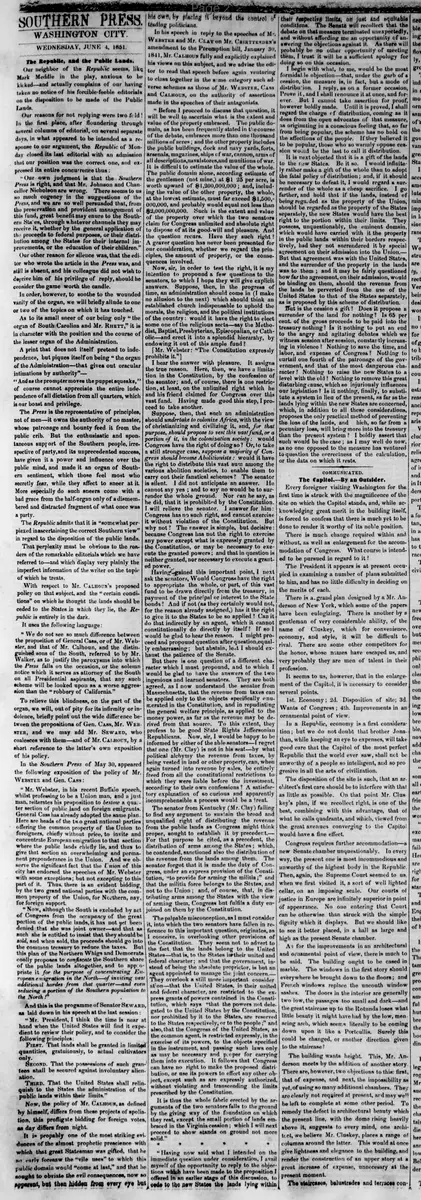
The Republic, and the Public Lands:
Our neighbor of the Republic seems, like Mark Meddle in the play, anxious to be kicked—and actually complains of our having taken no notice of his forcible-feeble editorials on the disposition to be made of the Public Lands.
Our reasons for not replying were two fold!
In the first place, after floundering through several columns of editorial, on several separate days, in what appeared to be intended as a response to our argument, the Republic of Monday closed its last editorial with an admission that our position was the correct one, and expressed its entire concurrence thus:
"Our own judgment is that the Southern Press is right, and that Mr. Johnson and Chancellor Nicholson are wrong. There seems to us so much cogency in the suggestions of the Press, and we are so well persuaded that, from the preservation and provident management of this fund, great benefit may ensue to the Southern States, through whatever channels they may receive it, whether by the general application of the proceeds to federal purposes, or their distribution among the States for their internal improvements, or the education of their children."
Our other reason for silence was, that the editor who wrote the article in the Press was, and still is absent, and his colleague did not wish to deprive him of his privilege of reply, should he consider the game worth the candle.
In order, however, to soothe the wounded vanity of the organ, we will briefly allude to one or two of the topics on which it has touched.
As to its small sneer of our being only "the organ of South Carolina and Mr. Rhett," it is in character with the position and the course of the lesser organ of the Administration
A print that does not itself pretend to independence, but piques itself on being "the organ of the Administration—that gives out oracular intimations by authority"
"And as the prompter moves the puppet squeaks,"
of course cannot appreciate the entire independence of all dictation from all quarters, which is our boast and privilege.
The Press is the representative of principles, not of men—it owns the authority of no master, whose patronage and bounty feed it from the public crib. But the enthusiastic and spontaneous support of the Southern people, irrespective of party, and its unprecedented success, have given it a power and influence over the public mind, and made it an organ of Southern sentiment, which those feel most who secretly fear, while they affect to sneer at it.
More especially do such sneers come with a bad grace from the half-organ only of a dismembered and distracted fragment of what once was a party.
The Republic admits that it is "somewhat perplexed in ascertaining the correct Southern view" in regard to the disposition of the public lands.
That perplexity must be obvious to the readers of the remarkable editorials which we have referred to—and which display very plainly the imperfect information of the writer on the topic of which he treats.
With respect to Mr. Calhoun's proposed policy on that subject, and the "certain conditions" on which he thought the lands should be ceded to the States in which they lie, the Republic is entirely in the dark.
It uses the following language
"We do not see so much difference between the proposition of General Cass, or of Mr. Webster, and that of Mr. Calhoun, and the distinguished sons of the South, referred to by Mr. Walker, as to justify the paroxysms into which the Press falls on the occasion, or the solemn notice which it serves as attorney of the South on all Presidential aspirants, that any such scheme will be looked upon as a worse aggression than the "robbery of California."
To relieve this blindness, on the part of the organ, we will, out of pity for its infirmity or indolence, briefly point out the wide difference between the propositions of Gen. Cass, Mr. Webster, and we may add Mr. Seward, who coalesces with them—and of Mr. Calhoun, by a short reference to the latter's own exposition of his policy.
In the Southern Press of May 30, appeared the following exposition of the policy of Mr. Webster and Gen. Cass:
"Mr. Webster, in his recent Buffalo speech, whilst professing to be a Union man, and a just man, reiterates his proposition to bestow a quarter section of public land on foreign emigrants.
General Cass has already adopted the same plan.
Here are heads of the two great national parties offering the common property of the Union to foreigners, chiefly without price, to invite and concentrate European emigration to that section where the public lands chiefly lie, and thus to give that section an overwhelming and permanent preponderance in the Union. And we observe the significant fact that the Union of this city has endorsed the speeches of Mr. Webster with some exceptions; but not excepting to this part of it. Thus, there is an evident bidding, by the two grand national parties with the common property of the Union, for Northern, nay, for foreign support.
"Now, although the South is excluded by act of Congress from the occupancy of the great portion of the public lands, it has not yet been denied that she was joint owner—and that as such she is entitled to insist that they should be sold, and when sold, the proceeds should go into the common treasury to reduce the taxes. But this plan of the Northern Whigs and Democrats coolly proposes to confiscate the Southern share of the public lands altogether, and to appropriate it for the purpose of concentrating European emigration in the North—of inviting vast additional hordes from that quarter—and even seducing a portion of the Southern population to the North!
And this is the programme of Senator Seward as laid down in his speech at the last session:
"Mr. President, I think the time is near at hand when the United States will find it expedient to review their policy, and to consider the following principles:
First. That lands shall be granted in limited quantities, gratuitously, to actual cultivators only.
Second. That the possessions of such grantees shall be secured against involuntary alienation.
Third. That the United States shall relinquish to the States the administration of the public lands within their limits."
Now, the policy of Mr. Calhoun, as defined by himself, differs from these projects of spoliation, this profligate bidding for foreign votes as day differs from night.
It is probably one of the most striking evidences of the almost prophetic prescience with which that great Statesman was gifted, that he so early foresaw the "vile uses" to which this public domain would "come at last," and that he sought to obviate the evil consequences, now so apparent, but then hidden from every eye but his own, by placing it beyond the control of trading politicians.
In his speech in reply to the speeches of Mr. Webster and Mr. Clay on Mr. Crittenden's amendment to the Preemption bill, January 30, 1841, Mr. Calhoun fully and explicitly explained his views on this subject, and we advise the editor to read that speech before again venturing to class together in the same category such adverse schemes as those of Mr. Webster, Cass and Calhoun, on the authority of assertions made in the speeches of their antagonists.
"Before I proceed to discuss that question, it will be well to ascertain what is the extent and value of the property embraced. The public domain, as has been frequently stated in the course of the debate, embraces more than one thousand millions of acres; and the other property includes the public buildings, dock and navy yards, forts, arsenals, magazines, ships of war, cannon, arms of all descriptions, naval stores, and munitions of war. It is difficult to estimate the value of the whole. The public domain alone, according to estimate of the gentlemen (not mine,) at $1.25 per acre, is worth upward of $1,200,000,000; and, including the value of the other property, the whole, at the lowest estimate, must far exceed $1,500,000,000, and probably would equal not less than 2,000,000,000. Such is the extent and value of the property over which the two senators claim for Congress unlimited and absolute right to dispose of at its good-will and pleasure. And the question recurs. Have they such right?
A graver question has never been presented for our consideration, whether we regard the principles, the amount of property, or the consequences involved.
Now, sir, in order to test the right, it is my intention to propound a few questions to the senators, to which I hope they will give explicit answers. Suppose, then, in the progress of time, an administration should come in (I make no allusion to the next) which should think an established church indispensable to uphold the morals, the religion, and the political institutions of the country: would it have the right to elect some one of the religious sects—say the Methodist, Baptist, Presbyterian, Episcopalian, or Catholic—and erect it into a splendid hierarchy, by endowing it out of this ample fund?
[Mr. Webster: "The Constitution expressly prohibits it."]
I hear the answer with pleasure. It assigns the true reason. Here, then, we have a limitation in the Constitution, by the confession of the senator; and, of course, there is one restriction, at least, on the unlimited right which he and his friend claimed for Congress over this vast fund. Having made good this step, I proceed to take another.
Suppose, then, that such an administration should undertake to colonize Africa, with the view of christianizing and civilizing it, and, for that purpose, should propose to vest this vast fund, or a portion of it, in the colonization society: would Congress have the right of doing so? Or, to take a still stronger case, suppose a majority of Congress should become Abolitionists: would it have the right to distribute this vast sum among the various abolition societies, to enable them to carry out their fanatical schemes? The senator is silent. I did not anticipate an answer. He cannot say yes; and to say no would be to surrender the whole ground. Nor can he say, as he did, that it is prohibited by the Constitution.
I will relieve the senator. I answer for him: Congress has no such right, and cannot exercise it without violation of the Constitution. But why not? The answer is simple, but decisive: because Congress has not the right to exercise any power except what is expressly granted by the Constitution, or may be necessary to execute the granted powers; and that in question is neither granted, nor necessary to execute a granted power.
Having gained this important point, I next ask the senators, Would Congress have the right to appropriate the whole, or part, of this vast fund to be drawn directly from the treasury, in payment of the principal or interest to the State bonds? And if not (as they certainly would not, for the reason already assigned,) has it the right to give it to the States to be so applied? Can it do that indirectly by an agent, which it cannot constitutionally do directly by itself? If so I would be glad to hear the reason. I might proceed and propound question after question, equally embarrassing; but abstain, lest I should exhaust the patience of the Senate.
But there is one question of a different character which I must propound, and to which I would be glad to have the answers of the two ingenious and learned senators. They are both agreed, as I now understand the senator from Massachusetts, that the revenue from taxes can be applied only to the objects specifically enumerated in the Constitution, and in repudiating the general welfare principle, as applied to the money power, as far as the revenue may be derived from that source. To this extent, they profess to be good State Rights Jeffersonian Republicans. Now, sir, I would be happy to be informed by either of the able senators—I regret that one (Mr. Clay) is not in his seat—by what political alchemy the revenue from taxes, by being vested in land or other property, can, when again turned into revenue by sales, be entirely freed from all the constitutional restrictions to which they were liable before the investment, according to their own confessions? A satisfactory explanation of so curious and apparently incomprehensible a process would be a treat.
The senator from Kentucky (Mr. Clay) failing to find any argument to sustain the broad and unqualified right of distributing the revenue from the public lands as Congress might think proper, sought to establish it by precedent.—For that purpose he cited, as a precedent, the distribution of arms among the States; which he contended, sanctioned also the distribution of the revenue from the lands among them. The senator forgot that it is made the duty of Congress, under an express provision of the Constitution, "to provide for arming the militia;" and that the militia force belongs to the States, and not to the Union; and, of course, that, in distributing arms among the States with the view of arming them, Congress but fulfils a duty enjoined on them by the Constitution.
The palpable misconception, as I must consider it, into which the two senators have fallen in reference to this important question, originates, as I conceive, in overlooking other provisions of the Constitution. They seem not to advert to the fact, that the lands belong to the United States—that is, to the States in their united and federal character; and that the government, instead of being the absolute proprietor, is but an agent appointed to manage the joint concern.—They overlook a still more important consideration—that the United States, in their united and federal character, are restricted to the express grants of powers contained in the Constitution, which says "that the powers not delegated to the United States by the Constitution, nor prohibited by it to the States, are reserved to the States respectively, or to the people;" and also, that the Congress of the United States, as the common agent, is restricted expressly, in the exercise of its powers, to the objects specified in the instrument, and passing such laws only as may be necessary and proper for carrying them into execution. It follows that Congress can have no right to make the proposed distribution, or use its powers to effect any other object, except such as are expressly authorized, without violating and transcending the limits prescribed by the Constitution.
It is thus the whole fabric erected by the arguments of the two senators falls to the ground by the giving way of the foundation on which they rest, except the small portion of lands embraced in the Virginia cession; which I will next proceed to show stands on ground not more solid."
"Having now said what I intended on the immediate question under consideration, I avail myself of the opportunity to reply to the objections which have been made to the proposition I offered in an earlier stage of this discussion, to cede to the new States the lands lying within their respective limits: on just and equitable conditions. The Senate will recollect that the debate on that measure terminated unexpectedly, and without affording me an opportunity of answering the objections against it. As there will probably be no other opportunity of meeting them, I trust it will be a sufficient apology for doing so on this occasion.
I begin with what, to me, would be the most formidable objection—that, under the garb of a cession, the measure is, in fact, but a mode of distribution. I reply, as on a former occasion, Prove it, and I shall renounce it at once, and forever. But I cannot take assertion for proof, however boldly made. Until it is proved, I shall regard the charge of distribution, coming as it does from the open advocates of that measure, as originating in a conscious feeling that, so far from being popular, the scheme has no hold on the affections of the people. If they believed it to be popular, those who so warmly oppose cession would be the last to call it distribution.
It is next objected that it is a gift of the lands to the new States. Be it so. I would infinitely rather make a gift of the whole than to adopt the fatal policy of distribution; and, if it should be necessary to defeat it, I would regard a surrender of the whole as a cheap sacrifice. I go farther, and hold that if the lands, instead of being regarded as the property of the Union, should be regarded as the property of the States separately, the new States would have the best right to the portion within their limits. They possess, unquestionably, the eminent domain which would have carried with it the property in the public lands within their borders respectively, had they not surrendered it by special agreement on their admission into the Union.—But that agreement was with the United States, and the surrender of the property in the lands was to them; and it may be fairly questioned how far the agreement, on their admission, would be binding on them, should the revenue from the lands be perverted from the use of the United States to that of the States separately as is proposed by this scheme of distribution.
But is the cession a gift? Does it propose a surrender of the land for nothing? Is 65 per cent. of the gross proceeds to be paid into the treasury nothing? Is it nothing to put an end to the angry and agitating debates which we witness session after session, constantly increasing in violence? Nothing to save the time, and labor, and expense of Congress? Nothing to curtail one fourth of the patronage of the government, and that of the most dangerous character? Nothing to raise the new States to a level with the old? Nothing to remove this great disturbing cause, which so injuriously influences our legislation? Is it nothing, finally, to substitute a system in lieu of the present, as far as the lands lying within the new States are concerned, which, in addition to all these considerations, proposes the only practical method of preventing the loss of the lands, and which, so far from a pecuniary loss, will bring more into the treasury than the present system? I boldly assert that such would be the case; as I may well do now, as no one opposed to the measure has ventured to question the correctness of the calculation, or the data on which it rests.
Our neighbor of the Republic seems, like Mark Meddle in the play, anxious to be kicked—and actually complains of our having taken no notice of his forcible-feeble editorials on the disposition to be made of the Public Lands.
Our reasons for not replying were two fold!
In the first place, after floundering through several columns of editorial, on several separate days, in what appeared to be intended as a response to our argument, the Republic of Monday closed its last editorial with an admission that our position was the correct one, and expressed its entire concurrence thus:
"Our own judgment is that the Southern Press is right, and that Mr. Johnson and Chancellor Nicholson are wrong. There seems to us so much cogency in the suggestions of the Press, and we are so well persuaded that, from the preservation and provident management of this fund, great benefit may ensue to the Southern States, through whatever channels they may receive it, whether by the general application of the proceeds to federal purposes, or their distribution among the States for their internal improvements, or the education of their children."
Our other reason for silence was, that the editor who wrote the article in the Press was, and still is absent, and his colleague did not wish to deprive him of his privilege of reply, should he consider the game worth the candle.
In order, however, to soothe the wounded vanity of the organ, we will briefly allude to one or two of the topics on which it has touched.
As to its small sneer of our being only "the organ of South Carolina and Mr. Rhett," it is in character with the position and the course of the lesser organ of the Administration
A print that does not itself pretend to independence, but piques itself on being "the organ of the Administration—that gives out oracular intimations by authority"
"And as the prompter moves the puppet squeaks,"
of course cannot appreciate the entire independence of all dictation from all quarters, which is our boast and privilege.
The Press is the representative of principles, not of men—it owns the authority of no master, whose patronage and bounty feed it from the public crib. But the enthusiastic and spontaneous support of the Southern people, irrespective of party, and its unprecedented success, have given it a power and influence over the public mind, and made it an organ of Southern sentiment, which those feel most who secretly fear, while they affect to sneer at it.
More especially do such sneers come with a bad grace from the half-organ only of a dismembered and distracted fragment of what once was a party.
The Republic admits that it is "somewhat perplexed in ascertaining the correct Southern view" in regard to the disposition of the public lands.
That perplexity must be obvious to the readers of the remarkable editorials which we have referred to—and which display very plainly the imperfect information of the writer on the topic of which he treats.
With respect to Mr. Calhoun's proposed policy on that subject, and the "certain conditions" on which he thought the lands should be ceded to the States in which they lie, the Republic is entirely in the dark.
It uses the following language
"We do not see so much difference between the proposition of General Cass, or of Mr. Webster, and that of Mr. Calhoun, and the distinguished sons of the South, referred to by Mr. Walker, as to justify the paroxysms into which the Press falls on the occasion, or the solemn notice which it serves as attorney of the South on all Presidential aspirants, that any such scheme will be looked upon as a worse aggression than the "robbery of California."
To relieve this blindness, on the part of the organ, we will, out of pity for its infirmity or indolence, briefly point out the wide difference between the propositions of Gen. Cass, Mr. Webster, and we may add Mr. Seward, who coalesces with them—and of Mr. Calhoun, by a short reference to the latter's own exposition of his policy.
In the Southern Press of May 30, appeared the following exposition of the policy of Mr. Webster and Gen. Cass:
"Mr. Webster, in his recent Buffalo speech, whilst professing to be a Union man, and a just man, reiterates his proposition to bestow a quarter section of public land on foreign emigrants.
General Cass has already adopted the same plan.
Here are heads of the two great national parties offering the common property of the Union to foreigners, chiefly without price, to invite and concentrate European emigration to that section where the public lands chiefly lie, and thus to give that section an overwhelming and permanent preponderance in the Union. And we observe the significant fact that the Union of this city has endorsed the speeches of Mr. Webster with some exceptions; but not excepting to this part of it. Thus, there is an evident bidding, by the two grand national parties with the common property of the Union, for Northern, nay, for foreign support.
"Now, although the South is excluded by act of Congress from the occupancy of the great portion of the public lands, it has not yet been denied that she was joint owner—and that as such she is entitled to insist that they should be sold, and when sold, the proceeds should go into the common treasury to reduce the taxes. But this plan of the Northern Whigs and Democrats coolly proposes to confiscate the Southern share of the public lands altogether, and to appropriate it for the purpose of concentrating European emigration in the North—of inviting vast additional hordes from that quarter—and even seducing a portion of the Southern population to the North!
And this is the programme of Senator Seward as laid down in his speech at the last session:
"Mr. President, I think the time is near at hand when the United States will find it expedient to review their policy, and to consider the following principles:
First. That lands shall be granted in limited quantities, gratuitously, to actual cultivators only.
Second. That the possessions of such grantees shall be secured against involuntary alienation.
Third. That the United States shall relinquish to the States the administration of the public lands within their limits."
Now, the policy of Mr. Calhoun, as defined by himself, differs from these projects of spoliation, this profligate bidding for foreign votes as day differs from night.
It is probably one of the most striking evidences of the almost prophetic prescience with which that great Statesman was gifted, that he so early foresaw the "vile uses" to which this public domain would "come at last," and that he sought to obviate the evil consequences, now so apparent, but then hidden from every eye but his own, by placing it beyond the control of trading politicians.
In his speech in reply to the speeches of Mr. Webster and Mr. Clay on Mr. Crittenden's amendment to the Preemption bill, January 30, 1841, Mr. Calhoun fully and explicitly explained his views on this subject, and we advise the editor to read that speech before again venturing to class together in the same category such adverse schemes as those of Mr. Webster, Cass and Calhoun, on the authority of assertions made in the speeches of their antagonists.
"Before I proceed to discuss that question, it will be well to ascertain what is the extent and value of the property embraced. The public domain, as has been frequently stated in the course of the debate, embraces more than one thousand millions of acres; and the other property includes the public buildings, dock and navy yards, forts, arsenals, magazines, ships of war, cannon, arms of all descriptions, naval stores, and munitions of war. It is difficult to estimate the value of the whole. The public domain alone, according to estimate of the gentlemen (not mine,) at $1.25 per acre, is worth upward of $1,200,000,000; and, including the value of the other property, the whole, at the lowest estimate, must far exceed $1,500,000,000, and probably would equal not less than 2,000,000,000. Such is the extent and value of the property over which the two senators claim for Congress unlimited and absolute right to dispose of at its good-will and pleasure. And the question recurs. Have they such right?
A graver question has never been presented for our consideration, whether we regard the principles, the amount of property, or the consequences involved.
Now, sir, in order to test the right, it is my intention to propound a few questions to the senators, to which I hope they will give explicit answers. Suppose, then, in the progress of time, an administration should come in (I make no allusion to the next) which should think an established church indispensable to uphold the morals, the religion, and the political institutions of the country: would it have the right to elect some one of the religious sects—say the Methodist, Baptist, Presbyterian, Episcopalian, or Catholic—and erect it into a splendid hierarchy, by endowing it out of this ample fund?
[Mr. Webster: "The Constitution expressly prohibits it."]
I hear the answer with pleasure. It assigns the true reason. Here, then, we have a limitation in the Constitution, by the confession of the senator; and, of course, there is one restriction, at least, on the unlimited right which he and his friend claimed for Congress over this vast fund. Having made good this step, I proceed to take another.
Suppose, then, that such an administration should undertake to colonize Africa, with the view of christianizing and civilizing it, and, for that purpose, should propose to vest this vast fund, or a portion of it, in the colonization society: would Congress have the right of doing so? Or, to take a still stronger case, suppose a majority of Congress should become Abolitionists: would it have the right to distribute this vast sum among the various abolition societies, to enable them to carry out their fanatical schemes? The senator is silent. I did not anticipate an answer. He cannot say yes; and to say no would be to surrender the whole ground. Nor can he say, as he did, that it is prohibited by the Constitution.
I will relieve the senator. I answer for him: Congress has no such right, and cannot exercise it without violation of the Constitution. But why not? The answer is simple, but decisive: because Congress has not the right to exercise any power except what is expressly granted by the Constitution, or may be necessary to execute the granted powers; and that in question is neither granted, nor necessary to execute a granted power.
Having gained this important point, I next ask the senators, Would Congress have the right to appropriate the whole, or part, of this vast fund to be drawn directly from the treasury, in payment of the principal or interest to the State bonds? And if not (as they certainly would not, for the reason already assigned,) has it the right to give it to the States to be so applied? Can it do that indirectly by an agent, which it cannot constitutionally do directly by itself? If so I would be glad to hear the reason. I might proceed and propound question after question, equally embarrassing; but abstain, lest I should exhaust the patience of the Senate.
But there is one question of a different character which I must propound, and to which I would be glad to have the answers of the two ingenious and learned senators. They are both agreed, as I now understand the senator from Massachusetts, that the revenue from taxes can be applied only to the objects specifically enumerated in the Constitution, and in repudiating the general welfare principle, as applied to the money power, as far as the revenue may be derived from that source. To this extent, they profess to be good State Rights Jeffersonian Republicans. Now, sir, I would be happy to be informed by either of the able senators—I regret that one (Mr. Clay) is not in his seat—by what political alchemy the revenue from taxes, by being vested in land or other property, can, when again turned into revenue by sales, be entirely freed from all the constitutional restrictions to which they were liable before the investment, according to their own confessions? A satisfactory explanation of so curious and apparently incomprehensible a process would be a treat.
The senator from Kentucky (Mr. Clay) failing to find any argument to sustain the broad and unqualified right of distributing the revenue from the public lands as Congress might think proper, sought to establish it by precedent.—For that purpose he cited, as a precedent, the distribution of arms among the States; which he contended, sanctioned also the distribution of the revenue from the lands among them. The senator forgot that it is made the duty of Congress, under an express provision of the Constitution, "to provide for arming the militia;" and that the militia force belongs to the States, and not to the Union; and, of course, that, in distributing arms among the States with the view of arming them, Congress but fulfils a duty enjoined on them by the Constitution.
The palpable misconception, as I must consider it, into which the two senators have fallen in reference to this important question, originates, as I conceive, in overlooking other provisions of the Constitution. They seem not to advert to the fact, that the lands belong to the United States—that is, to the States in their united and federal character; and that the government, instead of being the absolute proprietor, is but an agent appointed to manage the joint concern.—They overlook a still more important consideration—that the United States, in their united and federal character, are restricted to the express grants of powers contained in the Constitution, which says "that the powers not delegated to the United States by the Constitution, nor prohibited by it to the States, are reserved to the States respectively, or to the people;" and also, that the Congress of the United States, as the common agent, is restricted expressly, in the exercise of its powers, to the objects specified in the instrument, and passing such laws only as may be necessary and proper for carrying them into execution. It follows that Congress can have no right to make the proposed distribution, or use its powers to effect any other object, except such as are expressly authorized, without violating and transcending the limits prescribed by the Constitution.
It is thus the whole fabric erected by the arguments of the two senators falls to the ground by the giving way of the foundation on which they rest, except the small portion of lands embraced in the Virginia cession; which I will next proceed to show stands on ground not more solid."
"Having now said what I intended on the immediate question under consideration, I avail myself of the opportunity to reply to the objections which have been made to the proposition I offered in an earlier stage of this discussion, to cede to the new States the lands lying within their respective limits: on just and equitable conditions. The Senate will recollect that the debate on that measure terminated unexpectedly, and without affording me an opportunity of answering the objections against it. As there will probably be no other opportunity of meeting them, I trust it will be a sufficient apology for doing so on this occasion.
I begin with what, to me, would be the most formidable objection—that, under the garb of a cession, the measure is, in fact, but a mode of distribution. I reply, as on a former occasion, Prove it, and I shall renounce it at once, and forever. But I cannot take assertion for proof, however boldly made. Until it is proved, I shall regard the charge of distribution, coming as it does from the open advocates of that measure, as originating in a conscious feeling that, so far from being popular, the scheme has no hold on the affections of the people. If they believed it to be popular, those who so warmly oppose cession would be the last to call it distribution.
It is next objected that it is a gift of the lands to the new States. Be it so. I would infinitely rather make a gift of the whole than to adopt the fatal policy of distribution; and, if it should be necessary to defeat it, I would regard a surrender of the whole as a cheap sacrifice. I go farther, and hold that if the lands, instead of being regarded as the property of the Union, should be regarded as the property of the States separately, the new States would have the best right to the portion within their limits. They possess, unquestionably, the eminent domain which would have carried with it the property in the public lands within their borders respectively, had they not surrendered it by special agreement on their admission into the Union.—But that agreement was with the United States, and the surrender of the property in the lands was to them; and it may be fairly questioned how far the agreement, on their admission, would be binding on them, should the revenue from the lands be perverted from the use of the United States to that of the States separately as is proposed by this scheme of distribution.
But is the cession a gift? Does it propose a surrender of the land for nothing? Is 65 per cent. of the gross proceeds to be paid into the treasury nothing? Is it nothing to put an end to the angry and agitating debates which we witness session after session, constantly increasing in violence? Nothing to save the time, and labor, and expense of Congress? Nothing to curtail one fourth of the patronage of the government, and that of the most dangerous character? Nothing to raise the new States to a level with the old? Nothing to remove this great disturbing cause, which so injuriously influences our legislation? Is it nothing, finally, to substitute a system in lieu of the present, as far as the lands lying within the new States are concerned, which, in addition to all these considerations, proposes the only practical method of preventing the loss of the lands, and which, so far from a pecuniary loss, will bring more into the treasury than the present system? I boldly assert that such would be the case; as I may well do now, as no one opposed to the measure has ventured to question the correctness of the calculation, or the data on which it rests.
What sub-type of article is it?
Economic Policy
Constitutional
Partisan Politics
What keywords are associated?
Public Lands
Southern Interests
Calhoun Policy
Land Cession
Northern Proposals
Constitutional Limits
Immigrant Grants
Party Bidding
What entities or persons were involved?
Republic
Southern Press
Mr. Calhoun
Gen. Cass
Mr. Webster
Mr. Seward
Mr. Clay
Mr. Rhett
Mr. Johnson
Chancellor Nicholson
Editorial Details
Primary Topic
Disposition Of Public Lands And Calhoun's Cession Policy
Stance / Tone
Defensive Of Southern Interests And Calhoun's Views, Critical Of Northern Proposals
Key Figures
Republic
Southern Press
Mr. Calhoun
Gen. Cass
Mr. Webster
Mr. Seward
Mr. Clay
Mr. Rhett
Mr. Johnson
Chancellor Nicholson
Key Arguments
Republic Admits Southern Press Position Is Correct On Public Lands Management.
Northern Proposals By Webster, Cass, And Seward Grant Lands To Immigrants, Confiscating Southern Share.
Calhoun's Policy Cedes Lands To States On Equitable Conditions, Preserving 65% Proceeds For Treasury.
Congress Has Limited Constitutional Rights Over Public Domain, Acting As Agent For States.
Cession Avoids Distribution Perils, Ends Debates, Reduces Patronage, Benefits Treasury.
Criticizes Republic's Ignorance And Administration Ties, Asserts Press's Independence.