Thank you for visiting SNEWPapers!
Sign up free
Portland Gazette, And Maine Advertiser
Portland, Cumberland County, Maine
What is this article about?
The Massachusetts House of Representatives responds to the Governor's speech, mourning the late Chief Justice, critiquing the War of 1812's causes and the Embargo Act as unconstitutional, expressing hope for peace negotiations with Britain, and noting local legislative actions like committee appointments and bill readings on January 22.
Merged-components note: Continuation of the same article on Massachusetts legislature proceedings, including the answer to the governor's speech and specific actions on January 22.
Clipping
OCR Quality
Full Text
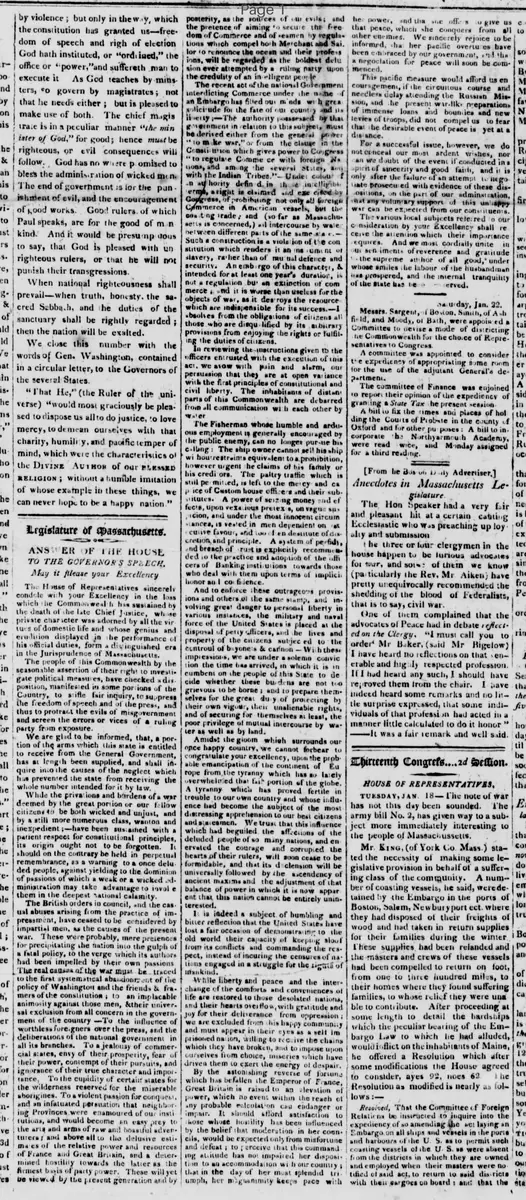
ANSWER OF THE HOUSE TO THE GOVERNOR'S SPEECH.
May it please your Excellency:
The House of Representatives sincerely condole with your Excellency in the loss which the Commonwealth has sustained by the death of the late Chief Justice, whose private character was adorned by all the virtues of domestic life and whose genius and erudition displayed in the performance of his official duties, form a distinguished era in the Jurisprudence of Massachusetts.
The people of this Commonwealth by the seasonable assertion of their right to investigate political measures, have checked a disposition, manifested in some portions of the Country, to stifle fair inquiry, to suppress the freedom of speech and of the press, and thus to protract the evils of misgovernment and screen the errors or vices of a ruling party from exposure.
We are glad to be informed, that a portion of the arms which this state is entitled to receive from the General Government, has at length been supplied, and shall inquire into the causes of the neglect which has prevented the state from receiving the whole number intended for it by law.
While the privations and burdens of a war deemed by the great portion of our fellow citizens to be both wicked and unjust, and by a still more numerous class, wanton and inexpedient;--have been sustained with patient respect for constitutional principles, its origin ought not to be forgotten. It should on the contrary be held in perpetual remembrance, as a warning to a once deluded people, against yielding to the dominion of passions of which a weak or a wicked administration may take advantage to involve them in the deepest national calamity.
The British orders in council, and the casual abuses arising from the practice of impressment, have ceased to be considered by impartial men, as the causes of the present war. These were probably, mere pretences for precipitating the nation into the gulph of a fatal policy, to the verge which its authors had been impelled by their own passions.
The real causes of the war must be traced to the first systematical abandonment of the policy of Washington and the friends & framers of the constitution; to an implacable animosity against those men, & their universal exclusion from all concern in the government of the country--To the influence of worthless foreigners over the press, and the deliberations of the national government in all its branches. To a jealousy of commercial states, envy of their prosperity, fear of their power, contempt of their pursuits, and ignorance of their true character and importance. To the cupidity of certain states for the wilderness reserved for the miserable aborigines. To a violent passion for conquest, and an infatuated persuasion that neighboring Provinces were enamoured of our institutions, and would become an easy prey to the arts and arms of raw and boastful adventurers; and above all to the delusive estimates of the relative power and resources of France and Great Britain, and a determined hostility towards the latter as the firmest basis of party power. These will yet be viewed by the present generation and by posterity, as the sources of our evils; and the pretence of aiming to secure the freedom of Commerce and of seamen by regulations which compel both Merchant and Sailor to renounce the ocean and their profession, will be regarded as the boldest delusion ever attempted by a ruling party upon the credulity of an intelligent people.
The recent act of the national Government interdicting Commerce under the name of an Embargo has filled our minds with great solicitude for the fate of our country and its liberty;--The authority possessed by that government in relation to this subject, must be derived either from the general power "to make war." or from the clause in the Constitution which gives power to Congress "to regulate Commerce with foreign Nations, and among the several States, and with the Indian Tribes." Under colour of authority defined in these intelligible terms, a right is claimed and exercised by Congress, of prohibiting not only all foreign Commerce in American vessels, but the coasting trade; and (so far as Massachusetts is concerned,) all intercourse by water between different parts of the same state.--Such a construction is a violation of the constitution which renders it an instrument of slavery, rather than of mutual defence and security. An embargo of this character, & intended for at least one year's duration, is not a regulation but an extinction of commerce; and it is worse than useless for the objects of war, as it destroys the resources which are indispensable for its success.--It absolves from the obligations of citizens all those who are disqualified by its arbitrary provisions from enjoying the rights or fulfilling the duties of citizens.
In reviewing the instructions given to the officers entrusted with the execution of this act, we avow with pain and alarm, our persuasion that they are at open variance with the first principles of constitutional and civil liberty. The inhabitants of distant parts of this Commonwealth are debarred from all communication with each other by water.
The Fisherman whose humble and arduous employment is generally encouraged by the public enemy, can no longer pursue his calling: The ship owner cannot sell his ship without restraints equivalent to a prohibition, however urgent the claims of his family or his creditors. The paltry traffic which is still permitted, is left to the mercy and caprice of Custom house officers and their substitutes. A power of seizing money and effects, upon vexatious pretences, on vague suspicion, and under the most innocent circumstances, is vested in men dependent on executive favour, and too often destitute of discretion and principle. A system of perfidy and breach of trust is explicitly recommended to the practice and adoption of the officers of Banking institutions towards those who deal with them upon terms of simple honor and confidence.
And to enforce these outrageous provisions and others of the same stamp, and involving great danger to personal liberty in various instances, the military and naval force of the United States is placed at the disposal of petty officers, and the lives and property of the citizens subjected to the controul of bayonets & cannon. With these impressions, we are under solemn conviction the time has arrived, in which it is incumbent on the people of this State to decide whether these burdens are not too grievous to be borne; and to prepare themselves for the great duty of protecting by their own vigour, their unalienable rights, and of securing for themselves at least, the poor privilege of mutual intercourse by water as well as by land.
Amidst the gloom which surrounds our once happy country, we cannot forbear to congratulate your excellency, upon the probable emancipation of the continent of Europe from, the tyranny which has so lately overwhelmed that fair portion of the globe. A tyranny which has proved fertile in trouble to our own country and whose influence had become the subject of the most distressing apprehension to our best citizens and statesmen. We trust that this influence which had beguiled the affections of the deluded people of so many nations, and enervated the courage and corrupted the hearts of their rulers, will soon cease to be formidable, and that its declension will be universally followed by the ascendency of ancient maxims and the adjustment of that balance of power in which it is now apparent that this nation cannot be entirely uninterested.
It is indeed a subject of humbling and bitter reflection that the United States have lost a fair occasion of demonstrating to the old world their capacity of keeping aloof from its conflicts and commanding the respect, instead of incuring the censures of nations engaged in a struggle for the rights of mankind.
While liberty and peace and the interchange of the comforts and conveniences of life are restored to those desolated nations, and their hearts overflow with gratitude and joy for their deliverance from oppression; we are excluded from this happy community and must appear in their eyes as a self imprisoned nation, willing to receive the chains which they have broken, and to impose upon ourselves from choice, miseries which have driven them to exert the energy of despair.
By the astonishing reverse of fortunes which has befallen the Emperor of France, Great Britain is raised to an elevation of power, which no event within the reach of any probable calculation can endanger or impair. It should afford satisfaction to those whose hostility has been influenced by the belief that moderation in her councils, would be expected only from misfortune and defeat; to perceive that this commanding attitude has not impaired her disposition to an accommodation with our country; that in the day of her most splendid triumph, her magnanimity keeps pace with her power, and that she offers to give us that peace, which she conquers from all other enemies. We sincerely rejoice to be informed, that her pacific overtures have been embraced by our government, and that a negotiation for peace will soon be commenced.
This pacific measure would afford us encouragement, if the circuitous course and needless delay attending the Russian Mission, and the present warlike preparations of immense loans and bounties and new levies of troops, did not compel us to fear that be desirable event of peace is yet at a distance.
For a successful issue, however, we do not conceal our most ardent wishes, nor can we doubt of the event if conducted in a spirit of sincerity and good faith, and it is only after the failure of an attempt to negotiate prosecuted with evidence of these dispositions, on the part of our administration, that any voluntary support of this unhappy war can be expected from our constituents.
The various local subjects referred to our consideration by your Excellency shall receive the attention which their importance requires. And we most cordially unite in our sentiments of reverence and gratitude to the supreme author of all good, under whose smiles the labour of the husbandman has prospered, and the internal tranquility of the state has been preserved.
Saturday, Jan. 22.
Messrs. Sargent, of Boston, Smith, of Ashfield, and Moody, of Bath, were appointed Committee to devise a mode of districting the Commonwealth for the choice of Representatives to Congress.
A committee was appointed to consider the expediency of appropriating some room for the use of the adjutant General's Department.
The committee of Finance was enjoined to report their opinion of the expediency of granting a State Tax the present session.
A bill to fix the times and places of holding the Courts of Probate in the county of Oxford and for other purposes: A bill to incorporate the North Yarmouth Academy, were read twice, and Monday assigned for a third reading.
What sub-type of article is it?
What keywords are associated?
What entities or persons were involved?
Where did it happen?
Domestic News Details
Primary Location
Massachusetts
Event Date
Saturday, Jan. 22.
Key Persons
Event Details
The House of Representatives delivers a formal response to the Governor's speech, expressing condolences for the late Chief Justice, critiquing the causes and conduct of the ongoing war, denouncing the Embargo Act as unconstitutional and burdensome, hoping for peace negotiations with Britain, and addressing local legislative matters including committee appointments for districting, adjutant general's department, finance, and bill readings for probate courts and academy incorporation.