Thank you for visiting SNEWPapers!
Sign up free
The New Hampshire Gazette And General Advertiser
Portsmouth, Exeter, Rockingham County, New Hampshire
What is this article about?
An anonymous letter to the printers quotes a law writer on the superiority of natural law over human law, arguing that human laws must be published and promote good to be valid. It concludes that retrospective laws are invalid, tyrannical, and contrary to the purpose of good laws, which aim to secure public good through foreknowledge and incentives.
Clipping
OCR Quality
Full Text
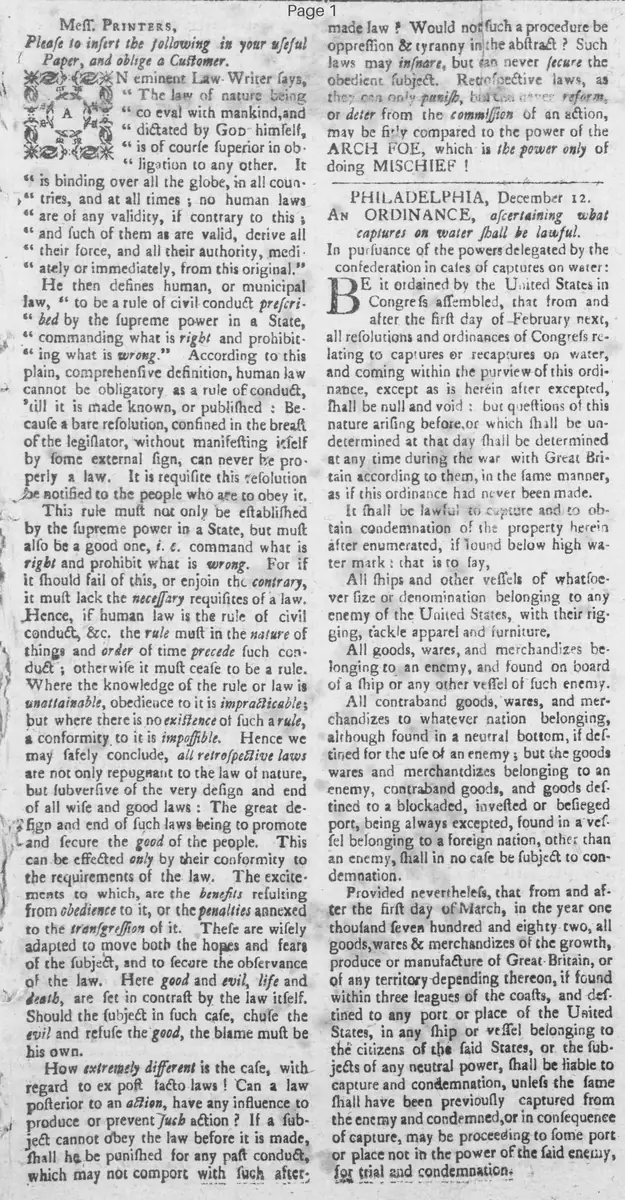
Please to insert the following in your useful Paper, and oblige a Customer.
* An eminent Law Writer says,
"The law of nature being coeval with mankind, and dictated by God himself, is of course superior in obligation to any other. It is binding over all the globe, in all countries, and at all times; no human laws are of any validity, if contrary to this; and such of them as are valid, derive all their force, and all their authority, mediately or immediately, from this original."
He then defines human, or municipal law, "to be a rule of civil conduct prescribed by the supreme power in a State, commanding what is right and prohibiting what is wrong." According to this plain, comprehensive definition, human law cannot be obligatory as a rule of conduct, till it is made known, or published: Because a bare resolution, confined in the breast of the legislator, without manifesting itself by some external sign, can never be properly a law. It is requisite this resolution be notified to the people who are to obey it.
This rule must not only be established by the supreme power in a State, but must also be a good one, i.e. command what is right and prohibit what is wrong. For if it should fail of this, or enjoin the contrary, it must lack the necessary requisites of a law.
Hence, if human law is the rule of civil conduct, &c. the rule must in the nature of things and order of time precede such conduct: otherwise it must cease to be a rule.
Where the knowledge of the rule or law is unattainable, obedience to it is impracticable; but where there is no existence of such a rule, a conformity to it is impossible. Hence we may safely conclude, all retrospective laws are not only repugnant to the law of nature, but subversive of the very design and end of all wise and good laws: The great design and end of such laws being to promote and secure the good of the people. This can be effected only by their conformity to the requirements of the law. The excitements to which, are the benefits resulting from obedience to it, or the penalties annexed to the transgression of it. These are wisely adapted to move both the hopes and fears of the subject, and to secure the observance of the law. Here good and evil, life and death, are set in contrast by the law itself.
Should the subject in such case, choose the evil and refuse the good, the blame must be his own.
How extremely different is the case, with regard to ex post facto laws! Can a law posterior to an action, have any influence to produce or prevent just action? If a subject cannot obey the law before it is made, shall he be punished for any past conduct, which may not comport with such after-made law? Would not such a procedure be oppression & tyranny in the abstract? Such laws may insure, but can never secure the obedient subject. Retrospective laws, as they can only punish, but good laws reform, or deter from the commission of an action, may be fairly compared to the power of the ARCH FOE, which is the power only of doing MISCHIEF!
What sub-type of article is it?
What themes does it cover?
What keywords are associated?
What entities or persons were involved?
Letter to Editor Details
Recipient
Mess. Printers
Main Argument
human laws must be published prior to conduct and align with natural law to be valid; retrospective or ex post facto laws are invalid, tyrannical, and subversive to the purpose of good laws, which promote public good through foreknowledge and incentives rather than mere punishment.
Notable Details