Thank you for visiting SNEWPapers!
Sign up free
Alexandria Gazette & Daily Advertiser
Alexandria, Virginia
What is this article about?
Continuation of the trial of Arbuthnot and Ambrister at Fort St. Marks, April 28, 1818. Includes letters from Gen. Mitchell relaying Lower Creek chief King Hatchy's complaints about American encroachments, a petition from Creek chiefs to British Governor Cameron for aid against Americans, and examination of witness Peter B. Cook.
Merged-components note: These two components form a continuous report on the trial of Arbuthnot and Ambrister, with sequential reading order and seamless text flow.
Clipping
OCR Quality
Full Text
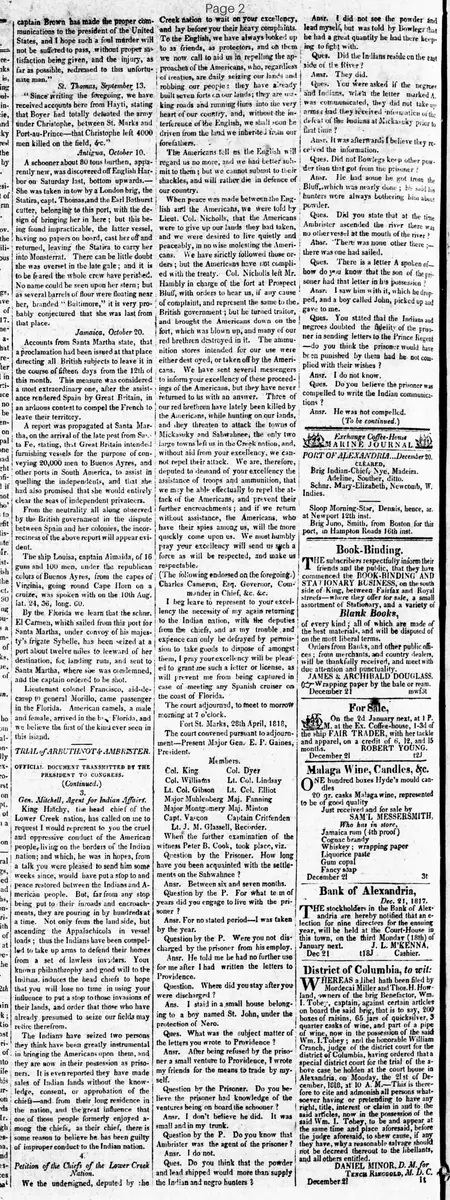
OFFICIAL. DOCUMENT TRANSMITTED BY THE
PRESIDENT TO CONGRESS.
(Continued.)
3.
Gen. Mitchell, Agent for Indian Affairs.
King Hatchy, the head chief of the
Lower Creek nation, has called on me to
request I would represent to you the cruel
and oppressive conduct of the American
people, living on the borders of the Indian
nation: and which, he was in hopes, from
a talk you were pleased to send him some
weeks since, would have put a stop to and
peace restored between the Indians and American people. But, far from any stop
being put to their inroads and encroachments, they are pouring in by hundreds at
a time. Not only from the land side, but
ascending the Apalachicola in vessel
loads; thus the Indians have been compelled to take up arms to defend their homes
from a set of lawless invaders. Your
known philanthropy and good will to the
Indians, induces the head chiefs to hope
that you will lose no time in using your
influence to put a stop to those invasions of
their lands, and order that those who have
already presumed to seize our fields may
retire therefrom.
The Indians have seized two persons
they think have been greatly instrumental
in bringing the Americans upon them, and
they are now in their possession as prisoners. It is even reported they have made
sales of Indian lands without the know-
ledge, consent, or approbation of the
chiefs—and from their long residence in
the nation, and the great influence that
one of those people formerly enjoyed a-
mong the chiefs, as their chief, there is
some reason to believe he has been guilty
of improper conduct to the Indian nation.
4.
Petition of the Chiefs of the Lower Creek
Nation.
We the undersigned, deputed by the
Creek nation to wait on your excellency,
and lay before you their heavy complaints.
To the English, we have always looked up
to as friends, as protectors, and on them
we now call to aid us in repelling the ap-
proaches of the Americans, who, regardless
of treaties, are daily seizing our lands and
robbing our people; they have already
built seven forts on our lands; they are wa-
king roads and running lines into the very
heart of our country, and, without the in-
terference of the English, we shall soon be
driven from the land we inherited from our
forefathers.
The Americans tell us the English will
regard us no more, and we had better sub-
mit to them; but we cannot submit to their
shackles, and will rather die in defence of
our country.
When peace was made between the Eng-
lish and the Americans, we were told by
Lieut. Col. Nicholls, that the Americans
were to give up our lands they had taken,
and we were desired to live quietly and
peaceably, in no wise molesting the Ameri-
cans. We have strictly followed those or-
ders; but the Americans have not compli-
ed with the treaty. Col. Nicholls left Mr.
Hambly in charge of the fort at Prospect
Bluff, with orders to hear us, if any cause
of complaint, and represent the same to the
British government: but he turned traitor,
and brought the Americans down on the
fort, which was blown up, and many of our
red brethren destroyed in it. The ammu-
ni tion stores intended for our use were
either destroyed, or taken off by the Ameri-
cans.
We have sent several messengers
to inform your excellency of these proceed-
ings of the Americans, but they have never
returned to us with an answer. Three of
our red brethren have lately been killed by
the Americans, while hunting on our lands,
and they threaten to attack the towns of
Mickasuky and Suwannee: the only two
large towns left us in the Creek nation, and,
without aid from your excellency, we can-
not repel their attack. We are, therefore,
deputed to demand of your excellency the
assistance of troops and ammunition, that
we may be able effectually to repel the at-
tack of the Americans: and prevent their
further encroachments; and if we return
without assistance, the Americans, who
have their spies among us, will the more
quickly come upon us. We most humbly
pray your excellency will send us such a
force as will be respected, and make us
respectable,
(The following endorsed on the foregoing.)
Charles Cameron, Esq. Governor, Com-
mander in Chief, &c. &c.
I beg leave to represent to your excel-
lency the necessity of my again returning
to the Indian nation, with the deputies
from the chiefs, and as my trouble, and
expence can only be defrayed by permis-
sion to take goods to dispose of amongst
them, I pray your excellency will be pleas-
ed to grant me such a letter or license, as
will prevent me from being captured in
case of meeting any Spanish cruiser on
the coast of Florida.
The court adjourned, to meet to morrow
morning at 7 o'clock.
Fort St. Marks, 28th April, 1818.
The court convened pursuant to adjourn-
ment—Present Major Gen. E. P. Gaines,
President.
Members.
Col. King Col. Dyer
Col. Williams Lt. Col. Lindsay
Lt. Col. Gibson Lt. Col. Elliot
Major Muhlenberg Maj. Fanning
Major Montgomery Maj. Minton
Capt. Vason Captain Crittenden
Lt. J. M. Glassell, Recorder.
When the further examination of the
witness Peter B. Cook, took place, viz.
Question by the Prisoner. How long
have you been acquainted with the settle-
ments on the Suwannee?
Ansr. Between six and seven months.
Question by the P. For what term of
years did you engage to live with the pri-
soner?
Ansr. For no stated period—I was taken
by the year.
Question by the P. Were you not dis-
charged by the prisoner from his employ.
Ansr. He told me he had no further use
for me after I had written the letters to
Providence.
Question. Where did you stay after you
were discharged?
Ans. I staid in a small house belong-
ing to a boy named St. John, under the
protection of Nero.
Ques. What was the subject matter of
the letters you wrote to Providence?
Ansr. After being refused by the pri-
soner a small venture to Providence, I wrote
my friends for the means to trade by my-
self.
Question by the Prisoner. Do you be-
lieve the prisoner had knowledge of the
ventures being on board the schooner?
Ansr. I don't believe he did. It was
small and in my trunk.
Question by the P. Do you know that
Ambrister was the agent of the prisoner?
Ansr. I do not.
Ques. Do you think that the powder
and lead shipped would more than supply
the Indian and negro hunters?
Ansr. I did not see the powder and
lead myself, but was told by Bowlegs that
he had a great quantity he had there keep-
ing to fight with.
Ques. Did the Indians reside on the east
side of the River?
Ansr. They did.
Ques. You were asked if the negroes
and Indians, when the letter marked A.
was communicated, they did not take up
arms; had they received information of the
defeat of the Indians at Mickasuky prior to
that time?
Ansr. It was afterwards I believe they re-
ceived the information
Ques. Did not Bowlegs keep other pow-
der than that got from the prisoner?
Ansr. He had some he got from the
Bluff, which was nearly done; he said his
hunters were always bothering him about
powder.
Ques. Did you state that at the time
Ambrister ascended the river there was
no other vessel at the mouth of the river?
Ansr. There was none other there;—
there was one had sailed.
Ques. There is a letter A spoken of—
how do you know that the son of the pri-
soner had that letter in his possession?
Ansr. I saw him with it, which he drop-
ped, and a boy called John, picked up and
gave to me.
Ques. You stated that the Indians and
negroes doubted the fidelity of the pri-
soner in sending letters to the Prince Regent
—do you think the prisoner would have
been punished by them had he not com-
plied with their wishes?
Ansr. I do not know.
Ques. Do you believe the prisoner was
compelled to write the Indian communica-
tions?
Ansr. He was not compelled.
(To be continued.)
What sub-type of article is it?
What keywords are associated?
What entities or persons were involved?
Where did it happen?
Domestic News Details
Primary Location
Fort St. Marks
Event Date
28th April, 1818
Key Persons
Outcome
three red brethren killed by americans; fort at prospect bluff blown up with many red brethren destroyed; trial proceedings ongoing with witness examination.
Event Details
Document includes letter from Gen. Mitchell conveying King Hatchy's complaints about American encroachments on Indian lands; petition from Lower Creek chiefs to British Governor Cameron requesting aid against American invasions, forts, and threats to towns; endorsement by Cameron; court reconvenes with members present; further examination of witness Peter B. Cook by the prisoner regarding settlements, employment, letters, ventures, and Indian activities.