Thank you for visiting SNEWPapers!
Sign up free
The National Intelligencer And Washington Advertiser
Washington, District Of Columbia
What is this article about?
Editorial from London Morning Chronicle criticizes British deposition of the Nabob of the Carnatic as unjust colonial expansion. Includes letter from deposed Nawab Walajah detailing his father's death in July, British troops' occupation, coerced succession negotiations, false accusations of correspondence with Mysore Sultan, and his refusal leading to dethronement by Lord Clive.
Merged-components note: This is a continuation of the same foreign news story about the deposed Nabob of the Carnatic, spanning pages 1 and 2, ending with 'To be Continued.'
Clippings
1 of 2
OCR Quality
Full Text
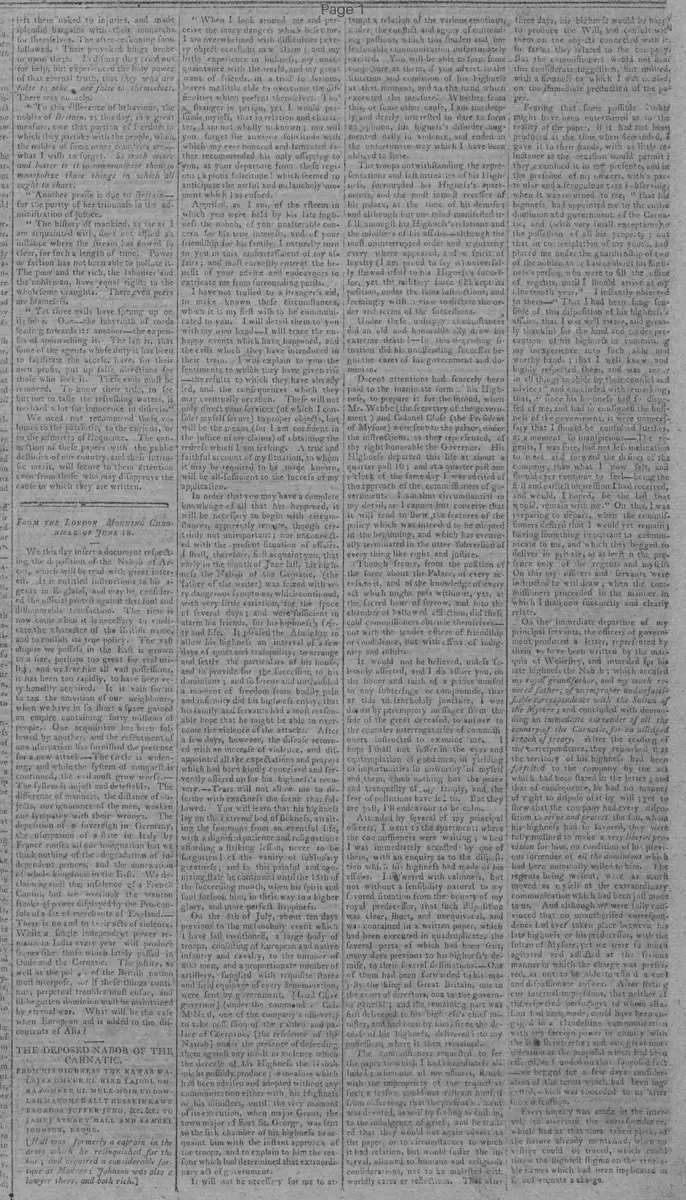
We this day insert a document respecting the deposition of the Nabob of Arcot, which will be read with great interest. It is entitled instructions to his agents in England, and may be considered the official protest against that foul and dishonorable transaction. The time is now come when it is necessary to vindicate the character of the British name, and to consult its true policy. The vast empire we possess in the East is grown to a size, perhaps too great for real utility, and we fear like all vast possessions, it has been too rapidly, to have been very honestly acquired. It is vain for us to tax the ambition of our neighbours, when we have in so short a space gained an empire containing forty millions of people. One acquisition has been followed by another, and the resentment of one usurpation has furnished the pretence for a new attack. The circle is widening, and while the system of conquest is continued, the evil must grow worse.--The system is unjust and detestable. The difference of manners, the distance of objects, our ignorance of the men, weaken our sympathy with their wrongs. The deposition of a sovereign in Germany, the usurpation of a state in Italy by France rouses all our indignation but we think nothing of the degradation of independent princes, and the annexation of whole kingdoms in the East. We declaim against the insolence of a French Consul, but we overlook the wanton freaks of power displayed by the Pro-consuls of a set of merchants of England.. There is no end to their acts of violence. While a single independent power remains in India every year will produce scenes like those which lately passed in Oude and the Carnatic. The justice, as well as the policy, of the British nation must interpose, for if these things continue, perpetual troubles must ensue, and ill-begotten dominion must be maintained by eternal war. What will be the case when European aid is added to the discontents of Asia?
THE DEPOSED NABOB OF THE CARNATIC.
FROM HIS HIGHNESS THE NAWAB WALAJAH MEERUL HINDTAJOOL- RAAOMEKR UL MULK MOIN UDDOW LAHMAHOMFDALLYHUSSEIN KAWN -BAHADOR FUFFER JUNG, &C. &C. TO JAMES STUART HALL AND SAMUEL JOHNSON, ESQRS.
[Hall was formerly a captain in the army which he relinquished for the bar; and acquired a considerable fortune at Madras; Johnson was also a lawyer there, and both rich.]
"When I look around me and perceive the many dangers which beset me, I am overwhelmed with difficulties; every object occasions new alarm; and my little experience in business, my unacquaintance with the world, and my great want of friends, in a trial so serious, leaves me little able to overcome those difficulties which present themselves. Tho' a stranger in person, yet I would persuade myself, that in relation and character, I am not wholly unknown; nor will you forget the anxious solicitude with which my ever honored and lamented father recommended his only offspring to you, at your departure from these regions; a pious solicitude! which seemed to anticipate the awful and melancholy moment which I have ensued.
Amprised, as I am, of the esteem in which you were held by his late highness the nabob, of your unalterable concern for his true interests, and of your friendship for his family. I naturally turn to you in this embarrassment of my affairs; and most earnestly entreat the benefit of your advice and endeavours to extricate me from surrounding perils.
I have not trusted to a stranger's aid, to make known these circumstances, which it is my first wish to be communicated to you. I will detail them to you with my own hand--I will trace the unhappy events which have happened, and the evils which they have introduced in their train. I will explain to you the sentiments to which they have given rise --the results to which they have already led, and the consequences which they may eventually occasion. These will not only direct your services (of which I consider myself secure) to proper objects, but will be the means (for I am confident in the justice of my claims) of obtaining the redress which I am seeking. A true and faithful account of my situation, to whom it may be required to be made known, will be all-sufficient to the success of my application.
In order that you may have a complete knowledge of all that has happened, it will be necessary to begin with circumstances, apparently remote, though certainly not unimportant; nor unconnected with the present situation of affairs.
I shall, therefore, it acquaint you, that early in the month of June last, his highness the Nabob of the Carnatic, (the father of the writer) was seized with very dangerous symptoms, which continued, with very little variation, for the space of several days; and were sufficient to alarm his friends, or his highness's safety and life. It pleased the Almighty to allow his highness an interval of a few days of quiet and tranquility, to arrange and settle the particulars of his house, and to provide for the succession to his dominions; and so serene and untroubled a moment of freedom from bodily pain and infirmity did his highness enjoy, that his family and servants had a most reasonable hope that he might be able to overcome the violence of the attacks. After a few days, however, the disease returned with an increase of violence, and disappointed all the expectations and prayers which had been kindly conceived and fervently offered up for his highness's recovery.--Tears will not allow me to describe with exactness the scene that followed. You will learn that his highness lay on the extreme bed of sickness, awaiting the summons from an eventful life, with a dignified patience and resignation affording a striking lesson, never to be forgotten! of the vanity of sublunary greatness; and in this painful and agonizing state he continued until the 15th of the succeeding month, when his spirit and soul forsook him, in their way to a higher glory, and more perfect happiness.
On the 5th of July, about ten days previous to the melancholy event which I have last mentioned, a large body of troops, consisting of European and native infantry and cavalry, to the number of 800 men, and a proportionate number of artillery, supplied with requisite stores and field equipage of every denomination, were sent by government, [Lord Clive governor (under the command Col. MoNel, one of the company's officers,) to take possession of the garden and palace of Chepauk, [the residence of the Nawab] under the pretence of defending them against any insult or violence which the decease of his Highness the Nabob might possibly produce; a measure which had been advised and adopted without any communication either with his Highness or his ministers, until: the very moment of its execution, when major Grant, the town major of Fort St. George, was sent to the sick chamber of his highness to acquaint him with the instant approach of the troops, and to explain to him the reasons which had determined that extraordinary act of government.
It will not be necessary for me to attempt a relation of the various emotions, under the conflict and agony of contending passions, which this sudden and unseasonable communication unfortunately excited.. You will be able to form some conjecture at them, if you advert to the situation and condition of his highness at that moment, and to the hand which executed the measure. Whether from this, or some other cause, I am too deeply and dearly interested to dare to form an opinion, his highness's disorder augmented daily in violence, and ended in the unfortunate way which I have been obliged to state.
The troops notwithstanding the representations and last intreaties of his Highness surrounded his Highness's apartments, and the most intimate recesses of his palace, at the time of his demise: and although but one mind manifested itself amongst his Highness's relations and the ministers of his affairs--although the not uninterrupted order and regularity every where appeared, and a spirit of loyalty (I am proud to say it) universally shewed itself to his Highness's successor, yet the military force still kept its position, under the same instructions, and seemingly with a view to dictate the order and terms of the succession.
Under these unhappy circumstances did an old and honorable ally draw his extreme death !--In this degrading situation did his unoffending successor begin the cares of his government and dominion.
Decent attentions had scarcely been paid to the inanimate form . his Highness, to prepare it for the shroud, when Mr. Webbe (the secretary of the government ) and Colonel Cloë (the President of Myore) were sent to the palace, under the instructions, as they represented, of the right honorable the Governor. His Highness departed this life at about a quarter past 10; and at a quarter past one o'clock of the same day I was advised of the approach of the commissioners of government. I am thus circumstantial in my detail, as I cannot but conceive that it will tend to shew the features of the policy which was intended to be adopted in the beginning, and which has eventually terminated in the utter subversion of every thing like right and justice.
Though secure, from the position of the force about the Palace, of every access. to it, and of the knowledge of every act which might pass within it, yet, at the sacred hour of sorrow, and into the chamber of hallowed affection, did these cold commissioners obtrude themselves. not with the tender offices of friendship or condolence, but with airs of indignity and insult.
It would not be believed, unless solemnly asserted, and I do assure you, on the honor and faith of a prince unused to any subterfuge or compromise, that at this melancholy juncture, I was drawn by peremptory messages from the side of the great deceased, to answer to the countless interrogatories of commissioners instructed to examine me. I hope I shall not suffer in the eyes and contemplation of good men, in yielding to importunities so unworthy of myself and them, which nothing but the peace and tranquility of my family, and the fear of pollutions have led to. But they are past, I'll endeavour to be calm.
Attended by several of my principal officers, I went to the apartments where the commissioners were waiting; when I was immediately accosted- by one of them, with an enquiry as to the disposition which his highness had made of his affairs. I answered with calmness, but not without a sensibility natural to my favored situation from the bounty of my royal predecessor, that such disposition was clear, short, and unequivocal, and was contained in a written paper, which had been executed in quadruplicate, the several parts of which had been sent, many days previous to his highness's demise, to their several destinations. One of them had been forwarded to his majesty the king of Great Britain, one to the court of directors, one to the governor-general ; and the remaining part was last delivered to his highness's chief minister, and had been by him, since the decease of his highness, delivered into my possession where it then remained.
The commissioners requested to see the paper to which I had immediately alluded; when one of my officers, struck with the impropriety of the request at such a season could not restrain himself from observing, that the present moment was devoted, as well by feeling as custom. to the indulgence of grief; and he trusted that they would not again advert to the paper, or to circumstances to which it had relation, but would suffer the interval, allowed to humane and religious considerations, not to be molested with worldly cares or reflections. That after three days, his highness would be happy to produce the Will, and consult with them on the objects connected with it. so far as they related to the company. But the commissioners would not hear this considerate suggestion, but insisted. with a firmness to which I was unused, on the immediate production of the paper.
Fearing that some possible doubts might have been entertained as to the reality of the paper, if it had not been produced at the time when demanded, gave it to their hands, with as little reluctance as the occasion would permit ; they examined it in my presence and in the presence of my officers, with a particular and a scrupulous care ; -observing, when it was returned to me, "that his highness had appointed me to the entire dominion and government of the Carnatic, and (with very small exceptions) to the possession of all his property ; but that in contemplation of my youth, he had placed me under the guardianship of two of the nobleman or khawns about his highness's person, who were to fill the office of regents, until I should arrive at my nineteenth year." I instantly observed to them-"That I had been long sensible of this disposition of his highness's affairs, that I was well aware, and greatly thankful for the kind and tender precaution of his highness in committing my inexperience into such able and worthy hands ; that I well knew and highly respected them, and was ready in all things to abide by their counsel and advice :" and concluded with remarking, that, " since his highness had disposed of me, and had so consigned the business of the government, it were unnecessary that I should be consulted further, at a moment so inauspicious.-The regents, I was sure, had not less inclination to meet and forward the desires of the company, than what I now felt, and should ever continue to feel-being the first and earliest impression I had received, and would, I hoped, be the last that would remain with me." On this, I was preparing to depart, when the commissioners desired that I would yet remain ; having something important to communicate to me, and which they begged to deliver in private, or at least in the presence only of :he regents and myself On this my officers and servants were instructed to withdraw; when the commissioners proceeded in the manner in which I shall now succinctly and clearly relate.
On the immediate departure of my principal servants, the officers of government produced a letter, represented by them to have been written by the Marquis of Wellesley, and intended for his late highness the Nabob ; which accused my royal grandfather, and my much revered father, of an improper and unjustifiable correspondence with the Sultan of the Mysore ; and concluded with demanding an immediate surrender of all the country of the Carnatic, for an alleged breach of treaty. after the reading of the correspondence, they remarked that the territory of his highness had been forfeited to the company by the act which had been stated in the letter : and that of consequence, he had no manner of right to dispose of it by will ; yet to shew that the company had every disposition to serve and protect the son, whom his highness had so favored, they were fully inclined to make a very liberal provision for him, on condition of his previous surrender of all the dominions which had been nominally willed to him. The regents being present, were as much moved as myself at the extraordinary communication which had been just made to us. And although we were fully convinced that no unauthorized correspondence had ever taken place between his late highness or his predecessor, with the Sultan of Myore, yet we were so much agitated and afflicted at the serious manner in which the charge was preferred. as not to be able for a good and dispassionate answer. After stating our internal impressions, that neither of the respected personages to whom allusion had been made-, could have been engaged in a clandestine communication with any foreign power in enmity with the British interests ; and our great mortification at the proposal which had been offered, as founded on that unfounded fact we begged for a few days consideration of the terms which had been suggested, which was conceded to us after some discussion.
Every inquiry was made in the interval; to ascertain the correspondence. which had at that time taken place, of the nature already mentioned, when no vestige could be traced, which could throw the slightest stigma on the venerable names which had been implicated in so unfortunate a charge.
The out correspondence which had ever occurred between the parties in union, and which could have given rise to the suspicion entertained by the company, happened at the instance of the Earl Cornwallis, after the termination of the war so successfully conducted by his lordship against the late Sultan; and related to a family connection, which, from the well known circumstances never took place. This correspondence naturally produced mutual communications of courtesy on several domestic events, which concerned either of the parties personally, as occasions happened; but nothing that could affect any interest, connected with national or public considerations.
The regents, at the conference on the next evening, being confirmed in their first impressions of the rectitude of his late highness's conduct, in the particular referred to, stating in perspicuous terms, the steps which they had pursued to investigate the truth of the accusation which had been alleged to have been contained in the letter of the Marquis of Wellesley; and that they have found, on a full investigation, that there was not the smallest foundation for the charge which had been urged : but, on the contrary, that the only correspondence which had occurred between his Highness and the Sultan, had been carried on with the knowledge and consent of the executive local government, and had been forwarded officially by them ; and on proof of this assertion, referred the commissioners to their own immediate records.
The regents then expressed their concern that the matter of this accusation had not been made known and inquired into in the life of his late highness, when it might have been fairly and candidly explained and answered. This circumstance alone led them to hope that the company did not seriously believe that correspondence of such a description had in reality happened, they might have felt themselves authorized in requesting an explanation concerning it; and under this conviction, they could not but conclude that the terms proposed to them at their last conference would be given up, as they were applicable to a situation of things which did not exist.
The regents next professed themselves most ready to receive any proposals which might serve to promote a good understanding in respect to the existing engagements, or might render them more convenient to either of the subscribing parties ; though they were not able to show how they could be improved ; at the same time they were apprehensive that a new arrangement might give rise to disputes which had been long set at rest by the existing treaty.
The commissioners still stood on their first ground, and insisted in peremptory language, on the proposal which they had before made. Seeing there was no possibility of diverting them entirely from their object, the regents considered of an expedient, which, in their expectations, might have induced the commissioners to have foregone their proposal, at least in the extent in which it had been moving. Being well aware, from an intimate knowledge of his late highness's affairs, that the preceding governors of Fort St. George had looked for possession of the Tinnevelly, and some of the adjacent countries as more convenient to their affairs, and sensible that the present government, from the nature of the proposal made, had similar views, though in a more extended shape; they determined, under the peculiar circumstances in which they stood, to meet their desires as much as they could, consistent with their own honor and the interests which they had been given in charge.
With this intention they proposed to deliver into the hands of the company, for their entire management and control, the whole of the Tinnevelly and Madura provinces to the southward, and the Ougole and Palnaud to the north ; on the condition that the Prince of the Carnatic should be allowed in his periodical Kists, [collections are made by instalments, usually after the harvest ; the instalment of each harvest is called a Kist] the amount of rent of such districts, agreeable to the Schedule No. 2, annexed to the treaty of 1792, being a yearly sum equal to the full amount of the sum claimable by the company by virtue of such treaty.
To the proposal of the regents, the officers of government gave a short reply — " that it would not in any way do, and that nothing short of the demand which had been made, could be accepted or considered. In consequence of this disposition on the part of the commissioners; the regents requested a further time to reflect, and were indulged to the next day.
I shall not trouble you with the particulars, of the next or succeeding meeting on the day following; for you shall find them circumstantially related, in the journal of the regents, which I have directed to be forwarded with this. You will readily anticipate, that although the regents have been disposed to render up more of the countries (which really was the case,) on a like condition with those already tendered by them, they could not bring themselves to make an unqualified and unconditional surrender those rights, which it was their duty to protect and guard. The meetings, therefore, to which I have last reduced your attention, passed without effect.
Seeing that the regents were inflexible in their duty, and conceiving from my want of knowledge in public concerns, that I might possibly be rendered an instrument, as I cannot but consider, to my own undoing; the commissioners at the last conference, and towards the conclusion of it, sent a note to Lord Clive, who thereupon appeared at the palace; but instead of going to the apartment where negociations had hitherto been carried on, his lordship went to the tent of Col. M'Neil, in charge of the troops about the gardens, and immediately requested my attendance on him.
I cheerfully complied with his lordship's request, and went to the tent.— His lordship then accosted me with seeming kindness, and begged— " I would well consider the company's proffered terms, which, if then neglected, would evade my acceptance for ever, that they were now offered for the last time ; that a liberal allowance should be made out of the collections, (but which his lordship did not particularize) if I would listen favorably to his proposals ; but that if I did not incline to them, that I should be reduced from the grandeur which awaited me, into an humble and private station."
I observed to his lordship " that I was not acquainted with matters of so high concern; that I was indeed an utter stranger to business; that my royal predecessor had wisely committed me to the care and attention of others, and had recommended my conformity to their advice ; that in respect to my father's will, and to the persons to whom my affairs were trusted, I could not think of answering for myself the important propositions made to me; but, from regard to his lordship's character and to the interests which he represented, I was inclined not only to give my ready attention to what his lordship communicated, but would advise the regents (if it were compatible with their honor and my own safety) to overlook any formal duty which might stand in the way of their acquiescence; for this purpose I would beg leave to acquaint them with what passed, and would appoint an early day, when his lordship should have my answer."
His lordship observed that he would wait on me again the next day, at the same place—and took his leave.
In consulting with the regents and the Kawns, and Omrahs of Empire, before whom the whole of what had passed at the preceding conferences was laid, I was fully advised of the dangers to which my affairs and family might be exposed, by the acceptance of terms so disreputable and so vague ; an advice which I had no reason to suspect of prejudice or infidelity, and by which, after the most mature consideration, I was determined to govern my conduct.—Accordingly, when the governor came the next evening, I acquainted him ingenuously, " that I could not accede to the offer which he had yesterday the goodness to make me; that I had every personal good wish for the prosperity of the company, and for the real and substantial interest of the British nation, which I had been taught to admire from my earliest years, but that I could not sacrifice my own and my family's rights, for any supposed benefit to the company, or any provisional good which I was given to expect. Besides the mode of surrender dictated, and the ground on which it professed to be founded, was such that I could not adopt it, without rendering a credit to calumnies highly dishonorable to those whom by duty and religion I was bound to honor and revere. I had already shown an inclination to attend to the company's requisitions, in so far as they should be attended to, and was much induced by my own sentiments to extend the proposal which had been made on my behalf, even to a greater latitude, on the principle of the footing on which it had been made. My motives therefore for the non-acceptance of his lordship's offer, could admit of no doubt. That I had the highest personal consideration for his lordship, and would hope that the frank and explicit answer which I had now given him, would not occasion offence."
While I was delivering at I had to say, a number of troopers rode round the tent, with drawn swords; and an unusual guard of sepoys, were posted at the door, who traversed constantly to and fro; and a certain degree of confusion seemed to reign around. I endeavoured, nevertheless, to preserve a coolness and consistency of demeanor, requisite for the occasion; and have to thank heaven that my reason and fortitude were not to be shaken by a circumstance calculated to move them; and which from after practices, I am sorry to add, that I cannot but imagine was contrived with that view.
After I had concluded what I had to answer, his lordship replied, " that I was extremely badly advised ; that I had sacrificed my best interests to specious appearances ; and that I should rue the rejection of his proposal; that it was the very last time that he should address me on the subject"—and with a few words of sorrow, he departed the tent.
I have taken some pains to acquaint you with the foregoing circumstances, as well by myself as by the more detailed account of the regents, as they tend to shew the true grounds of the disagreement which existed between me and the government : and which have been made the pretence of disposing me of my throne, to which, by personal right, as well as by the will of my royal predecessor, I was lawfully and indisputably entitled.
From the detail, of which you are in possession, you will readily perceive the policy on which the Madras government have acted ; and they had an ambitious design from the beginning, of possessing themselves of the whole dominions of the Carnatic ; a design which the circumstances of the times seemed peculiarly to favor. Apprehensive, however, of the opinions of the European and Asiatic world, they determined on arriving at their ends by means the least alarming and suspicious. They, therefore, first betook themselves to him, who they well knew, if he could be brought to consent, could give not only legality and effect to their unbounded views ; but they soon experienced, from the wise precautions of his predecessor, that he was not left a ready instrument to their purposes, (tho not indisposed in sentiment to accept any reasonable terms) and judging from the latter circumstances (which shewed a pliancy of character) that he might yet be made what the government desired to see him, they endeavoured by promises, allurements, and threats, to mould him to their wishes. But seeing in the event, that all their stratagems failed, while their ambition remained unabated, they resorted to other expedients which seemed to promise, if not a more honorable, at least a more successful issue.
Their ambition still exhibited its original mixed character; it possessed not any of that daring, open, and dazzling quality, which leads the world to overlook the means in the splendour of the event ; but a lofty and towering mind, with a diminutive and assured spirit, which affects but can never perfect a great or admirable atchievemnent.
Disappointed in their first expectation, the government sought to accomplish their object by the instrumentality of the next immediate Prince to the Musnud [of the throne] of the Carnatic; and unmindful of the order and succession, and of the disposition of his late highness, did not scruple to open negociations with him for filling the imperial seat. But I shall not trouble you at any length on the many subterfuges used on this occasion; or of the measures a-dopted, through an oblique medium, of obtaining their originally intended end.
(To be Continued.)
What sub-type of article is it?
What keywords are associated?
What entities or persons were involved?
Where did it happen?
Foreign News Details
Primary Location
Carnatic
Event Date
Early June To 15th July Last
Key Persons
Outcome
deposition of nawab walajah from the throne of the carnatic; british east india company demands and ultimately seizes control of the dominions on pretext of treaty breach involving alleged correspondence with sultan of mysore.
Event Details
Following the death of the Nabob of the Carnatic on 15 July, British troops occupy his palace under Lord Clive's government. Commissioners confront the successor, Nawab Walajah, with a letter from Marquis of Wellesley accusing his father and grandfather of unauthorized correspondence with the Sultan of Mysore, demanding surrender of the Carnatic. Despite denials, investigations showing no breach, and offers to cede specific provinces, negotiations fail. Nawab refuses unconditional surrender, leading to his dethronement.