Thank you for visiting SNEWPapers!
Sign up free
The National Intelligencer And Washington Advertiser
Washington, District Of Columbia
What is this article about?
This editorial concludes a piece on Winthrop Sargent's vindication after his removal as Governor of the Mississippi Territory in 1801. It presents Sargent's letters and arguments claiming duplicity by President Jefferson and Secretary Madison in appointing William C. C. Claiborne, then refutes these claims, defending the administration's integrity and decisions.
Merged-components note: This is a single continuous article across pages 1 and 2 discussing Winthrop Sargent's vindication and providing critical editorial remarks; merged due to sequential reading order and direct text continuation; labeled as editorial to reflect the opinionated commentary.
Clippings
1 of 2
OCR Quality
Full Text
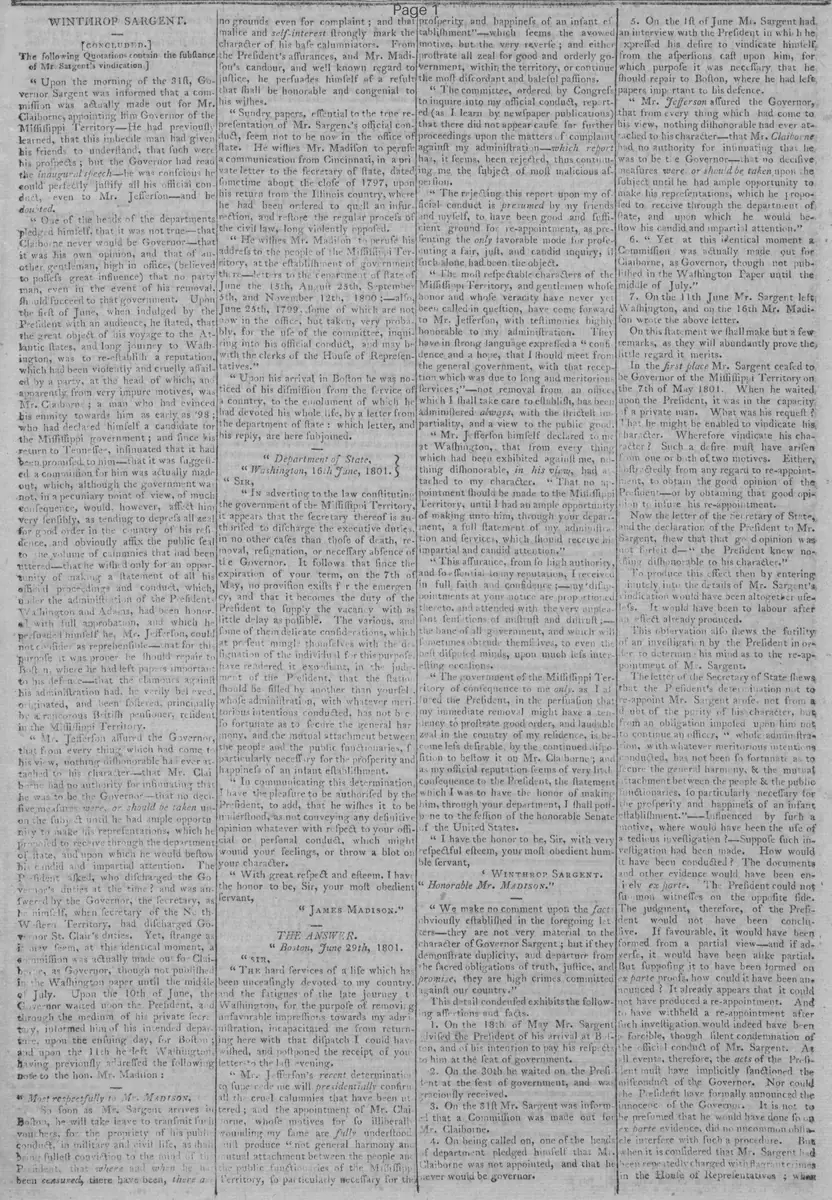
[CONCLUDED.]
The following Quotations contain the substance of Mr. Sargent's vindication.
"Upon the morning of the 31st, Governor Sargent was informed that a commission was actually made out for Mr. Claiborne, appointing him Governor of the Mississippi Territory. He had previously learned, that this imbecile man had given his friends to understand, that such were his prospects; but the Governor had read the inaugural speech—he was conscious he could perfectly justify all his official conduct, even to Mr. Jefferson—and he doubted.
"One of the heads of the departments pledged himself, that it was not true—that Claiborne never would be Governor—that it was his own opinion, and that of all other gentlemen, high in office, (believed to possess great influence) that no party man, even in the event of his removal, should succeed to that government. Upon the first of June, when indulged by the President with an audience, he stated, that the great object of his voyage to the Atlantic states, and long journey to Washington, was to re-establish a reputation, which had been violently and cruelly assailed by a party, at the head of which, and apparently from very impure motives, was Mr. Claiborne; a man who had evinced his enmity towards him as early as '98: who had declared himself a candidate for the Mississippi government; and since his return to Tennessee, insinuated that it had been promised to him—that it was suggested a commission for him was actually made out, which, although the government was not, in a pecuniary point of view, of much consequence, would, however, affect him very sensibly, as tending to depress all zeal for good order in the country of his residence, and obviously affix the public seal to the volume of calumnies that had been uttered—that he wished only for an opportunity of making a statement of all his official proceedings and conduct, which, under the administration of the Presidents Washington and Adams, had been honorably approved, and which he persuaded himself he, Mr. Jefferson, could not consider as reprehensible—that for this purpose it was proper he should repair to Boston, where he had left papers important to his defence—that the clamours against his administration had, he verily believed, originated, and been fostered, principally by a rancorous British pensioner, resident in the Mississippi Territory.
"Mr. Jefferson assured the Governor, that from every thing which had come to his view, nothing dishonorable had ever attached to his character—that Mr. Claiborne had no authority for insinuating that he was to be the Governor—that no decisive measures were, or should be taken upon the subject until he had ample opportunity to make his representations, which he promised to receive through the department of state, and upon which he would bestow his candid and impartial attention. The President asked, who discharged the Governor's duties at the time? and was answered by the Governor, the secretary, as he himself, when secretary of the North-Western Territory, had discharged Governor St. Clair's duties. Yet, strange as it may seem, at this identical moment, a commission was actually made out for Claiborne, as Governor, though not published in the Washington paper until the middle of July. Upon the 10th of June, the Governor waited upon the President, and through the medium of his private secretary, informed him of his intended departure, upon the ensuing day, for Boston; and upon the 11th he left Washington, having previously addressed the following note to the hon. Mr. Madison:
"Most respectfully to Mr. MADISON,
Soon as Mr. Sargent arrives in Boston, he will take leave to transmit to you vouchers, for the propriety of his public conduct, in military and civil life, with the bringing fullest conviction to the mind of the President, that where and when he has been censured, there have been, there are no grounds even for complaint: and that malice and self-interest strongly mark the character of his base calumniators. From the President's assurances, and Mr. Madison's candour, and well known regard to justice, he persuades himself of a result that shall be honorable and congenial to his wishes.
"Sundry papers, essential to the true representation of Mr. Sargent's official conduct, seem not to be now in the office of state. He wishes Mr. Madison to peruse a communication from Cincinnati, in a private letter to the secretary of state, dated sometime about the close of 1797, upon his return from the Illinois country, where he had been ordered to quell an insurrection, and restore the regular process of the civil law, long violently opposed.
"He wishes Mr. Madison to peruse his address to the people of the Mississippi Territory, at the establishment of government there—letters to the department of state of June the 15th, August 25th, September 5th, and November 12th, 1800; also, June 25th, 1799, some of which are not now in the office, but taken, very probably, for the use of the committee, inquiring into his official conduct, and may be with the clerks of the House of Representatives."
"Upon his arrival in Boston he was notified of his dismission from the service of a country, to the emolument of which he had devoted his whole life, by a letter from the department of state: which letter, and his reply, are here subjoined.
"Department of State,
Washington, 16th June, 1801.
"SIR,
"In adverting to the law constituting the government of the Mississippi Territory, it appears that the secretary thereof is authorised to discharge the executive duties, in no other cases than those of death, removal, resignation, or necessary absence of the Governor. It follows that since the expiration of your term, on the 7th of May, no provision exists for the emergency, and that it becomes the duty of the President to supply the vacancy with as little delay as possible. The various, and some of them delicate considerations, which at present mingle themselves with the designation of the individual for this purpose, have rendered it expedient, in the judgment of the President, that the station should be filled by another than yourself, whose administration, with whatever meritorious intentions conducted, has not been so fortunate as to secure the general harmony, and the mutual attachment between the people and the public functionaries, so particularly necessary for the prosperity and happiness of an infant establishment.
"In communicating this determination, I have the pleasure to be authorised by the President, to add, that he wishes it to be understood, as not conveying any definitive opinion whatever with respect to your official or personal conduct, which might wound your feelings, or throw a blot on your character.
"With great respect and esteem, I have the honor to be, Sir, your most obedient servant,
"JAMES MADISON."
THE ANSWER.
"Boston, June 29th, 1801.
"SIR,
"The hard services of a life which has been unceasingly devoted to my country, and the fatigues of the late journey to Washington, for the purpose of removing unfavorable impressions towards my administration, incapacitated me from returning here with that dispatch I could have wished, and postponed the receipt of your letter to the last evening.
"Mr. Jefferson's recent determination coupled with presidential confirmation will cruelly confirm all the calumnies that have been uttered; and the appointment of Mr. Claiborne, whose motives for so illiberally wounding my fame are fully understood but produce "not general harmony and mutual attachment between the people and the public functionaries of the Mississippi Territory, so particularly necessary for the prosperity and happiness of an infant establishment"—which seems the avowed motive, but the very reverse; and either prostrate all zeal for good and orderly government, within the territory, or continue the most discordant and baleful passions.
"The committee, ordered by Congress to inquire into my official conduct, reported (as I learn by newspaper publications) that there did not appear cause for further proceedings upon the matters of complaint against my administration—which report has, it seems, been rejected, thus continuing me the subject of most malicious aspersions.
"The rejecting this report upon my official conduct is presumed by my friends and myself, to have been good and sufficient ground for re-appointment, as presenting the only favorable mode for prosecuting a fair, just, and candid inquiry, if such alone had been the object.
"The most respectable characters of the Mississippi Territory, and gentlemen whose honor and whose veracity have never yet been called in question, have come forward to Mr. Jefferson, with testimonies highly honorable to my administration. They have in strong language expressed a "confidence and a hope, that I should meet from the general government, with that reception which was due to long and meritorious services;" not removal from an office, which I shall take care to establish, has been administered always, with the strictest impartiality, and a view to the public good.
"Mr. Jefferson himself declared to me at Washington, that from every thing which had been exhibited against me, nothing dishonorable, in his view, had attached to my character. "That no appointment should be made to the Mississippi Territory, until I had an ample opportunity of making unto him, through your department, a full statement of my administration and services, which should receive his impartial and candid attention."
"This assurance, from so high authority, and so-essential to my reputation, I received in full faith and confidence;—my disappointments at your notice are proportioned thereto, and attended with the very unpleasant sensations of mistrust and distrust;— the bane of all government, and which will sometimes obtrude themselves, to even the best disposed minds, upon much less interesting occasions.
"The government of the Mississippi Territory of consequence to me only, as I assured the President, in the persuasion that my immediate removal might have a tendency to prostrate good order, and laudable zeal in the country of my residence, is become less desirable, by the continued disposition to bestow it on Mr. Claiborne; and as my official reputation seems of very little consequence to the President, the statement which I was to have the honor of making him, through your department, I shall postpone to the session of the honorable Senate of the United States.
"I have the honor to be, Sir, with very respectful esteem, your most obedient humble servant,
Winthrop Sargent.
"Honorable Mr. Madison."
"We make no comment upon the facts obviously established in the foregoing letters—they are not very material to the character of Governor Sargent; but if they demonstrate duplicity, and departure from the sacred obligations of truth, justice, and promise, they are high crimes committed against our country."
This detail condensed exhibits the following assertions and facts.
1. On the 18th, of May Mr. Sargent visited the President of his arrival at Boston, and of his intention to pay his respects to him at the seat of government.
2. On the 30th he waited on the President at the seat of government, and was graciously received.
3. On the 31st Mr. Sargent was informed that a Commission was made out for Mr. Claiborne.
4. On being called on, one of the heads of department pledged himself that Mr. Claiborne was not appointed, and that he never would be governor
5. On the 1st of June Mr. Sargent had an interview with the President in which he expressed his desire to vindicate himself from the aspersions cast upon him, for which purpose it was necessary that he should repair to Boston, where he had left papers important to his defence.
"Mr. Jefferson assured the Governor, that from every thing which had come to his view, nothing dishonorable had ever attached to his character—that Mr. Claiborne had no authority for insinuating that he was to be the Governor—that no decisive measures were or should be taken upon the subject until he had ample opportunity to make his representations, which he proposed to receive through the department of state, and upon which he would bestow his candid and impartial attention."
6. "Yet at this identical moment a Commission was actually made out for Claiborne, as Governor, though not published in the Washington Paper until the middle of July."
7. On the 11th June Mr. Sargent left Washington, and on the 16th Mr. Madison wrote the above letter.
On this statement we shall make but a few remarks, as they will abundantly prove the little regard it merits.
In the first place Mr. Sargent ceased to be Governor of the Mississippi Territory on the 7th of May 1801. When he waited upon the President, it was in the capacity of a private man. What was his request? That he might be enabled to vindicate his character. Wherefore vindicate his character? Such a desire must have arisen from one or both of two motives. Either, officiously from any regard to re-appointment, to obtain the good opinion of the President—or by obtaining that good opinion to insure his re-appointment.
Now the letter of the Secretary of State, and the declaration of the President to Mr. Sargent, show that that good opinion was not forfeited—"the President knew nothing dishonorable to his character."
To produce this effect then by entering minutely into the details of Mr. Sargent's vindication would have been altogether useless. It would have been to labour after an effect already produced.
This observation also shows the futility of an investigation by the President in order to determine his mind as to the re-appointment of Mr. Sargent.
The letter of the Secretary of State shows that the President's determination not to re-appoint Mr. Sargent arose, not from a doubt of the purity of his character, but from an obligation imposed upon him not to continue an officer, "whose administration, with whatever meritorious intentions conducted, has not been so fortunate as to secure the general harmony, & the mutual attachment between the people & the public Functionaries, so particularly necessary for the prosperity and happiness of an infant establishment."—Influenced by such a motive, where would have been the use of a tedious investigation? Suppose such investigation had been made. How would it have been conducted? The documents and other evidence would have been entirely ex parte. The President could not summon witnesses on the opposite side.
The judgment, therefore, of the President would not have been conclusive. If favourable, it would have been formed from a partial view—and if adverse, it would have been alike partial.
But supposing it to have been formed on ex parte proofs, how could it have been announced? It already appears that it could not have produced a re-appointment. And to have withheld a re-appointment after such investigation, would indeed have been a forcible, though silent condemnation of the official conduct of Mr. Sargent. At all events, therefore, the acts of the President must have implicitly sanctioned the misconduct of the Governor. Nor could the President have formally announced the innocence of the Governor. It is not to be presumed that he would have done so openly on ex parte evidence, did no uncontrollable interfere with such a procedure. But when it is considered that Mr. Sargent had been repeatedly charged with flagrant crimes in the House of Representatives; when
Several of the members of that body avowed a determination to impeach him; which each body itself had virtually declared that there were grounds for further procedure on the charges preferred against him, would it not have been an improper interference in the President, to say no more, prematurely and officially to decide a question constitutionally under the cognizance of another tribunal?
How different the conduct of Mr. Jefferson! Compelled by duty to fill the place of Governor with another citizen, his delicacy and scrupulous regard to character dictate a letter in the highest degree complimentary and respectful, calculated to soften feelings likely to be wounded, and to raise a friendly barrier between the act of non-reappointment and any implied condemnation of character. But the kindest offices are too often misinterpreted, and the truest magnanimity is in this instance called malice!
It may in the second place, be truly said, that the President could not, without a violation of duty, have acted differently from what he did. On the 7th of May there ceased to be a Governor of the Mississippi Territory. Mr. Sargent knew this about the middle of May when he left Boston for the seat of Government. He came, he says, to vindicate his character—and yet with this express purpose in view, he left all his documents behind him. For what reason? He does not say. What are the documents?—He is silent. Under the strange circumstances it is fair to infer that he really had none which he thought would be of any avail. Is it conceivable, if he had, that critically situated as he was, knowing the necessity of an appointment; knowing, as he ought to have known, that the Secretary could not legally during an interregnum discharge the duties of Governor; is it conceivable that he would have neglected to bring with him documents material to his vindication and re-appointment? It is not conceivable; and we are justified in believing his object to have been to have obtained a re-appointment under the idea of their existence, without an exhibition of them.
In the third place, the President and head of department are charged with duplicity—Recollect reader by whom, and against whom the charge is made. It is made by Mr. Sargent against the President. Weigh their comparative characters, and decide which is entitled to most respect.
Mr. Sargent affirms that at the moment when he was assured by the President that no decisive measures were or should be taken on the subject until he had ample opportunity to make his representations, a commission was actually made out for Mr. Claiborne.
Grant that a commission was made out. Was that commission irrevocable? Had it been sent to Mr. Claiborne? Did Mr. Claiborne know anything about it?—Was not Mr. Sargent expressly informed, that though the commission was made out, it was a measure not definitively taken, and which would not for some time be taken—that in truth it was not yet considered as an appointment?—Of consequence it was not announced until the middle of July, and we observe by the Tennessee Prints that Mr. Claiborne informs the Governor of that State, that he was not acquainted with it till August.
If this statement be true, and Mr. Sargent will not deny it—what becomes of the charge of duplicity against the President? It is to be found in the assertion of Winthrop Sargent, and no where else. Candid men, while they appreciate the ingenuousness of the Executive, and discern in it a disposition to treat Mr. Sargent with tenderness, will be astonished at the wilful suppression and distortion of the above facts.
It is full time to close these remarks. In itself, the subject is very unimportant. The handle, however, attempted to be made of it to the Eastward seemed to merit some notice; and this elucidation will supply another proof of the prevalence of a spirit of misrepresentation, which perseveringly, amidst daily detection, continues to circulate its poison against the present administration of our General Government.
Since the above remarks were written, the author has perused a long Pamphlet, published by Winthrop Sargent, entitled "Papers in relation to the official conduct of Governor Sargent."—The Public prints have taken but little notice of this performance, and from the dulness and obscurity of its contents few readers will probably have patience to wade through it.
It consists entirely of Mr. Sargent's own vindicatory letters, of complimentary addresses, and of the partial statement of friends. Its contents are altogether unimportant, except in the establishment of one result, viz. that Mr. Sargent has a host of enemies in the Mississippi Territory, and
What sub-type of article is it?
What keywords are associated?
What entities or persons were involved?
Editorial Details
Primary Topic
Defense Against Winthrop Sargent's Claims Of Duplicity In His Removal As Governor Of Mississippi Territory
Stance / Tone
Supportive Of Jefferson Administration, Refuting Sargent's Accusations
Key Figures
Key Arguments