Thank you for visiting SNEWPapers!
Sign up free
The Daily Union
Washington, District Of Columbia
What is this article about?
New York correspondence dated May 4, 1846, by MORGAN: Details mail delay from Cambria steamer disappointing merchants; notes relief at Democrats scuttling Whig proposal for early Congress adjournment; pushes free trade reforms like revenue tariffs and mints to aid agriculture and emigrants; reports dull dry goods trade, falling print prices, and steady markets for cotton, flour, corn amid overproduction.
Clipping
OCR Quality
Full Text
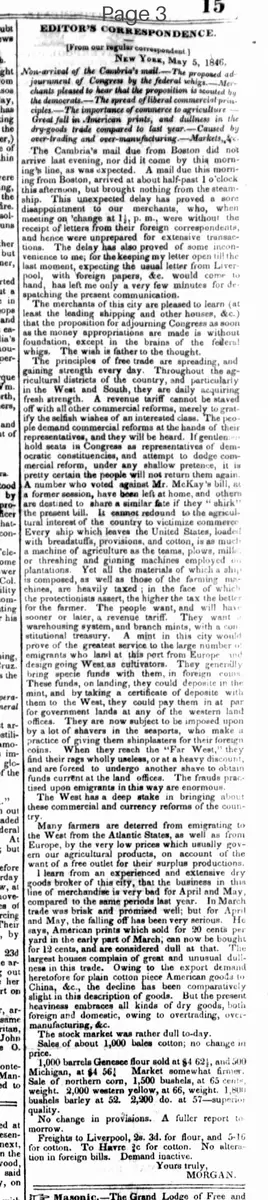
New York, May 4, 1846.
Non-arrival of the Cambria's mail.—The proposed adjournment of Congress by the federal whigs.—Merchants pleased to hear that the proposition is scouted by the democrats.—The spread of liberal commercial principles.—The importance of commerce to agriculture Great fall in American prints, and dullness in the dry-goods trade compared to last year.—Caused by over-trading and over-manufacturing.—Markets, &c.
The Cambria's mail due from Boston did not arrive last evening, nor did it come by this morning's line, as was expected. A mail due this morning from Boston, arrived at about half-past 1 o'clock this afternoon, but brought nothing from the steam-ship. This unexpected delay has proved a sore disappointment to our merchants, who, when meeting on 'change at 1½, p. m., were without the receipt of letters from their foreign correspondents, and hence were unprepared for extensive transactions. The delay has also proved of some inconvenience to me; for keeping my letter open till the last moment, expecting the usual letter from Liverpool, with foreign papers, &c. would come to hand, has left me only a very few minutes for despatching the present communication.
The merchants of this city are pleased to learn (at least the leading shipping and other houses, &c.) that the proposition for adjourning Congress as soon as the money appropriations are made is without foundation, 'except in the brains of the federal whigs. The wish is father to the thought.
The principles of free trade are spreading, and gaining strength every day. Throughout the agricultural districts of the country, and particularly in the West and South, they are daily acquiring fresh strength. A revenue tariff cannot be staved off with all other commercial reforms, merely to gratify the selfish wishes of an interested class. The people demand commercial reforms at the hands of their representatives, and they will be heard. If gentlemen hold seats in Congress as representatives of democratic constituencies, and attempt to dodge commercial reform, under any shallow pretence, it is pretty certain the people will not return them again A number who voted against Mr. McKay's bill, a former session, have been left at home, and others are destined to share a similar fate if they "shirk" the present bill. It cannot redound to the agricultural interest of the country to victimize commerce Every ship which leaves the United States, loaded with breadstuffs, provisions, and cotton, is as much a machine of agriculture as the teams, plows, mills, or threshing and ginning machines employed on plantations. Yet all the materials of which a ship is composed, as well as those of the farming machines, are heavily taxed; in the face of which the protectionists assert, the higher the tax the better for the farmer. The people want, and will have sooner or later, a revenue tariff. They want warehousing system, and branch mints, with a constitutional treasury. A mint in this city would prove of the greatest service to the large number of emigrants who land at this port from Europe who design going West, as cultivators. They generally bring specie funds with them, in foreign coins These funds, on landing, they could deposite in the mint, and by taking a certificate of deposite with them to the West, they could pay them in at par for government lands at any of the western land offices. They are now subject to be imposed upon by a lot of shavers in the seaports, who make a practice of giving them shinplasters for their foreign coins. When they reach the "Far West," they find their rags wholly useless, or at a heavy discount, and are forced to undergo another shave to obtain funds current at the land offices. The frauds practised upon emigrants in this way are enormous.
The West has a deep stake in bringing about these commercial and currency reforms of the country.
Many farmers are deterred from emigrating to the West from the Atlantic States, as well as from Europe, by the very low prices which usually govern our agricultural products, on account of the want of a free outlet for their surplus productions.
I learn from an experienced and extensive dry goods broker of this city, that the business in this line of merchandise is very bad for April and May compared to the same periods last year. In March trade was brisk and promised well; but for April and May, the falling off has been very serious. He says, American prints which sold for 20 cents per yard in the early part of March; can now be bought for 12 cents, and are considered dull at that. The largest houses complain of great and unusual dullness in this trade. Owing to the export demand heretofore for plain cotton piece American goods to China, &c., the decline has been comparatively slight in this description of goods. But the present heaviness embraces all kinds of dry goods, both foreign and domestic, owing to overtrading, over-manufacturing, &c.
The stock market was rather dull to-day.
Sales of about 1,000 bales cotton; no change in price.
1,000 barrels Genesee flour sold at $4 62½, and 500 Michigan, at $4 56½ Market somewhat firmer.
Sale of northern corn, 1,500 bushels, at 65 cents weight. 2,000 western yellow, at 66, weight. 1,800 bushels barley at 52. 2,200 do. at 57—superior quality.
No change in provisions.
A fuller report to-morrow.
Freights to Liverpool, 2s. 3d. for flour, and 5-16 for cotton. To Havre 3c for cotton. No alteration in foreign bills. Demand inactive.
Yours truly,
MORGAN.
What sub-type of article is it?
What themes does it cover?
What keywords are associated?
What entities or persons were involved?
Letter to Editor Details
Author
Morgan
Recipient
Editor
Main Argument
reports on the delay of the cambria's mail and merchants' disappointment; expresses pleasure that the proposed early adjournment of congress by federal whigs is unfounded and opposed by democrats; advocates strongly for the spread of free trade principles, a revenue tariff, warehousing system, branch mints, and constitutional treasury to benefit commerce and agriculture, criticizing protectionists and warning politicians against dodging reforms.
Notable Details