Thank you for visiting SNEWPapers!
Sign up free
Gazette Of The United States
New York, New York County, New York
What is this article about?
Account of U.S. House debates on June 18, 1789, regarding the President's authority to remove the Secretary of Foreign Affairs, with speeches by White, Page, Sedgwick, Lee, Boudinot, Jackson, Scott, Goodhue, Gerry, Sherman, and Ames. Includes updates on passage of the Foreign Affairs Department bill on June 24 (29-22 vote), and progress on impost, tonnage, war, and treasury department bills through June 26.
Merged-components note: These components form a continuous report on congressional proceedings, with text flowing directly from one to the next across pages; relabeled the 'story' component to 'domestic_news' for consistency as it is a sketch of U.S. government activities.
Clippings
1 of 3
OCR Quality
Full Text
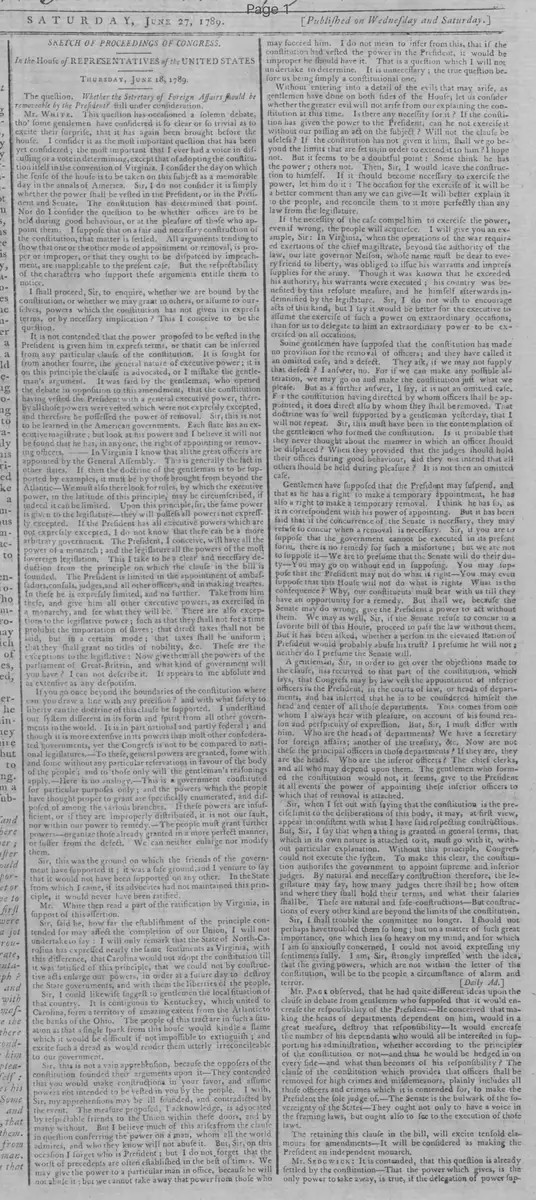
SKETCH OF PROCEEDINGS OF CONGRESS.
In the House of Representatives of the United States, THURSDAY, JUNE 18, 1789.
The question, Whether the Secretary of Foreign Affairs should be removable by the President? still under consideration.
Mr. WHITE.
This question has occasioned a solemn debate, though some gentlemen have considered it so clear or so trivial as to excite their surprise, that it has again been brought before the house. I consider it as the most important question that has been yet considered; the most important that I ever had a voice in discussing or a vote in determining, except that of adopting the constitution itself in the convention of Virginia. I consider the day on which the sense of the house is to be taken on this subject as a memorable day in the annals of America. Sir, I do not consider it is simply whether the power shall be vested in the President, or in the President and Senate. The constitution has determined that point. Nor do I consider the question to be whether offices are to be held during good behaviour, or at the pleasure of those who appoint them. I suppose that on a fair and necessary construction of the constitution, that matter is settled. All arguments tending to show that one or the other mode of appointment or removal, is proper or improper, or that they ought to be dispatched by impeachment, are inapplicable to the present case. But the respectability of the characters who support these arguments entitle them to notice.
I shall proceed, Sir, to enquire, whether we are bound by the constitution, or whether we may grant to others, or assume to ourselves, powers which the constitution has not given in express terms, or by necessary implication? This I conceive to be the question.
It is not contended that the power proposed to be vested in the President is given him in express terms, or that it can be inferred from any particular clause of the constitution. It is sought for from another source, the general nature of executive power; it is on this principle the clause is advocated, or I mistake the gentleman's argument. It was said by the gentleman, who opened the debate in opposition to this amendment, that the constitution having vested the President with a general executive power, thereby all those powers were vested which were not expressly excepted, and therefore he possessed the power of removal. Sir, this is not to be learned in the American governments. Each state has an executive magistrate; but look at his powers and I believe it will not be found that he has, in any one, the right of appointing or removing officers.
In Virginia I know that all the great officers are appointed by the General Assembly. This is generally the fact in other states. If then the doctrine of the gentleman is to be supported by examples, it must be by those brought from beyond the Atlantic. We must also there look for rules, by which the executive power, in the latitude of this principle, may be circumscribed, if indeed it can be limited. Upon this principle, sir, the same power is given to the legislature—they will possess all powers not expressly excepted. If the President has all executive powers which are not expressly excepted, I do not know that there can be a more arbitrary government. The President, I conceive, will have all the power of a monarch; and the legislature all the powers of the most sovereign legislation. This I take to be a clear and necessary deduction from the principle on which the clause in the bill is founded. The President is limited in the appointment of ambassadors, consuls, judges, and all other officers, and in making treaties. In these he is expressly limited, and no further. Take from him these, and give him all other executive powers, as exercised in a monarchy, and see what they will be. There are also exceptions to the legislative power; such as that they shall not for a time prohibit the importation of slaves: that direct taxes shall not be laid, but in a certain mode; that taxes shall be uniform: that they shall grant no titles of nobility, &c. These are the exceptions to the legislative: Now give them all the powers of the parliament of Great-Britain, and what kind of government will you have? I cannot describe it. It appears to me absolute and as extensive as any despotism.
If you go once beyond the boundaries of the constitution where can you draw a line with any precision? and with what safety to liberty can the doctrine of this clause be supported. I understand our system different in its form and spirit from all other governments in the world. It is in part national and partly federal; and though it is more extensive in its powers than most other confederated governments, yet the Congress is not to be compared to national legislatures. To these, general powers are granted, some with and some without any particular reservations in favour of the body of the people; and to those only will the gentleman's reasonings apply. Here is no analogy. This is a government constituted for particular purposes only; and the powers which the people have thought proper to grant are specifically enumerated, and disposed of among the various branches. If these powers are insufficient, or if they are improperly distributed, it is not our fault, nor within our power to remedy. The people must grant further powers—organize those already granted in a more perfect manner, or suffer from the defect. We can neither enlarge nor modify them.
Sir, this was the ground on which the friends of the government have supported it; it was a safe ground, and I venture to say that it would not have been supported on any other. In the State from which I came, if its advocates had not maintained this principle, it would never have been ratified.
Mr. White then read a part of the ratification by Virginia, in support of this assertion.
Sir, said he, how far the establishment of the principle contended for may affect the completion of our Union, I will not undertake to say: I will only remark that the State of North-Carolina has expressed nearly the same sentiments as Virginia, with this difference, that Carolina would not adopt the constitution till it was satisfied of this principle, that we could not by constructive acts enlarge our powers, in order at a future day to destroy the State governments, and with them the liberties of the people.
Sir, I could likewise suggest to gentlemen the local situation of that country. It is contiguous to Kentucky, which united to Carolina, form a territory of amazing extent from the Atlantic to the banks of the Ohio. The people of this tract are in such a situation as that a single spark from this house would kindle a flame which it would be difficult if not impossible to extinguish; and excite such a dread as would render them utterly irreconcileable to our government.
Sir, this is not a vain apprehension, because the opposers of the constitution founded their arguments upon it. They contended that you would make constructions in your favor, and assume powers not intended to be vested in you by the people. I wish, Sir, my apprehensions may be ill founded, and contradicted by the event. The measure proposed, I acknowledge, is advocated by respectable friends to the Union within these doors, and by many without. But I believe much of this arises from the clause in question conferring the power on a man, whom all the world admires, and who they know will not abuse it. But, Sir, on this occasion I forget who is President; but I do not forget that the worst of precedents are often established in the best of times. We may give the power to a particular man in office, because he will not abuse it; but we cannot take away that power from those who may succeed him. I do not mean to infer from this, that if the constitution had vested the power in the President, it would be improper he should have it. That is a question which I will not undertake to determine. It is unnecessary; the true question before us being simply a constitutional one.
Without entering into a detail of the evils that may arise, as gentlemen have done on both sides of the House; let us consider whether the greater evil will not arise from our explaining the constitution at this time. Is there any necessity for it? If the constitution has given the power to the President, can he not exercise it without our passing an act on the subject? Will not the clause be useless? If the constitution has not given it him, shall we go beyond the limits that are set us, in order to extend it to him? I hope not. But it seems to be a doubtful point: Some think he has the power; others not. Then, Sir, I would leave the construction to himself. If it should become necessary to exercise the power, let him do it: The occasion for the exercise of it will be a better comment than any we can give. It will better explain it to the people, and reconcile them to it more perfectly than any law from the legislature.
If the necessity of the case compel him to exercise the power, even if wrong, the people will acquiesce. I will give you an example, Sir: In Virginia, when the operations of the war required exertions of the chief magistrate, beyond the authority of the law, our late governor Nelson, whose name must be dear to every friend to liberty, was obliged to issue his warrants and impress supplies for the army. Though it was known that he exceeded his authority; his warrants were executed; his country was benefited by this resolute measure, and he himself afterwards indemnified by the legislature. Sir, I do not wish to encourage acts of this kind, but I say it would be better for the executive to assume the exercise of such a power on extraordinary occasions, than for us to delegate to him an extraordinary power to be exercised on all occasions.
Some gentlemen have supposed that the constitution has made no provision for the removal of officers; and they have called it an omitted case, and a defect. They ask, if we may not supply that defect? I answer, no. For if we can make any possible alteration, we may go on and make the constitution just what we please. But as a further answer, I say, it is not an omitted case. For the constitution having directed by whom officers shall be appointed, it does direct also by whom they shall be removed. That doctrine was so well supported by a gentleman yesterday, that I will not repeat. Sir, this must have been in the contemplation of the gentlemen who formed the constitution. Is it probable that they never thought about the manner in which an officer should be displaced? When they provided that the judges should hold their offices during good behaviour, did they not intend that all others should be held during pleasure? It is not then an omitted case.
Gentlemen have supposed that the President may suspend, and that as he has a right to make a temporary appointment, he has also a right to make a temporary removal. I think he has so, as it is correspondent with his power of appointing. But it has been said that if the concurrence of the Senate is necessary, they may refuse to concur when a removal is necessary. Sir, if you are to suppose that the government cannot be executed in its present form, there is no remedy for such a misfortune; but we are not to suppose it. We are to presume that the Senate will do their duty. You may go on without end in supposing. You may suppose that the President may not do what is right. You may even suppose that this House will not do what is right. What is the consequence? Why, our constituents must bear with us till they have an opportunity for a remedy. But shall we, because the Senate may do wrong, give the President a power to act without them. We may as well, Sir, if the Senate refuse to concur in a favorite bill of this House, proceed to pass the law without them.
But it has been asked, whether a person in the elevated station of President would probably abuse his trust? I presume he will not; neither do I presume the Senate will.
A gentleman, Sir, in order to get over the objections made to the clause, has recurred to that part of the constitution, which says, that Congress may by law vest the appointment of inferior officers in the President, in the courts of law, or heads of departments, and has inferred that he is to be considered himself the head and center of all those departments. This comes from one whom I always hear with pleasure, on account of his sound reason and perspicuity of expression. But, Sir, I must differ with him. Who are the heads of departments? We have a secretary for foreign affairs; another of the treasury, &c. Now are not these the principal officers in those departments? If they are, they are the heads. Who are the inferior officers? The chief clerks, and all who may depend upon them. The gentlemen who formed the constitution would not, it seems, give to the President at all events the power of appointing these inferior officers to which that of removal is attached.
Sir, when I set out with saying that the constitution is the precise limit to the deliberations of this body, it may, at first view, appear inconsistent with what I have said respecting constructions. But, Sir, I say that when a thing is granted in general terms, that which in its own nature is attached to it, must go with it, without particular explanation. Without this principle, Congress could not execute the system. To make this clear, the constitution authorizes the government to appoint supreme and inferior judges. By natural and necessary construction therefore, the legislature may say, how many judges there shall be; how often and where they shall hold their terms, and what their salaries shall be. These are natural and safe constructions. But constructions of every other kind are beyond the limits of the constitution.
Sir, I shall trouble the committee no longer. I should not perhaps have troubled them so long; but on a matter of such great importance, one which lies so heavy on my mind, and for which I am so anxiously concerned, I could not avoid expressing my sentiments fully. I am, Sir, strongly impressed with the idea, that the giving powers, which are not within the letter of the constitution, will be to the people a circumstance of alarm and terror.
[Published on Wednesday and Saturday.]
[Daily Ad.]
Mr. Page observed, that he had quite different ideas upon the clause in debate from gentlemen who supposed that it would increase the responsibility of the President. He conceived that making the heads of departments dependent on him, would in a great measure, destroy that responsibility. It would increase the number of his dependants who would all be interested in supporting his administration, whether according to the principles of the constitution or not—and thus he would be hedged in on every side—and what then becomes of his responsibility? The clause of the constitution which provides that officers shall be removed for high crimes and misdemeanors, plainly includes all those officers and crimes which it is contended for, to make the President the sole judge of. The Senate is the bulwark of the sovereignty of the States—They ought not only to have a voice in the framing laws, but ought also to see to the execution of those laws.
The retaining this clause in the bill, will excite tenfold clamours for amendments. It will be considered as making the President an independent monarch.
Mr. SEDGWICK: It is contended, that this question is already settled by the constitution—That the power which gives, is the only power to take away, is true, if the delegation of power sup-
possesses all that which is requisite to the acquisition of the object of the power. It has been contended on one side, but is not conceded on the other; that the power of appointments is not vested in the Senate. That the President is to nominate and appoint is evident.—Treaties are to be made by the President, by and with the advice and consent of the Senate—Does the Senate make treaties? But not to recapitulate arguments, it was upon another idea. (Mr. Sedgwick observed that) he rose.
The institution of the office to be established by this bill originates in the idea of the incompetency of man. All the powers necessarily devolve upon the President which this officer is to be appointed to execute—hence the reason and propriety of the absolute dependence on, and responsibility of this officer to the President.—The executive department is extensive, and naturally divides itself into a variety of different branches—all these branches are, or ought to be, amenable to the chief magistrate, hence his responsibility is greatly increased, provided the officers of these several branches are made dependent upon him—but can this responsibility be reasonably or justly expected of him, while the persons executing the duties of these departments are independent of him: The truth is, all these executive officers are as so many auxiliaries of the supreme executive, and therefore their responsibility is naturally resolved into that of the President as constituent parts of it: And without an entire dependence upon him the idea of responsibility in him is weakened and destroyed.
In cases of incapacity and disqualification, which perhaps can be known only by long acquaintance and the frequent recurring of evidence, what is to be done? must the President before he shall be relieved from the burden of such an officer, or the public service placed in an eligible situation by displacing unsuitable and introducing proper characters—I say must the President appear before a court of impeachment? must he be one party and the accused another? Let gentlemen consider what must be the result of such a situation of things.
The responsibility of the Senate is lost in contemplating the difficulty of impeaching the members of a collective body. It has been said, that the judges are the only suitable persons to determine this question; but from the reasoning of others this point is by no means clear: An appeal to the judiciary must be conceded as foreign, and can not engage the serious attention of the committee at the present moment.
Mr. Lee replied to the various objections of Mr. White: He then proceeded to state the merits of the question, and observed, That it is a maxim in government, that the legislative, executive, and judicial powers, should be kept separate and distinct as possible. In the formation of the Constitution of the several States, particular attention has been paid to this essential point.
The Constitution under which this House is now sitting, is framed upon the same principle; and it lays with this body to keep those powers in that state of separation: It is of consequence that the people should form just ideas of these distinct powers, and know where they are severally deposited, so that by this means, the public jealousy may at all times receive a proper direction: On this, the liberties of the people depend—that modification of the branches which invests them with the powers peculiar to their original design, is the only way to create that responsibility, without which the government never can be watched and guarded. This responsibility must of necessity rest principally with the executive branch; it is in vain to look for it in the other branches: It is that branch which is naturally resorted to as the centre of this responsibility; it is congenial to the ideas which we connect with the institution of the office of Chief Magistrate; it is implied in the very expression: Now if the ministers of those departments which are created to carry into effect the great executive objects of government, are independent of the President, or are rendered accountable to the joint control of the Senate and the President, it is evident that the idea of responsibility is dissipated, and in a great measure lost—will this be agreeable to the wishes of the people? Upon the whole I cannot see the danger which gentlemen appear to apprehend from that construction of the Constitution which this clause is calculated to give: On the other hand it appears to me perfectly consonant to its spirit and design; and it is the duty of the House to give a decisive opinion on the case.
Mr. Boudinot: I have, Sir, attended with the greatest care to the arguments which have been offered upon both sides of the subject before the committee, and from the whole am convinced, that the efficacy of the government depends on a just decision of this question: I shall always turn my attention to the Constitution; it is our only safe directory: I cannot agree with the gentleman from Virginia, that this Congress cannot with propriety explain and modify the principles of the Constitution; for if this is a fact, we have no business here: Congress has a right to exercise all the powers that are deducible from the Constitution: We are not to be influenced by ratifications, or by the seceding States: I contend that this power is invested in the President, and that it is the duty of this House to declare it: The powers of the respective branches ought to be defined and separated: One great objection to the Constitution is, that the powers are not properly separated.
Mr. Boudinot then repeated the arguments upon appropriating the respective powers, and observed, that officers were appointed and commissioned by the President, and not by the Senate: The officer at the head of the department of Foreign Affairs is to obey the orders of the President, and consequently must be dependent upon him, or else his obedience cannot be commanded: If we forbear by a legislative act to declare that the power of removal is in the President, shall we not leave our great executive departments in confusion, and sow the seeds of jealousy and dissatisfaction among the several branches of government? Gentlemen have proposed as a substitute the power of suspension; but this power will be found as exceptionable as the other, and liable to great abuses. The President will be cautious of unnecessary removals; the Senate may refuse to fill the vacancies; what will be the consequence? It is painful to reflect upon the subject in this point of view: The power must then rest with the President; it will be impossible for him to perform the duties of his department without it.
Mr. Jackson observed, That the decision upon the clause in this bill involves the fate of the other two, the War and Treasury departments; and it is evidently the object of the Bill, to establish the principle in the present instance, before the department of the Treasury is brought forward.
I contend Sir, that the several branches of the Legislature are plainly pointed out in the constitution; and those of the President are particularly enumerated: The heads also of the several departments are enumerated and designated as separate; and the President is not considered as the head of the whole: He is to receive their advice and require their opinions in writing—this is the express language of the constitution: If they are then merely parts or appendages of the executive, this provision in the Constitution will be nugatory. I beg leave to differ from gentlemen in regard to constructions—I consider them as dangerous: The Constitution has pointed out these departments—Congress may arrange them; but this is different from construing the system: If we presume to define and construe the Constitution, there is no limits to the business; if one is made, we may go on from alpha to omega.
The various branches cannot in the nature of things be so separate and independent as some gentlemen pretend: Let us revert to that excellent writer Publius: He has proved that the Senate are armed with executive power; and on the other hand the President has a share in legislation. Gentlemen have said, that the power contended for is necessary to prevent a misapplication of the public money; but I contend Sir, if we give this power to the President, he will have the liberties of the people in his hands; for if the officers should oppose his measures, however bad, he may displace them at pleasure—and whose hands will the Treasury then fall into? The purse and the sword are paramount to all other considerations: Give a man an uncontrollable dominion over these, and you make him a despot; give him these, and where will be your boasted liberties?
It has been said, that the power being vested in the Senate would be equally dangerous; but I ask, where is the greater danger from power, in the one, or the many? The Senate is continually reverting to the mass of the people; the state legislatures will be a check upon them. The President has already got the sword—give him the purse with the army and navy, and what is there left? What can he not do? With the command of the public chest, he would always be able to secure his election, and thus perpetuate his political existence. Let us look round us this very moment, and see what strides we are making towards venality and corruption. We already hear the high sounding titles of His Highness, and Most Honorable, which ten years ago would have exalted a man to a station as high as Haman's gallows: These titles have been echoed in the newspapers of Boston, a town which fifteen years since would acknowledge no King but the Lord of Hosts.
Mr. Jackson further observed, that the principle he had repeatedly advanced, respecting the great departments being pointed out in the constitution specifically, and not as necessarily connected with the President, had not been attended to; he called upon gentlemen to show the fallacy of this principle: It was clearly in his mind, that it went to show the unconstitutionality of delegating this power to the President; and he hoped the clause would not be adopted by the committee.
Mr. Scott: I have listened with great attention to the debates upon this question, and putting the arguments of some gentlemen together, they amount to just this; the raising a great number of frightful pictures, which at first sight appear very terrific indeed; but when minutely examined, turn out to be the harmless progeny of a disordered imagination: Let us examine one or two of these pictures as a sample of the whole group; that we may judge whether there is such danger in giving this power to the President; and that security which some gentlemen pretend in striking out the clause in the bill.
One of those pictures represents the President grasping the money chest, after having arbitrarily removed the officer whose duty it is to guard the treasury: Then, Sir, in the back ground, we see the President with the army the navy and the money chest engaging against the liberties of America and reducing the people to abject slavery; so sudden is the alarm, and so terrible the onset, that we are hardly allowed time to say Farewell to Liberty: And all this in consequence of the President's having a power to remove the officer of the treasury.
But, Sir, the fact is, that our money may be in the treasury by millions, and without special appropriation by the legislature, neither the President nor this officer can touch a farthing of it, unless they steal it: This being the case, I see as little safety to the treasury from the independence of this officer, as danger to it, from his dependence on the President.
But the President may come with his army at his back, and seize the money chest: In this case I see but little advantage in the officer's independence; for if he should stand in the President's way, I think he will be very apt to take him, and the money too.
From this view of the matter, it appears that gentlemen have been arguing from premises that do not exist, in order that they may draw strong conclusions from them. They have been drawing pictures on a hard wall, to batter them down with their knuckles.
Another of these frightful pictures is raised out of a comparison of the relationship between the President and the people, with that between the Senate and the people, and here we have run deep into the science of calculating kindred, and it seems to be concluded by the supporters of this motion, that the Senate are a much nearer kin to the people than the President; therefore this stranger, the President, must not be intrusted with the removal of officers; but our near kinsmen the Senate.
But the fact is, that the President, above all the officers of government, both from the nature of his appointment and the duties of his office, may justly and truly be denominated The Man Of The People, whereas the Senate are the mere representatives of the sovereignties of the several States composing the Union, which sovereignties are the only effectual bar that can ever be raised against the just execution of the federal government, and perhaps a very efficient check to keep the federal government within proper constitutional bounds, and which representatives have (officially) little or nothing to do with the people or their interests. Hence it appears that although this picture is not quite so ludicrous as the other, it is equally an airy phantom, and so of the rest.
Mr. Goodhue observed, that the great object of the present constitution is to provide those powers, which we suffered so much for the want of, under the old confederation: It is clearly within the meaning and design of the constitution, that all those powers which are necessary to carry the government into execution, should be vested in the several branches; of this description is the power which the clause in this bill declares is vested in the President; and although this power enables him to remove an officer, yet the power of impeachment residing in the Senate, the President cannot continue an officer in his place, without their consent, however great a favorite he may be.
Mr. Gerry observed upon the danger and impropriety of the committee's undertaking to expound the constitution, or to construe its various parts: The clause in the bill has been called a declaration of the sense of the committee on the meaning of the constitution; upon this idea, it ought to be denominated a declaratory act: but he contended that Congress had no power to make a declaratory act.
Mr. Sherman: The more I hear the question discussed, the more I think the clause should be struck out: It is said, that the power is vested in the President by the constitution; if so, why should we officiously go to tell the President of it? It appears to me, it would be more proper to leave the matter to his determination according to the constitution: The President is authorized to do every thing necessary to discharge the duties of the executive; but it is considered, that by restricting him from the power of appointing and removing officers at his will and pleasure, the liberties of the people are more effectually secured. The exercise of this power in England has swallowed up all the rights and privileges of the nation, by giving all the power of government in a measure into the hands of the executive branch.
It has been said, that the Senate are considered as a council of advice; But I think they are not considered in the constitution as merely an advisory body; their consent is also necessary in appointments; and they should have the power of dismission consequently: Those who do not suppose that the constitution invests the power in the President, and are in favor of the clause, suppose that the power should be given him by law: This would be safer than construing the constitution, as conveying such a power: But it appears to me, that the best way will be to leave the constitution to speak for itself, whenever the public exigencies may require it; and not make a declaration, which may involve consequences unfavorable to the freedom and happiness of the people.
Mr. Ames said it was disagreeable to ask the attention of the committee, when their patience was already weary, and their curiosity sated: Still he hoped to be of some use in bringing the various arguments to a point.
If the Constitution has vested this power in any branch, it is agreed to be in the President alone, or in the President with advice of the Senate: But we are warned with great solemnity to forbear this enquiry. It is said to be unnecessary and dangerous. It is true we may decide wrong; but we are bound to decide. We are as much sworn to exercise lawful powers for the common good, as to refrain from assuming powers not given us. We are as responsible for forbearing to act, as for acting. Shall we leave this question to be contended between the President and Senate? Is it not disingenuous to say, it is too perplexed, and too important for us to determine, and to throw the burden of it upon the President? After so long debate, a decision must be had. It could not be avoided by striking the words out. That was deciding. We must resolve it for ourselves, as it may never come before the judges.
The executive power is vested in the President. If the Constitution had stopped there, and had not defined any duties, either he would have had no power at all, or he would derive from that general expression, all the powers properly belonging to the executive.
The Senate's power of advice is an exception from the rule. This exception must be construed strictly to reconcile the Constitution with itself. For without the power in question how can that the laws are executed as he is required to do? It is the control over officers. Take that out of his hands and he is stripped of the power of his office. He is not only to be made answerable secretly but for what he cannot own discretion prevent. The Senate are not answerable. The blame divided among so many will be lost. We are servants, it is true; but we are watchmen—and we should be unfaithful in both characters, if we should so administer the government, as to destroy its great principles, and most essential advantages.
This power seems, therefore, to fall within the lawful limits of the President, to be necessary to control officers, and to preserve to the executive his independence. If gentlemen on the other side should not be satisfied with this constitution, a conclusion almost as strong results from their doubts as from their assent: For they must bring more proof of the Senate's power of advising, or admit the power to be in the President alone; unless they prefer rejecting both doctrines, and agree to dispose of the power as it may be expedient. In that case, the dreadful array of objections drawn from the Constitution will avail nothing. The Constitution has not imposed any duty upon the Senate, which this construction in favor of the President will prevent being done; nor is there a single letter or clause, which by any fair or unfair construction, is opposed to it. The argument drawn from the Constitution, rests solely upon this principle, which is not to be found in it, but is said to be reasonable, that the power of removal from office is incident to the power of appointing to office. Thus is an assumed principle, and if denied, cannot be proved. Certainly it is often not true. But if true, it is not favorable to their doctrine; for the President has expressly the power of nominating and appointing, though he must obtain the consent of the Senate. He is the agent. They may prevent action; but cannot act. It is not easy to illustrate this point by examples which will exactly correspond. But suppose that a man devises to his executor land, to be sold (with the advice of a certain person) on certain conditions: The executor sells with the consent, and upon the conditions required in the will: The conditions are broken. Shall the executor re-enter for the breach of them; or has the person whom he was obliged to advise with in the sale, any power to restrain him? The executor may remove the wrongful possessor from the land, though perhaps by the will he may hold it in trust for some other person's benefit. In this manner the President may remove from office, though, when vacant, he cannot fill it without advice of Senate.
We are told that it is dangerous to adopt constructions, and that what is not expressly given, is retained. Surely it is as improper in this way to confer power upon the Senate, as upon the President. The result is, that if the power is not in the President solely, it is clearly not in the President and Senate. For the very arguments which make the former doubtful, make the latter absurd. Because the question was not free from doubt, he was safe in voting for the words in question. If the Senate has not the power, which the arguments on both sides prove with almost equal force, then the President is vested with it, or it is in the disposal of the Legislature. Certainly we shall not, of choice, confer it on the Senate. For the doubt whether the President is not already entitled to it, is an argument against placing it in any other hands. Besides the Senate is not always sitting—is not responsible. It is out of their line of duty as legislators: They are to try; not accuse offenders: They are not to give orders, but on complaint to judge of the breach of them.
We are warned against betraying liberty: We are told that all power tends to abuse. And yet we cannot avoid trusting it out of our hands. What is intended by this? To the people it is of no importance as it respects their power. They cannot remove bad officers: They can neither gain nor lose power by it. For the question is only which of their servants shall have the power already granted. Wise and worthy as the Senators are, the power in their hands will not only tend to abuse, but cannot tend to any thing else. Many free governments have been subverted. The world has profited by their experience, and agreed upon certain maxims: That all power is a trust; that to prevent abuse it must be distributed into three branches, who must be made independent, and to watch and check one another. If all power is given to the executive, it is a despotism. If the senatorial branch is invested with the executive authority, it is an aristocracy, which of all tyrannies is the worst. As one usurps the powers of the other, or has them conferred upon it, the government will vibrate towards one of these points. These are to watch one another, and the people are to watch them all—and liberty may long be safe. Neglecting or despising these maxims, the ancient commonwealths were destroyed. A voice issues from the earth which hides their ruins, and proclaims to mankind the sacredness of those truths which are at this moment in controversy. It is said that the constitution has in fact blended the legislative and executive powers. This has been an objection against the constitution. If it is true, we should restrain, not extend the evil. But perhaps with the sole power of removal in the President, the check of the Senate in appointments is proper: It is merely a check: It affords the most solid answer to the objection. There is much less objection to the advisory power in appointments than in removals from office. The first may prevent a man's coming into office; but the latter holds him in office. The first is the transaction of an instant: The latter, a permanent thing. It creates a continued connection.
It is obvious how this will nurse faction: How much it will promote intrigue to procure protectors, and to shelter tools. It is infusing poison into the Constitution. It is an impure, unchaste connection: There is ruin in it: It is tempting the integrity of the Senate with forbidden fruit. It should not be possible for a branch of the legislature to hope for a share of the executive power, which they are bound to watch: For they may be tempted to increase the executive power, by the hope of partaking in the exercise of it. People are seldom jealous of their own power and if they may become partners with the executive, will they be suitable watchmen? Instead of being champions for liberty, they will become conspirators against it. The executive should be so far independent, as to defeat any attempts by either of the legislative branches to usurp his prerogatives. In every possible event, his power should be exclusive of their partnership.
But the control of the Senate is setting that body above the President. It tends to establish an aristocracy by law; and at the moment of endangering the principles of our free and excellent Government, the people are to be amused with the sound of liberty: For in this lies the danger to liberty. It infuses principle of mortality into a government, which the lovers of mankind have wished might last to the end of the world. With a mixture of executive into the legislative, liberty may long be preserved. But with a corrupt legislative, it is impossible. A government so formed, would be the most formidable curse that could befall this country. Probably an enlightened people would foresee and amend the error in season. But if time was allowed for such a compound to produce its natural effects it would either banish liberty or the people would be driven to exercise the primary rights of nature and to destroy a monster which would destroy them.
He admired the free principles of the Constitution and should vote for the clause on account of its conformity to those principles.
Wednesday, June 24.
The bill entitled An act for establishing an Executive Department, denominated the department of foreign affairs which was referred this day was again read and upon the question shall this bill pass to be enacted the yeas and nays were called for when it appeared that there were 29 in the affirmative and 22 in the negative.
The amendments to the impost bill insisted upon by the Senate, occasioned some debate; but terminated in not acceding to the 15 to 12 cts., and on all other foreign ports from 12 to 8 cts. The diminution of the duties on spirits of Jamaica proof, from [garbled], was agreed to as per amendment of the Senate.
It was then proposed that the House choose a committee of equal confidence; which consisted of Mr. Boudinot, Mr. Fitzsimons, and Mr. Madison.
[Amendments] were not acceded to, and the bill was referred to the committee of conference.
The House proceeded next to consider the amendments proposed by the Senate to the bill imposing duties on tonnage. These [amendments led to a] conference.
[Consideration of] the bill for establishing an executive department to be denominated the department of war. This bill after several amendments was agreed to; the committee then rose; and the bill as reported by the chairman was taken up by the House, but without coming to a full decision an adjournment was called for.
Thursday, June 25.
Mr. Wynkoop introduced the petition of Griggs, of Pennsylvania; stating, that he had invented a machine for the more speedy manufacturing of nails; and praying for an exclusive right to the benefit of his invention for a term of years—laid on the table.
The bill for establishing the war department, as reported by the committee of the whole, was taken into consideration, and the several amendments being agreed to—it was voted that the bill as amended should be engrossed, in order for a third reading, and to-morrow was assigned for that purpose.
In committee of the whole on the bill to establish a treasury department.
Mr. Trumbull in the chair.
This bill provides, that there shall be the following officers in this department, viz. A Secretary of the Treasury, a Comptroller, an Auditor, a Treasurer, a Register, and an Assistant to the Secretary of the Treasury, and principal Clerks to the Comptroller and Auditor. Several amendments were proposed and agreed to. But one proposed by Mr. Page, viz. To strike out from the second clause these words, "to digest and report plans for the improvement and management of the revenue and the support of the public credit" referring to the duty of the Secretary of the Treasury, brought on an interesting debate, which ended in substituting the word prepare, for report. The debate continued till three o'clock, when the committee rose, and the House adjourned.
Friday, June 26.
The House met this day pursuant to adjournment, but the committee of conference being assembled, and a great proportion of the members attending their deliberations, it was moved to adjourn till to-morrow, which accordingly took place.
What sub-type of article is it?
What keywords are associated?
What entities or persons were involved?
Domestic News Details
Event Date
June 18 To June 26, 1789
Key Persons
Outcome
foreign affairs department bill passed 29-22 on june 24; amendments to impost and tonnage bills debated and referred to conference; war department bill advanced; treasury department bill debated with amendment substituting 'prepare' for 'report'; nail manufacturing patent petition laid on table; house adjourned june 26 due to conference.
Event Details
Debate in the House of Representatives on whether the President has the power to remove the Secretary of Foreign Affairs, with extensive speeches arguing constitutional limits, separation of powers, and risks to liberty. Discussion continues on establishing executive departments for foreign affairs, war, and treasury, including officer roles and duties. Amendments to impost and tonnage bills addressed via conference committees. Petition for nail manufacturing invention introduced.