Thank you for visiting SNEWPapers!
Sign up free
The Virginia Gazette
Richmond, Williamsburg, Richmond County, Virginia
What is this article about?
In late September 1768, Governor Bernard received orders to prepare for the arrival of British regiments 14th and 29th in Boston, sparking disputes over quartering against parliamentary acts. Troops landed October 3, encamped on the Common, and temporarily occupied Faneuil Hall amid local resistance and political tensions.
Merged-components note: The component originally labeled 'story' is a direct textual continuation of the Boston news article on troop arrivals and related events.
Clippings
1 of 2
OCR Quality
Full Text
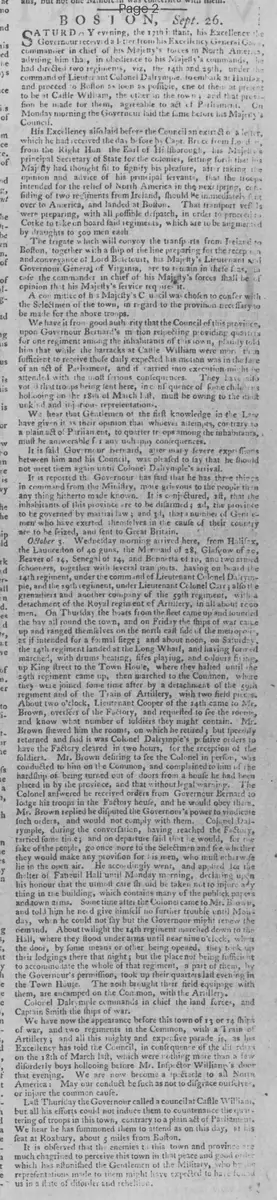
Saturday evening, the 17th instant, his Excellency Governor received a letter from his Excellency General Gage, commander in chief of his Majesty's forces in North America, advising him that, in obedience to his Majesty's commands, he had directed two regiments, viz, the 14th and 29th, under the command of Lieutenant Colonel Dalrymple, to embark at Halifax, and proceed to Boston as soon as possible, one of them, at present to be at Castle William, the other in the town; and that provision be made for them, agreeable to act of Parliament. On Monday morning the Governor laid the same before his Majesty's Council.
His Excellency also laid before the Council an extract of a letter, which he had received the day before by Capt. Bruce from London, from the Right Hon the Earl of Hillsborough, his Majesty's principal Secretary of State for the colonies, setting forth that his Majesty had thought fit to signify his pleasure, after taking the opinion and advice of his principal servants, that the troops intended for the relief of North America in the ensuing spring, consisting of two regiments from Ireland, should be immediately sent over to America, and landed at Boston. That transport vessels were preparing, with all possible dispatch, in order to proceed to Cork to take on board said regiments, which are to be augmented by draughts to 500 men each.
The frigate which will convoy the transports from Ireland to Boston, together with a ship of the line preparing for the reception and conveyance of Lord Botetourt, his Majesty's Lieutenant Governor General of Virginia, are to remain in these seas, in case the commander in chief of his Majesty's forces shall be of opinion that his Majesty's service requires it.
A committee of his Majesty's Council was chosen to confer with the Selectmen of the town, in regard to the provision necessary to be made for the above troops.
We have it from good authority that the Council of this province, upon Governor Bernard's motion respecting providing quarters for one regiment among the inhabitants of this town, plainly told him that while the barracks at Castle William were more than sufficient to receive those daily expected his motion was in the face of an act of Parliament, and if carried into execution might be attended with the most serious consequences. They have also voted that troops being sent here, in consequence of one child's being killed on the 18th of March last, must be owing to the most unkind and injurious representations.
We hear that Gentlemen of the first knowledge in the Law have given it as their opinion that whoever a tenant, contrary to a plain act of Parliament, to quarter troops among the inhabitants, must be answerable for any unhappy consequences.
It is said Governor Bernard, after many severe expressions between him and his Council, was pleased to say that he should not meet them again until Colonel Dalrymple's arrival.
It is reported that Governor has said that he has three things in command from the Ministry, more grievous to the people than any thing hitherto made known. It is conjectured, 1st, that the inhabitants of this province are to be disarmed; 2d, the province to be governed by martial law; and 3d, that a number of Gentlemen who have exerted themselves in the cause of their country are to be seized, and sent to Great Britain.
October 3. Wednesday morning arrived here, from Halifax, the Launceston of 40 guns, the Mermaid of 28, Glasgow of 20, Beaver of 14, Senegal of 14, and Bonetta of 10, and two armed schooners, together with several transports, having on board the 14th regiment, under the command of Lieutenant Colonel Dalrymple, and the 29th regiment, under Lieutenant Colonel Carr; also the grenadiers and another company of the 59th regiment, with a detachment of the Royal regiment of Artillery, in all about 1200 men. On Thursday the boats from the fleet came up and sounded the bay all round the town, and on Friday the ships of war came up and ranged themselves on the north east side of the metropolis, as if intended for a formal siege; and about noon, on Saturday, the 14th regiment landed at the Long Wharf, and having formed, marched, with drums beating, fifes playing, and colours flying, up King Street to the Town House, where they halted until the 29th regiment came up, then marched to the Common, where they were joined some time after by a detachment of the 59th regiment and of the Train of Artillery, with two field pieces.
About two o'clock, Lieutenant Cooper of the 14th came to Mr. Brown, overseer of the Factory, and requested to see the rooms, and know what number of soldiers they might contain. Mr. Brown showed him the rooms, on which he retired; but presently returned and said it was Colonel Dalrymple's positive orders to have the Factory cleared in two hours, for the reception of the soldiers. Mr. Brown desiring to see the Colonel in person, was conducted to him on the Common, and complained to him of the hardship of being turned out of doors from a house he had been placed in by the province, and that without legal warning. The Colonel answered he received orders from Governor Bernard to lodge his troops in the Factory house, and he would obey them. Mr. Brown replied he disputed the Governor's power to vindicate such orders, and would not comply with them. Colonel Dalrymple, during the conversation, having reached the Factory, tarried some time; and on departure said that he would, for the sake of the people, go once more to the Selectmen and see whether they would make any provision for his men, who must otherwise lie in the open air. He accordingly went, and applied for the shelter of Faneuil Hall until Monday morning, declaring upon his honour that the utmost care should be taken not to injure anything in the building, which contains many of the publick papers and town arms. Some time after the Colonel came to Mr. Brown, and told him he need give himself no further trouble until Monday, when he could not say but the Governor might renew the demand. About twilight the 14th regiment marched down to the Hall, where they stood under arms until near nine o'clock, when the door, by some means or other being opened, they took up their lodgings there that night; but the place not being sufficient to accommodate the whole of that regiment, a part of them, by the Governor's permission, took up their quarters last evening in the Town House. The 29th brought their field equipage with them, are encamped on the Common, with the Artillery.
Colonel Dalrymple commands in chief the land forces, and Captain Smith the ships of war.
We have now the appearance before this town of 13 or 14 ships of war, and two regiments in the Common, with a Train of Artillery; and all this mighty and expensive parade is, as his Excellency has told the Council, in consequence of the disturbances on the 18th of March last, which were nothing more than a few disorderly boys hollooing before Mr. Inspector Williams's door that evening. We are now become a spectacle to all North America: May our conduct be such as not to disgrace ourselves, or injure the common cause.
Last Thursday the Governor called a council at Castle William, but all his efforts could not induce them to countenance the quartering of troops in this town, contrary to a plain act of Parliament. We hear he has summoned them to attend as on this day, at his seat at Roxbury, about 5 miles from Boston.
It is observed that the enemies to this town and province are much chagrined to perceive this town in that peace and good order which has astonished the Gentlemen of the Military, who by their representations made to them might have expected to have found us in a state of disorder and rebellion.
Not the least attempt has been made, or even contemplated, to oppose the landing of the King's troops, or their encampment on the Common; and whoever among us shall presume to act counter to law must answer for any unhappy consequences: It is not doubted but the posse comitatus, in aid of the civil magistrate, when necessary, will be sufficient to maintain every individual in the exercise and enjoyment of his rights and property.
The best families in town and country have and are laying aside the use of India teas, and many are determined not to eat, drink, or wear, any thing foreign, until relieved under our present burdens.
The committees chosen by 96 towns and eight districts, convened at Boston the 22d of September 1768, being greatly alarmed at the present aspect of our publick affairs, and deeply distressed in their minds upon authentick advice that the humble and dutiful petition of their representatives to our most gracious Sovereign, for the redress of their grievances, have not reached the Royal presence; at a time when troops are sent among them, and they are in an unusual manner deprived of the benefit of a General Assembly, the Grand Council of the province; and being desirous, to the utmost of their ability, to promote peace, good order, and due submission, among their fellow subjects in the province; thought it advisable to prefer a dutiful petition to his Excellency Governour Bernard, his Majesty's representative in this province, therein setting forth, and explaining to his Excellency, the nature and design of their meeting, and supplicating him to convene a General Assembly of the representative body of the people: But his Excellency, having considered their thus meeting as unlawful, refused to receive the petition, and sent them a message admonishing them to separate themselves, and also afterwards he refused to receive their answer. And the said committees considering themselves only as so many private fellow subjects, convened from divers towns in this province, at the request of their inhabitants, have made known to each other the loyal and dutiful disposition of the same, and their desire that no irregular steps should be taken by the people, but that all constitutional and prudential methods should be closely attended to for the redress of their grievances.
There are barracks at the Castle within the limits of this town sufficient in the judgment of his Majesty's Council, who were unanimous in their opinion, to receive both the regiments arrived there and lodge them comfortably; but the Governour thinks it necessary that they should be quartered among the inhabitants.
The sensible part of the people see no reason for a step so disagreeable and dangerous, unless barely to gratify the Commissioners of the Customs, who it seems are tired of their chosen residence at the Castle, and think they have made themselves so obnoxious to the inhabitants as to render their residence in the town hazardous, without 2000 men to protect them. His Majesty's affairs, in the mean time, do not seem to be affected at all in this struggle; for the revenue, which has never been interrupted, is paid with as much punctuality while they are at the Castle as if they were in the body of the town. One of the regiments is encamped on the Common, near the center of the town; the other being unprovided with quarters before their landing, not having their tents on shore; and the commanding officer, who knows his duty, being, it is presumed, sensible that quarters could not by act of Parliament be demanded even in publick houses WHILE THE BARRACKS AT THE CASTLE remain empty, after having in vain endeavoured to persuade the families living in the Manufactory House to remove, in which case they would have had no where to go but into the street, he marched the regiment at sunset to Faneuil Hall. Here they halted several hours, but it is said could not obtain liberty of the Selectmen of the town to enter; however, they finally took possession. The Gentlemen of the regiments, as well as the soldiers, behave at present with civility to the inhabitants, and we are persuaded will find that they have been misinformed, even since their arrival at the Castle, with respect to the true character of the people. On the other hand, the inhabitants have no personal disregard to them, but would be glad to treat the King's troops with the cordiality with which they treated the regiments formerly in town with the brave General Amherst; but the errand on which they now come seems to be TOO APPARENTLY DIFFERENT: Nothing will either flatter or awe this people into a voluntary submission TO BE TAXED WITHOUT their consent.
It is said that Colonel Dalrymple has given his honour that Faneuil Hall shall be cleared this day; compassion to the soldiers, who must have suffered in the streets, being the only cause of their being lodged there, and by no means a concession on the part of the town to provide quarters until the barracks at the Castle are full.
What sub-type of article is it?
What keywords are associated?
What entities or persons were involved?
Where did it happen?
Domestic News Details
Primary Location
Boston
Event Date
September 17 To October 3, 1768
Key Persons
Outcome
troops temporarily quartered in faneuil hall and town house; 29th regiment encamped on the common; council refuses to quarter troops in town against parliamentary act; heightened political tensions without violence.
Event Details
British regiments 14th and 29th, plus detachments, arrived in Boston from Halifax on October 3, 1768, under orders from General Gage and Governor Bernard. Disputes arose over quartering in town versus available barracks at Castle William, leading to temporary occupation of Faneuil Hall after failed attempts to use the Factory. Local council and selectmen opposed, citing acts of Parliament; reports of ministerial commands and local boycotts of foreign goods.