Thank you for visiting SNEWPapers!
Sign up free
Literary
December 2, 1915
Audubon Republican
Audubon, Audubon County, Iowa
What is this article about?
In 'The Red Mist,' Confederate Sergeant Wyatt is summoned by General Jackson and meets Generals Ewell, Ashby, and Lee. Assigned a dangerous spy mission into Union-held Green Briar County disguised as a Federal officer to gather intelligence on forces and sympathizers. In Chapter II, Wyatt encounters a suspicious mountaineer while heading home.
Clipping
OCR Quality
95%
Excellent
Full Text
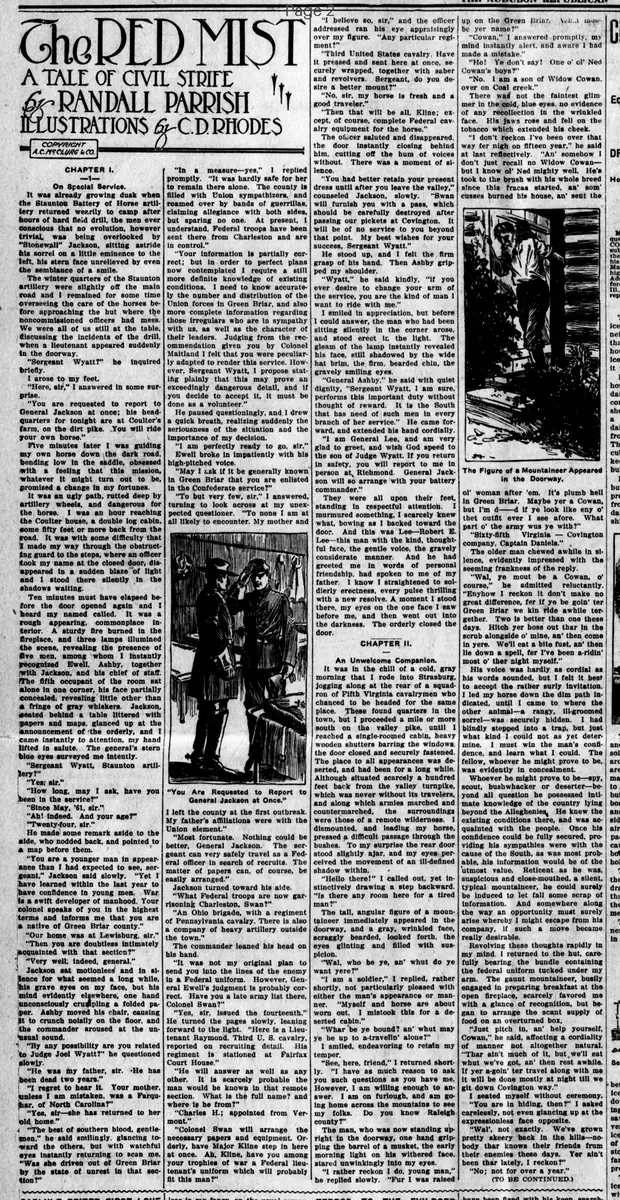
The Red Mist
A Tale of Civil Strife
Randall Parrish
Illustrations by C. D. Rhodes
Copyright
A. C. M. Clurg & Co.
Chapter I
On Special Service.
It was already growing dusk when the Staunton Battery of Horse Artillery returned wearily to camp after hours of hard field drill, the men ever conscious that no evolution, however trivial, was being overlooked by "Stonewall" Jackson, sitting astride his sorrel on a little eminence to the left, his stern face unrelieved by even the semblance of a smile.
The winter quarters of the Staunton artillery were slightly off the main road and I remained for some time overseeing the care of the horses before approaching the hut where the noncommissioned officers had mess.
We were all of us still at the table, discussing the incidents of the drill, when a lieutenant appeared suddenly in the doorway.
"Sergeant Wyatt?" he inquired briefly.
I arose to my feet.
"Here, sir," I answered in some surprise.
"You are requested to report to General Jackson at once; his headquarters for tonight are at Coulter's farm, on the dirt pike. You will ride your own horse."
Five minutes later I was guiding my own horse down the dark road, bending low in the saddle, obsessed with a feeling that this mission, whatever it might turn out to be, promised a change in my fortunes.
It was an ugly path, rutted deep by artillery wheels, and dangerous for the horse. I was an hour reaching the Coulter house, a double log cabin, some fifty feet or more back from the road. It was with some difficulty that I made my way through the obstructing guard to the steps, where an officer took my name at the closed door, disappeared in a sudden blaze of light and I stood there silently in the shadows waiting.
Ten minutes must have elapsed before the door opened again and I heard my name called. It was a rough appearing, commonplace interior. A sturdy fire burned in the fireplace, and three lamps illumined the scene, revealing the presence of five men, among whom I instantly recognized Ewell, Ashby, together with Jackson, and his chief of staff.
The fifth occupant of the room sat alone in one corner, his face partially concealed, revealing little other than fringe of gray whiskers. Jackson, seated behind a table littered with papers and maps, glanced up at the announcement of the orderly, and I came instantly to attention, my hand lifted in salute. The general's stern blue eyes surveyed me intently.
"Sergeant Wyatt, Staunton artillery?"
"Yes, sir."
"How long, may I ask, have you been in the service?"
"Since May, '61, sir."
"Ah! Indeed. And your age?"
"Twenty-four, sir."
He made some remark aside to the aide, who nodded back, and pointed to a map before them.
"You are a younger man in appearance than I had expected to see, sergeant," Jackson said slowly. "Yet I have learned within the last year to have confidence in young men. War is a swift developer of manhood. Your colonel speaks of you in the highest terms and informs me that you are a native of Green Briar county."
"Our home was at Lewisburg, sir."
"Then you are doubtless intimately acquainted with that section?"
"Very well, indeed, general."
Jackson sat motionless and in silence for what seemed a long while, his grave eyes on my face, but his mind evidently elsewhere, one hand unconsciously crumpling a folded paper. Ashby moved his chair, causing it to crunch noisily on the floor, and the commander aroused at the unusual sound.
"By any possibility are you related to Judge Joel Wyatt?" he questioned slowly.
"He was my father, sir. He has been dead two years."
"I regret to hear it. Your mother, unless I am mistaken, was a Farquhar, of North Carolina?"
"Yes, sir--she has returned to her old home."
"The best of southern blood, gentlemen," he said smilingly, glancing toward the others, but with watchful eyes instantly returning to scan me.
"Was she driven out of Green Briar by the state of unrest in that section?"
"In a measure--yes," I replied promptly. "It was hardly safe for her to remain there alone. The county is filled with Union sympathizers, and roamed over by bands of guerrillas, claiming allegiance with both sides, but sparing no one. At present, I understand, Federal troops have been sent there from Charleston and are in control."
"Your information is partially correct; but in order to perfect plans now contemplated I require a still more definite knowledge of existing conditions. I need to know accurately the number and distribution of the Union forces in Green Briar, and also more complete information regarding those irregulars who are in sympathy with us, as well as the character of their leaders. Judging from the recommendation given you by Colonel Maitland I felt that you were peculiarly adapted to render this service. However, Sergeant Wyatt, I propose stating plainly that this may prove an exceedingly dangerous detail, and if you decide to accept it, it must be done as a volunteer."
He paused questioningly, and I drew a quick breath, realizing suddenly the seriousness of the situation and the importance of my decision.
"I am perfectly ready to go, sir."
Ewell broke in impatiently with his high-pitched voice.
"May I ask if it be generally known in Green Briar that you are enlisted in the Confederate service?"
"To but very few, sir," I answered turning to look across at my unexpected questioner. "To none I am at all likely to encounter. My mother and I left the county at the first outbreak. My father's affiliations were with the Union element."
"Most fortunate. Nothing could be better, General Jackson. The sergeant can very safely travel as a Federal officer in search of recruits. The matter of papers can, of course, be easily arranged."
Jackson turned toward his aide.
"What Federal troops are now garrisoning Charleston, Swan?"
"An Ohio brigade, with a regiment of Pennsylvania cavalry. There is also a company of heavy artillery outside the town."
The commander leaned his head on his hand.
"It was not my original plan to send you into the lines of the enemy in a Federal uniform. However, General Ewell's judgment is probably correct. Have you a late army list there, Colonel Swan?"
"Yes, sir, issued the fourteenth."
He turned the pages slowly, leaning forward to the light. "Here is a Lieutenant Raymond, Third U. S. cavalry, reported on recruiting detail. His regiment is stationed at Fairfax Court House."
"He will answer as well as any other. It is scarcely probable the man would be known in that remote section. What is the full name? and where is he from?"
"Charles H.; appointed from Vermont."
"Colonel Swan will arrange the necessary papers and equipment. Orderly, have Major Kline step in here at once. Ah, Kline, have you among your trophies of war a Federal lieutenant's uniform which will probably fit this man?"
"I believe so, sir," and the officer addressed ran his eye appraisingly over my figure. "Any particular regiment?"
"Third United States cavalry. Have it pressed and sent here at once, securely wrapped, together with saber and revolvers. Sergeant, do you desire a better mount?"
"No, sir. my horse is fresh and a good traveler."
"Then that will be all, Kline; except, of course, complete Federal cavalry equipment for the horse."
The officer saluted and disappeared, the door instantly closing behind him, cutting off the hum of voices without. There was a moment of silence.
"You had better retain your present dress until after you leave the valley," counseled Jackson, slowly. "Swan will furnish you with a pass, which should be carefully destroyed after passing our pickets at Covington. It will be of no service to you beyond that point. My best wishes for your success, Sergeant Wyatt."
He stood up, and I felt the firm grasp of his hand. Then Ashby gripped my shoulder.
"Wyatt," he said kindly, "if you ever desire to change your arm of the service, you are the kind of man I want to ride with me."
I smiled in appreciation, but before I could answer, the man who had been sitting silently in the corner arose, and stood erect in the light. The gleam of the lamp instantly revealed his face, still shadowed by the wide hat brim, the firm, bearded chin, the gravely smiling eyes.
"General Ashby," he said with quiet dignity. "Sergeant Wyatt, I am sure, performs this important duty without thought of reward. It is the South that has need of such men in every branch of her service." He came forward, and extended his hand cordially.
"I am General Lee, and am very glad to greet, and wish God speed to the son of Judge Wyatt. If you return in safety, you will report to me in person at Richmond. General Jackson will so arrange with your battery commander."
They were all upon their feet, standing in respectful attention. I murmured something, I scarcely knew what, bowing as I backed toward the door. And this was Lee--Robert E. Lee--this man with the kind, thoughtful face, the gentle voice, the gravely considerate manner. And he had greeted me in words of personal friendship, had spoken to me of my father. I know I straightened to soldierly erectness, every pulse thrilling with a new resolve. A moment I stood there, my eyes on the one face I saw before me, and then went out into the darkness. The orderly closed the door.
CHAPTER II.
An Unwelcome Companion.
It was in the chill of a cold, gray morning that I rode into Strasburg, jogging along at the rear of a squadron of Fifth Virginia cavalrymen who chanced to be headed for the same place. These found quarters in the town, but I proceeded a mile or more south on the valley pike, until I reached a single-roomed cabin, heavy wooden shutters barring the windows, the door closed and securely fastened.
The place to all appearances was deserted, and had been for a long while. Although situated scarcely a hundred feet back from the valley turnpike, which was never without its travelers and along which armies marched and countermarched, the surroundings were those of a remote wilderness. I dismounted, and leading my horse, pressed a difficult passage through the bushes. To my surprise the rear door stood slightly ajar, and my eyes perceived the movement of an ill-defined shadow within.
"Hello there!" I called out, yet instinctively drawing a step backward. "Is there any room here for a tired man?"
The tall, angular figure of a mountaineer immediately appeared in the doorway, and a gray, wrinkled face, scraggly bearded, looked forth, the eyes glinting and filled with suspicion.
"Wal, who be ye, an' whut do ye want yere?"
"I am a soldier," I replied, rather shortly, not particularly pleased with either the man's appearance or manner. "Myself and horse are about worn out. I mistook this for a deserted cabin."
"Whar be ye bound? an' whut may ye be up to a-travelin' alone?"
I smiled, endeavoring to retain my temper.
"See, here, friend," I returned shortly. "I have as much reason to ask you such questions as you have me. However, I am willing enough to answer. I am on furlough, and am going home across the mountains to see my folks. Do you know Raleigh county?"
The man, who was now standing up right in the doorway, one hand gripping the barrel of a musket, the early morning light on his withered face, stared unwinkingly into my eyes.
"I rather reckon I do, young man," he replied slowly. "Fur I was raised up on the Green Briar.
Whut mout be yer name?"
"Cowan," I answered promptly, my mind instantly alert, and aware I had made a mistake.
"Ho! Ye don't say! One o' ol' Ned Cowan's boys?"
"No. I am a son of Widow Cowan, over on Coal creek."
There was not the faintest glimmer in the cold, blue eyes, no evidence of any recollection in the wrinkled face. His jaws rose and fell on the tobacco which extended his cheek.
"I don't reckon I've been over that way fer nigh on fifteen year," he said at last reflectively. "An' somehow I don't just recall no Widow Cowan-- but I know ol' Ned mighty well. He's took to the brush with his whole breed since this fracas started, an' som' cusses burned his house, an' sent the ol' woman after 'em. It's plumb hell in Green Briar. Maybe yer a Cowan, but I'm d--d if ye look like eny o' thet outfit ever I see afore. What part o' the army wus ye with?"
"Sixty-fifth Virginia - Covington company, Captain Daniels."
The older man chewed awhile in silence, evidently impressed with the seeming frankness of the reply.
"Wal, ye mout be a Cowan, o' course," he admitted reluctantly. "Enyhow I reckon it don't make no great difference, fer if ye be goin' ter Green Briar we kin ride awhile tergether. Two is better than one these days. Hitch yer hoss out thar in the scrub alongside o' mine, an' then come in yere. We'll eat a bite fust, an' then lie down a spell, fer I've been a-ridin' most o' ther night myself."
His voice was hardly as cordial as his words sounded, but I felt it best to accept the rather surly invitation. I led my horse down the dim path indicated, until I came to where the other animal--a rangy, ill-groomed sorrel--was securely hidden. I had blindly stepped into a trap, but just what kind I could not as yet determine. I must win the man's confidence, and learn what I could. The fellow, whoever he might prove to be, was evidently in concealment. Whoever he might prove to be--spy, scout, bushwhacker or deserter--beyond all question he possessed intimate knowledge of the country lying beyond the Alleghenies. He knew the existing conditions there, and was acquainted with the people. Once his confidence could be fully secured, providing his sympathies were with the cause of the South, as was most probable, his information would be of the utmost value. Reticent as he was, suspicious and close-mouthed, a silent, typical mountaineer, he could surely be induced to let fall some scrap of information. And somewhere along the way an opportunity must surely arise whereby I might escape from his company, if such a move became really desirable.
Revolving these thoughts rapidly in my mind, I returned to the hut, carefully bearing the bundle containing the federal uniform tucked under my arm. The gaunt mountaineer, busily engaged in preparing breakfast at the open fireplace, scarcely favored me with a glance of recognition, but began to arrange the scant supply of food on an overturned box.
"Just pitch in, an' help yourself, Cowan," he said, affecting a cordiality of manner not altogether natural. "Thar ain't much of it, but we'll eat whut we've got, an' then rest awhile. If yer a-goin' ter travel along with me it will be done mostly at night till we git down Covington way."
I seated myself without ceremony.
"You are in hiding, then?" I asked carelessly, not even glancing up at the expressionless face opposite.
"Wal', not exactly. We've grown pretty skeery back in the hills--nobody thar knows their friends frum their enemies these days. Yer ain't been thar lately, I reckon?"
"No; not for over a year."
(TO BE CONTINUED.)
A Tale of Civil Strife
Randall Parrish
Illustrations by C. D. Rhodes
Copyright
A. C. M. Clurg & Co.
Chapter I
On Special Service.
It was already growing dusk when the Staunton Battery of Horse Artillery returned wearily to camp after hours of hard field drill, the men ever conscious that no evolution, however trivial, was being overlooked by "Stonewall" Jackson, sitting astride his sorrel on a little eminence to the left, his stern face unrelieved by even the semblance of a smile.
The winter quarters of the Staunton artillery were slightly off the main road and I remained for some time overseeing the care of the horses before approaching the hut where the noncommissioned officers had mess.
We were all of us still at the table, discussing the incidents of the drill, when a lieutenant appeared suddenly in the doorway.
"Sergeant Wyatt?" he inquired briefly.
I arose to my feet.
"Here, sir," I answered in some surprise.
"You are requested to report to General Jackson at once; his headquarters for tonight are at Coulter's farm, on the dirt pike. You will ride your own horse."
Five minutes later I was guiding my own horse down the dark road, bending low in the saddle, obsessed with a feeling that this mission, whatever it might turn out to be, promised a change in my fortunes.
It was an ugly path, rutted deep by artillery wheels, and dangerous for the horse. I was an hour reaching the Coulter house, a double log cabin, some fifty feet or more back from the road. It was with some difficulty that I made my way through the obstructing guard to the steps, where an officer took my name at the closed door, disappeared in a sudden blaze of light and I stood there silently in the shadows waiting.
Ten minutes must have elapsed before the door opened again and I heard my name called. It was a rough appearing, commonplace interior. A sturdy fire burned in the fireplace, and three lamps illumined the scene, revealing the presence of five men, among whom I instantly recognized Ewell, Ashby, together with Jackson, and his chief of staff.
The fifth occupant of the room sat alone in one corner, his face partially concealed, revealing little other than fringe of gray whiskers. Jackson, seated behind a table littered with papers and maps, glanced up at the announcement of the orderly, and I came instantly to attention, my hand lifted in salute. The general's stern blue eyes surveyed me intently.
"Sergeant Wyatt, Staunton artillery?"
"Yes, sir."
"How long, may I ask, have you been in the service?"
"Since May, '61, sir."
"Ah! Indeed. And your age?"
"Twenty-four, sir."
He made some remark aside to the aide, who nodded back, and pointed to a map before them.
"You are a younger man in appearance than I had expected to see, sergeant," Jackson said slowly. "Yet I have learned within the last year to have confidence in young men. War is a swift developer of manhood. Your colonel speaks of you in the highest terms and informs me that you are a native of Green Briar county."
"Our home was at Lewisburg, sir."
"Then you are doubtless intimately acquainted with that section?"
"Very well, indeed, general."
Jackson sat motionless and in silence for what seemed a long while, his grave eyes on my face, but his mind evidently elsewhere, one hand unconsciously crumpling a folded paper. Ashby moved his chair, causing it to crunch noisily on the floor, and the commander aroused at the unusual sound.
"By any possibility are you related to Judge Joel Wyatt?" he questioned slowly.
"He was my father, sir. He has been dead two years."
"I regret to hear it. Your mother, unless I am mistaken, was a Farquhar, of North Carolina?"
"Yes, sir--she has returned to her old home."
"The best of southern blood, gentlemen," he said smilingly, glancing toward the others, but with watchful eyes instantly returning to scan me.
"Was she driven out of Green Briar by the state of unrest in that section?"
"In a measure--yes," I replied promptly. "It was hardly safe for her to remain there alone. The county is filled with Union sympathizers, and roamed over by bands of guerrillas, claiming allegiance with both sides, but sparing no one. At present, I understand, Federal troops have been sent there from Charleston and are in control."
"Your information is partially correct; but in order to perfect plans now contemplated I require a still more definite knowledge of existing conditions. I need to know accurately the number and distribution of the Union forces in Green Briar, and also more complete information regarding those irregulars who are in sympathy with us, as well as the character of their leaders. Judging from the recommendation given you by Colonel Maitland I felt that you were peculiarly adapted to render this service. However, Sergeant Wyatt, I propose stating plainly that this may prove an exceedingly dangerous detail, and if you decide to accept it, it must be done as a volunteer."
He paused questioningly, and I drew a quick breath, realizing suddenly the seriousness of the situation and the importance of my decision.
"I am perfectly ready to go, sir."
Ewell broke in impatiently with his high-pitched voice.
"May I ask if it be generally known in Green Briar that you are enlisted in the Confederate service?"
"To but very few, sir," I answered turning to look across at my unexpected questioner. "To none I am at all likely to encounter. My mother and I left the county at the first outbreak. My father's affiliations were with the Union element."
"Most fortunate. Nothing could be better, General Jackson. The sergeant can very safely travel as a Federal officer in search of recruits. The matter of papers can, of course, be easily arranged."
Jackson turned toward his aide.
"What Federal troops are now garrisoning Charleston, Swan?"
"An Ohio brigade, with a regiment of Pennsylvania cavalry. There is also a company of heavy artillery outside the town."
The commander leaned his head on his hand.
"It was not my original plan to send you into the lines of the enemy in a Federal uniform. However, General Ewell's judgment is probably correct. Have you a late army list there, Colonel Swan?"
"Yes, sir, issued the fourteenth."
He turned the pages slowly, leaning forward to the light. "Here is a Lieutenant Raymond, Third U. S. cavalry, reported on recruiting detail. His regiment is stationed at Fairfax Court House."
"He will answer as well as any other. It is scarcely probable the man would be known in that remote section. What is the full name? and where is he from?"
"Charles H.; appointed from Vermont."
"Colonel Swan will arrange the necessary papers and equipment. Orderly, have Major Kline step in here at once. Ah, Kline, have you among your trophies of war a Federal lieutenant's uniform which will probably fit this man?"
"I believe so, sir," and the officer addressed ran his eye appraisingly over my figure. "Any particular regiment?"
"Third United States cavalry. Have it pressed and sent here at once, securely wrapped, together with saber and revolvers. Sergeant, do you desire a better mount?"
"No, sir. my horse is fresh and a good traveler."
"Then that will be all, Kline; except, of course, complete Federal cavalry equipment for the horse."
The officer saluted and disappeared, the door instantly closing behind him, cutting off the hum of voices without. There was a moment of silence.
"You had better retain your present dress until after you leave the valley," counseled Jackson, slowly. "Swan will furnish you with a pass, which should be carefully destroyed after passing our pickets at Covington. It will be of no service to you beyond that point. My best wishes for your success, Sergeant Wyatt."
He stood up, and I felt the firm grasp of his hand. Then Ashby gripped my shoulder.
"Wyatt," he said kindly, "if you ever desire to change your arm of the service, you are the kind of man I want to ride with me."
I smiled in appreciation, but before I could answer, the man who had been sitting silently in the corner arose, and stood erect in the light. The gleam of the lamp instantly revealed his face, still shadowed by the wide hat brim, the firm, bearded chin, the gravely smiling eyes.
"General Ashby," he said with quiet dignity. "Sergeant Wyatt, I am sure, performs this important duty without thought of reward. It is the South that has need of such men in every branch of her service." He came forward, and extended his hand cordially.
"I am General Lee, and am very glad to greet, and wish God speed to the son of Judge Wyatt. If you return in safety, you will report to me in person at Richmond. General Jackson will so arrange with your battery commander."
They were all upon their feet, standing in respectful attention. I murmured something, I scarcely knew what, bowing as I backed toward the door. And this was Lee--Robert E. Lee--this man with the kind, thoughtful face, the gentle voice, the gravely considerate manner. And he had greeted me in words of personal friendship, had spoken to me of my father. I know I straightened to soldierly erectness, every pulse thrilling with a new resolve. A moment I stood there, my eyes on the one face I saw before me, and then went out into the darkness. The orderly closed the door.
CHAPTER II.
An Unwelcome Companion.
It was in the chill of a cold, gray morning that I rode into Strasburg, jogging along at the rear of a squadron of Fifth Virginia cavalrymen who chanced to be headed for the same place. These found quarters in the town, but I proceeded a mile or more south on the valley pike, until I reached a single-roomed cabin, heavy wooden shutters barring the windows, the door closed and securely fastened.
The place to all appearances was deserted, and had been for a long while. Although situated scarcely a hundred feet back from the valley turnpike, which was never without its travelers and along which armies marched and countermarched, the surroundings were those of a remote wilderness. I dismounted, and leading my horse, pressed a difficult passage through the bushes. To my surprise the rear door stood slightly ajar, and my eyes perceived the movement of an ill-defined shadow within.
"Hello there!" I called out, yet instinctively drawing a step backward. "Is there any room here for a tired man?"
The tall, angular figure of a mountaineer immediately appeared in the doorway, and a gray, wrinkled face, scraggly bearded, looked forth, the eyes glinting and filled with suspicion.
"Wal, who be ye, an' whut do ye want yere?"
"I am a soldier," I replied, rather shortly, not particularly pleased with either the man's appearance or manner. "Myself and horse are about worn out. I mistook this for a deserted cabin."
"Whar be ye bound? an' whut may ye be up to a-travelin' alone?"
I smiled, endeavoring to retain my temper.
"See, here, friend," I returned shortly. "I have as much reason to ask you such questions as you have me. However, I am willing enough to answer. I am on furlough, and am going home across the mountains to see my folks. Do you know Raleigh county?"
The man, who was now standing up right in the doorway, one hand gripping the barrel of a musket, the early morning light on his withered face, stared unwinkingly into my eyes.
"I rather reckon I do, young man," he replied slowly. "Fur I was raised up on the Green Briar.
Whut mout be yer name?"
"Cowan," I answered promptly, my mind instantly alert, and aware I had made a mistake.
"Ho! Ye don't say! One o' ol' Ned Cowan's boys?"
"No. I am a son of Widow Cowan, over on Coal creek."
There was not the faintest glimmer in the cold, blue eyes, no evidence of any recollection in the wrinkled face. His jaws rose and fell on the tobacco which extended his cheek.
"I don't reckon I've been over that way fer nigh on fifteen year," he said at last reflectively. "An' somehow I don't just recall no Widow Cowan-- but I know ol' Ned mighty well. He's took to the brush with his whole breed since this fracas started, an' som' cusses burned his house, an' sent the ol' woman after 'em. It's plumb hell in Green Briar. Maybe yer a Cowan, but I'm d--d if ye look like eny o' thet outfit ever I see afore. What part o' the army wus ye with?"
"Sixty-fifth Virginia - Covington company, Captain Daniels."
The older man chewed awhile in silence, evidently impressed with the seeming frankness of the reply.
"Wal, ye mout be a Cowan, o' course," he admitted reluctantly. "Enyhow I reckon it don't make no great difference, fer if ye be goin' ter Green Briar we kin ride awhile tergether. Two is better than one these days. Hitch yer hoss out thar in the scrub alongside o' mine, an' then come in yere. We'll eat a bite fust, an' then lie down a spell, fer I've been a-ridin' most o' ther night myself."
His voice was hardly as cordial as his words sounded, but I felt it best to accept the rather surly invitation. I led my horse down the dim path indicated, until I came to where the other animal--a rangy, ill-groomed sorrel--was securely hidden. I had blindly stepped into a trap, but just what kind I could not as yet determine. I must win the man's confidence, and learn what I could. The fellow, whoever he might prove to be, was evidently in concealment. Whoever he might prove to be--spy, scout, bushwhacker or deserter--beyond all question he possessed intimate knowledge of the country lying beyond the Alleghenies. He knew the existing conditions there, and was acquainted with the people. Once his confidence could be fully secured, providing his sympathies were with the cause of the South, as was most probable, his information would be of the utmost value. Reticent as he was, suspicious and close-mouthed, a silent, typical mountaineer, he could surely be induced to let fall some scrap of information. And somewhere along the way an opportunity must surely arise whereby I might escape from his company, if such a move became really desirable.
Revolving these thoughts rapidly in my mind, I returned to the hut, carefully bearing the bundle containing the federal uniform tucked under my arm. The gaunt mountaineer, busily engaged in preparing breakfast at the open fireplace, scarcely favored me with a glance of recognition, but began to arrange the scant supply of food on an overturned box.
"Just pitch in, an' help yourself, Cowan," he said, affecting a cordiality of manner not altogether natural. "Thar ain't much of it, but we'll eat whut we've got, an' then rest awhile. If yer a-goin' ter travel along with me it will be done mostly at night till we git down Covington way."
I seated myself without ceremony.
"You are in hiding, then?" I asked carelessly, not even glancing up at the expressionless face opposite.
"Wal', not exactly. We've grown pretty skeery back in the hills--nobody thar knows their friends frum their enemies these days. Yer ain't been thar lately, I reckon?"
"No; not for over a year."
(TO BE CONTINUED.)
What sub-type of article is it?
Prose Fiction
What themes does it cover?
War Peace
Political
Liberty Freedom
What keywords are associated?
Civil War
Confederate Spy
Stonewall Jackson
Robert E Lee
Green Briar County
Guerrillas
Federal Disguise
What entities or persons were involved?
Randall Parrish
Literary Details
Title
The Red Mist: A Tale Of Civil Strife
Author
Randall Parrish
Subject
A Tale Of Civil Strife During The Civil War, Focusing On A Confederate Spy Mission
Form / Style
Historical Fiction Novel Excerpt In First Person Narrative
Key Lines
"I Am General Lee, And Am Very Glad To Greet, And Wish God Speed To The Son Of Judge Wyatt."
"It Was Not My Original Plan To Send You Into The Lines Of The Enemy In A Federal Uniform."
"It's Plumb Hell In Green Briar."