Thank you for visiting SNEWPapers!
Sign up free
Phenix Gazette
Alexandria, Virginia
What is this article about?
Robert B. Randolph, former US Navy lieutenant, arrested and imprisoned on a $25,000 Treasury warrant for an unliquidated debt estimated at $4,000-$5,000, amid disputes over his dismissal and insult to the President. Critics allege the inflated amount aims to prevent his release via injunction.
Clipping
OCR Quality
Full Text
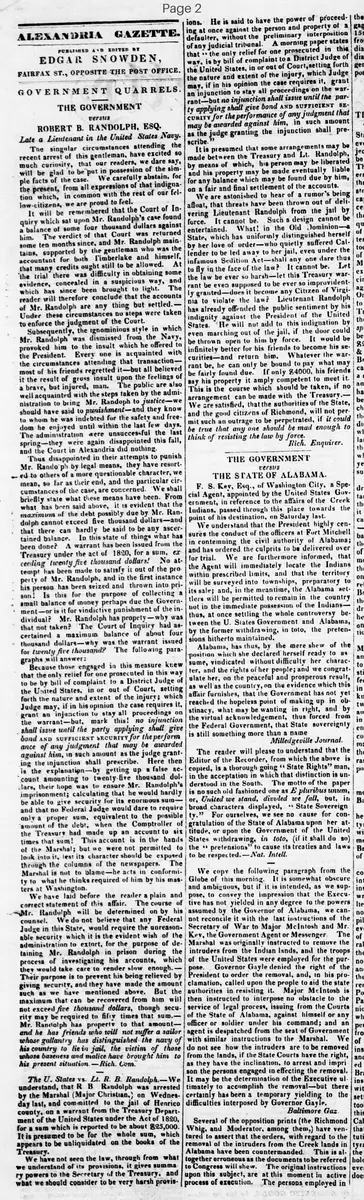
THE GOVERNMENT versus ROBERT B. RANDOLPH, ESQ.
Late a Lieutenant in the United States Navy.
The singular circumstances attending the recent arrest of this gentleman, have excited so much curiosity, that our readers, we dare say, will be glad to be put in possession of the simple facts of the case. We carefully abstain, for the present, from all expressions of that indignation which, in common with the rest of our fellow-citizens, we are proud to feel.
It will be remembered that the Court of Inquiry which sat upon Mr. Randolph's case found a balance of some four thousand dollars against him. The verdict of that Court was returned some ten months since, and Mr. Randolph maintains, supported by the gentleman who was the accountant for both Timberlake and himself, that many credits ought still to be allowed. At the trial there was difficulty in obtaining some evidence, concealed in a suspicious way, and which has since been brought to light. The reader will therefore conclude that the accounts of Mr. Randolph are anything but settled.
Under these circumstances no steps were taken to enforce the judgment of the Court. Subsequently, the ignominious style in which Mr. Randolph was dismissed from the Navy, provoked him to the insult which he offered to the President. Everyone is acquainted with the circumstances attending that transaction—most of his friends regretted it—but all believed it the result of gross insult upon the feelings of a brave, but injured, man. The public are also well acquainted with the steps taken by the administration to bring Mr. Randolph to justice—we should have said to punishment—and they know to whom he was indebted for the safety and freedom he enjoyed until within the last few days.
The administration were unsuccessful the last spring—they were again disappointed this fall, and the Court in Alexandria did nothing. Thus disappointed in their attempts to punish Mr. Randolph by legal means, they have resorted to others of a more questionable character, we mean, so far as their end, and the particular circumstances of the case, are concerned. We shall briefly state what these means have been. From what has been said above, it is evident that the maximum of the debt possibly due by Mr. Randolph cannot exceed five thousand dollars—and that there can hardly be said to be any ascertained balance. In this state of things what has been done? A warrant has been issued from the Treasury under the act of 1820, for a sum exceeding twenty five thousand dollars! No attempt has been made to satisfy it out of the property of Mr. Randolph, and in the first instance his person has been seized and thrown into prison! Is this for the purpose of collecting a small balance of money perhaps due the Government—or is it for vindictive punishment of the individual? Mr. Randolph has property—why was that not taken? The Court of Inquiry had ascertained a maximum balance of about four thousand dollars—why was the warrant issued for twenty five thousand? The following paragraphs will answer:
Because those engaged in this measure knew that the only relief for one prosecuted in this way was to be by bill of complaint to a District Judge of the United States, in or out of Court, setting forth the nature and extent of the injury; which Judge may, if in his opinion the case requires it, grant an injunction to stay all proceedings on the warrant—but, mark this! no injunction shall issue until the party applying shall give bond AND SUFFICIENT SECURITY for the performance of any judgment that may be awarded against him, in such amount as the judge granting the injunction shall prescribe. Here then is the explanation—by getting up a false account amounting to twenty-five thousand dollars, their hope was to ensure Mr. Randolph's imprisonment; calculating that he would hardly be able to give security for its enormous sum—and that no Federal Judge would dare to require only a proper sum, equivalent to the possible amount of the debt, when the Comptroller of the Treasury had made up an account to six times that sum! This account is in the hands of the Marshal; but we were not permitted to look into it, lest its character should be exposed through the columns of the newspapers. The Marshal is not to blame—he acts in conformity to what he thinks required of him by his masters at Washington.
We have laid before the reader a plain and correct statement of this affair. The course of Mr. Randolph will be determined on by his counsel. We do not believe that any Federal Judge in this State, would require the unreasonable security which it is the evident wish of the administration to extort, for the purpose of detaining Mr. Randolph in prison during the process of investigating his accounts, which they would take care to render slow enough. Their purpose is to prevent his being relieved by giving security, and they have made the amount such as we have mentioned above. But the maximum that can be recovered from him will not exceed five thousand dollars, though security may be required to fifty times that sum. Mr. Randolph has property to that amount—and he has friends who will not suffer a sailor whose gallantry has distinguished the navy of his country to lie in jail, the victim of those whose baseness and malice have brought him to his present situation.—Rich. Com.
The U. States vs. Lt. R. B. Randolph.—We understand, that R B Randolph was arrested by the Marshal (Major Christian) on Wednesday last, and committed to the jail of Henrico county, on a warrant from the Treasury Department of the United States under the Act of 1820, for a sum which is reported to be about $25,000. It is presumed to be for the whole sum, which appears to be unliquidated on the books of the Treasury.
We have not seen the law, though from what we understand of its provisions, it gives summary powers to the Secretary of the Treasury, and what we should consider to be very harsh provisions. He is said to have the power of proceeding at once against the person and property of a defaulter, without the preliminary interposition of any judicial tribunal. A morning paper states that the only relief for one prosecuted in this way, is by bill of complaint to a District Judge of the United States, in or out of Court, setting forth the nature and extent of the injury, which Judge may, if in his opinion the case requires it, grant an injunction to stay all proceedings on the warrant—but no injunction shall issue until the party applying shall give bond and sufficient security for the performance of any judgment that may be awarded against him, in such amount as the judge granting the injunction shall prescribe.
It is presumed that some arrangements may be made between the Treasury and Lt. Randolph, by means of which, his person may be liberated and his property may be made eventually liable for any balance which may be found due by him, on a fair and final settlement of the accounts.
We are astonished to hear of a rumor's being afloat, that threats have been thrown out of delivering Lieutenant Randolph from the jail by force. It cannot be. Such a design cannot be entertained. What! in the Old Dominion—a State, which has uniformly distinguished herself by her love of order—who quietly suffered Callender to be led away to her jail, even under the infamous Sedition Act—shall any one dare thus to fly in the face of the law? It cannot be. Let the law be ever so harsh—let this Treasury warrant be even supposed to be ever so improvidently granted—does it become any Citizen of Virginia to violate the law? Lieutenant Randolph has already offended the public sentiment by his indignity against the President of the United States. He will not add to this indignation by even marching out of the jail, if the door could be thrown open to him by force. It would be infinitely better for his friends to become his securities—and return him. Whatever the warrant be, he can only be bound to pay what may be fairly found due. If only $4000, his friends say his property is amply competent to meet it. This is the course which should be taken, if no arrangement can be made with the Treasury.
We are satisfied, that the authorities of the State, and the good citizens of Richmond, will not permit such an outrage to be perpetrated, if it could be true that any one should be mad enough to think of resisting the law by force.
Rich. Enquirer.
What sub-type of article is it?
What themes does it cover?
What keywords are associated?
What entities or persons were involved?
Where did it happen?
Story Details
Key Persons
Location
Richmond, Virginia; Henrico County; Alexandria
Event Date
Recent; Last Spring; This Fall; Ten Months Since Court Verdict
Story Details
Former Navy Lt. Robert B. Randolph arrested on inflated $25,000 Treasury warrant under 1820 Act for disputed $4,000 debt from Court of Inquiry. Dismissed ignominiously, he insulted President; administration seeks punishment via legal means, alleging warrant designed to prevent injunction release without excessive security. Imprisoned in Henrico jail; friends expected to secure release.