Thank you for visiting SNEWPapers!
Sign up free
Story
October 27, 1859
Holmes County Republican
Millersburg, Holmes County, Ohio
What is this article about?
Detailed account from Cleveland Herald of John Brown's raid on Harper's Ferry arsenal to liberate slaves. Involves 22 insurgents seizing facilities, taking hostages, clashes resulting in deaths, and eventual capture by U.S. Marines. Includes interviews, timelines, and aftermath reactions. (248 chars)
Clipping
OCR Quality
98%
Excellent
Full Text
From the Cleveland Herald.
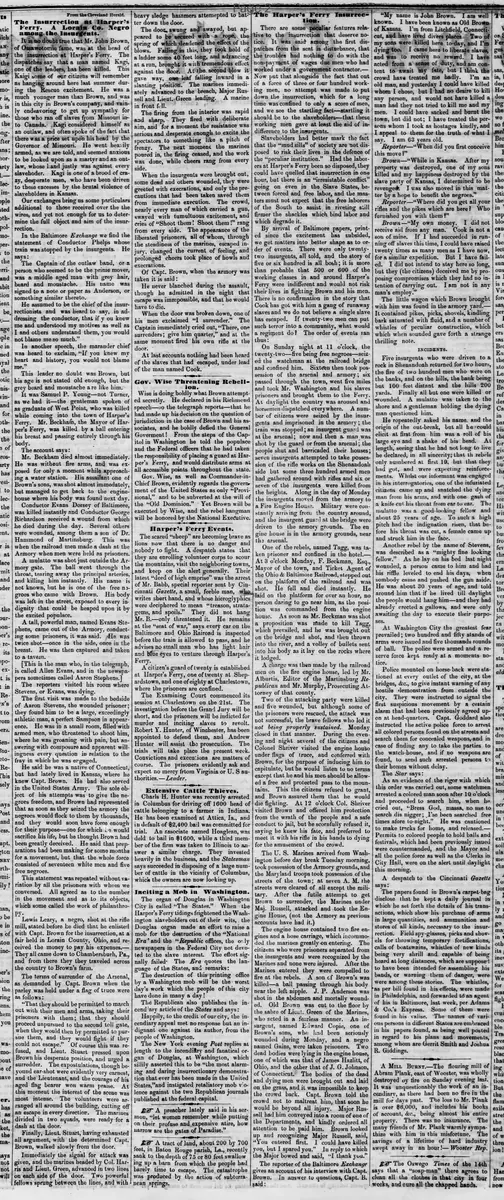
The Insurrection at Harper's Ferry, A Lorain County Negro among the Insurgents.
It is no doubt true that Mr. John Brown of Ossawatomie fame, was at the head of the insurrection at Harper's Ferry. The dispatches say that a man named Kagi, one of the leaders, has been killed. This Kagi some of our citizens will remember as hanging around here last summer during the Rescue excitement. He was a much younger man than Brown, and was in this city in Brown's company, and vainly endeavoring to get up sympathy for those who ran off slaves from Missouri into Canada. Kagi considered himself as an outlaw, and often spoke of the fact that there was a price set upon his head by the Governor of Missouri. He went heavily armed, as we are told, and seemed anxious to be looked upon as a martyr and an outlaw, whose hand justly was against every slaveholder. Kagi is one of a brood of crazy, desperate men, who have been driven to these excesses by the brutal violence of slaveholders in Kansas.
Our exchanges bring us some particulars additional to those received over the wires, and yet not enough for us to determine the full object and aim of the insurrection.
In the Baltimore Exchange we find the statement of Conductor Phelps whose train was stopped by the insurgents. He says:
The Captain of the outlaw band, or a person who seemed to be the prime mover, was a middle aged man with grey hair, beard and moustache. His name was signed to a note or paper as Anderson, or something similar thereto.
He assumed to be the chief of the insurrectionists and was heard to say, in addressing the conductor, that if you knew me and understood my motives as well as I and others understand them, you would not blame me so much."
In another speech, the marauder chief was heard to exclaim, "If you knew my heart and history, you would not blame me."
This leader no doubt was Brown, but his age is not stated old enough, but the grey beard and moustache are like him.
It was Samuel P. Young—not Turner, as we had it—the gentleman spoken of as graduate of West Point, who was killed while coming into the town of Harper's Ferry. Mr. Beckham, the Mayor of Harper's Ferry, was killed by a ball entering his breast and passing entirely through his body.
The account says:
Mr. Beckham died almost immediately. He was without fire arms, and was exposed for only a moment while approaching a water station. His assailant one of Brown's sons, was shot almost immediately, but managed to get back to the engine house where his body was found next day.
Conductor Evans Dorsey of Baltimore, was killed instantly and Conductor George Richardson received a wound from which he died during the day. Several others were wounded, among them a son of Dr. Hammond of Martinsburg. This was when the railroad men made a dash at the Armory when men were held as prisoners.
A mulatto was shot just outside the Armory gate. The ball went through the throat, tearing away the principal arteries, and killing him instantly. His name is not known, but he is one of the free negroes who came with Brown. His body was left in the street, exposed to every indignity that could be heaped upon it by the excited populace.
A tall, powerful man, named Evans Stephens, came out of the Armory, conducting some prisoners, it was said. He was twice shot—once in the side, once in the breast. He was then captured and taken to a tavern.
[This is the man who, in the telegraph, is called Allen Evans, and in the newspapers sometimes called Aaron Stephens.]
The reporters visited his room where Stevens, or Evans, was dying.
The first visit was made to the bedside of Aaron Stevens, the wounded prisoner; they found him to be a large, exceedingly athletic man, a perfect Sampson in appearance. He was in a small room, filled with armed men, who threatened to shoot him, where he was groaning with pain, but answering with composure and apparent willingness every question in relation to the fray in which he was engaged.
He said he was a native of Connecticut, but had lately lived in Kansas, where he knew Capt. Brown. He had also served in the United States Army. The sole object of his attempts was to give the negroes freedom, and Brown had represented that as soon as they seized the armory the negroes would flock to them by thousands, and they would soon have force enough for their purpose—one for which he would sacrifice his life, but he thought Brown had been greatly deceived. He said that preparations had been making for some months for a movement, but that the whole force consisted of seventeen white men and five free negroes.
This statement was repeated without variation by all the prisoners with whom we conversed. All agreed as to the number in the movement and as to its objects which some called the work of philanthropy.
Lewis Leary, a negro, shot at the rifle mill, stated before he died that he enlisted with Capt. Brown for the insurrection, at a fair held in Lorain County, Ohio, and received the money to pay his expenses. They all came down to Chambersburg, Pa., and from there they traveled across the country to Brown's farm.
The terms of surrender of the Arsenal as demanded by Capt. Brown when the parley was held under a flag of truce were as follows:
"That they should be permitted to march out with their men and arms, taking their prisoners with them: that they should proceed unpursued to the second toll gate, when they would then be permitted to pursue them, and they would fight if they could not escape." Of course this was refused, and Lieut. Stuart pressed upon Brown his desperate position, and urged a surrender. The expostulations, though beyond ear-shot were evidently very earnest, and the Lieutenant, and the courage of his aged flag bearer won warm praise. At this moment the interest of the scene was most intense. The volunteers were arranged all around the building, cutting off an escape in every direction. The marines divided in two squads, were ready for a dash at the door.
Finally, Lieut. Stuart, having exhausted all argument, with the determined Capt. Brown, walked slowly from the door. Immediately the signal for attack was given, and the marines headed by Col. Harris and Lieut. Green, advanced in two lines on each side of the door. Two powerful fellows sprung between the lines, and with heavy sledge hammers attempted to batter down the door.
The door swung and swayed, but appeared to be secured with a rope, the spring of which deadened the effect of the blows. Failing in this, they took hold of a ladder some 40 feet long, and advancing at a run, brought it with tremendous effect against the door. At the second blow it gave way, one leaf falling inward in a slanting position. The marines immediately advanced to the breach, Major Russell and Lieut. Green leading. A marine in front fell.
The firing from the interior was rapid and sharp. They fired with deliberate aim, and for a moment the resistance was serious and desperate enough to excite the spectators to something like a pitch of frenzy. The next moment the marines poured in, the firing ceased, and the work was done, while cheers rang from every side.
When the insurgents were brought out, some dead and others wounded, they were greeted with execrations, and only the precautions that had been taken saved them from immediate execution. The crowd, nearly every man of which carried a gun, swayed with tumultuous excitement, and cries of "Shoot them! Shoot them!" rang from every side. The appearance of the liberated prisoners, all of whom, through the steadiness of the marines, escaped injury, changed the current of feeling, and prolonged cheers took place of howls and execrations.
Of Capt. Brown, when the armory was taken it is said:
He never blanched during the assault, though he admitted in the night that escape was impossible, and that he would have to die.
When the door was broken down, one of his men exclaimed "I surrender." The Captain immediately cried out, "There, one surrenders; give him quarter." and at the same moment fired his own rifle at the door.
At last accounts nothing had been heard of the slaves that had escaped, under lead of the man named Cook.
Gov. Wise Threatening Rebellion.
Wise is doing boldly what Brown attempted secretly. He declared in his Richmond speech—so the telegraph reports—that he had made up his decision on the question of jurisdiction in the case of Brown and his associates, and he boldly defied the General Government! From the steps of the Capitol in Washington he told the populace and the Federal officers that he had taken the responsibility of placing a guard at Harper's Ferry, and would distribute arms at all accessible points throughout the state.
Gov. Wise, as well as Commander-in-Chief Brown, evidently regards the government of the United States as only "Provisional," and to be subverted at the will of the "Old Dominion." Yet Brown will be executed by Wise, and the rebel hangman will be honored by the National Executive.
Harper's Ferry Events.
The scared "sheep" are becoming brave as lions now that there is no danger and nobody to fight. A despatch states that they are enrolling volunteer corps to scour the mountains, visit the neighboring towns, and keep on the alert generally." Their latest "deed of high emprise" was the arrest of Mr. Babb, special reporter sent by Cincinnati Gazette, a small, feeble man, who writes short hand, and whose hieroglyphics were deciphered to mean "treason, stratagems, and spoils." They did not hang Mr. B. only threatened it. He remains at the "seat of war," says every car on the Baltimore and Ohio Railroad is inspected before the train is allowed to pass, and he advises no small man who has light hair and blue eyes to venture through Harper's Ferry.
A citizen's guard of twenty is established at Harper's Ferry, one of twenty at Shepherdstown, and one of eighty at Charlestown, where the prisoners are confined.
The Examining Court commenced its session at Charlestown on the 21st. The investigation before the Grand Jury will be short, and the prisoners will be indicted for murder and inciting slaves to revolt.
Robert Y. Hunter, of Winchester, has been appointed to defend them, and Andrew Hunter will assist the prosecution. The trials will take place the present week.
Convictions and executions are matters of course. The prisoners evidently ask and expect no mercy from Virginia or U. S. authorities.—Leader.
There are some peculiar features relative to the insurrection that deserve notice. It was said among the first dispatches from the seat of disturbance, that the troubles had nothing to do with the non-payment of wages due men who had worked under a government contractor.
Now put that alongside the fact that out of a force of three or four hundred working men, no attempt was made to put down the insurrection, which for a long time was confined to only a score of men. and we see the startling fact—startling it should be to the slaveholders—that these working men gave at least the aid of indifference to the insurgents.
Slaveholders had better mark the fact that the "mud sills" of society are not disposed to risk their lives in the defence of the "peculiar institution." Had the laborers at Harper's Ferry been so disposed, they could have quelled that insurrection in one hour, but there is an "irresistible conflict" going on even in the Slave States, between forced and free labor, and the masters must not expect that the free laborers of the South to assist in riveting still firmer the shackles which bind labor and which degrade it.
By arrival of Baltimore papers, printed since the excitement has subsided we get matters into better shape as to order of events. There were only twenty-two insurgents, all told, and the story of five or six hundred is all bosh; it is more than probable that 500 or 600 of the working classes in and around Harper's Ferry were indifferent and would not risk their lives in fighting Brown and his men.
There is no confirmation in the story that Cook has got with him a gang of runaway slaves and we do not believe a single slave has escaped. If twenty-two men can put such terror into a community, what would a regiment do? The order of events is thus:
On Sunday night at 11 o'clock, the twenty-two—five being free negroes—seized the watchman at the railroad bridge and confined him. Sixteen then took possession of the arsenal and armory; six passed through the town, went five miles and took Mr. Washington and his slaves prisoners and brought them to the Ferry.
At daylight the country was aroused and horsemen dispatched everywhere. A number of citizens were seized by the insurgents and imprisoned in the armory; the train was stopped; an insurgent guard was at the arsenal; now and then a man was shot by the guard or from the arsenal; the people shut and barricaded their houses;
seven insurgents attempted to take possession of the rifle works on the Shenandoah side but some three hundred armed men had gathered around with rifles and six or seven of the insurgents were killed, from the heights. Along in the day of Monday the insurgents moved from the armory to a Fire Engine House. Military were constantly arriving from the country around and the insurgent guard at the bridge were driven to the armory grounds. The engine house is in the armory grounds, near the arsenal.
One of the rebels, named Tagg, was taken prisoner and confined in the hotel.
At 3 o'clock Monday, F. Beckham, Esq., Mayor of the town, and Ticket Agent of the Ohio & Baltimore Railroad, stepped out on the platform of the railroad and was shot. He fell and died instantly. He laid on the platform for over an hour, no person daring to go near him, as the position was commanded from the engine house. As soon as Mr. Beckham was shot a proposition was made to kill Tagg, which prevailed, and he was brought out on the bridge and shot, and then thrown into the river, and a volley of bullets sent into his body as it lay on the rocks where it lodged.
A charge was then made by the railroad men on the fire engine house, led by Mr. Alburtis, Editor of the Martinsburg Republican and Mr. Murphy, Prosecuting Attorney of that county.
Two of the attacking party were killed and five wounded, but although some of the prisoners were rescued, the attack was not successful, the brave fellows who led it not being properly sustained. Monday closed in that manner. During the evening and night several of the citizens and Colonel Shriver visited the engine house under flags of truce, and conferred with Brown, for the purpose of inducing him to capitulate, but he would listen to no terms except that he and his men should be allowed a free and protected pass to the mountains. This the citizens refused to grant and Brown assured them that he would die fighting. At 12 o'clock Col. Shriver visited Brown and offered him protection from the wrath of the people and a safe conduct to jail, but he scornfully refused it, saying he knew his fate, and preferred to meet it with his rifle in his hands to dying for the amusement of the crowd.
The U. S. Marines arrived from Washington before day break Tuesday morning, took possession of the Armory grounds, and the Maryland troops took possession of the streets of the town; at seven A. M. the streets were cleared of all except the military. After the futile attempt to get Brown to surrender, the Marines under Maj. Russell, attacked and took the Engine House, (not the Armory as previous accounts have had it.)
The engine house contained two fire engines and a hose carriage, which incommoded the marines greatly on entering. The citizens who were prisoners separated from the insurgents and were recognized by the Marines and none were injured. After the Marines entered they were compelled to fire at the rebels. A son of Brown's was killed—a ball passing through his body near the left nipple. J. P. Anderson was shot in the abdomen and mortally wounded. Old Brown was cut to the floor by the sabre of Lieut. Green of the Marines, who acted in a fearless manner. An insurgent, named Edward Coppie, one of Brown's sons, who had been seriously wounded during Monday, and a negro named Gains, were taken prisoners. Two dead bodies were lying in the engine house, one of which was that of James Hazlitt, of Ohio, and the other that of J. G. Johnson, of Connecticut. The bodies of the dead and dying men were brought out and laid on the grass, and it was impossible to keep the crowd back. Capt. Brown told the crowd not to maltreat him, that soon he would be beyond all injury. Major Russell had him conveyed into a room of one of the Departments, and kindly ordered all attention to be paid him. Brown looked up and recognizing Major Russell, said, "You entered first. I could have killed you, but I spared you." In reply to which the Major bowed and said, "I thank you."
The reporter of the Baltimore Exchange gives an account of his interview with Capt. Brown, who said:
"My name is John Brown. I am a well known. I have been known as Old Brown of Kansas. I'm from Litchfield, Connecticut, and have lived divers places. Two of my sons were killed here to-day, and I'm dying too. I came here to liberate slaves and was to receive no reward. I have acted from a sense of duty, and am content to await my fate, but I think the crowd have treated me badly. I'm an old man, and yesterday I could have killed whom I chose, but I had no desire to kill any person, and would not have killed a man had they not tried to kill me and my men. I could have sacked and burnt the town, but did not; I have treated the persons whom I took as hostages kindly, and I appeal to them for the truth of what I say. I am 63 years old."
Reporter—”When did you first conceive this move?"
Brown—”While in Kansas. After my property was destroyed, one of my sons killed and my happiness destroyed by the slave party of Kansas, I determined to be revenged. I was also moved in this matter by a hope to benefit the negroes."
Reporter—”Where did you get all your rifles and the pikes which are here? Who furnished you with them!"
Brown—”My own money. I did not receive aid from any man.' Cook is not a son of mine. If I had succeeded in running off slaves this time, I could have raised twenty times as many men as I have now, for a similar expedition. But I have failed. I did not intend to stay here so long, but they (the citizens) deceived me by proposing compromises which they had no intention of carrying out. I am not in any man's employ."
The little wagon which Brown brought with him was found in the armory yard. It contained pikes, picks, shovels, kindling bark saturated with fluid, and a number of whistles of peculiar construction, which when sounded gave forth a strange thrilling note.
INCIDENTS.
Five insurgents who were driven to a rock in Shenandoah returned for two hours the fire of two hundred men who were on the banks, and on the hills, the bank being but 100 feet distant and the hills 200 yards. Finally all but one were killed or wounded. A mulatto was taken to the shore and a gentleman holding the dying man questioned him.
He repeatedly asked his name. and the origin of the out-break, but all he could elicit at first from him was a roll of his large eye and a shake of his head. At length, seeing that he had not long to live he declared, in all sincerity; that the rebels only numbered at first 19, but that they had got, and were expecting reinforcements. Whilst our informant was engaged in his interrogatories, one of the infuriated citizens came up and snatched the dying man from his arms, and with one gash of a knife cut his throat from ear to ear. The mulatto was a good-looking fellow and about 25 years of age. To such a high pitch had the indignation risen, that before his throat was cut, a female came up and struck him in the face.
Another rebel by the name of Stevens, was described as a "mighty fine looking fellow." As he lay on his bed last night wounded, a person came to him and had his rifle leveled to end his days, when somebody came and pushed the gun aside.
He was about 30 years of age, and told around him that if he lived till daylight the people would hang him—and they had already erected a gallows, and were only awaiting the day to execute their purposes.
At Washington City the greatest fear prevailed; two hundred and fifty stands of arms were issued and five thousand rounds of ball. The police were armed and a reserve force kept ready at a moments notice.
Police mounted on horse-back were stationed at every outlet of the city, at the bridges, &c., to give instant warning of any hostile demonstration from outside the city. They were instructed to signal the first suspicious movement by a certain alarm that had been previously agreed upon at head-quarters. Capt. Goddard also instructed the active police force to arrest all colored persons found on the streets and search them for concealed weapons, and in case of finding any to take the parties to the watch-house, and if no weapons are found, to send such arrested persons to their homes without delay.
The Star says:
As an evidence of the rigor with which this order was carried out, some watchmen arrested a colored man soon after 10 o'clock and proceeded to search him, when he cried out, "Bress God, massa, no use to search dis nigger; I'se been searched free times afore to-night." He was cautioned to make tracks for home, and released.—
Permits to colored people to hold balls and festivals, which had been previously issued were countermanded, and the Mayor and all the police force as well as the Clerks in City Hall, were on the alert until daylight this morning.
A despatch to the Cincinnati Gazette says:
The papers found in Brown's carpet-bag disclose that he kept a daily journal in which he set forth the details of his transactions, which show his purchase of arms in large quantities, and ammunition and stores of all kinds, necessary to the insurrection. Field spy-glasses, picks and shovels for throwing temporary fortifications, calls of boatswains, whistles of new kinds being very shrill and capable of being heard at long distances, which are supposed to have been intended for assembling his bands, or warning them of danger, were among these stores. The whistles, as per bill found in his effects, were made in Philadelphia, and forwarded to an agent of his in Baltimore, last week, per Adams & Co.'s Express. Some of them were found in his valise. The names of various persons in different States are embraced in his papers found, as being well posted in regard to his plans and movements, among whom are Gerrit Smith and Joshua R. Giddings.
The Insurrection at Harper's Ferry, A Lorain County Negro among the Insurgents.
It is no doubt true that Mr. John Brown of Ossawatomie fame, was at the head of the insurrection at Harper's Ferry. The dispatches say that a man named Kagi, one of the leaders, has been killed. This Kagi some of our citizens will remember as hanging around here last summer during the Rescue excitement. He was a much younger man than Brown, and was in this city in Brown's company, and vainly endeavoring to get up sympathy for those who ran off slaves from Missouri into Canada. Kagi considered himself as an outlaw, and often spoke of the fact that there was a price set upon his head by the Governor of Missouri. He went heavily armed, as we are told, and seemed anxious to be looked upon as a martyr and an outlaw, whose hand justly was against every slaveholder. Kagi is one of a brood of crazy, desperate men, who have been driven to these excesses by the brutal violence of slaveholders in Kansas.
Our exchanges bring us some particulars additional to those received over the wires, and yet not enough for us to determine the full object and aim of the insurrection.
In the Baltimore Exchange we find the statement of Conductor Phelps whose train was stopped by the insurgents. He says:
The Captain of the outlaw band, or a person who seemed to be the prime mover, was a middle aged man with grey hair, beard and moustache. His name was signed to a note or paper as Anderson, or something similar thereto.
He assumed to be the chief of the insurrectionists and was heard to say, in addressing the conductor, that if you knew me and understood my motives as well as I and others understand them, you would not blame me so much."
In another speech, the marauder chief was heard to exclaim, "If you knew my heart and history, you would not blame me."
This leader no doubt was Brown, but his age is not stated old enough, but the grey beard and moustache are like him.
It was Samuel P. Young—not Turner, as we had it—the gentleman spoken of as graduate of West Point, who was killed while coming into the town of Harper's Ferry. Mr. Beckham, the Mayor of Harper's Ferry, was killed by a ball entering his breast and passing entirely through his body.
The account says:
Mr. Beckham died almost immediately. He was without fire arms, and was exposed for only a moment while approaching a water station. His assailant one of Brown's sons, was shot almost immediately, but managed to get back to the engine house where his body was found next day.
Conductor Evans Dorsey of Baltimore, was killed instantly and Conductor George Richardson received a wound from which he died during the day. Several others were wounded, among them a son of Dr. Hammond of Martinsburg. This was when the railroad men made a dash at the Armory when men were held as prisoners.
A mulatto was shot just outside the Armory gate. The ball went through the throat, tearing away the principal arteries, and killing him instantly. His name is not known, but he is one of the free negroes who came with Brown. His body was left in the street, exposed to every indignity that could be heaped upon it by the excited populace.
A tall, powerful man, named Evans Stephens, came out of the Armory, conducting some prisoners, it was said. He was twice shot—once in the side, once in the breast. He was then captured and taken to a tavern.
[This is the man who, in the telegraph, is called Allen Evans, and in the newspapers sometimes called Aaron Stephens.]
The reporters visited his room where Stevens, or Evans, was dying.
The first visit was made to the bedside of Aaron Stevens, the wounded prisoner; they found him to be a large, exceedingly athletic man, a perfect Sampson in appearance. He was in a small room, filled with armed men, who threatened to shoot him, where he was groaning with pain, but answering with composure and apparent willingness every question in relation to the fray in which he was engaged.
He said he was a native of Connecticut, but had lately lived in Kansas, where he knew Capt. Brown. He had also served in the United States Army. The sole object of his attempts was to give the negroes freedom, and Brown had represented that as soon as they seized the armory the negroes would flock to them by thousands, and they would soon have force enough for their purpose—one for which he would sacrifice his life, but he thought Brown had been greatly deceived. He said that preparations had been making for some months for a movement, but that the whole force consisted of seventeen white men and five free negroes.
This statement was repeated without variation by all the prisoners with whom we conversed. All agreed as to the number in the movement and as to its objects which some called the work of philanthropy.
Lewis Leary, a negro, shot at the rifle mill, stated before he died that he enlisted with Capt. Brown for the insurrection, at a fair held in Lorain County, Ohio, and received the money to pay his expenses. They all came down to Chambersburg, Pa., and from there they traveled across the country to Brown's farm.
The terms of surrender of the Arsenal as demanded by Capt. Brown when the parley was held under a flag of truce were as follows:
"That they should be permitted to march out with their men and arms, taking their prisoners with them: that they should proceed unpursued to the second toll gate, when they would then be permitted to pursue them, and they would fight if they could not escape." Of course this was refused, and Lieut. Stuart pressed upon Brown his desperate position, and urged a surrender. The expostulations, though beyond ear-shot were evidently very earnest, and the Lieutenant, and the courage of his aged flag bearer won warm praise. At this moment the interest of the scene was most intense. The volunteers were arranged all around the building, cutting off an escape in every direction. The marines divided in two squads, were ready for a dash at the door.
Finally, Lieut. Stuart, having exhausted all argument, with the determined Capt. Brown, walked slowly from the door. Immediately the signal for attack was given, and the marines headed by Col. Harris and Lieut. Green, advanced in two lines on each side of the door. Two powerful fellows sprung between the lines, and with heavy sledge hammers attempted to batter down the door.
The door swung and swayed, but appeared to be secured with a rope, the spring of which deadened the effect of the blows. Failing in this, they took hold of a ladder some 40 feet long, and advancing at a run, brought it with tremendous effect against the door. At the second blow it gave way, one leaf falling inward in a slanting position. The marines immediately advanced to the breach, Major Russell and Lieut. Green leading. A marine in front fell.
The firing from the interior was rapid and sharp. They fired with deliberate aim, and for a moment the resistance was serious and desperate enough to excite the spectators to something like a pitch of frenzy. The next moment the marines poured in, the firing ceased, and the work was done, while cheers rang from every side.
When the insurgents were brought out, some dead and others wounded, they were greeted with execrations, and only the precautions that had been taken saved them from immediate execution. The crowd, nearly every man of which carried a gun, swayed with tumultuous excitement, and cries of "Shoot them! Shoot them!" rang from every side. The appearance of the liberated prisoners, all of whom, through the steadiness of the marines, escaped injury, changed the current of feeling, and prolonged cheers took place of howls and execrations.
Of Capt. Brown, when the armory was taken it is said:
He never blanched during the assault, though he admitted in the night that escape was impossible, and that he would have to die.
When the door was broken down, one of his men exclaimed "I surrender." The Captain immediately cried out, "There, one surrenders; give him quarter." and at the same moment fired his own rifle at the door.
At last accounts nothing had been heard of the slaves that had escaped, under lead of the man named Cook.
Gov. Wise Threatening Rebellion.
Wise is doing boldly what Brown attempted secretly. He declared in his Richmond speech—so the telegraph reports—that he had made up his decision on the question of jurisdiction in the case of Brown and his associates, and he boldly defied the General Government! From the steps of the Capitol in Washington he told the populace and the Federal officers that he had taken the responsibility of placing a guard at Harper's Ferry, and would distribute arms at all accessible points throughout the state.
Gov. Wise, as well as Commander-in-Chief Brown, evidently regards the government of the United States as only "Provisional," and to be subverted at the will of the "Old Dominion." Yet Brown will be executed by Wise, and the rebel hangman will be honored by the National Executive.
Harper's Ferry Events.
The scared "sheep" are becoming brave as lions now that there is no danger and nobody to fight. A despatch states that they are enrolling volunteer corps to scour the mountains, visit the neighboring towns, and keep on the alert generally." Their latest "deed of high emprise" was the arrest of Mr. Babb, special reporter sent by Cincinnati Gazette, a small, feeble man, who writes short hand, and whose hieroglyphics were deciphered to mean "treason, stratagems, and spoils." They did not hang Mr. B. only threatened it. He remains at the "seat of war," says every car on the Baltimore and Ohio Railroad is inspected before the train is allowed to pass, and he advises no small man who has light hair and blue eyes to venture through Harper's Ferry.
A citizen's guard of twenty is established at Harper's Ferry, one of twenty at Shepherdstown, and one of eighty at Charlestown, where the prisoners are confined.
The Examining Court commenced its session at Charlestown on the 21st. The investigation before the Grand Jury will be short, and the prisoners will be indicted for murder and inciting slaves to revolt.
Robert Y. Hunter, of Winchester, has been appointed to defend them, and Andrew Hunter will assist the prosecution. The trials will take place the present week.
Convictions and executions are matters of course. The prisoners evidently ask and expect no mercy from Virginia or U. S. authorities.—Leader.
There are some peculiar features relative to the insurrection that deserve notice. It was said among the first dispatches from the seat of disturbance, that the troubles had nothing to do with the non-payment of wages due men who had worked under a government contractor.
Now put that alongside the fact that out of a force of three or four hundred working men, no attempt was made to put down the insurrection, which for a long time was confined to only a score of men. and we see the startling fact—startling it should be to the slaveholders—that these working men gave at least the aid of indifference to the insurgents.
Slaveholders had better mark the fact that the "mud sills" of society are not disposed to risk their lives in the defence of the "peculiar institution." Had the laborers at Harper's Ferry been so disposed, they could have quelled that insurrection in one hour, but there is an "irresistible conflict" going on even in the Slave States, between forced and free labor, and the masters must not expect that the free laborers of the South to assist in riveting still firmer the shackles which bind labor and which degrade it.
By arrival of Baltimore papers, printed since the excitement has subsided we get matters into better shape as to order of events. There were only twenty-two insurgents, all told, and the story of five or six hundred is all bosh; it is more than probable that 500 or 600 of the working classes in and around Harper's Ferry were indifferent and would not risk their lives in fighting Brown and his men.
There is no confirmation in the story that Cook has got with him a gang of runaway slaves and we do not believe a single slave has escaped. If twenty-two men can put such terror into a community, what would a regiment do? The order of events is thus:
On Sunday night at 11 o'clock, the twenty-two—five being free negroes—seized the watchman at the railroad bridge and confined him. Sixteen then took possession of the arsenal and armory; six passed through the town, went five miles and took Mr. Washington and his slaves prisoners and brought them to the Ferry.
At daylight the country was aroused and horsemen dispatched everywhere. A number of citizens were seized by the insurgents and imprisoned in the armory; the train was stopped; an insurgent guard was at the arsenal; now and then a man was shot by the guard or from the arsenal; the people shut and barricaded their houses;
seven insurgents attempted to take possession of the rifle works on the Shenandoah side but some three hundred armed men had gathered around with rifles and six or seven of the insurgents were killed, from the heights. Along in the day of Monday the insurgents moved from the armory to a Fire Engine House. Military were constantly arriving from the country around and the insurgent guard at the bridge were driven to the armory grounds. The engine house is in the armory grounds, near the arsenal.
One of the rebels, named Tagg, was taken prisoner and confined in the hotel.
At 3 o'clock Monday, F. Beckham, Esq., Mayor of the town, and Ticket Agent of the Ohio & Baltimore Railroad, stepped out on the platform of the railroad and was shot. He fell and died instantly. He laid on the platform for over an hour, no person daring to go near him, as the position was commanded from the engine house. As soon as Mr. Beckham was shot a proposition was made to kill Tagg, which prevailed, and he was brought out on the bridge and shot, and then thrown into the river, and a volley of bullets sent into his body as it lay on the rocks where it lodged.
A charge was then made by the railroad men on the fire engine house, led by Mr. Alburtis, Editor of the Martinsburg Republican and Mr. Murphy, Prosecuting Attorney of that county.
Two of the attacking party were killed and five wounded, but although some of the prisoners were rescued, the attack was not successful, the brave fellows who led it not being properly sustained. Monday closed in that manner. During the evening and night several of the citizens and Colonel Shriver visited the engine house under flags of truce, and conferred with Brown, for the purpose of inducing him to capitulate, but he would listen to no terms except that he and his men should be allowed a free and protected pass to the mountains. This the citizens refused to grant and Brown assured them that he would die fighting. At 12 o'clock Col. Shriver visited Brown and offered him protection from the wrath of the people and a safe conduct to jail, but he scornfully refused it, saying he knew his fate, and preferred to meet it with his rifle in his hands to dying for the amusement of the crowd.
The U. S. Marines arrived from Washington before day break Tuesday morning, took possession of the Armory grounds, and the Maryland troops took possession of the streets of the town; at seven A. M. the streets were cleared of all except the military. After the futile attempt to get Brown to surrender, the Marines under Maj. Russell, attacked and took the Engine House, (not the Armory as previous accounts have had it.)
The engine house contained two fire engines and a hose carriage, which incommoded the marines greatly on entering. The citizens who were prisoners separated from the insurgents and were recognized by the Marines and none were injured. After the Marines entered they were compelled to fire at the rebels. A son of Brown's was killed—a ball passing through his body near the left nipple. J. P. Anderson was shot in the abdomen and mortally wounded. Old Brown was cut to the floor by the sabre of Lieut. Green of the Marines, who acted in a fearless manner. An insurgent, named Edward Coppie, one of Brown's sons, who had been seriously wounded during Monday, and a negro named Gains, were taken prisoners. Two dead bodies were lying in the engine house, one of which was that of James Hazlitt, of Ohio, and the other that of J. G. Johnson, of Connecticut. The bodies of the dead and dying men were brought out and laid on the grass, and it was impossible to keep the crowd back. Capt. Brown told the crowd not to maltreat him, that soon he would be beyond all injury. Major Russell had him conveyed into a room of one of the Departments, and kindly ordered all attention to be paid him. Brown looked up and recognizing Major Russell, said, "You entered first. I could have killed you, but I spared you." In reply to which the Major bowed and said, "I thank you."
The reporter of the Baltimore Exchange gives an account of his interview with Capt. Brown, who said:
"My name is John Brown. I am a well known. I have been known as Old Brown of Kansas. I'm from Litchfield, Connecticut, and have lived divers places. Two of my sons were killed here to-day, and I'm dying too. I came here to liberate slaves and was to receive no reward. I have acted from a sense of duty, and am content to await my fate, but I think the crowd have treated me badly. I'm an old man, and yesterday I could have killed whom I chose, but I had no desire to kill any person, and would not have killed a man had they not tried to kill me and my men. I could have sacked and burnt the town, but did not; I have treated the persons whom I took as hostages kindly, and I appeal to them for the truth of what I say. I am 63 years old."
Reporter—”When did you first conceive this move?"
Brown—”While in Kansas. After my property was destroyed, one of my sons killed and my happiness destroyed by the slave party of Kansas, I determined to be revenged. I was also moved in this matter by a hope to benefit the negroes."
Reporter—”Where did you get all your rifles and the pikes which are here? Who furnished you with them!"
Brown—”My own money. I did not receive aid from any man.' Cook is not a son of mine. If I had succeeded in running off slaves this time, I could have raised twenty times as many men as I have now, for a similar expedition. But I have failed. I did not intend to stay here so long, but they (the citizens) deceived me by proposing compromises which they had no intention of carrying out. I am not in any man's employ."
The little wagon which Brown brought with him was found in the armory yard. It contained pikes, picks, shovels, kindling bark saturated with fluid, and a number of whistles of peculiar construction, which when sounded gave forth a strange thrilling note.
INCIDENTS.
Five insurgents who were driven to a rock in Shenandoah returned for two hours the fire of two hundred men who were on the banks, and on the hills, the bank being but 100 feet distant and the hills 200 yards. Finally all but one were killed or wounded. A mulatto was taken to the shore and a gentleman holding the dying man questioned him.
He repeatedly asked his name. and the origin of the out-break, but all he could elicit at first from him was a roll of his large eye and a shake of his head. At length, seeing that he had not long to live he declared, in all sincerity; that the rebels only numbered at first 19, but that they had got, and were expecting reinforcements. Whilst our informant was engaged in his interrogatories, one of the infuriated citizens came up and snatched the dying man from his arms, and with one gash of a knife cut his throat from ear to ear. The mulatto was a good-looking fellow and about 25 years of age. To such a high pitch had the indignation risen, that before his throat was cut, a female came up and struck him in the face.
Another rebel by the name of Stevens, was described as a "mighty fine looking fellow." As he lay on his bed last night wounded, a person came to him and had his rifle leveled to end his days, when somebody came and pushed the gun aside.
He was about 30 years of age, and told around him that if he lived till daylight the people would hang him—and they had already erected a gallows, and were only awaiting the day to execute their purposes.
At Washington City the greatest fear prevailed; two hundred and fifty stands of arms were issued and five thousand rounds of ball. The police were armed and a reserve force kept ready at a moments notice.
Police mounted on horse-back were stationed at every outlet of the city, at the bridges, &c., to give instant warning of any hostile demonstration from outside the city. They were instructed to signal the first suspicious movement by a certain alarm that had been previously agreed upon at head-quarters. Capt. Goddard also instructed the active police force to arrest all colored persons found on the streets and search them for concealed weapons, and in case of finding any to take the parties to the watch-house, and if no weapons are found, to send such arrested persons to their homes without delay.
The Star says:
As an evidence of the rigor with which this order was carried out, some watchmen arrested a colored man soon after 10 o'clock and proceeded to search him, when he cried out, "Bress God, massa, no use to search dis nigger; I'se been searched free times afore to-night." He was cautioned to make tracks for home, and released.—
Permits to colored people to hold balls and festivals, which had been previously issued were countermanded, and the Mayor and all the police force as well as the Clerks in City Hall, were on the alert until daylight this morning.
A despatch to the Cincinnati Gazette says:
The papers found in Brown's carpet-bag disclose that he kept a daily journal in which he set forth the details of his transactions, which show his purchase of arms in large quantities, and ammunition and stores of all kinds, necessary to the insurrection. Field spy-glasses, picks and shovels for throwing temporary fortifications, calls of boatswains, whistles of new kinds being very shrill and capable of being heard at long distances, which are supposed to have been intended for assembling his bands, or warning them of danger, were among these stores. The whistles, as per bill found in his effects, were made in Philadelphia, and forwarded to an agent of his in Baltimore, last week, per Adams & Co.'s Express. Some of them were found in his valise. The names of various persons in different States are embraced in his papers found, as being well posted in regard to his plans and movements, among whom are Gerrit Smith and Joshua R. Giddings.
What sub-type of article is it?
Historical Event
Crime Story
Extraordinary Event
What themes does it cover?
Bravery Heroism
Crime Punishment
Justice
What keywords are associated?
Harper's Ferry
John Brown
Insurrection
Slavery
Raid
Capture
Killings
Arrests
What entities or persons were involved?
John Brown
Kagi
Anderson
Samuel P. Young
Beckham
Evans Stephens
Aaron Stevens
Lewis Leary
Edward Coppie
James Hazlitt
J. G. Johnson
Cook
Wise
Where did it happen?
Harper's Ferry
Story Details
Key Persons
John Brown
Kagi
Anderson
Samuel P. Young
Beckham
Evans Stephens
Aaron Stevens
Lewis Leary
Edward Coppie
James Hazlitt
J. G. Johnson
Cook
Wise
Location
Harper's Ferry
Event Date
Recent (October 1859 Implied)
Story Details
John Brown led an insurrection at Harper's Ferry to free slaves, involving 22 men including free negroes. They seized armory and arsenal, took hostages, but were overwhelmed by military forces. Several insurgents and locals killed; Brown captured and defiant.