Thank you for visiting SNEWPapers!
Sign up free
United Automobile Worker
Detroit, Wayne County, Michigan
What is this article about?
Vice President Henry A. Wallace's speech on July 25, 1943, in Detroit, outlines a vision for post-WWII America, emphasizing world leadership in peace, full employment, democracy at home and abroad, and cooperation against fascism and scarcity economics.
Merged-components note: Merged continuation of Henry A. Wallace's speech 'America Tomorrow' across pages, including overlapping images likely illustrative; relabeled to unify under story as a full narrative address, differing from one original editorial label.
Clippings
1 of 2
OCR Quality
Full Text
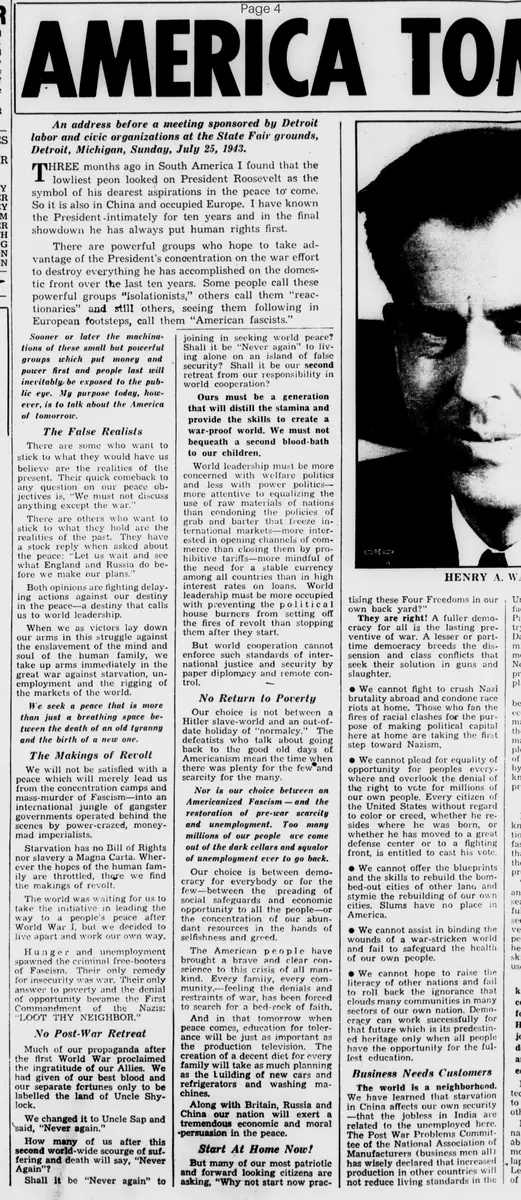
An address before a meeting sponsored by Detroit labor and civic organizations at the State Fair grounds, Detroit, Michigan, Sunday, July 25, 1943.
THREE months ago in South America I found that the lowliest peon looked on President Roosevelt as the symbol of his dearest aspirations in the peace to come. So it is also in China and occupied Europe. I have known the President intimately for ten years and in the final showdown he has always put human rights first.
There are powerful groups who hope to take advantage of the President's concentration on the war effort to destroy everything he has accomplished on the domestic front over the last ten years.
Some people call these powerful groups "isolationists," others call them "reactionaries" and still others, seeing them following in European footsteps, call them "American fascists."
Sooner or later the machinations of these small but powerful groups which put money and power first and people last will inevitably be exposed to the public eye. My purpose today, however, is to talk about the America of tomorrow.
The False Realists
There are some who want to stick to what they would have us believe are the realities of the present. Their quick comeback to any question on our peace objectives is, "We must not discuss anything except the war."
There are others who want to stick to what they hold are the realities of the past. They have a stock reply when asked about the peace: "Let us wait and see what England and Russia do before we make our plans."
Both opinions are fighting delaying actions against our destiny in the peace—a destiny that calls us to world leadership.
When we as victors lay down our arms in this struggle against the enslavement of the mind and soul of the human family, we take up arms immediately in the great war against starvation, unemployment and the rigging of the markets of the world.
We seek a peace that is more than just a breathing space between the death of an old tyranny and the birth of a new one.
The Makings of Revolt
We will not be satisfied with a peace which will merely lead us from the concentration camps and mass-murder of Fascism—into an international jungle of gangster governments operated behind the scenes by power-crazed, money-mad imperialists.
Starvation has no Bill of Rights nor slavery a Magna Carta. Wherever the hopes of the human family are throttled, there we find the makings of revolt.
The world was waiting for us to take the initiative in leading the way to a people's peace after World War I, but we decided to live apart and work our own way.
Hunger and unemployment spawned the criminal free-booters of Fascism. Their only remedy for insecurity was war. Their only answer to poverty and the denial of opportunity became the First Commandment of the Nazis: "LOOT THY NEIGHBOR."
No Post-War Retreat
Much of our propaganda after the first World War proclaimed the ingratitude of our Allies. We had given of our best blood and our separate fortunes only to be labelled the land of Uncle Shylock.
We changed it to Uncle Sap and said, "Never again."
How many of us after this second world-wide scourge of suffering and death will say, "Never Again"?
Shall it be "Never again" to joining in seeking world peace?
Shall it be "Never again" to living alone on an island of false security? Shall it be our second retreat from our responsibility in world cooperation?
Ours must be a generation that will distill the stamina and provide the skills to create a war-proof world. We must not bequeath a second blood-bath to our children.
World leadership must be more concerned with welfare politics and less with power politics—more attentive to equalizing the use of raw materials of nations than condoning the policies of grab and barter that freeze international markets—more interesting in opening channels of commerce than closing them by prohibitive tariffs—more mindful of the need for a stable currency among all countries than in high interest rates on loans. World leadership must be more occupied with preventing the political house burners from setting off the fires of revolt than stopping them after they start.
But world cooperation cannot enforce such standards of international justice and security by paper diplomacy and remote control.
No Return to Poverty
Our choice is not between a Hitler slave-world and an out-of-date holiday of "normalcy." The defeatists who talk about going back to the good old days of Americanism mean the time when there was plenty for the few and scarcity for the many.
Nor is our choice between an Americanized Fascism—and the restoration of pre-war scarcity and unemployment. Too many millions of our people have come out of the dark cellars and squalor of unemployment ever to go back.
Our choice is between democracy for everybody or for the few—between the spreading of social safeguards and economic opportunity to all the people—or the concentration of our abundant resources in the hands of selfishness and greed.
The American people have brought a brave and clear conscience to this crisis of all mankind. Every family, every community—feeling the denials and restraints of war, has been forced to search for a bed-rock of faith.
And in that tomorrow when peace comes, education for tolerance will be just as important as the production television. The creation of a decent diet for every family will take as much planning as the building of new cars and refrigerators and washing machines.
Along with Britain, Russia and China our nation will exert a tremendous economic and moral persuasion in the peace.
Start At Home Now!
But many of our most patriotic and forward looking citizens are asking, "Why not start now practising these Four Freedoms in our own back yard?"
They are right! A fuller democracy for all is the lasting preventive of war. A lesser or part-time democracy breeds the dissension and class conflicts that lead to slaughter.
We cannot fight to crush Nazi brutality abroad and condone race riots at home. Those who fan the fires of racial clashes for the purpose of making political capital here at home are taking the first step toward Nazism.
We cannot plead for equality of opportunity for peoples everywhere and overlook the denial of the right to vote for millions of our own people. Every citizen of the United States without regard to color or creed, whether he resides where he was born, or whether he has moved to a great defense center or to a fighting front, is entitled to cast his vote.
We cannot offer the blueprints and the skills to rebuild the bombed-out cities of other lands and stymie the rebuilding of our own cities. Slums have no place in America.
We cannot assist in binding the wounds of a war-stricken world and fail to safeguard the health of our own people.
We cannot hope to raise the literacy of other nations and fail to roll back the ignorance that clouds many communities in many sectors of our own nation. Democracy can work successfully for that future which is its predestined heritage only when all people have the opportunity for the fullest education.
Business Needs Customers
The world is a neighborhood. We have learned that starvation in China affects our own security—that the jobless in India are related to the unemployed here.
The Post War Problems Committee of the National Association of Manufacturers (business men all) has wisely declared that increased production in other countries will not reduce living standards in the United States. Those twisters of fact who shriek that your Vice President is a wild-eyed dreamer trying to set up T.V.A.s on the Danube and deliver a bottle of milk to every Hottentot every morning should read that report.
No business prospers without prosperous customers. That is plain common sense.
The average American may not be an expert on all phases of our economic and political life. He may not understand completely the complexities of money and markets. He may never feel completely at home in the intricacies of world trade as they are affected by tariffs and cartels. He may not know too much about parity farm prices and subsidies.
For Full Employment
But the average American does know what happens when inflation comes—when prices rise faster than wages, and he knows that the worst lie of all is that the way to make money is to produce scarcity.
The common man in America, and every American soldier overseas, wants free enterprise and full employment. He wants to see the great new war plants converted into plants producing peacetime goods. He knows that he and others have acquired new skills and they should be put to use.
The average man of America knows that we can make and consume all goods which make for a higher standard of living. He wants and he must have a job, enough to eat and wear, decent shelter, his own home and automobile, and a chance to educate his children.
He knows that high tariff protection for our markets leads only to retaliation and boycotts by other countries. He knows that no coalition of nations can weather the innumerable impacts of money and trade monopolies. He witnessed the collapse of the League of Nations and the growth of dictatorships that appealed to their peoples by promising to free them from economic slavery. He is convinced that nations must be organized by something more than trade pacts and non-aggression treaties. The peace-makers must have more daring and vision than the war-makers.
The Peoples Four Duties
A YEAR ago I cited the four duties of the people's revolution as I saw them. They were:
1. The duty to produce to the limit.
2. The duty to transport as rapidly as possible to the field of battle.
3. The duty to fight with all that is in us.
4. The duty to build a peace—just, charitable and enduring.
Millions of our people from offices and factories, from farms, mines, oil fields and timber lands, have accepted those duties with typical American courage and fortitude. They are making heroic sacrifices to speed the victory.
But if war has its duties, peace has its responsibilities. Three outstanding peace-time responsibilities as I see them today are these:
1. The responsibility for enlightenment of the people.
2. The responsibility for mobilizing peace-time production for full employment.
3. The responsibility for planning world cooperation.
The American press, radio, school, and church free from domination by either Government or corporate interest can hold up to our people the vision of the freedom and abundance of the America that is to be. These great agencies of enlightenment can educate us with regard to the fundamental decencies and understandings which are essential if our power is to be a blessing to the world and not a curse.
Labor Doing Its Part
Labor is beginning to do its part in enlightening the public. It is beginning to make crystal clear that 97 percent of labor has cooperated 100 percent with our Government in the war effort. More and more in the future labor will demonstrate that it can cooperate with both employers and with agriculture in those measures which lead to increased employment, increased production and a higher standard of living.
The people of America know that the second step toward Nazism is the destruction of labor unions. There are midget Hitlers here who continually attack labor. There are other demagogues blind to the errors of every other group who shout, "We love labor, but..." Both the midget Hitlers and the demagogues are enemies of America. Both would destroy labor unions if they could. Labor should be fully aware of its friends and of its enemies.
The second responsibility, that of mobilizing the peace for full production and full employment, will challenge the best brains and imagination of our industries large and small, our trade associations, our labor unions, and our financial institutions.
Peace-time Assets
When the guns stop, America will find itself with the following assets:
1. Manpower by the million; skilled workers from war industries, military manpower and young people coming of working age.
2. The largest industrial plant capacity in the world.
3. The greatest resources both natural and artificial to make peace-time products—and thousands of new inventions waiting to be converted to peace-time use.
4. The largest scientific farm plant in the world.
5. The biggest back-log of requirements for housing, transportation, communications and living comforts.
6. The greatest reserve of accumulated savings by individuals that any nation has ever known.
With such wealth who says this nation is now bankrupt?
If industrial management can bring the same wisdom in producing for peace that it has shown on many production fronts in the supply program for war, the horizons we face are bright. We have witnessed many evidences of industrial statesmanship, of cooperation with labor to increase production and cut costs. In hundreds of industries the war has demonstrated that management and labor can be friends in the service of the nation.
For Labor Participation
Our industries, trade associations and lending institutions will open the gates of labor's participation wider. They have the choice of approaching the new world of greatly expanded production with new energies and foresight—or they can hold back and fearfully await the stimulus of their government to expand production and consumption.
Whichever choice they consciously make, I believe they want to do their part in keeping this nation on solid ground when peace comes.
If we are to mobilize peace production in the service of all the people we must completely turn away from scarcity economics. Too many corporations have made money by holding inventions out of use, by holding up prices and by cutting down production. Witness 1932 with farm machinery and automobile prices cut less than 15 percent, but with production cut 75 percent. No wonder hog prices in 1933 fell as a result of unemployment and scarcity in the cities to a level only 40 percent of normal. But pig production in 1933, even with the program of killing pigs at light weights, was normal. In contrast pig iron production went down by more than 60 percent.
I say that a million times as much injustice has been done to the American people by the slaughter of immature pig iron, the abortion of baby farm machinery, and the killing of promising inventions as was ever done by killing little pigs at light weight. But in any event, the little pigs did not die in vain. Their death helped the country through the emergency. And the fact that it was necessary to kill them gave the American public a complete and utter abhorrence of scarcity economics—the economics which in 1932 held up city prices, cut city manufactures in half, lengthened bread lines, and cut farm prices by more than one half. We want balanced abundant production of both pigs and pig iron with prices of both equally flexible and equally stable.
The Returning Soldiers
I believe in our democratic, capitalistic system, but it must be a capitalism of abundance and full employment.
If we return to a capitalism of scarcity such as that which produced both 1929 and 1932, we must anticipate that the returning soldiers and displaced war workers will speak in no uncertain terms.
The third responsibility—that of planning world cooperation—will stem from the open and full partnership between the people and their government.
We will face combustible realities when this struggle has passed. Even now there are millions in Europe and Asia who have only one thought, one question: "When do we eat?"
Peace does not come where starvation stays. Peace is a mockery where millions of homeless and diseased are given only the freedom to die.
America will have to fill many bread-baskets, help to restore homes and provide medical care here and in other lands before our own peace will be secure.
We know that a combination of countries seeking to limit our air commerce could shut off our international skyways. We know that a ganging-up by a group of international cartels at odds with us could wipe out our markets and sow the seeds of war. We know that we cannot close the doors on other nations and not expect them to close their doors on us. We know that imperialistic free-booters using the United States as a base can make another war inevitable.
In that knowledge we can create cooperation or conflict; unity of purpose or under-the-table dealing.
Our Foreign Relations
We must continue our splendid teamwork with the British. We must become better acquainted with our new friends, the Russians. We can live peacefully in the same world with the Russians if we demonstrate to ourselves and the world after the war that we have gone in for all-out peace production and total consumer use of our products to bring about the maximum of human welfare.
The Atlantic Charter provides the broad base of general principles to safeguard our decisions. It is a Charter of Faith that must be worked out to endure and the American people intend that it shall work and that it shall endure.
Shouldering our responsibilities for enlightenment, abundant production and world cooperation, we can begin now our apprenticeship to world peace. There will be heart-breaking delays—there will be prejudices creeping in and the faint-hearted will spread their whispers of doubt. Some blueprints and many programs will be tested and found unworkable—some men with selfish motives will use the propaganda of protest and the sabotage of delay to promote disunity in peace as they have in war.
The World One Family
But the day of victory for humanity will come just as this night of terror and desolation will pass. Nothing will prevail against the common-man's peace in a common-man's world as he fights both for free enterprise and full employment.
The world is one family with one future—a future which will bind our brotherhood with heart and mind and not with chains—which will save and share the culture past and now aborning—which will work out the peace on a level of high and open cooperation—which will make democracy work for mankind by giving everyone a chance to build his own stake in it.
The challenge and the opportunity to win the battle of the peace has joined mankind. Victory demands our best thought, our best energies and our everlasting faith.
By Henry A. Wallace
Vice-President of the United States.
What sub-type of article is it?
What themes does it cover?
What keywords are associated?
What entities or persons were involved?
Where did it happen?
Story Details
Key Persons
Location
Detroit, Michigan, State Fair Grounds
Event Date
Sunday, July 25, 1943
Story Details
Vice President Wallace delivers a visionary speech advocating for post-war world leadership focused on peace, economic abundance, full employment, democracy, and international cooperation, while criticizing isolationists, reactionaries, and scarcity economics, and emphasizing domestic reforms like voting rights, anti-racism, and education.