Thank you for visiting SNEWPapers!
Sign up free
Editorial
July 11, 1935
White Bluffs Spokesman
White Bluffs, Benton County, Washington
What is this article about?
J. B. Whitehead argues for taxing public utilities like private ones, using the Los Angeles example to refute Los Angeles Times claims that public utilities avoid taxes, highlighting savings and contributions to city funds despite no direct taxes.
Clipping
OCR Quality
98%
Excellent
Full Text
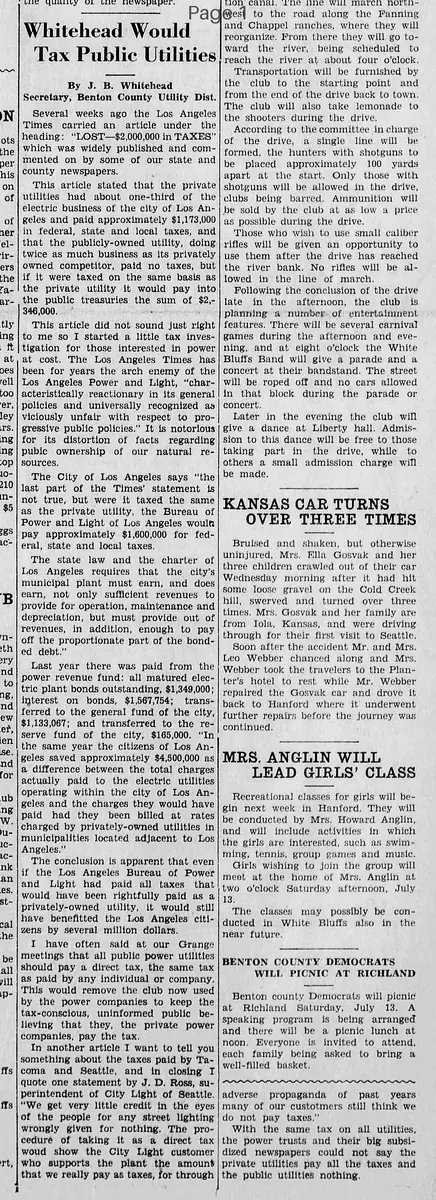
Whitehead Would
Tax Public Utilities
By J. B. Whitehead
Secretary, Benton County Utility Dist.
Several weeks ago the Los Angeles Times carried an article under the heading: "LOST—$2,000,000 in TAXES" which was widely published and commented on by some of our state and county newspapers.
This article stated that the private utilities had about one-third of the electric business of the city of Los Angeles and paid approximately $1,173,000 in federal, state and local taxes, and that the publicly-owned utility, doing twice as much business as its privately owned competitor, paid no taxes, but if it were taxed on the same basis as the private utility it would pay into the public treasuries the sum of $2,346,000.
This article did not sound just right to me so I started a little tax investigation for those interested in power at cost. The Los Angeles Times has been for years the arch enemy of the Los Angeles Power and Light, "characteristically reactionary in its general policies and universally recognized as viciously unfair with respect to progressive public policies." It is notorious for its distortion of facts regarding public ownership of our natural resources.
The City of Los Angeles says "the last part of the Times' statement is not true, but were it taxed the same as the private utility, the Bureau of Power and Light of Los Angeles would pay approximately $1,600,000 for federal, state and local taxes.
The state law and the charter of Los Angeles requires that the city's municipal plant must earn, and does earn, not only sufficient revenues to provide for operation, maintenance and depreciation, but must provide out of revenues, in addition, enough to pay off the proportionate part of the bonded debt."
Last year there was paid from the power revenue fund: all matured electric plant bonds outstanding, $1,349,000; interest on bonds, $1,567,754; transferred to the general fund of the city $1,133,067; and transferred to the reserve fund of the city, $165,000. "In the same year the citizens of Los Angeles saved approximately $4,500,000 as a difference between the total charges actually paid to the electric utilities operating within the city of Los Angeles and the charges they would have paid had they been billed at rates charged by privately-owned utilities in municipalities located adjacent to Los Angeles."
The conclusion is apparent that even if the Los Angeles Bureau of Power and Light had paid all taxes that would have been rightfully paid as a privately-owned utility, it would still have benefitted the Los Angeles citizens by several million dollars.
I have often said at our Grange meetings that all public power utilities should pay a direct tax, the same tax as paid by any individual or company. This would remove the club now used by the power companies to keep the tax-conscious, uninformed public believing that they, the private power companies, pay the tax.
In another article I want to tell you something about the taxes paid by Tacoma and Seattle, and in closing I quote one statement by J. D. Ross, superintendent of City Light of Seattle.
"We get very little credit in the eyes of the people for any street lighting wrongly given for nothing. The procedure of taking it as a direct tax would show the City Light customer who supports the plant the amount that we really pay as taxes, for through adverse propaganda of past years many of our customers still think we do not pay taxes."
With the same tax on all utilities, the power trusts and their big subsidized newspapers could not say the private utilities pay all the taxes and the public utilities nothing.
Tax Public Utilities
By J. B. Whitehead
Secretary, Benton County Utility Dist.
Several weeks ago the Los Angeles Times carried an article under the heading: "LOST—$2,000,000 in TAXES" which was widely published and commented on by some of our state and county newspapers.
This article stated that the private utilities had about one-third of the electric business of the city of Los Angeles and paid approximately $1,173,000 in federal, state and local taxes, and that the publicly-owned utility, doing twice as much business as its privately owned competitor, paid no taxes, but if it were taxed on the same basis as the private utility it would pay into the public treasuries the sum of $2,346,000.
This article did not sound just right to me so I started a little tax investigation for those interested in power at cost. The Los Angeles Times has been for years the arch enemy of the Los Angeles Power and Light, "characteristically reactionary in its general policies and universally recognized as viciously unfair with respect to progressive public policies." It is notorious for its distortion of facts regarding public ownership of our natural resources.
The City of Los Angeles says "the last part of the Times' statement is not true, but were it taxed the same as the private utility, the Bureau of Power and Light of Los Angeles would pay approximately $1,600,000 for federal, state and local taxes.
The state law and the charter of Los Angeles requires that the city's municipal plant must earn, and does earn, not only sufficient revenues to provide for operation, maintenance and depreciation, but must provide out of revenues, in addition, enough to pay off the proportionate part of the bonded debt."
Last year there was paid from the power revenue fund: all matured electric plant bonds outstanding, $1,349,000; interest on bonds, $1,567,754; transferred to the general fund of the city $1,133,067; and transferred to the reserve fund of the city, $165,000. "In the same year the citizens of Los Angeles saved approximately $4,500,000 as a difference between the total charges actually paid to the electric utilities operating within the city of Los Angeles and the charges they would have paid had they been billed at rates charged by privately-owned utilities in municipalities located adjacent to Los Angeles."
The conclusion is apparent that even if the Los Angeles Bureau of Power and Light had paid all taxes that would have been rightfully paid as a privately-owned utility, it would still have benefitted the Los Angeles citizens by several million dollars.
I have often said at our Grange meetings that all public power utilities should pay a direct tax, the same tax as paid by any individual or company. This would remove the club now used by the power companies to keep the tax-conscious, uninformed public believing that they, the private power companies, pay the tax.
In another article I want to tell you something about the taxes paid by Tacoma and Seattle, and in closing I quote one statement by J. D. Ross, superintendent of City Light of Seattle.
"We get very little credit in the eyes of the people for any street lighting wrongly given for nothing. The procedure of taking it as a direct tax would show the City Light customer who supports the plant the amount that we really pay as taxes, for through adverse propaganda of past years many of our customers still think we do not pay taxes."
With the same tax on all utilities, the power trusts and their big subsidized newspapers could not say the private utilities pay all the taxes and the public utilities nothing.
What sub-type of article is it?
Taxation
Economic Policy
What keywords are associated?
Public Utilities
Taxation
Los Angeles
Private Utilities
Power Companies
Propaganda
Grange Meetings
What entities or persons were involved?
J. B. Whitehead
Los Angeles Times
Los Angeles Bureau Of Power And Light
J. D. Ross
City Light Of Seattle
Tacoma
Seattle
Editorial Details
Primary Topic
Taxing Public Utilities Equally To Private Ones
Stance / Tone
Supportive Of Direct Taxation On Public Utilities To Counter Private Company Propaganda
Key Figures
J. B. Whitehead
Los Angeles Times
Los Angeles Bureau Of Power And Light
J. D. Ross
City Light Of Seattle
Tacoma
Seattle
Key Arguments
Private Utilities In Los Angeles Pay $1,173,000 In Taxes For One Third Business; Public Utility With Twice The Business Would Pay $1,600,000 If Taxed Similarly
Public Utility Revenues Cover Operations, Maintenance, Depreciation, Bonds, Interest, And Transfers To City Funds Totaling Over $4 Million
Los Angeles Citizens Saved $4,500,000 Compared To Private Utility Rates
Even With Taxes, Public Utility Benefits Citizens By Millions
Direct Taxes On Public Utilities Would Educate Public And Counter Power Company Claims