Thank you for visiting SNEWPapers!
Sign up free
New York Daily Tribune
New York, New York County, New York
What is this article about?
In August 1856, A. Bowen writes from Kearney City, Nebraska Territory, detailing his journey from New York to Kansas via northern Missouri. He observes fertile lands undervalued due to slavery, counters pro-slavery rumors discouraging free-state settlers, faces armed border guards preventing entry without oath, and critiques political agitation fueling Kansas conflicts.
Clipping
OCR Quality
Full Text
Correspondence of The N. Y. Tribune.
KEARNEY CITY, Otoe Co., N. T., Aug. 14, 1856,
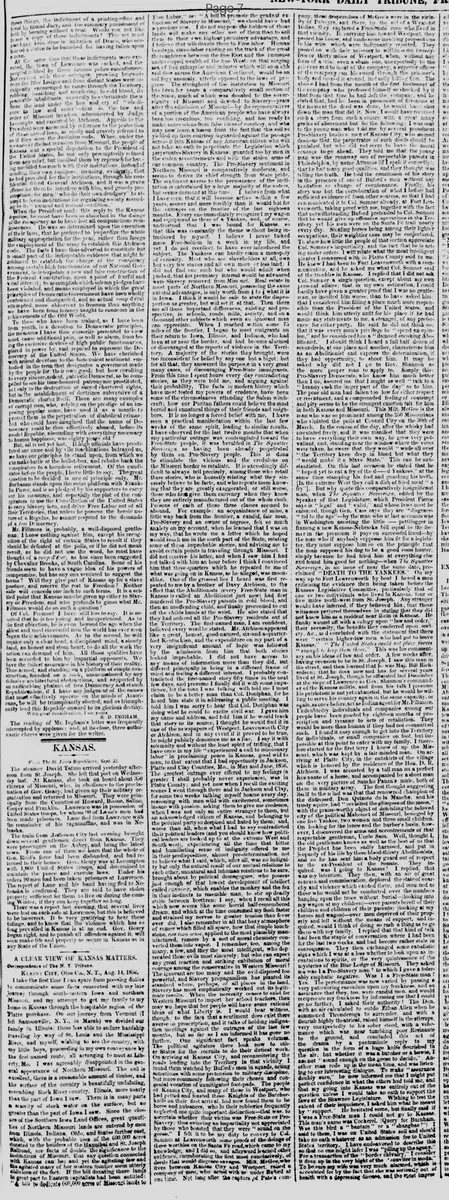
I take the first time I can spare from pressing duties to communicate some facts connected with my late journey through south-eastern Iowa and northern Missouri, and my attempt to get my family to my home in Kansas through the hospitable region of the Platte purchase. On our journey from Vermont (I left Samsonville, N. Y., in March) we divided our family in Illinois: those less able to endure hardship traveling by way of St. Louis and the Mississippi River, and myself, wishing to see the country, with my little boys, proceeding in my own conveyance by the first-named route, all arranging to meet at Liberty, Mo. I was agreeably disappointed in the general appearance of Northern Missouri. The soil is excellent, there is a reasonable amount of timber, and the surface of the country is beautifully undulating, resembling Rock River country, Illinois, more nearly than the part of Iowa I saw. There is in many parts a scarcity of stock water on the surface, but no greater than the part of Iowa I saw. Since the closure of the Southern Iowa Land Offices, great quantities of Northern Missouri lands are entered by men from Illinois, Indiana, Ohio, and States further east, which, with the probable uses of the 600,000 acres donated the builders the Hannibal and Joseph Railroad, are facts of double the significance to the institutions Missouri that any question connected with Kansas can be; and yet she agitating few and the agitated many her western frontier seem utterly oblivious of the fact. If the bill donating those lands great part Eastern capitalists had been entitled "A bill to promote the gradual extinction of Slavery in Missouri," we should have had Free Labor." or: "A bill to promote the gradual er precious row do not suppose the holders those lands will make any other use of them than to sell them to their own highest pecuniary advantage, and I believe that will devote them to Free labor Human bondago, slave-labor existing on the track of the great thoroughfares between the free East and the immense undeveoped wealth of the free West: on that surging sea of free enterprise and industry which will soon ebb and flow across the American Continent, would be an old fogy anomaly, utterly opposed to the laws of progress The stronghold of the institution in Missouri has been for years a comparatively small section of the State, much of which was donated to the sovereignty of Missouri and devoted to Slavery-years after the admission of Missouri by the representatives of a portion of the American people who have always been too credulous, too confiding, and too ready to make concessions from false ideas of courtesy, and who may now learn a lesson from the fact that the soil so yielded up from courtesy is guarded against the passage across it into Kansas of any American citizen who will not take an oath to perpetuate the Legislation which perpetuates Slavery in Kansas: guarded too by men in the stolen accoutrements and with the stolen arms of our common country. The Pro-Slavery sentiment in Northern Missouri is comparatively moderate, and seems to derive its chief strength from State pride. The sentiment averse to the permanence of the institution is entertained by a large majority of the voters, but seems dormant at this time. I believe from what I have seen, that it will become active within a few years, sooner and more forcibly than it would but for the outrages on the frontier of the last eighteen months. Every one immediately recognized my wagon and equipment as those of a Yankee, and, of course, understood that I was bound for Kansas, so that this was constantly the theme without being introduced by myself. I believe I never talked more Free-Soil-ism in a week in my life, and yet I do not recollect to have ever introduced the subject. The Yankees can hardly claim a monopoly of curiosity. Most who are slaveholders at all, own but very few slaves and all own more or less land; I did not find one such but who would admit when pushed, that his pecuniary interest would be advanced were Slavery removed from Missouri. Real estate in most parts of Northern Missouri, possessing the same natural advantages, is only worth from 1/2 to what it is in Iowa. I think it would be safe to state the disproportion as greater, but will set it at that. Then there are all those important differences, existing and prospective, in schools, roads, mills, society, and on a thousand other subjects which even an ignorant man can appreciate. When I reached within some 75 miles of the frontier, I began to meet emigrants on their return to Iowa, Illinois, and Indiana, who had been at or near the border, and had become alarmed or discouraged at the reports of violence in the Territory. A majority of the stories they brought, were too inconsistent for belief by any one but a bigot; but for all that, they answered the purpose, in a very great many cases, of discouraging Free-State immigrants. From this time I spent hours every day contradicting stories, as they were told me, and arguing against their probability. The facts in modern history which have most tested my powers of credence, have been some of the circumstances attending the Salem witchcraft; how our Puritan fathers could believe the most horrid and unnatural things of their friends and neighbors. It is no longer a forced belief with me. I have seen a practical manifestation within the last few weeks of the same spirit, leading to similar results. I have observed for the last twelve months that when any particular outrage was contemplated toward the Free-State people, it was heralded in The Squatter Sovereign as having been already perpetrated by them on Pro-Slavery people. This is done to stimulate the vicious and the credulous on the Missouri border to retaliate. It is exceedingly difficult to always tell precisely, among those who retail these stories, who is honestly relating what they sincerely believe to be facts, and who repeats them knowing that they are greatly exaggerated; or still worse, those who first give them currency when they know they are entirely manufactured out of the whole cloth. Persons of each of these three classes seemed to abound. For example: an acquaintance of mine, a little way back from the frontier, a candid, fair man, Pro-Slavery and an owner of negroes, felt so much anxiety on my account, when he learned that I was on my way, that he wrote me a letter which he hoped would reach me in the north part of the State, relating some of these improbable stories, and advising me to avoid certain points in traveling through Missouri. I did not receive his letter, and when I saw him I had not talked with him an hour before I think I convinced him that three-quarters which he repeated to me of what was going on in Kansas, as he alleged, was moonshine. One of the grossest lies I heard was first repeated to me by a brother of Davy Atchison, to the effect that the Abolitionists (every Free-State man in Kansas is called an Abolitionist just now) had first murdered the Pro-Slavery parents in cold blood, and then an unoffending child, and finally proceeded to cut off the child's hands at the wrist. He also stated that they had ordered all the Pro-Slavery residents out of the Territory. The first-named man, I am confident, believed every word he stated. Mr. Atchison appeared like a great, honest, good-natured, six-and-a-quarter-foot Kentuckian, and the expenditure on my part of a very insignificant amount of logic was followed by the admission from him that both stories looked improbable. I did not have access to any means of information more than they did, but differed principally in being in a different frame of mind and feeling a different interest. I probably contradicted the first-named story fifty times in the next few days, and presume I finally did it with some impatience, for the man I was talking with told me I must claim to be a better man than Col. Doniphan, for he heard him state it in addressing a public meeting. I told him I was sorry to hear that Col. Doniphan was doing what he could to excite civil war. I gave him my name and address, and told him if he would track that story to its source, I thought he would find it in one of the newspapers of Westport, Leavenworth City or Atchison, and in any event if it proved to be true, he might publicly denounce me as a liar. I say it with solemnity and without the least spirit of trifling, that I have once in my life "experienced a call to missionary labor" in proclaiming peace in Kansas, good will to man, to that extent that I had opportunity in Jackson, Platte and Clay Counties, Mo., in May and June, 1856. The greatest outrage ever offered to my feelings (a greater I shall probably never experience), was in Platte County: and yet now when I recall the exciting scenes I went through there and in Jackson and Clay, for some two weeks talking myself hoarse every day, reasoning with men wild with excitement, sometimes insane with passion, asking them to give me credence, when I was not only an entire stranger to them, but an acknowledged citizen of Kansas, and belonging to the political party so despised and hated by them: and, worse than all, when what I had to say contradicted the ir political leaders (and you should know how political leaders are looked up to at the extreme West and South west), experiencing all the time that bitter and humiliating sense of indignity offered to me in their predisposition, almost pre-determination, not to believe what I said, which, after all, was no indignity but only the natural result of our mutual relations to each other, unnatural and inhuman relations to be sure, brought about by political demagogues, who possess just enough of that lowest development of intellect called cunning, which enables the monkey and the fox in their instincts to resemble man, to stir up deadly strife between brethren: I say, when I recall all this which now seems like some horrid half-remembered dream, and which at the time consumed my flesh faster and strained my nerves to greater tension than fever ever did, I also remember in all that hazy atmosphere of rumor which filled all space, how that simple touchstone, common sense, applied to the most plausibly manufactured, rumors by a sort of moral chemistry converted them into vapor. I remember, too, among the many, a few, and they the most intelligent, who deprecated these evils most sincerely; but who can expect any great reaction and striking exhibition of moral courage among the conservative in Western Missouri? The ignorant are too many and the evil-disposed too powerful, and Slavery propagandism has planted its standard where, perhaps, of all places in the land, Slavery has most emphatically worked out its legitimate mate results. When the necessity ceases to exist for Western Missouri to import her school teachers, then may we hope that her people will have some rational ideas of what Liberty is. I would bear witness, though, to the fact that a sentiment does exist there averse to proscription, and it talks of holding indignation meetings against the outrages of the last few months, but so far as I am informed it has gone no further. One significant fact speaks volumes. The political agitators there look now to other States for the recruits to do their dirtiest work. On arriving at Kansas City, and reconnoitering the roads leading into the Territory in that vicinity, I found them watched by Buford's men in squads, acting sometimes with some pretension to military discipline, but more commonly following their chosen and congenial vocation of unmitigated foot-pads. The people of Kansas City, and many of those in Westport, who had petted and feasted these Knights of the Butcher-knife on their first arrival, had now found them to be bores and nuisances, who in their robberies frequently neglected one quite important distinction-that was, to ascertain whether their victim was Free-State or Pro-Slavery; thus evincing an impartiality not appreciated by those who boasted that they were "sound on the goose." I felt it to be my duty to convey to Col. Sumner at Leavenworth some proofs of the doings of there worthies on the Santa Fe road, which came to my knowledge, and I did so, and afterward learned other evidence, corroborating the first most conclusively, of deeds that would disgrace savages lives between Kansas City and Westport, raised a company of men, who acted with or under Buford at one time. Not long after the capture of Pate's company, these desperadoes of McGee's were in the vicinity of Palmyra, and there, by the aid of a Wyandot Indian, they captured a Free-state man who lived in that vicinity. Carrying him toward Westport, they passed his house, and made some insulting propositions to his wife which were indignantly rejected. They passed on with their prisoner to within some twenty-five or thirty miles of Westport, when, without any form of a trial even a sham one, unexpectedly to the prisoner and to most of the company, a superior officer of the company ran his sword through the prisoner's body and turned it around instantly killing him. The above I had from the mouth of the first lieutenant of the company who professed himself so shocked by it that from that time he had left the company, and he stated that, had he been in possession of fire-arms at the moment the deed was done, he would have shot down the man that did it. Now, I would have received such a story from such a source with a great many grains of abatement but for the following: I was sent to the young man who told me by several prominent Pro-Slavery business men of Kansas City, who seemed desirous that the perpetrator of such deeds should be punished, but who did not seem to have the moral courage to go ahead. They told me that the young man was the runaway son of respectable parents in Philadelphia, by name Artemus (if I spell it correctly): that he had many good qualities, and they thought was telling the truth. He told the conclusion of his story in the presence of one of Buford's men without any hesitation or change of countenance. Finally, his story was but the corroboration of what I before had sufficient evidence of from other sources, so that I had communicated it to Col. Sumner already, at Fort Leavenworth, taking proof with me, together with the fact that notwithstanding Buford pretended to Col. Sumner that he would give up offensive operations in the Territory, yet his men were on the Santa Fe trail nearly every day. Stealing horses being among their lighter occupations, their weightier ones may be conjectured. To show how little the people of that section appreciate Col. Sumner's impartiality, and the fact that he is acting under orders I will relate what the most intelligent planter conversed with Platte County said me He knew I had been to Fort Leavenworth with a communication, and he asked me what Col. Sumner said of the trouble in Kansas. I replied that I did not ask Col. Sumner a single question, except about my own personal affairs; that, in my own estimation, I could hardly have given a greater proof that I was no gentleman, or insulted him worse, than to have asked him that I considered him filling a place much more responsible than the President of the United States, and would think him utterly unfit for his place if he had made any statements to me, a stranger, of any preference for either party. He said he did not think so; that it was every man's privilege to "spend an opinion," and he considered him a "damned sneaking Abolitionist." I should think I heard a full half dozen of scoundrels, at one place and another, characterize him as an Abolitionist and express the determination, if they had opportunity, to "shoot him. It may be asked why did not I go to Gov. Shannon as the more proper man to apply to. Simply this: Pro-Slavery Democrats, who know him much better than I do, assured me that I might as well "talk to a brandy cask the larger part of the day" as to him. The poor old man had fallen too low for either respect or resentment, and a compounded feeling of contempt and pity seems to be the strongest emotion felt for him in both Kansas and Missouri. "This Milt. McGee is the man who was so prominent among the 250 Missourians who violated the polls at Council City on the 30th of March. In the course of the day, after the whisky had circulated freely, and it was manifest that they were to have everything their own way, he grew very potent-valiant, and, standing near the window where the votes were taken, he swore that they would "wade all over the Territory knee deep in blood but what they would make it a Slave State." This can be substantiated. On this last occasion he stated that he "hoped yet to eat a fry of the d--d Yankees." at the same time stamping his foot and gnashing his teeth. [In the extreme West they call a dish of fried meat "a fry"]. But why quote this comparatively insignificant man, when The Squatter Sovereign, edited by the Speaker of that Legislature, which President Pierce says is "legal" and valid," and whose laws must be enforced, though Gen. Cass says they are "disgraceful to the age"-by the man who at last accounts was in Washington assisting the little pettifogger in framing a new Kansas-Nebraska bill equal to the former in the premium it pays on successful fraud-by the man who if anybody supposes him fit for a legislator, they must suppose him so on the principle that the man supposed his dog to be a good coon hunter, simply because he had tried him at everything else and found him good for nothing-when The Squatter Sovereign, in an issue of near the same date, proclaimed "DEATH TO THE YANKEES." On my way up to Fort Leavenworth by boat I heard a man criticizing the evidence then being taken before the Kansas Legislative Committee, particularly that of one or two individuals who lived in Kansas, four or five miles north-west from St. Joseph. Any stranger would have inferred, if they believed him, that these witnesses perjured themselves in stating that they did not know Lin as a resident near them in Kansas. He finally wound off with a eulogy upon "law and order," their necessity, the benefits they conferred upon society, &c., and concluded with the statement that there were "certain higher-law men who had got to leave Kansas." "The United States could not place forces enough to keep them there." This was his comment-having occasion to be in St. Joseph, I saw this man in the street, and then learned that he was Maj. Bull Richardson; that he does now and has for several years lived at St. Joseph, though he officiated last December at the siege of Lawrence as Gov. Shannon's commander-his patriotism is not yet exhausted, but he would be willing to serve his country again in the same capacity, or again, as once before, act as Indian agent for Mr. Fillmore. Undoubtedly individuals and companies among our people have been goaded by eighteen months of proscription and tyranny to acts of retaliation. They would be more than human if they had not committed such. I found it easy enough to get into the Territory for individuals, or small companies on foot, but impossible at this point to enter with my family. I therefore started for the first ferry I knew of up the Missouri, which was kept by a fair-minded man. On arriving at Platte City, in the outskirts of the village which is honored by the residence of the Hon. D. R. Atchison, I was accosted by a tall man on a perfect Rosinante of a horse, and accompanied by a short man on the very picture of Sancho Panza's mule, both of them in military array. The first thought suggesting itself to the mind was that that renowned champion of the distressed, Don Quixote de la Mancha, and his trusty squire, had "revisited the glimpses of the moon," with the praise-worthy object of defending the beloved city of the political Mahomet of Missouri, besieged by one live Yankee, two women and three small children. On looking for the lance and the barber's basin, however, I discovered the arms and accoutrements of that respectable gentleman, Uncle Sam. Well, thought I, the old gentleman knows as well as the best of us that the Prophet has been sadly harassed, and put in jeopardy of his life by these blood-thirsty Abolitionists, and so he has sent him a body guard out of respect to the ex-President of the Senate. They inquired, was I going to Kansas? I replied, that was my intention. They then, with an air of great concern and commiseration, deplored the state of anarchy and violence which existed there, and inou:ned as hanging upon the trees without burial-(looking into those who would not be comforted over the numbers children and children of their parents; (looking at my wagon at my children)-over parents bereft of their horses and wagon)—over men deprived of their property and left without the means of support, and inquired, would I think of doing so rash a thing as to go there with my family. I replied that that kind of talk had been the staple of conversation where I had been there with my family. I replied that that kind of talk had been the staple of conversation where I had been for the last two weeks, and had become rather stale in consequence. They then exchanged some cabalistic signs which I was at a loss whether to look upon as incantations to spirits, or the very quintessence of the mysteries of the Blue Lodge of Missouri. They asked was I a Pro-Slavery man? to which I gave a tolerably emphatic negative. Was I a Free-State man? Yes. The performance was now varied by passing a very patronizing encomium upon my frankness, and an assurance that they, too, were candid men, and would reciprocate my frankness by informing me that I could go no further. I asked their authority! The Don, with an air calculated to outdo Ethan Allen when he summoned Ticonderoga to surrender, and with a vehemence which was near tumbling poor Rosinante very unexpectedly to his sober steed, with a voice-flourish highly theatrical, raised himself in the stirrups, and concluded this act of the drama by a pantomimic reply to my question in the form of a huge knife flourished in the air, but whether it was a butcher or bowie, I am not "sound enough on the goose to decide." Another man rode up in the mean time, and was listening to our interesting dialogue. To make "assurance doubly sure," he now informed me that I might put perfect confidence in what the others had told me, and that my going into Kansas was entirely out of the question unless I would take an oath to support the Wishing extent of their impudence, I asked him what he meant by "support." He hesitated some, but finally said if I was a Free-State man I could not go to Kansas. This man's name was Cockerel. (Query for Burnham. Wse this bird "bantam United States coil and should "or a "shanghae?"I said to them, I was on take no oath whatever as an admission fee to United States territory. I have endeavored to describe this eo that no one might infer I was "piling up the agony." For a transaction of the "border chivalry." I consider it done up in the very height of the suaviter in modo." To be sure my wife was very much alarmed, which is accounted for by the fact that she orious's out of di-ome sii the pomt img eible cnedf my children shed tear freely, but I had never taken them to the theater before, and the un "ghisticated are very apt to be moved by tragic representations Both the first named worthies dirgrace the uniform that Col. Sumner has so honored for many years. They swore that could they catch Iim outside of Fort Leaveaworth Poot hm es quick as they would a wolf. 1 wie informed that thace nen were members of the Platte County Self-Defence Association krow but there may be one hud of propriety in providing thut honorable and patriotic organization with the arms and accoutrements of the United States which were plundered from the Liberty it stated in Platte County that when complaint was made to the Department of that robbery, Government was satisfied would pay for every thing which was not finally restored. Of course the people of Kansas and the country at large are very reasonable to suppose there are any other questions than those dollars and cents connected with the forcible entry of a United States Aisenal the holding wokmed, and the robbery of the depot of cannon, muskets small arms and for the destruction of Lawrence. Did not a Judge head the gang of robbers! and does not that legalize up and catching the Abolition treason-plotters in Kansas? And then cae attend to such small matters this communication I expressed a wish that President Prerce could have been present with me the seaviens of the Shawnee La gislature, and also of the Topeka Convention. I feel the same wish now that he could have been with me in my recent journey through Missouri severe criticisms upon his Excellency, but never such utter contempt as was expressed by Missouri slave-holding Democrats by scores. Said Teunessean emigrant to Missouri to me, "Stranger, what sort of a Northern man have you got the White House "If old Andy Jackson had been President this er guarl yours and mine would loi g ago." I will not pretend to say what kind of a vote such Democrats as these will cast next November, but this much I will aver, that a stronger apprehension cannot exist in the mind of a Garrisonian Abolitionist than does in theirs, that the party calling itself Democratic will never make peace in Kansas. For the last three months I have been upon or near the great western thoroughfares, and have conversed a great deal with men from every Western and Southern State and Territory in the Union. If Slavery Propaganda is not effectually rebuked next November, it is my most profound conviction that the allied forces of Slavery extension and Fillibusterism will within the next four years develop schemes, the programme of which is already laid down, but the announcement of which at this time would convulse the country with dread and alarm. There is a class of men to whom no one of President Pierce's denunciations apply-against whom no accusation of the border chivalry can with propriety be brought, even in pretense. They have no name in history or ballad, and yet this mighty Republic owes much of its increase in wealth and power, and cultivated territory to them. Their fathers were perhaps of Puritan stock, or of the first settlers of the middle Atlantic States. They first saw light in Ohio, or on the prairies or rich bottom-lands of Indiana or Illinois. They have always been frontiersmen and they always will be. The first sickness, the first privations, and a very small share of the first rewards of a new country, are theirs. This is their lot and they are contented with it. Much better fitted by early training and habits to endure the peculiar hardships of a new country, than the present generation in the Eastern States, they as a general thing constitute two thirds the population on the Western frontier. Always nomadic to a much greater degree than any other of the new settlers of the West, if they may be said to have any fixed habitation, it is a wagon almost as much as a log cabin. When I left Kansas last Fall these people constituted at least two-thirds of her Free-State voters, and more than outnumbered all her Pro-Slavery voters. I have with my own eyes seen as many more this Summer who have been turned back from going into Kansas, either by lying alarms raised near the frontier for the purpose of discouraging them from going in, or by forcible prevention directly. A part of this dammed-up flood of emigration has found a new channel through Iowa and Nebraska into Kansas, but that oppressed Territory lacks thousands of the population she would have had this day, but that her organic law has been shamefully violated by those who got it up. Fair-minded men of all political parties! Shall Republican Institutions be a mockery?
Yours very truly,
A. BOWEN.
What sub-type of article is it?
What themes does it cover?
What keywords are associated?
What entities or persons were involved?
Where did it happen?
Story Details
Key Persons
Location
Northern Missouri, Kansas Border, Platte County, Kansas City, Leavenworth
Event Date
Aug. 14, 1856
Story Details
A. Bowen travels from New York to Kansas in 1856, observes slavery's economic drag on Missouri, debunks pro-slavery rumors to encourage free-state migration, reports border violence and robberies by Buford's men, faces armed guards blocking family entry without pro-slavery oath, and warns of escalating national conflict over slavery expansion.