Thank you for visiting SNEWPapers!
Sign up free
Constitutional Whig
Richmond, Virginia
What is this article about?
Dona Apolinaria Zallibarriata, known as La Pola, a young Bogota woman, spied for Bolivar by extracting intelligence from Spanish officers at her home gatherings. Captured after a messenger's betrayal, she was tried and executed with her betrothed by Zamano, refusing to disclose accomplices despite threats and bribes.
Clipping
OCR Quality
Full Text
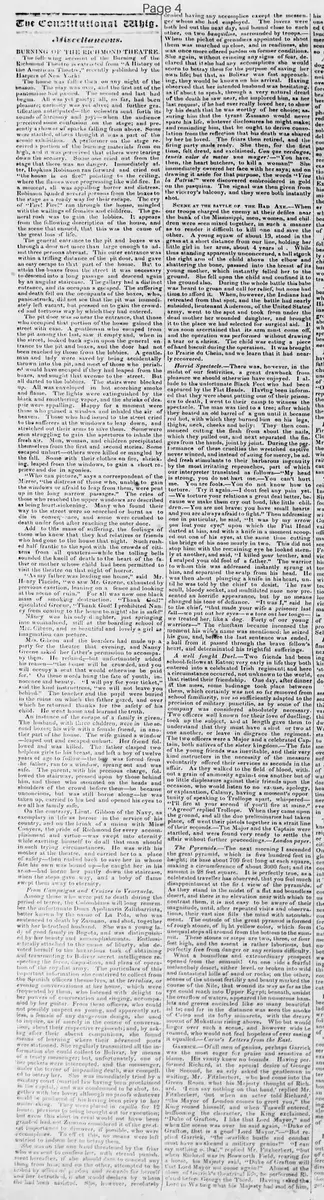
Among those who were put to death during the period of terror, the Colombians will long remember the unfortunate Dona Apolinaria Zallibarriata, better known by the name of La Pola, who was sentenced to death by Zamano, and shot, together with her betrothed husband. She was a young lady of good family in Bogota, and was distinguished by her beauty and accomplishments. Enthusiastically attached to the cause of liberty, she devoted herself to the hazardous task of obtaining and transmitting to Bolivar secret intelligence respecting the force, disposition, and plans of operation of the royalist army. The particulars of this important information she contrived to collect from the Spanish officers themselves, at the tertulias, or evening conversaziones at her house, which were frequented by them, who listened with delight to her powers of conversation and singing, accompanied by her guitar. From these officers, who could not possibly suspect so young, and apparently artless, a female of any dangerous design, she used to inquire, as if merely in the course of conversation, about their respective regiments; and, by asking after their absent companions, she found means of learning where their advanced posts were stationed. She regularly transmitted all the information she could collect to Bolivar, by means of a trusty messenger; but, unfortunately, one of her packets was intercepted, and the messenger, under the terror of impending death, was compelled to betray her. She was immediately tried by a military court (martial law having been proclaimed in the capital,) and was condemned to be shot, together with her lover; although no proofs whatever could be produced of his having been privy to her undertaking. They were placed in capilla for 12 hours, previous to being brought out for execution; but even this short interval would not have been granted had not Zamano considered it of the greatest importance to discover, if possible, who were her accomplices. To effect this, no means were left untried to induce her to betray them. She was on the one hand threatened by the friar who was sent to confess her, with eternal punishment hereafter, if she should dare to conceal anything from him; and on the other, attempted to be bribed by offers of pardon and rewards for herself and her betrothed, if she would declare by whom she had been assisted. She, however, resolutely denied having any accomplice except the messenger whom she had employed. The lovers were both led out the next day, and bound close to each other, on two banguilios, surrounded by troops. When the picket of grenadiers appointed to shoot them was marched up close, and in readiness, she was once more offered pardon on former conditions. She again, without evincing any signs of fear, declared that if she had any accomplices she would scorn to betray them for the purpose of saving her own life; but that, as Bolivar was fast approaching, they would be known on his arrival. Having observed that her intended husband was hesitating, as if about to speak, through a very natural dread of the death he saw near, she implored him, as her last request, if he had ever really loved her, to show by his death that he was worthy of her choice; assuring him that the tyrant Zamano would never spare his life, whatever disclosures he might make; and reminding him, that he ought to derive consolation from the reflection that his death was shared by her he loved. The friars then retired, and the firing party made ready. She then, for the first time, felt dread, and exclaimed, Con que verdugos, teneis valor de matar una muger!—“You have, then, the heart butchers, to kill a woman!” She immediately covered her face with her saya; and on drawing it aside for that purpose, the words "Viva la Patria!" were discovered embroidered in gold on the pasquina. The signal was then given from the viceroy's balcony, and they were both instantly shot.
What sub-type of article is it?
What themes does it cover?
What keywords are associated?
What entities or persons were involved?
Where did it happen?
Story Details
Key Persons
Location
Bogota
Event Date
During The Period Of Terror
Story Details
La Pola, a beautiful and accomplished young woman from a good Bogota family, spied for Bolivar by gathering military intelligence from unsuspecting Spanish officers at her evening gatherings. Betrayed by a captured messenger, she was tried under martial law and sentenced to death with her betrothed, despite no evidence of his involvement. She refused to betray accomplices under threats and bribes, encouraged her lover to die bravely, and was executed after proclaiming 'Viva la Patria!'