Thank you for visiting SNEWPapers!
Sign up free
Domestic News
March 25, 1807
The National Intelligencer And Washington Advertiser
Washington, District Of Columbia
What is this article about?
John L. Gardiner observes similarities between Knistenaux, Algonkin, and Maniock Indian languages, supporting theories on Native American nations' origins. Anticipates vocabularies from Lewis and Clark's expedition narrative.
Clipping
OCR Quality
98%
Excellent
Full Text
INDIAN LANGUAGE:
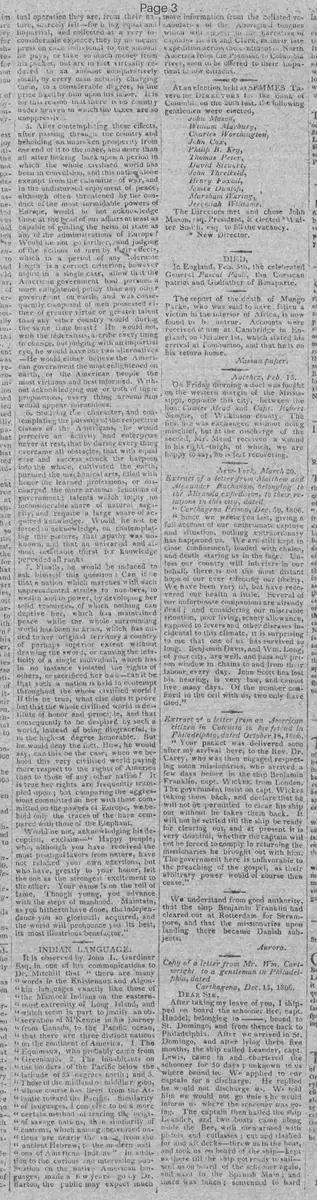
It is observed by John L. Gardiner Esq. in one of his communications to Dr. Mitchill that "there are many words in the Knistenaux and Algonkin languages exactly like those of the Maniock Indians on the easternmost extremity of Long Island, and which seem in part to justify an observation of M'Kenzie in his journey from Canada to the Pacific ocean, that there are three distinct nations on the continent of America. 1. The Equimaux, who probably came from Greenland. 2. The inhabitants on the borders of the Pacific below the latitude of 55 degrees north: and 3. Those of the midland or middle region, whose course has been from the Atlantic toward the Pacific. Similarity of languages, I conceive to be a more certain method of tracing the origin of savage nations than similarity of customs, which among uncivilized nations are nearly the same from the ancient Hebrew to the modern natives of American Indians." In addition to the curious and interesting observations on the native American languages, made a few years ago by Dr. Barton, the public may expect much more information from the collated vocabularies of the Aboriginal tongues which will appear in the narrative of captains Lewis and Clark, in their late expedition across the continent of North America from the Potomac to Columbia river, soon to be offered to their impatient fellow citizens.
It is observed by John L. Gardiner Esq. in one of his communications to Dr. Mitchill that "there are many words in the Knistenaux and Algonkin languages exactly like those of the Maniock Indians on the easternmost extremity of Long Island, and which seem in part to justify an observation of M'Kenzie in his journey from Canada to the Pacific ocean, that there are three distinct nations on the continent of America. 1. The Equimaux, who probably came from Greenland. 2. The inhabitants on the borders of the Pacific below the latitude of 55 degrees north: and 3. Those of the midland or middle region, whose course has been from the Atlantic toward the Pacific. Similarity of languages, I conceive to be a more certain method of tracing the origin of savage nations than similarity of customs, which among uncivilized nations are nearly the same from the ancient Hebrew to the modern natives of American Indians." In addition to the curious and interesting observations on the native American languages, made a few years ago by Dr. Barton, the public may expect much more information from the collated vocabularies of the Aboriginal tongues which will appear in the narrative of captains Lewis and Clark, in their late expedition across the continent of North America from the Potomac to Columbia river, soon to be offered to their impatient fellow citizens.
What sub-type of article is it?
Indian Affairs
What keywords are associated?
Indian Languages
Knistenaux
Algonkin
Maniock Indians
Lewis And Clark
Native American Origins
What entities or persons were involved?
John L. Gardiner Esq.
Dr. Mitchill
M'kenzie
Dr. Barton
Captains Lewis And Clark
Domestic News Details
Key Persons
John L. Gardiner Esq.
Dr. Mitchill
M'kenzie
Dr. Barton
Captains Lewis And Clark
Event Details
Observations on similarities in Knistenaux, Algonkin, and Maniock Indian languages supporting theories of three distinct Native American nations; anticipation of linguistic vocabularies in Lewis and Clark's expedition narrative.