Thank you for visiting SNEWPapers!
Sign up free
Wood County Reporter
Wisconsin Rapids, Wood County, Wisconsin
What is this article about?
In Dane County Circuit Court, Madison, Judge Siebecker grants a non-suit in the roster trial where plaintiffs Tracy Gibbs & Co., George and Robert Dow, and W.J.P. McFail sued Gov. Peck and others for $15,000 fraud in a state printing contract conspiracy. Case to appeal to Supreme Court in fall after 18-day trial starting Feb. 26.
Clipping
OCR Quality
Full Text
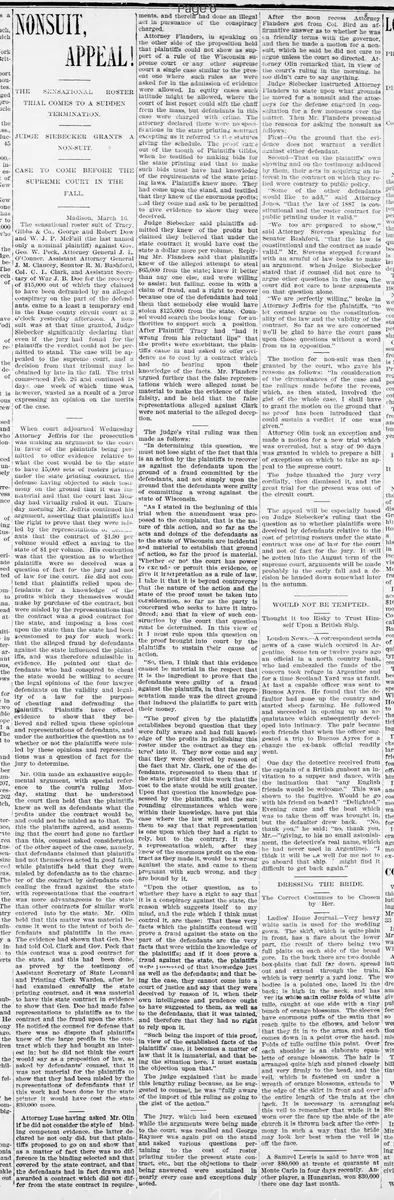
THE SENSATIONAL ROSTER TRIAL COMES TO A SUDDEN TERMINATION.
JUDGE SIEBECKER GRANTS A NON-SUIT.
CASE TO COME BEFORE THE SUPREME COURT IN THE FALL.
Madison, March 16.
The sensational roster suit of Tracy Gibbs & Co., George and Robert Dow and W. J. P. McFail (the last named only a nominal plaintiff) against Gov. Geo. W. Peck, Attorney General J. L. O'Connor, Assistant Attorney General J. M. Clancey, Senator R. M. Bashford, Col. C. I. Clark, and Assistant Secretary of War J. B. Doe for the recovery of $15,000 out of which they claimed to have been defrauded by an alleged conspiracy on the part of the defendants, came to at least a temporary end in the Dane county circuit court at 3 o'clock yesterday afternoon. A non-suit was at that time granted, Judge Siebecker significantly declaring that even if the jury had found for the plaintiffs the verdict could not be permitted to stand. The case will be appealed to the supreme court, and a decision from that tribunal may be obtained by late in the fall. The trial commenced Feb. 26 and continued 18 days, one week of which time was, however, wasted as a result of a juror expressing an opinion on the merits of the case.
When court adjourned Wednesday Attorney Jeffris for the prosecution was making an argument to the court in favor of the plaintiffs being permitted to offer evidence relative to what the cost would be to the state to have 15,000 sets of rosters printed under the state printing contract, the defense having objected to such testimony on the ground that it was immaterial and that the court last Monday had virtually ruled it out. Thursday morning Mr. Jeffris continued his argument, asserting that plaintiffs had the right to prove that they were misled by the representations of defendants that the contract of $1.90 per volume would effect a saving to the state of $1 per volume. His contention was that the question as to whether plaintiffs were so deceived was a question of fact for the jury and not of law for the court. He did not contend that plaintiffs relied upon defendants for a knowledge of the profits which they themselves would make by purchase of the contract, but were misled by the representations that the contract was a good contract for the state, and imposing a less cost upon the state than the state had been accustomed to pay for such work; that the alleged fraud by defendants against the state influenced the plaintiffs, and was therefore admissible in evidence. He pointed out that defendants who had conspired to cheat the state would be willing to secure the legal opinions of the four lawyer defendants on the validity and legality of a law for the purpose of cheating and defrauding the plaintiffs. Plaintiffs have offered evidence to show that they believed and relied upon these opinions and representations of defendants, and under the authorities the question as to whether or not the plaintiffs were misled by these opinions and representations was a question of fact for the jury to determine.
Mr. Olin made an exhaustive supplemental argument, with special reference to the court's ruling Monday, stating that he understood the court then held that the plaintiffs knew as well as defendants what the profits under the contract would be, and could not be misled as to that. To this the plaintiffs agreed, and assuming that the court had gone no farther than this, counsel asked consideration of the other aspect of the case, namely, that defendants claimed that plaintiffs had not themselves acted in good faith, while plaintiffs held that they were misled by defendants as to the character of the contract by defendants concealing the fraud against the state with representations that the contract was more advantageous to the state than other contracts for similar work entered into by the state. Mr. Olin held that this matter was material because it went to the intent of both defendants and plaintiffs in the case. The evidence had shown that Gen. Doe had told Col. Clark and Gov. Peck that this contract was a good contract for the state, and this had been done, as proved by the testimony of Assistant Secretary of State Leonard and Printing Clerk Warden, after he had examined carefully the state printing contract, and it was material to have this state contract in evidence to show that Gen. Doe had made false representations to plaintiffs as to the contract and the fraud upon the state. He notified the counsel for defense that there was no dispute that plaintiffs knew of the large profits in the contract which they had bought an interest in; but he did not think the court would say as a proposition of law, as asked by defendants' counsel, that it was not material for the plaintiffs to show that they had been misled by the representations of defendants that if this work had been done by the state printer it would have cost the state $30,000 more.
Attorney Luse having asked Mr. Olin if he did not consider the style of binding competent evidence, the latter declared he not only did, but that plaintiffs proposed to go on and show that as a matter of fact there was no difference in the binding selected and that covered by the state contract, and that the defendants had in fact drawn and awarded a contract which did not differ from the state contract in requirements, and therein had done an illegal act in pursuance of the conspiracy charged.
Attorney Flanders, in speaking on the other side of the proposition held that plaintiffs could not show as support of a rule of the Wisconsin supreme court or any other supreme court a single case similar to the present one where such rules as were asked for in the admission of evidence were allowed. In equity cases such latitude might be allowed, where the court of last resort could sift the chaff from the mass, but defendants in this case were charged with crime. The attorney declared there were no specifications in the state printing contract excepting as it referred to the statutes giving the schedule. The proof came out of the mouth of Plaintiffs Gibbs, when he testified to making bids for the state printing and that to make such bids must have had knowledge of the requirements of the state printing laws. Plaintiffs knew more. They had come upon the stand, and testified that they knew of the enormous profits; and they come and ask to be permitted to give evidence to show they were deceived.
Judge Siebecker said plaintiffs admitted they knew of the profits but claimed they believed that under the state contract it would have cost the state a dollar more per volume. Replying Mr. Flanders said that plaintiffs knew of the alleged attempt to steal $65,000 from the state; knew it better than any one else, and were willing to assist; but failing, come in with a claim of fraud, and a right to recover because one of the defendants had told them that somebody else would have stolen $125,000 from the state. Counsel would search the books long for authorities to support such a position. After Plaintiff Tracy had had it wrung from his reluctant lips that the profits were exorbitant, the plaintiffs came in and asked to offer evidence as to cost by a contract which had no bearing upon their knowledge of the facts. Mr. Flanders argued further that the false representations which were alleged must be material to make the evidence of their falsity, and he held that the false representations alleged against Clark were not material to the alleged deception.
The judge's vital ruling was then made as follows:
"In determining this question, we must not lose sight of the fact that this is an action by the plaintiffs to recover as against the defendants upon the ground of a fraud committed by the defendants, and not simply upon the ground that the defendants were guilty of committing a wrong against the state of Wisconsin.
"As I stated in the beginning of this trial when the amendment was proposed to the complaint, that is the nature of this action, and so far as the acts and doings of the defendants as to the state of Wisconsin are incidental and material to establish that ground of action, so far the proof is material. Whether or no the court has power to exclude or permit this evidence, or give it interpretation as a rule of law, I take it that it is beyond controversy that the nature of the action and the state of the proof must be taken into consideration, so far as the party is concerned who seeks to have it introduced; and that in view of such construction by the court that question must be determined. In this view of it I must rule upon this question on the proof brought into court by the plaintiffs to sustain their cause of action.
So, then, I think that this evidence cannot be material in the respect that it is the ingredient to prove that the defendants were guilty of a fraud against the plaintiffs, in that the representation made was the direct ground that induced the plaintiffs to part with their money.
The proof given by the plaintiffs establishes beyond question that they were fully aware and had full knowledge of the profits in publishing this roster under the contract as they entered into it. They now come and say that they were deceived by reason of the fact that Mr. Clark, one of the defendants, represented to them that if the state printer did this work that the cost to the state would be still greater. Upon that question the knowledge possessed by the plaintiffs, and the surrounding circumstances which were within their knowledge, have put this case where the law will not permit them to say that that representation is one upon which they had a right to rely, but to the contrary. It was a representation which, after they knew of the enormous profit on the contract as they made it, would be a wrong against the state, and came to them pregnant with such wrong, and they are bound by it.
"Upon the other question, as to whether they have a right to say that it is a conspiracy against the state, the reason which suggests itself to my mind, and the rule which I think must control it, are these: That these very facts which the plaintiffs contend will prove a fraud against the state on the part of the defendants are the very facts that were within the knowledge of the plaintiffs; and if it does prove a fraud against the state, the plaintiffs were possessed of that knowledge just as well as the defendants; and that being the case, they cannot come into a court of justice and say that they were deceived by reason of it, when their own intelligence and prudence ought to have suggested to them, as well as to the defendants, that it was tainted, and therefore that they had no right to rely upon it.
"Such being the import of this proof, in view of the established facts of the plaintiffs' case, it becomes a matter of law that it is immaterial, and that being the situation here, I must sustain the objection upon that."
The judge explained that he made this lengthy ruling because, as he suggested to counsel, he was "fully aware of the import of this ruling as going to the gist of the action."
The jury, which had been excused while the arguments were being made to the court, was recalled and George Raymer was again put on the stand and asked various questions pertaining to the cost of roster printing under the present state contract, etc., but the objections to their being answered were sustained in nearly every case and exceptions duly noted.
After the noon recess Attorney Flanders got from Col. Bird an affirmative answer as to whether he was on friendly terms with the governor, and then he made a motion for a non-suit, which he said he did not care to argue unless the court so directed. Attorney Olin remarked that, in view of the court's ruling in the morning, he too didn't care to say anything. Judge Siebecker instructed Attorney Flanders to state upon what grounds he moved for a nonsuit and the attorneys for the defense engaged in consultation for a few moments over the matter. Then Mr. Flanders presented the reasons for asking the nonsuit as follows:
First—On the ground that the evidence does not warrant a verdict against either defendant.
Second—That on the plaintiffs' own showing and on the testimony adduced by them, their acts in acquiring an interest in the contract on which they relied were contrary to public policy.
“…Some of the other defendants would like to add,” said Attorney Jones, “that the law of 1887 is constitutional and the roster contract for public printing under it valid.”
“We too are prepared to show,” said Attorney Stevens speaking for Senator Bashford, “that the law is constitutional and the contract as made valid.” Mr. Stevens stepped forward with an armful of law books to make an argument, when Judge Siebecker stated that if counsel did not care to argue other questions in the case the court did not care to hear arguments on that question alone.
“We are perfectly willing,” broke in Attorney Jeffris for the plaintiffs, “to let counsel argue on the constitutionality of the law and the validity of the contract. So far as we are concerned we'll be glad to have the court pass upon those questions without a word from us in opposition.'"
The motion for non-suit was then granted by the court, who gave his reasons as follows: "In consideration of the circumstances of the case and the rulings made before the recess, which, as then stated, involved the gist of the whole case, I shall have to grant the motion on the ground that no proof has been introduced that could sustain a verdict if one was given."
Attorney Olin took an exception and made a motion for a new trial which was overruled, but a stay of 90 days was granted in which to prepare a bill of exceptions on which to take an appeal to the supreme court.
The judge thanked the jury very cordially, then dismissed it, and the great trial for the present was out of the circuit court.
The appeal will be especially based on Judge Siebecker's ruling that the question as to whether plaintiffs were deceived by defendants relative to the cost of printing rosters under the state contract was one of law for the court and not of fact for the jury. It will be gotten into the August term of the supreme court, arguments will be made probably in the early fall and a decision be handed down somewhat later in the autumn.
What sub-type of article is it?
What themes does it cover?
What keywords are associated?
What entities or persons were involved?
Where did it happen?
Story Details
Key Persons
Location
Dane County Circuit Court, Madison
Event Date
Feb. 26 To March 15
Story Details
Plaintiffs sued defendants for fraud in a state roster printing contract conspiracy, claiming $15,000 loss. After 18-day trial, Judge Siebecker granted non-suit, ruling plaintiffs knew profits and could not claim deception on state costs. Case appealed to Supreme Court.