Thank you for visiting SNEWPapers!
Sign up free
The National Intelligencer And Washington Advertiser
Washington, District Of Columbia
What is this article about?
An editorial from the Aurora criticizes Federalists for hypocrisy in taxation policies, accusing them of imposing duties on salt, tea, sugar, and coffee under Adams while now pretending to support relief for the poor after losing power. It details historical duties and congressional votes from Washington and Adams eras, highlighting Republican opposition.
Merged-components note: These components form a single continuous editorial article criticizing federalist policies on taxes, with historical details and yeas/nays lists.
Clippings
1 of 2
OCR Quality
Full Text
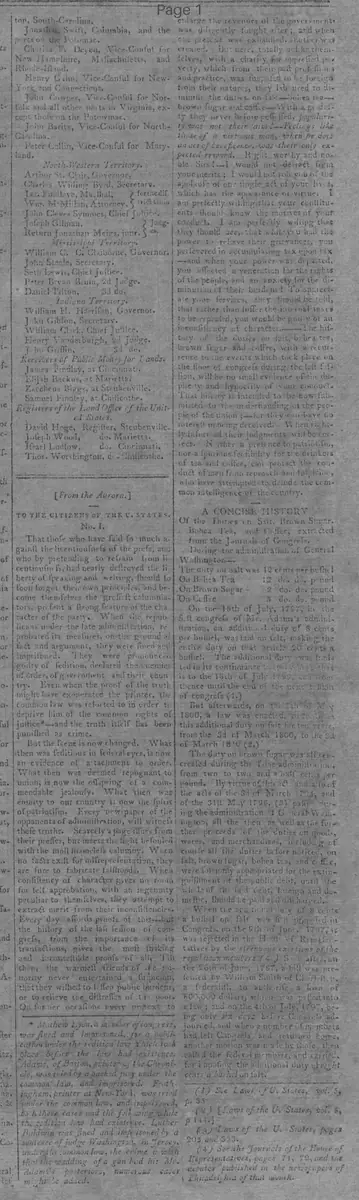
TO THE CITIZENS OF THE U. STATES.
No. I.
That those who have said so much against the licentiousness of the press, and who by pretending to refrain from licentiousness, had nearly destroyed the liberty of speaking and writing, should so soon forget their own principles, and become themselves the grossest calumniators, presents a strong feature of the character of the party. When the republicans under the late administration, reprobated its measures, on the ground of fact and argument, they were fined and imprisoned. They were pronounced guilty of sedition, declared the enemies of order, of government and their country. Even when the proof of the truth might have exonerated the printer, the common law was resorted to in order to deprive him of the common rights of justice; and the truth itself has been punished as crime.
But the scene is now changed. What then was seditious in federal eyes, is now an evidence of an attachment to order. What then was deemed repugnant to union, is now the offspring of a commendable jealousy. What then was enmity to our country is now the spirit of patriotism. Every newspaper of the opponents of administration, will witness these truths. Scarcely a page issues from their presses, but meets the sight befouled with the most shameless calumny. When no facts exist for misrepresentation, they are sure to fabricate falsehoods. When consistency of character gives no room for self approbation, with an ingenuity peculiar to themselves, they attempt to extract merit from their inconsistencies. Every day affords proofs of this—but the history of the late session of congress, from the importance of its transactions, gives the most striking and incontestible proofs of all. Till then, the warmest friends of the minority never entertained a suspicion, that they wished to lessen public burdens, or to relieve the distresses of the poor. On former occasions every pretext to enlarge the revenues of the government was diligently sought after; and when one pretext was exhausted, another was created. But here, totally unlike themselves, with a charity for oppressed poverty, which from their past professions and practice, was supposed to be foreign from their natures, they laboured to diminish the duties on salt, bohea teas, brown sugar and coffee. With an assiduity they never before evinced, popularity was not their aim. Feelings like those of a virtuous man, when he does an act of beneficence, was their only expected reward. Right worthy and noble Sirs!—I would not detract from your merits; I would not rob you of the applause of one single act of your lives, which has the appearance of virtue. I am perfectly willing that your constituents should know the motives of your conduct. I am perfectly willing that they should see, that while you had the power to relieve their grievances, you persevered in accumulating tax upon tax—and when your power was departed, you affected a veneration for the rights of the people, and an anxiety for the diminution of their burdens! To appreciate your services, they should be told, that rather than suffer the internal taxes to be repealed, you would be guilty of an inconsistency of character. The history of the duties on salt, bohea tea, brown sugar and coffee, with a recurrence to the events which took place on the floor of congress during the last session, will be no small evidence of the duplicity and hypocrisy of your conduct. That history is intended to be now submitted to the understanding of the people of the union;—for they can have no interest in being deceived. When rightly informed their judgments will be correct. Neither a pretence to patriotism, nor a spurious sensibility for the drinkers of tea and coffee, can protect the conduct of men from reproach and suspicion, who have attempted to delude the common intelligence of the country.
A CONCISE HISTORY
Of the Duties on Salt, Brown Sugar.
Bohea Tea, and Coffee, extracted
from the Journals of Congress.
During the administration of General
Washington—
The duty on salt was 12 cents per bushel.
On Bohea Tea 12 dols. per pound.
On Brown Sugar— 2 do. do. pound.
On Coffee 5 do. do. pound.
On the 18th of July, 1797, in the
fifth congress of Mr. Adams's administration, an additional duty of 8 cents
per bushel, was laid on salt, making the
entire duty on that article 20 cents a
bushel. The additional duty was limited in its continuance to twice: the
first to the 18th of July 1799, and from
thence until the end of the next session
of congress (1.)
But afterwards, on the 7th May
1800, a law was enacted, this to lay
this additional duty on salt for ten years.
from the 3d of March 1800, to the 1
of March 1810 (2.)
The duty on brown sugar was also en-
creased during the same administration,
from two to two and a half cents per
pound. By virtue of this act and also of
the acts of the 8th of March 1797, and
of the 31st May 1796. (3) passed dur-
ing the administration of John Adams, all the then as well as the further proceeds of the duties on goods,
wares, and merchandizes, including of
course all the duties before noticed, on
salt, brown sugar, bohea tea, and coffee,
were solemnly appropriated for the extin-
guishment of the public debt, until the
whole of the said debt, foreign and do-
me stic, should be paid and discharged.
When the additional duty of 8 cents
a bushel on salt was first proposed in
Congress, on the 9th of June, 1797, it
was rejected in the House of Representa-
tives by the strenuous exertions of the
republican members.(4) Soon after,
on the 26th of June, 1797, a bill was pre-
sented by William Smith of Charles-
toa federalist, to authorise a loan of
two millions of dollars, which was passed into
a law: and on the 4th of July, 1797, be-
ing only six days before Congress ad-
joumed, and when a number of members
had left Congress and returned home,
another motion was made by those then
called the federal members, and carried,
for imposing the additional duty of eight
cents a bushel on salt.
(1) See Laws of U. States, vol. 5,
p.335
(2) [Laws of the U. States, vol. 5,
p.144.]
(3) Laws of the U. States, pages
205 and 353.
(4) See the Journals of the House of
Representatives, pages 71, 72, and the
debates published in the news-papers of
Philadelphia of that month.
In this motion the yeas and nays were taken, when the yeas were 47 and the nays 41—the names are subjoined in a note.(5)
Accordingly a bill was brought in, and on the second reading passed into a law by those then called federalists, for laying the additional duty of eight cents a bushel on salt. This bill was without limitation of time, and of course designed to make the duty permanent: and a perpetual tax. The republicans thereupon moved a clause to be added to the law, which would limit the continuance of this additional duty to two years. This clause was violently opposed by the federalists, but carried by the republicans on a voice 47 to 43. (6)
At a subsequent session of Congress during Mr. Adams' administration, and after an act had been passed by the federalists to authorize another loan of five millions of dollars, at an interest of eight per cent. a motion was made by the federalists for a law "to continue in force the act passed on the 18th of July 1797, levying an additional duty on salt," this motion was carried by the federalists, 54 to 38. (7)
The bill was accordingly brought in and passed into a law by the federalists, directing the additional duty of eight cents per bushel on salt, to be continued in force, for and during the term of ten years from the 3d of March, 1800, to the 3d of March 1810. On the discussion of this bill, the republicans moved to strike out "ten years" and to insert in stead thereof "two years," so as to leave the law in force only until the 3d of March 1802, but this alteration was rejected by the federalists, 44 to 50. (8)
(3) The Yeas and Nays following are extracted from the Journal of the House of Representatives, pages, 120, 121.
YEAS.
Messrs. Allen, Baer jun. Bayard. Brooks. Chapman, Champlin, Cochran, Coit, Clark, Dana, J. Davenport, Dennis, Dent, Evans, A. Foster, D. Foster, Freeland, Goodrich, Gordon, Griswold. Hart, Hartley, Hindman, Holm, Imlay. Kittera, Lyman, Mathews, L. R. Morris, Otis, Parker, Reed, Soule, Sewall, Shepard, Smickland, Sitgreaves, J. Smith, N. Smith, W. Smith, (Charles.) Swanwick, Thatcher, Thomas Thompson, Van Allen, Wadsworth, J. Williams—47.
NAYS.
Messrs. Baldwin Baird, Benton, Brent, Bryan. Burgess, Carnell, Claiborne Clay, Clinton, Davis, Dawson, Elmendorf, Fowler, Gallatin, Gillespie. Grove, Hanna, Havens, Holmes, Jones, Locke. Lyon, Mitchill. Macon, M'Cleannchan, A. Moore. Milledge. New, Nicholas, Skinner, W. Smith, (of Pinckney district) Sprigg, jun. Stanford, Sumter, A. Trigg. J. Trigg, Van Cortlandt, Varnum, Venable, R. Williams—41.
(6.) See the Journals, pages 123 and 124—The yeas and nays stood on this vote contrary to the former, the nays being the yeas only with the following alterations: John Chapman, George Dent. Thomas Evans, Thomas Hartley, W. Kittera, and John Williams voted among the yeas, or for the limitation of the tax to two years, and Thomas Blount, and Daniel Morgan who were not present on the former vote, voted also for the limitation. Demsey Burgess who had voted against the tax altogether, voted also against this limitation, and W. B. Grove was absent on this question.
(7) See the Journal, P. 321-322—for the names as follows:-
YEAS.
Baer, Bailey, Bartlett, Bayard, Brace, Brown, Champlin, Cooper, Dana, J. Davenport. F. Davenport, Dennis, Dent, Elmendorf, Evans, A. Foster, D. Foster, Freeland, Glen, C. Goodrich. E. Goodrich, Gordon, Gray, Griswold, Grove, Harper, Hill, Huger, Imlay, Kitchell, Lee, Lyman, Linn, Morris, Nott, Page, Parker, Pinckney, Platt, Powell, Reed. Rutledge, Sewall, Sheafe, Shepard, Smith, Spaight, Thatcher, J. C. Thomas, R. Thomas, P. Van Cortlandt, Wadsworth, Waln, L. Williams. --54.
NAYS.
Aiton, Bishop, Brown, Cabell, Christie, Clay, Claiborne, Davis, Dawson, Dickson, Eggleston, Elmendorf, Fowler, Gallatin, Gregg, Hartley, Henderson, Holmes, Jackson, Jones, Lyon, Macon, Muhlenberg, New, Nicholas, Nicholson, Randolph, Saul, Stanford, Stone, Sumter, Talliaferro, Thompson, A. Trigg, J. Trigg, Varnum, R. Williams, Woods. -38.
(8) See Journals, page 338, 339, for the yeas and nays, which were as follows:
YEAS.
Alton, Bishop, Brown, Cabell, Clay, Claiborne, Condit, Dawson, Dickson, Eggleston, Elmendorf, Fowler, Gallatin, Gray. Gregg; Hanna, Hartley, Hester, Henderson, Holmes, Jackson, Jones, Leib, Lyon, Linn. Macon, Muhlenberg, New, Nicholas, Nicholson, Nott, Randolph, Smith, Smilie, Stanford. Stone, Sumter, Taliaferro, Thomas, A.
From the foregoing facts, it will appear that the duties on salt, brown sugar, bohea tea, and coffee, were originally laid during the administration of Gen. Washington.
That additional duties on salt and brown sugar were imposed by the federalists, during the administration of Adams.
That the additional duty of eight cents per bushel on salt, was, when first proposed by the federalists, rejected by the republicans.
That the same additional duty was afterwards, in the same session, moved and carried by the Federalists.
That it was again strenuously objected to and opposed by the Republicans.
That this additional duty was first proposed to be made perpetual by the Federalists.
That this attempt was opposed and defeated by the Republicans.
That the first limitation of the said additional duty to two years was moved and carried by the Republicans.
That this limitation to two years was objected to and opposed by the Federalists.
That the law passed May 7, 1800, to continue the additional duty of eight cents per bushel on salt for ten years, was first proposed by the Federalists.
That it was vigorously opposed by the Republicans.
That a second attempt to limit the said additional duty to two years, that is, to the 3d March, 1802, was made by the Republicans.
That this attempt was defeated, and the law as it now stands to continue the said additional duty until the 3d March, 1810. was carried by the Federalists.
That the increase and continuance of these duties were preceded by laws authorizing loans of money to the public.
and
That the proceeds of the duties on salt, bohea tea, brown sugar, and coffee, were by law appropriated to the payment of the public debt until the whole of it should be discharged.
The reflections resulting from these facts, and from the repeal of the internal taxes, will in a future number be submitted to the calm and dispassionate judgment of a free and discerning people.
ANDREW MARVEL.
Trigg, Varnum, R. Williams, Woods. —44.
NAYS.
Baer, Bailey. Bartlett, Bayard, Bird, Brace, Brown Champlin, Cooper, Dana, J. Davenport, F. Davenport. Dennis, Dent, Edmord, Evans, A. Fuller, D. Foster, Glen. C. Goodrich, E. Goodrich, Gordon, Griswold, Harper, Hill, Huger, Imlay, Kitchell, H. Lee, S. Lee, Lyman, Marshall, Morris, Page. Parker, Pinckney, Platt, Powell, Reed, Rutledge, Sewall, Shepard, S. Smith, Thatcher, J. C. Thomas, R. Thomas, Van Cortlandt, Wadsworth, Waln, L. Williams—50.
What sub-type of article is it?
What keywords are associated?
What entities or persons were involved?
Editorial Details
Primary Topic
Federalist Hypocrisy In Taxation And Duties On Salt, Tea, Sugar, And Coffee
Stance / Tone
Accusatory And Anti Federalist
Key Figures
Key Arguments