Thank you for visiting SNEWPapers!
Sign up free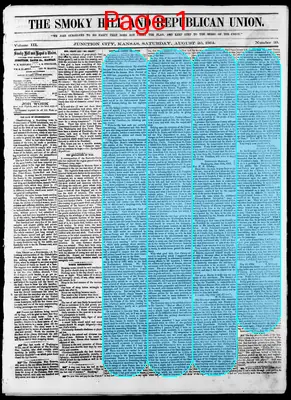
Editorial
August 20, 1864
The Smoky Hill And Republican Union
Junction City, Geary County, Kansas
What is this article about?
James G. Blunt's editorial sharply criticizes Kansas Governor Thomas Carney for duplicity in military affairs, betrayal of promises on officer removals and recruitment, support for Gen. Schofield post-Lawrence massacre, and impertinent correspondence with President Lincoln, defending Blunt's own command integrity during the Civil War.
Clipping
OCR Quality
95%
Excellent
Full Text
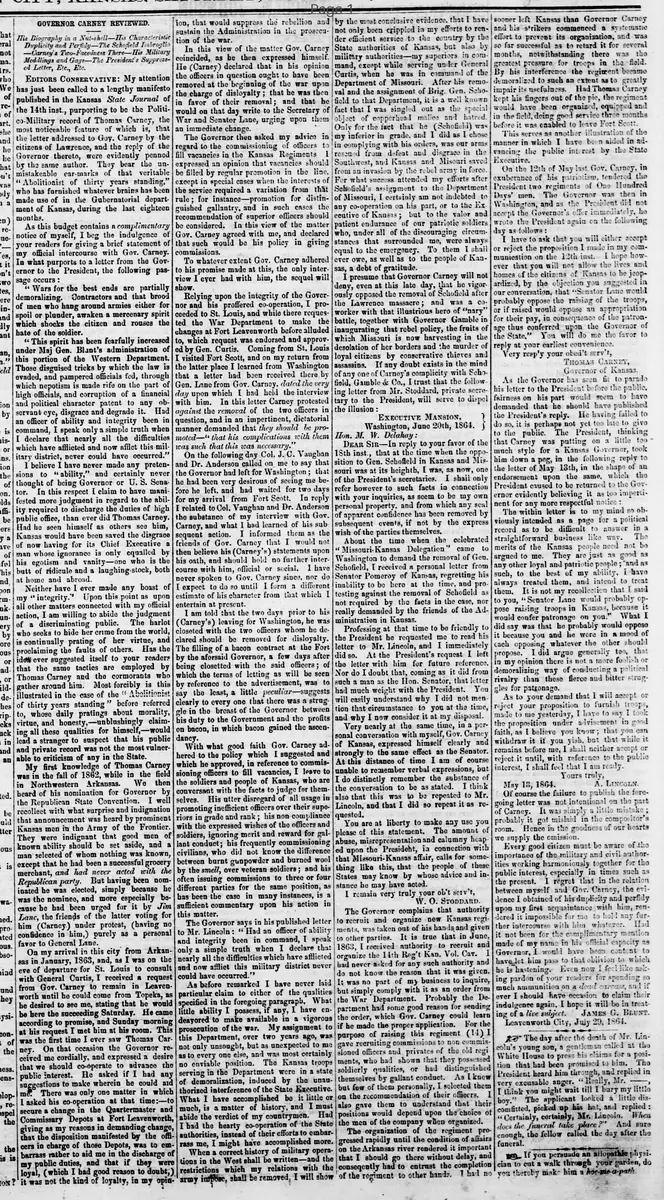
GOVERNOR CARNEY REVIEWED
His Biography in a Nut-shell—His Characteristic Duplicity and Perfidy—The Schofield Imbroglio—Carney's Two-Facedness There—His Military Meddlings and Gags—The President's Suppressed Letter, Etc., Etc.
Editors Conservative: My attention has just been called to a lengthy manifesto published in the Kansas State Journal of the 14th inst., purporting to be the Politico-Military record of Thomas Carney, the most noticeable feature of which is, that the letter addressed to Gov. Carney by the citizens of Lawrence, and the reply of the Governor thereto, were evidently penned by the same author. They bear the unmistakable ear-marks of that veritable "Abolitionist of thirty years standing," who has furnished whatever brains has been made use of in the Gubernatorial department of Kansas, during the last eighteen months.
As this budget contains a complimentary notice of myself, I beg the indulgence of your readers for giving a brief statement of my official intercourse with Gov. Carney.
In what purports to a letter from the Governor to the President, the following passage occurs:
"Wars for the best ends are partially demoralizing. Contractors and that brood of men who hang around armies either for spoil or plunder, awaken a mercenary spirit which shocks the citizen and rouses the hate of the soldier.
"This spirit has been fearfully increased under Maj Gen. Blunt's administration of this portion of the Western Department. Those disguised tricks by which the law is evaded, and pampered officials fed, through which nepotism is made rife on the part of high officials, and corruption of a financial and political character patent to any observant eye, disgrace and degrade it. Had an officer of ability and integrity been in command, I speak only a simple truth when I declare that nearly all the difficulties which have afflicted and now afflict this military district, never could have occurred."
I believe I have never made any pretensions to "ability," and certainly never thought of being Governor or U. S. Senator. In this respect I claim to have manifested more judgment in regard to the ability required to discharge the duties of high public office, than ever did Thomas Carney. Had he seen himself as others see him, Kansas would have been saved the disgrace of now having for its Chief Executive a man whose ignorance is only equalled by his egotism and vanity—one who is the butt of ridicule and a laughing-stock, both at home and abroad.
Neither have I ever made any boast of my "integrity." Upon this point as upon all other matters connected with my official action, I am willing to abide the judgment of a discriminating public. The harlot who seeks to hide her crime from the world, is continually prating of her virtue, and proclaiming the faults of others. Has the idea ever suggested itself to your readers that the same tactics are employed by Thomas Carney and the cormorants who gather around him. Most forcibly is this illustrated in the case of the "Abolitionist of thirty years standing" before referred to, whose daily pratings about morality, virtue, and honesty,—unblushingly claiming all these qualities for himself,—would lead a stranger to suspect that his public and private record was not the most vulnerable to criticism of any in the State.
My first knowledge of Thomas Carney was in the fall of 1862, while in the field in Northwestern Arkansas. We then heard of his nomination for Governor by the Republican State Convention. I well recollect with what surprise and indignation that announcement was heard by prominent Kansas men in the Army of the Frontier. They were indignant that good men of known ability should be set aside, and a man selected of whom nothing was known, except that he had been a successful grocery merchant, and had never acted with the Republican party. But having been nominated he was elected, simply because he was the nominee, and more especially because he had been urged for it by Jim Lane, the friends of the latter voting for him (Carney) under protest, (having no confidence in him,) purely as a personal favor to General Lane.
On my arrival in this city from Arkansas in January, 1863, and, as I was on the eve of departure for St. Louis to consult with General Curtis, I received a request from Gov. Carney to remain in Leavenworth until he could come from Topeka, as he desired to see me, stating that he would be here the succeeding Saturday. He came according to promise, and Sunday morning at his request I met him at his room. This was the first time I ever saw Thomas Carney. On that occasion the Governor received me cordially, and expressed a desire that we should co-operate to advance the public interest. He asked if I had any suggestions to make wherein he could aid me. There was only one matter in which I asked his co-operation at that time: to secure a change in the Quartermaster and Commissary Depots at Fort Leavenworth, giving as my reasons in demanding change, that the disposition manifested by the officers in charge of those Depots, was to embarrass rather to aid me in the discharge of my public duties, and that if they were loyal, (which I had good reason to doubt,) it was not the kind of loyalty, in my opinion, that would suppress the rebellion and sustain the Administration in the prosecution of the war.
In this view of the matter Gov. Carney coincided, as he then expressed himself. He (Carney) declared that in his opinion the officers in question ought to have been removed at the beginning of the war upon the charge of disloyalty; that he was then in favor of their removal; and that he would on that day write to the Secretary of War and Senator Lane, urging upon them an immediate change.
The Governor then asked my advice in regard to the commissioning of officers to fill vacancies in the Kansas Regiments. I expressed an opinion that vacancies should be filled by regular promotion in the line, except in special cases when the interests of the service required a variation from that rule; for instance—promotion for distinguished gallantry, and in such cases the recommendation of superior officers should be considered. In this view of the matter Gov. Carney agreed with me, and declared that such would be his policy in giving commissions.
To whatever extent Gov. Carney adhered to his promise made at this, the only interview I ever had with him, the sequel will show.
Relying upon the integrity of the Governor and his proffered co-operation, I proceeded to St. Louis, and while there requested the War Department to make the changes at Fort Leavenworth before alluded to, which request was endorsed and approved by Gen. Curtis. Coming from St. Louis I visited Fort Scott, and on my return from the latter place I learned from Washington that a letter had been received there by Gen. Lane from Gov. Carney, dated the very day upon which I had held the interview with him. In this letter Carney protested against the removal of the two officers in question, and in an impertinent, dictatorial manner demanded that they should be promoted—“that his complications with them was such that this was necessary."
On the following day Col. J. C. Vaughan and Dr. Anderson called on me to say that the Governor had left for Washington; that he had been very desirous of seeing me before he left, and had waited for two days for my arrival from Fort Scott. In reply I related to Col. Vaughan and Dr. Anderson the substance of my interview with Gov. Carney, and what I had learned of his subsequent action. I informed them as the friends of Gov. Carney that I would not then believe his (Carney's) statements upon his oath, and should hold no further intercourse with him, official or social. I have never spoken to Gov. Carney since, nor do I expect to do so until I form a different estimate of his character from that which I entertain at present.
I am told that the two days prior to his (Carney's) leaving for Washington, he was closeted with the two officers whom he declared should be removed for disloyalty. The filling of a bacon contract at the Fort by the aforesaid Governor, a few days after being closeted with the said officers; of which the terms of letting as will be seen by reference to the advertisement, was to say the least, a little peculiar—suggests clearly to every one that there was a struggle in the breast of the Governor between his duty to the Government and the profits on bacon, in which bacon gained the ascendancy.
With what good faith Gov. Carney adhered to the policy which I suggested and which he approved, in reference to commissioning officers to fill vacancies, I leave to the soldiers and people of Kansas, who are conversant with the facts to judge for themselves. His utter disregard of all usage in promoting inefficient officers over their superiors in grade and rank; his non compliance with the expressed wishes of the officers and soldiers, ignoring merit and reward for gallant conduct; his frequently commissioning civilians, who did not know the difference between burnt gunpowder and burned wool by the smell, over veteran soldiers; and his often issuing commissions to three or four different parties for the same position, as has been the case in many instances, is a sufficient commentary upon his action in this matter.
The Governor says in his published letter to Mr. Lincoln: "Had an officer of ability and integrity been in command, I speak only a simple truth when I declare that nearly all the difficulties which have afflicted and now afflict this military district never could have occurred."
As before remarked I have never laid particular claim to either of the qualities specified in the foregoing paragraph. What little ability I possess, if any, I have endeavored to make available in a vigorous prosecution of the war. My assignment to this Department, over two years ago, was not only unsought, but as unexpected to me as to every one else, and was most certainly no enviable position. The Kansas troops serving in the Department were in a state of demoralization, induced by the unauthorized interference of the State Executive. What I have accomplished be it little or much, is a matter of history, and I must abide the verdict of my countrymen. Had I had the hearty co-operation of the State authorities, instead of their efforts to embarrass me, I might have accomplished more.
When a correct history of military operations in the West shall be written—and the restrictions which my relations with the army impose, shall be removed, I will show by the most conclusive evidence, that I have not only been crippled in my efforts to render efficient service to the country by the State authorities of Kansas, but also by military authorities—my superiors in command, except while serving under General Curtis, when he was in command of the Department of Missouri. After his removal and the assignment of Brig. Gen. Schofield to that Department, it is a well known fact that I was singled out as the special object of copperhead malice and hatred. Only for the fact that he (Schofield) was my inferior in grade, and I did as I chose in complying with his orders, was our army rescued from defeat and disgrace in the Southwest, and Kansas and Missouri saved from an invasion by the rebel army in force.
For what success attended my efforts after Schofield's assignment to the Department of Missouri, I certainly am not indebted to any co-operation on his part, or to the Executive of Kansas; but to the valor and patient endurance of our patriotic soldiers who, under all of the discouraging circumstances that surrounded me, were always equal to the emergency. To them I shall ever owe, as well as to the people of Kansas, a debt of gratitude.
I presume that Governor Carney will not deny, even at this late day, that he vigorously opposed the removal of Schofield after the Lawrence massacre; and was a co-worker with that illustrious hero of "nary" battle, together with Governor Gamble in inaugurating that rebel policy, the fruits of which Missouri is now harvesting in the desolation of her borders and the murder of loyal citizens by conservative thieves and assassins. If any doubt exists in the mind of any one of Carney's complicity with Schofield, Gamble & Co., I trust that the following letter from Mr. Stoddard, private secretary to the President, will serve to dispel the illusion:
Executive Mansion,
Washington, June 20th, 1864.
Hon. M. W. Delahay:
Dear Sir—In reply to your favor of the 18th inst., that at the time when the opposition to Gen. Schofield in Kansas and Missouri was at its height, I was, as now, one of the President's secretaries. I shall only refer however to such facts in connection with your inquiries, as seem to be my own personal property, and from which any seal of apparent confidence has been removed by subsequent events, if not by the express wish of the parties themselves.
About the time when the celebrated "Missouri-Kansas Delegation" came to Washington to demand the removal of Gen. Schofield, I received a personal letter from Senator Pomeroy of Kansas, regretting his inability to be here at the time, and protesting against the removal of Schofield as not required by the facts in the case, nor really demanded by the friends of the Administration in Kansas.
Professing at that time to be friendly to the President he requested me to read his letter to Mr. Lincoln, and I immediately did so. At the President's request I left the letter with him for future reference. Nor do I doubt that, coming as it did from such a man as the Hon. Senator, that letter had much weight with the President. You will easily understand why I did not mention that circumstance to you at the time, and why I now consider it at my disposal.
Very nearly at the same time, in a personal conversation with myself, Gov. Carney of Kansas, expressed himself clearly and strongly to the same effect as the Senator. At this distance of time I am of course unable to remember verbal expressions, but I do distinctly remember the substance of the conversation to be as stated. I think also that this was to be repeated to Mr. Lincoln, and that I did so repeat it as requested.
You are at liberty to make any use you please of this statement. The amount of abuse, misrepresentation and calumny heaped upon the President, in connection with that Missouri-Kansas affair, calls for something like this, that the people of these States may know by whose advice and instance he may have acted.
I remain very truly your ob't serv't,
W. O. STODDARD.
The Governor complains that authority to recruit and organize new Kansas regiments, was taken out of his hands and given to other parties. It is true that in June, 1863, I received authority to recruit and organize the 14th Reg't Kan. Vol. Cav. I had never asked for any such authority and do not know the reason that it was given. It was no part of my business to inquire, but simply comply with it as an order from the War Department. Probably the Department had some good reason for sending the order, which Gov. Carney could learn if he made the proper application. For the purpose of raising this regiment (14) I gave recruiting commissions to non-commissioned officers and privates of the old regiments, who had shown that they possessed soldierly qualities, or had distinguished themselves by gallant conduct. As I knew but few of them personally, I selected them on the recommendation of their officers. I also gave them to understand that their positions would depend upon the choice of the men of the company when organized.
The organization of the regiment progressed rapidly until the condition of affairs on the Arkansas river rendered it important that I should go there without delay, and consequently had to entrust the completion of the regiment to other hands. I had no sooner left Kansas than Governor Carney and his strikers commenced a systematic effort to prevent its organization, and was so far successful as to retard it for several months, notwithstanding there was the greatest pressure for troops in the field. By his interference the regiment became demoralized to such an extent as to greatly impair its usefulness. Had Thomas Carney kept his fingers out of the pie, the regiment would have been organized, equipped and in the field, doing good service three months before it was enabled to leave Fort Scott.
This serves as another illustration of the manner in which I have been aided in advancing the public interest by the State Executive.
On the 12th of May last Gov. Carney, in exuberance of his patriotism, tendered the President two regiments of One Hundred Days' men. The Governor was then in Washington, and as the President did not accept the Governor's offer immediately, he wrote the President again on the following day as follows:
I have to ask that you will either accept or reject the proposition I made in my communication on the 12th inst. I hope however that you will not allow the lives and homes of the citizens of Kansas to be jeopardized, by the objection you suggested in our conversation, that "Senator Lane would probably oppose the raising of the troops, or if raised would oppose an appropriation for their pay, in consequence of the patronage thus conferred upon the Governor of the State." You will do me the favor to reply at your earliest convenience.
Very resp'y your obed't serv't,
THOMAS CARNEY,
Governor of Kansas.
As the Governor has seen fit to parade his letter to the President before the public, fairness on his part would seem to have demanded that he should have published the President's reply. He having failed to do so, it is perhaps not yet too late to give it to the public. The President, thinking that Carney was putting on a little too much style for a Kansas Governor, took him down a peg, in the following reply to the letter of May 13th, in the shape of an endorsement upon the same, which the President caused to be returned to the Governor evidently believing it as too impertinent for any more respectful notice:
The within letter is to my mind so obviously intended as a page for a political record as to be difficult to answer in a straightforward business like way. The merits of the Kansas people need not be argued to me. They are just as good as any other loyal and patriotic people; and as such, to the best of my ability, I have always treated them, and intend to treat them. It is not my recollection that I said to you, "Senator Lane would probably oppose raising troops in Kansas, because it would confer patronage on you." What I did say was that he probably would oppose it because you and he were in a mood of each opposing whatever the other should propose. I did argue generally too, that in my opinion there is not a more foolish or demoralizing way of conducting a political rivalry than these fierce and bitter struggles for patronage.
As to your demand that I will accept or reject your proposition to furnish troops, made to me yesterday, I have to say I took the proposition under advisement in good faith, as I believe you know; that you can withdraw it if you wish, but that while it remains before me, I shall neither accept or reject it until, with reference to the public interest, I shall feel that I am ready.
Yours truly,
A. LINCOLN.
May 13, 1864.
Of course the failure to publish the foregoing letter was not intentional on the part of Carney. It was simply a little mistake; probably it got mislaid in the compositor's room. Hence in the goodness of our hearts we supply the omission.
Every good citizen must be aware of the importance of the military and civil authorities working harmoniously together for the public interest, especially in times such as the present. I regret that in the relation between myself and Gov. Carney, the evidence I obtained of his duplicity and perfidy upon my first acquaintance with him, rendered it impossible for me to hold any further intercourse with him whatever. Had it not been for the complimentary mention made of my name in his official capacity as Governor, I would have been content to have let him pass to that oblivion to which he is hastening. Even now I feel like asking pardon of your readers for spending so much ammunition on a dead carcass, and if ever I should have occasion to claim their indulgence again, I hope it will be in treating of a live subject.
James G. Blunt.
Leavenworth City, July 29, 1864.
His Biography in a Nut-shell—His Characteristic Duplicity and Perfidy—The Schofield Imbroglio—Carney's Two-Facedness There—His Military Meddlings and Gags—The President's Suppressed Letter, Etc., Etc.
Editors Conservative: My attention has just been called to a lengthy manifesto published in the Kansas State Journal of the 14th inst., purporting to be the Politico-Military record of Thomas Carney, the most noticeable feature of which is, that the letter addressed to Gov. Carney by the citizens of Lawrence, and the reply of the Governor thereto, were evidently penned by the same author. They bear the unmistakable ear-marks of that veritable "Abolitionist of thirty years standing," who has furnished whatever brains has been made use of in the Gubernatorial department of Kansas, during the last eighteen months.
As this budget contains a complimentary notice of myself, I beg the indulgence of your readers for giving a brief statement of my official intercourse with Gov. Carney.
In what purports to a letter from the Governor to the President, the following passage occurs:
"Wars for the best ends are partially demoralizing. Contractors and that brood of men who hang around armies either for spoil or plunder, awaken a mercenary spirit which shocks the citizen and rouses the hate of the soldier.
"This spirit has been fearfully increased under Maj Gen. Blunt's administration of this portion of the Western Department. Those disguised tricks by which the law is evaded, and pampered officials fed, through which nepotism is made rife on the part of high officials, and corruption of a financial and political character patent to any observant eye, disgrace and degrade it. Had an officer of ability and integrity been in command, I speak only a simple truth when I declare that nearly all the difficulties which have afflicted and now afflict this military district, never could have occurred."
I believe I have never made any pretensions to "ability," and certainly never thought of being Governor or U. S. Senator. In this respect I claim to have manifested more judgment in regard to the ability required to discharge the duties of high public office, than ever did Thomas Carney. Had he seen himself as others see him, Kansas would have been saved the disgrace of now having for its Chief Executive a man whose ignorance is only equalled by his egotism and vanity—one who is the butt of ridicule and a laughing-stock, both at home and abroad.
Neither have I ever made any boast of my "integrity." Upon this point as upon all other matters connected with my official action, I am willing to abide the judgment of a discriminating public. The harlot who seeks to hide her crime from the world, is continually prating of her virtue, and proclaiming the faults of others. Has the idea ever suggested itself to your readers that the same tactics are employed by Thomas Carney and the cormorants who gather around him. Most forcibly is this illustrated in the case of the "Abolitionist of thirty years standing" before referred to, whose daily pratings about morality, virtue, and honesty,—unblushingly claiming all these qualities for himself,—would lead a stranger to suspect that his public and private record was not the most vulnerable to criticism of any in the State.
My first knowledge of Thomas Carney was in the fall of 1862, while in the field in Northwestern Arkansas. We then heard of his nomination for Governor by the Republican State Convention. I well recollect with what surprise and indignation that announcement was heard by prominent Kansas men in the Army of the Frontier. They were indignant that good men of known ability should be set aside, and a man selected of whom nothing was known, except that he had been a successful grocery merchant, and had never acted with the Republican party. But having been nominated he was elected, simply because he was the nominee, and more especially because he had been urged for it by Jim Lane, the friends of the latter voting for him (Carney) under protest, (having no confidence in him,) purely as a personal favor to General Lane.
On my arrival in this city from Arkansas in January, 1863, and, as I was on the eve of departure for St. Louis to consult with General Curtis, I received a request from Gov. Carney to remain in Leavenworth until he could come from Topeka, as he desired to see me, stating that he would be here the succeeding Saturday. He came according to promise, and Sunday morning at his request I met him at his room. This was the first time I ever saw Thomas Carney. On that occasion the Governor received me cordially, and expressed a desire that we should co-operate to advance the public interest. He asked if I had any suggestions to make wherein he could aid me. There was only one matter in which I asked his co-operation at that time: to secure a change in the Quartermaster and Commissary Depots at Fort Leavenworth, giving as my reasons in demanding change, that the disposition manifested by the officers in charge of those Depots, was to embarrass rather to aid me in the discharge of my public duties, and that if they were loyal, (which I had good reason to doubt,) it was not the kind of loyalty, in my opinion, that would suppress the rebellion and sustain the Administration in the prosecution of the war.
In this view of the matter Gov. Carney coincided, as he then expressed himself. He (Carney) declared that in his opinion the officers in question ought to have been removed at the beginning of the war upon the charge of disloyalty; that he was then in favor of their removal; and that he would on that day write to the Secretary of War and Senator Lane, urging upon them an immediate change.
The Governor then asked my advice in regard to the commissioning of officers to fill vacancies in the Kansas Regiments. I expressed an opinion that vacancies should be filled by regular promotion in the line, except in special cases when the interests of the service required a variation from that rule; for instance—promotion for distinguished gallantry, and in such cases the recommendation of superior officers should be considered. In this view of the matter Gov. Carney agreed with me, and declared that such would be his policy in giving commissions.
To whatever extent Gov. Carney adhered to his promise made at this, the only interview I ever had with him, the sequel will show.
Relying upon the integrity of the Governor and his proffered co-operation, I proceeded to St. Louis, and while there requested the War Department to make the changes at Fort Leavenworth before alluded to, which request was endorsed and approved by Gen. Curtis. Coming from St. Louis I visited Fort Scott, and on my return from the latter place I learned from Washington that a letter had been received there by Gen. Lane from Gov. Carney, dated the very day upon which I had held the interview with him. In this letter Carney protested against the removal of the two officers in question, and in an impertinent, dictatorial manner demanded that they should be promoted—“that his complications with them was such that this was necessary."
On the following day Col. J. C. Vaughan and Dr. Anderson called on me to say that the Governor had left for Washington; that he had been very desirous of seeing me before he left, and had waited for two days for my arrival from Fort Scott. In reply I related to Col. Vaughan and Dr. Anderson the substance of my interview with Gov. Carney, and what I had learned of his subsequent action. I informed them as the friends of Gov. Carney that I would not then believe his (Carney's) statements upon his oath, and should hold no further intercourse with him, official or social. I have never spoken to Gov. Carney since, nor do I expect to do so until I form a different estimate of his character from that which I entertain at present.
I am told that the two days prior to his (Carney's) leaving for Washington, he was closeted with the two officers whom he declared should be removed for disloyalty. The filling of a bacon contract at the Fort by the aforesaid Governor, a few days after being closeted with the said officers; of which the terms of letting as will be seen by reference to the advertisement, was to say the least, a little peculiar—suggests clearly to every one that there was a struggle in the breast of the Governor between his duty to the Government and the profits on bacon, in which bacon gained the ascendancy.
With what good faith Gov. Carney adhered to the policy which I suggested and which he approved, in reference to commissioning officers to fill vacancies, I leave to the soldiers and people of Kansas, who are conversant with the facts to judge for themselves. His utter disregard of all usage in promoting inefficient officers over their superiors in grade and rank; his non compliance with the expressed wishes of the officers and soldiers, ignoring merit and reward for gallant conduct; his frequently commissioning civilians, who did not know the difference between burnt gunpowder and burned wool by the smell, over veteran soldiers; and his often issuing commissions to three or four different parties for the same position, as has been the case in many instances, is a sufficient commentary upon his action in this matter.
The Governor says in his published letter to Mr. Lincoln: "Had an officer of ability and integrity been in command, I speak only a simple truth when I declare that nearly all the difficulties which have afflicted and now afflict this military district never could have occurred."
As before remarked I have never laid particular claim to either of the qualities specified in the foregoing paragraph. What little ability I possess, if any, I have endeavored to make available in a vigorous prosecution of the war. My assignment to this Department, over two years ago, was not only unsought, but as unexpected to me as to every one else, and was most certainly no enviable position. The Kansas troops serving in the Department were in a state of demoralization, induced by the unauthorized interference of the State Executive. What I have accomplished be it little or much, is a matter of history, and I must abide the verdict of my countrymen. Had I had the hearty co-operation of the State authorities, instead of their efforts to embarrass me, I might have accomplished more.
When a correct history of military operations in the West shall be written—and the restrictions which my relations with the army impose, shall be removed, I will show by the most conclusive evidence, that I have not only been crippled in my efforts to render efficient service to the country by the State authorities of Kansas, but also by military authorities—my superiors in command, except while serving under General Curtis, when he was in command of the Department of Missouri. After his removal and the assignment of Brig. Gen. Schofield to that Department, it is a well known fact that I was singled out as the special object of copperhead malice and hatred. Only for the fact that he (Schofield) was my inferior in grade, and I did as I chose in complying with his orders, was our army rescued from defeat and disgrace in the Southwest, and Kansas and Missouri saved from an invasion by the rebel army in force.
For what success attended my efforts after Schofield's assignment to the Department of Missouri, I certainly am not indebted to any co-operation on his part, or to the Executive of Kansas; but to the valor and patient endurance of our patriotic soldiers who, under all of the discouraging circumstances that surrounded me, were always equal to the emergency. To them I shall ever owe, as well as to the people of Kansas, a debt of gratitude.
I presume that Governor Carney will not deny, even at this late day, that he vigorously opposed the removal of Schofield after the Lawrence massacre; and was a co-worker with that illustrious hero of "nary" battle, together with Governor Gamble in inaugurating that rebel policy, the fruits of which Missouri is now harvesting in the desolation of her borders and the murder of loyal citizens by conservative thieves and assassins. If any doubt exists in the mind of any one of Carney's complicity with Schofield, Gamble & Co., I trust that the following letter from Mr. Stoddard, private secretary to the President, will serve to dispel the illusion:
Executive Mansion,
Washington, June 20th, 1864.
Hon. M. W. Delahay:
Dear Sir—In reply to your favor of the 18th inst., that at the time when the opposition to Gen. Schofield in Kansas and Missouri was at its height, I was, as now, one of the President's secretaries. I shall only refer however to such facts in connection with your inquiries, as seem to be my own personal property, and from which any seal of apparent confidence has been removed by subsequent events, if not by the express wish of the parties themselves.
About the time when the celebrated "Missouri-Kansas Delegation" came to Washington to demand the removal of Gen. Schofield, I received a personal letter from Senator Pomeroy of Kansas, regretting his inability to be here at the time, and protesting against the removal of Schofield as not required by the facts in the case, nor really demanded by the friends of the Administration in Kansas.
Professing at that time to be friendly to the President he requested me to read his letter to Mr. Lincoln, and I immediately did so. At the President's request I left the letter with him for future reference. Nor do I doubt that, coming as it did from such a man as the Hon. Senator, that letter had much weight with the President. You will easily understand why I did not mention that circumstance to you at the time, and why I now consider it at my disposal.
Very nearly at the same time, in a personal conversation with myself, Gov. Carney of Kansas, expressed himself clearly and strongly to the same effect as the Senator. At this distance of time I am of course unable to remember verbal expressions, but I do distinctly remember the substance of the conversation to be as stated. I think also that this was to be repeated to Mr. Lincoln, and that I did so repeat it as requested.
You are at liberty to make any use you please of this statement. The amount of abuse, misrepresentation and calumny heaped upon the President, in connection with that Missouri-Kansas affair, calls for something like this, that the people of these States may know by whose advice and instance he may have acted.
I remain very truly your ob't serv't,
W. O. STODDARD.
The Governor complains that authority to recruit and organize new Kansas regiments, was taken out of his hands and given to other parties. It is true that in June, 1863, I received authority to recruit and organize the 14th Reg't Kan. Vol. Cav. I had never asked for any such authority and do not know the reason that it was given. It was no part of my business to inquire, but simply comply with it as an order from the War Department. Probably the Department had some good reason for sending the order, which Gov. Carney could learn if he made the proper application. For the purpose of raising this regiment (14) I gave recruiting commissions to non-commissioned officers and privates of the old regiments, who had shown that they possessed soldierly qualities, or had distinguished themselves by gallant conduct. As I knew but few of them personally, I selected them on the recommendation of their officers. I also gave them to understand that their positions would depend upon the choice of the men of the company when organized.
The organization of the regiment progressed rapidly until the condition of affairs on the Arkansas river rendered it important that I should go there without delay, and consequently had to entrust the completion of the regiment to other hands. I had no sooner left Kansas than Governor Carney and his strikers commenced a systematic effort to prevent its organization, and was so far successful as to retard it for several months, notwithstanding there was the greatest pressure for troops in the field. By his interference the regiment became demoralized to such an extent as to greatly impair its usefulness. Had Thomas Carney kept his fingers out of the pie, the regiment would have been organized, equipped and in the field, doing good service three months before it was enabled to leave Fort Scott.
This serves as another illustration of the manner in which I have been aided in advancing the public interest by the State Executive.
On the 12th of May last Gov. Carney, in exuberance of his patriotism, tendered the President two regiments of One Hundred Days' men. The Governor was then in Washington, and as the President did not accept the Governor's offer immediately, he wrote the President again on the following day as follows:
I have to ask that you will either accept or reject the proposition I made in my communication on the 12th inst. I hope however that you will not allow the lives and homes of the citizens of Kansas to be jeopardized, by the objection you suggested in our conversation, that "Senator Lane would probably oppose the raising of the troops, or if raised would oppose an appropriation for their pay, in consequence of the patronage thus conferred upon the Governor of the State." You will do me the favor to reply at your earliest convenience.
Very resp'y your obed't serv't,
THOMAS CARNEY,
Governor of Kansas.
As the Governor has seen fit to parade his letter to the President before the public, fairness on his part would seem to have demanded that he should have published the President's reply. He having failed to do so, it is perhaps not yet too late to give it to the public. The President, thinking that Carney was putting on a little too much style for a Kansas Governor, took him down a peg, in the following reply to the letter of May 13th, in the shape of an endorsement upon the same, which the President caused to be returned to the Governor evidently believing it as too impertinent for any more respectful notice:
The within letter is to my mind so obviously intended as a page for a political record as to be difficult to answer in a straightforward business like way. The merits of the Kansas people need not be argued to me. They are just as good as any other loyal and patriotic people; and as such, to the best of my ability, I have always treated them, and intend to treat them. It is not my recollection that I said to you, "Senator Lane would probably oppose raising troops in Kansas, because it would confer patronage on you." What I did say was that he probably would oppose it because you and he were in a mood of each opposing whatever the other should propose. I did argue generally too, that in my opinion there is not a more foolish or demoralizing way of conducting a political rivalry than these fierce and bitter struggles for patronage.
As to your demand that I will accept or reject your proposition to furnish troops, made to me yesterday, I have to say I took the proposition under advisement in good faith, as I believe you know; that you can withdraw it if you wish, but that while it remains before me, I shall neither accept or reject it until, with reference to the public interest, I shall feel that I am ready.
Yours truly,
A. LINCOLN.
May 13, 1864.
Of course the failure to publish the foregoing letter was not intentional on the part of Carney. It was simply a little mistake; probably it got mislaid in the compositor's room. Hence in the goodness of our hearts we supply the omission.
Every good citizen must be aware of the importance of the military and civil authorities working harmoniously together for the public interest, especially in times such as the present. I regret that in the relation between myself and Gov. Carney, the evidence I obtained of his duplicity and perfidy upon my first acquaintance with him, rendered it impossible for me to hold any further intercourse with him whatever. Had it not been for the complimentary mention made of my name in his official capacity as Governor, I would have been content to have let him pass to that oblivion to which he is hastening. Even now I feel like asking pardon of your readers for spending so much ammunition on a dead carcass, and if ever I should have occasion to claim their indulgence again, I hope it will be in treating of a live subject.
James G. Blunt.
Leavenworth City, July 29, 1864.
What sub-type of article is it?
Partisan Politics
Military Affairs
What keywords are associated?
Thomas Carney
Governor Criticism
Kansas Politics
Military Duplicity
James Blunt
Civil War Kansas
Schofield Opposition
Lincoln Correspondence
Officer Promotions
Regiment Recruitment
What entities or persons were involved?
Thomas Carney
James G. Blunt
Abraham Lincoln
Jim Lane
John Schofield
Samuel C. Pomeroy
Samuel R. Curtis
Hamilton R. Gamble
W. O. Stoddard
M. W. Delahay
Editorial Details
Primary Topic
Criticism Of Governor Thomas Carney's Duplicity And Interference In Military Affairs
Stance / Tone
Strongly Critical And Defensive
Key Figures
Thomas Carney
James G. Blunt
Abraham Lincoln
Jim Lane
John Schofield
Samuel C. Pomeroy
Samuel R. Curtis
Hamilton R. Gamble
W. O. Stoddard
M. W. Delahay
Key Arguments
Carney Betrayed Promise To Remove Disloyal Officers At Fort Leavenworth For Personal Gain
Carney Ignored Advice On Promoting Officers By Merit And Issued Multiple Commissions
Carney Opposed Schofield's Removal After Lawrence Massacre, Aligning With Rebel Policies
Carney Interfered With Recruitment Of 14th Kansas Cavalry, Delaying Its Organization
Carney's Letter To Lincoln Was Impertinent And Suppressed The President's Critical Reply
Blunt's Command Succeeded Despite Lack Of Cooperation From Carney And Superiors
Carney's Nomination And Election Were Controversial, Lacking Party Loyalty