Thank you for visiting SNEWPapers!
Sign up free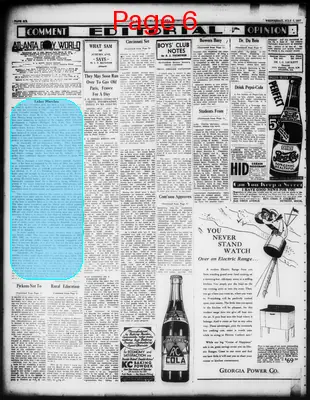
Editorial
July 7, 1937
Atlanta Daily World
Atlanta, Fulton County, Georgia
What is this article about?
The editorial analyzes a surge in U.S. labor strikes since November, highlighting a shift from wage demands to closed shop requirements, labor's unprecedented political involvement supporting Roosevelt, and the one-sided Wagner Act's limited role in preventing strikes.
Clipping
OCR Quality
98%
Excellent
Full Text
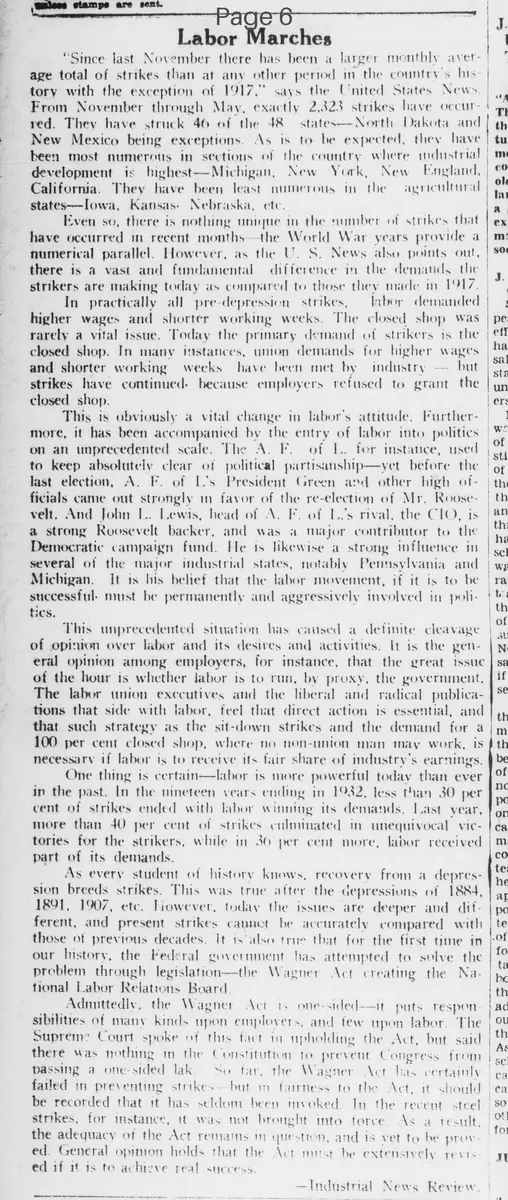
Labor Marches
"Since last November there has been a larger monthly average total of strikes than at any other period in the country's history with the exception of 1917," says the United States News.
From November through May, exactly 2,323 strikes have occurred. They have struck 46 of the 48 states—North Dakota and New Mexico being exceptions. As is to be expected, they have been most numerous in sections of the country where industrial development is highest—Michigan, New York, New England, California. They have been least numerous in the agricultural states—Iowa, Kansas, Nebraska, etc.
Even so, there is nothing unique in the number of strikes that have occurred in recent months—the World War years provide a numerical parallel. However, as the U. S. News also points out, there is a vast and fundamental difference in the demands the strikers are making today as compared to those they made in 1917.
In practically all pre-depression strikes, labor demanded higher wages and shorter working weeks. The closed shop was rarely a vital issue. Today the primary demand of strikers is the closed shop. In many instances, union demands for higher wages and shorter working weeks have been met by industry—but strikes have continued, because employers refused to grant the closed shop.
This is obviously a vital change in labor's attitude. Furthermore, it has been accompanied by the entry of labor into politics on an unprecedented scale. The A. F. of L., for instance, used to keep absolutely clear of political partisanship—yet before the last election, A. F. of L.'s President Green and other high officials came out strongly in favor of the re-election of Mr. Roosevelt. And John L. Lewis, head of A. F. of L.'s rival, the CIO, is a strong Roosevelt backer, and was a major contributor to the Democratic campaign fund. He is likewise a strong influence in several of the major industrial states, notably Pennsylvania and Michigan. It is his belief that the labor movement, if it is to be successful—must be permanently and aggressively involved in politics.
This unprecedented situation has caused a definite cleavage of opinion over labor and its desires and activities. It is the general opinion among employers, for instance, that the great issue of the hour is whether labor is to run, by proxy, the government. The labor union executives and the liberal and radical publications that side with labor, feel that direct action is essential, and that such strategy as the sit-down strikes and the demand for a 100 per cent closed shop, where no non-union man may work, is necessary if labor is to receive its fair share of industry's earnings.
One thing is certain—labor is more powerful today than ever in the past. In the nineteen years ending in 1932, less than 30 per cent of strikes ended with labor winning its demands. Last year, more than 40 per cent of strikes culminated in unequivocal victories for the strikers, while in 30 per cent more, labor received part of its demands.
As every student of history knows, recovery from a depression breeds strikes. This was true after the depressions of 1884, 1891, 1907, etc. However, today the issues are deeper and different, and present strikes cannot be accurately compared with those of previous decades. It is also true that for the first time in our history, the Federal government has attempted to solve the problem through legislation—the Wagner Act creating the National Labor Relations Board.
Admittedly, the Wagner Act is one sided—it puts responsibilities of many kinds upon employers, and few upon labor. The Supreme Court spoke of this fact in upholding the Act, but said there was nothing in the Constitution to prevent Congress from passing a one-sided law. So far, the Wagner Act has certainly failed in preventing strikes but in fairness to the Act, it should be recorded that it has seldom been invoked. In the recent steel strikes, for instance, it was not brought into force. As a result, the adequacy of the Act remains an open question, and is yet to be proved. General opinion holds that the Act must be extensively revised if it is to achieve real success.
"Since last November there has been a larger monthly average total of strikes than at any other period in the country's history with the exception of 1917," says the United States News.
From November through May, exactly 2,323 strikes have occurred. They have struck 46 of the 48 states—North Dakota and New Mexico being exceptions. As is to be expected, they have been most numerous in sections of the country where industrial development is highest—Michigan, New York, New England, California. They have been least numerous in the agricultural states—Iowa, Kansas, Nebraska, etc.
Even so, there is nothing unique in the number of strikes that have occurred in recent months—the World War years provide a numerical parallel. However, as the U. S. News also points out, there is a vast and fundamental difference in the demands the strikers are making today as compared to those they made in 1917.
In practically all pre-depression strikes, labor demanded higher wages and shorter working weeks. The closed shop was rarely a vital issue. Today the primary demand of strikers is the closed shop. In many instances, union demands for higher wages and shorter working weeks have been met by industry—but strikes have continued, because employers refused to grant the closed shop.
This is obviously a vital change in labor's attitude. Furthermore, it has been accompanied by the entry of labor into politics on an unprecedented scale. The A. F. of L., for instance, used to keep absolutely clear of political partisanship—yet before the last election, A. F. of L.'s President Green and other high officials came out strongly in favor of the re-election of Mr. Roosevelt. And John L. Lewis, head of A. F. of L.'s rival, the CIO, is a strong Roosevelt backer, and was a major contributor to the Democratic campaign fund. He is likewise a strong influence in several of the major industrial states, notably Pennsylvania and Michigan. It is his belief that the labor movement, if it is to be successful—must be permanently and aggressively involved in politics.
This unprecedented situation has caused a definite cleavage of opinion over labor and its desires and activities. It is the general opinion among employers, for instance, that the great issue of the hour is whether labor is to run, by proxy, the government. The labor union executives and the liberal and radical publications that side with labor, feel that direct action is essential, and that such strategy as the sit-down strikes and the demand for a 100 per cent closed shop, where no non-union man may work, is necessary if labor is to receive its fair share of industry's earnings.
One thing is certain—labor is more powerful today than ever in the past. In the nineteen years ending in 1932, less than 30 per cent of strikes ended with labor winning its demands. Last year, more than 40 per cent of strikes culminated in unequivocal victories for the strikers, while in 30 per cent more, labor received part of its demands.
As every student of history knows, recovery from a depression breeds strikes. This was true after the depressions of 1884, 1891, 1907, etc. However, today the issues are deeper and different, and present strikes cannot be accurately compared with those of previous decades. It is also true that for the first time in our history, the Federal government has attempted to solve the problem through legislation—the Wagner Act creating the National Labor Relations Board.
Admittedly, the Wagner Act is one sided—it puts responsibilities of many kinds upon employers, and few upon labor. The Supreme Court spoke of this fact in upholding the Act, but said there was nothing in the Constitution to prevent Congress from passing a one-sided law. So far, the Wagner Act has certainly failed in preventing strikes but in fairness to the Act, it should be recorded that it has seldom been invoked. In the recent steel strikes, for instance, it was not brought into force. As a result, the adequacy of the Act remains an open question, and is yet to be proved. General opinion holds that the Act must be extensively revised if it is to achieve real success.
What sub-type of article is it?
Labor
Partisan Politics
Legal Reform
What keywords are associated?
Labor Strikes
Closed Shop
Wagner Act
Labor Politics
Roosevelt Support
Sit Down Strikes
What entities or persons were involved?
United States News
A. F. Of L.
President Green
John L. Lewis
Cio
Mr. Roosevelt
Wagner Act
National Labor Relations Board
Supreme Court
Editorial Details
Primary Topic
Surge In Labor Strikes And Demands For Closed Shop
Stance / Tone
Neutral Analysis Of Labor's Changing Demands And Political Role
Key Figures
United States News
A. F. Of L.
President Green
John L. Lewis
Cio
Mr. Roosevelt
Wagner Act
National Labor Relations Board
Supreme Court
Key Arguments
Strikes Since November Exceed All But 1917, Affecting 46 States.
Shift From Wage Demands To Closed Shop As Primary Issue.
Labor Entering Politics Unprecedentedly, Supporting Roosevelt.
Cleavage: Employers Fear Labor Proxy Control; Unions See Direct Action Necessary.
Labor More Successful In Strikes Recently.
Post Depression Strikes Historical, But Current Issues Deeper.
Wagner Act One Sided, Rarely Invoked, Needs Revision.