Thank you for visiting SNEWPapers!
Sign up free
Editorial
May 28, 1940
Imperial Valley Press
El Centro, Imperial County, California
What is this article about?
Editorial argues against US involvement in Europe's war, attributing shifting public opinion to propaganda. Advocates strong arming and defense of the Western Hemisphere against potential German expansion into South and North America, emphasizing realism over idealism.
Clipping
OCR Quality
95%
Excellent
Full Text
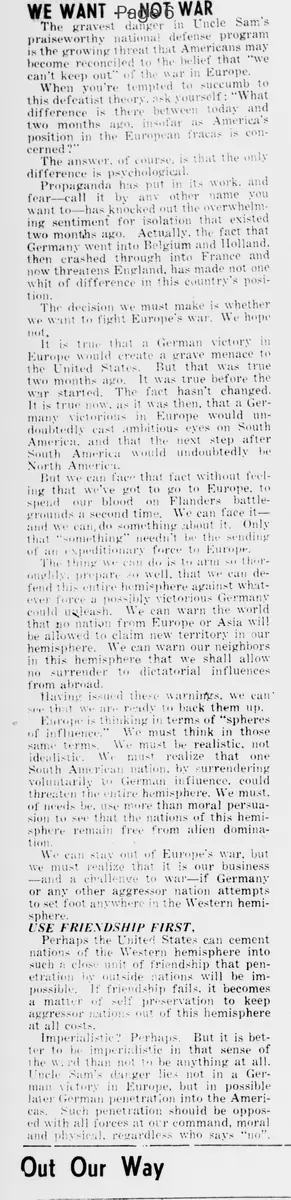
The gravest danger in Uncle Sam's praiseworthy national defense program is the growing threat that Americans may become reconciled to the belief that "we can't keep out" of the war in Europe.
When you're tempted to succumb to this defeatist theory, ask yourself: "What difference is there between today and two months ago, insofar as America's position in the European fracas is concerned?"
The answer, of course, is that the only difference is psychological.
Propaganda has put in its work, and fear—call it by any other name you want to—has knocked out the overwhelming sentiment for isolation that existed two months ago. Actually, the fact that Germany went into Belgium and Holland, then crashed through into France and now threatens England, has made not one whit of difference in this country's position.
The decision we must make is whether we want to fight Europe's war. We hope not.
It is true that a German victory in Europe would create a grave menace to the United States. But that was true two months ago. It was true before the war started. The fact hasn't changed.
It is true now, as it was then, that a German victorious in Europe would undoubtedly cast ambitious eyes on South America, and that the next step after South America would undoubtedly be North America.
But we can face that fact without feeling that we've got to go to Europe, to spend our blood on Flanders battlegrounds a second time. We can face it—and we can do something about it. Only that "something" needn't be the sending of an expeditionary force to Europe.
The thing we can do is to arm so thoroughly, prepare so well, that we can defend this entire hemisphere against whatever force a possibly victorious Germany could unleash. We can warn the world that no nation from Europe or Asia will be allowed to claim new territory in our hemisphere. We can warn our neighbors in this hemisphere that we shall allow no surrender to dictatorial influences from abroad.
Having issued these warnings, we can see that we are ready to back them up.
Europe is thinking in terms of "spheres of influence." We must think in those same terms. We must be realistic, not idealistic. We must realize that one South American nation, by surrendering voluntarily to German influence, could threaten the entire hemisphere. We must, of need be, use more than moral persuasion to see that the nations of this hemisphere remain free from alien domination.
We can stay out of Europe's war, but we must realize that it is our business—and a challenge to war—if Germany or any other aggressor nation attempts to set foot anywhere in the Western hemisphere.
USE FRIENDSHIP FIRST.
Perhaps the United States can cement nations of the Western hemisphere into such a close unit of friendship that penetration by outside nations will be impossible. If friendship fails, it becomes a matter of self preservation to keep aggressor nations out of this hemisphere at all costs.
Imperialistic? Perhaps. But it is better to be imperialistic in that sense of the word than not to be anything at all.
Uncle Sam's danger lies not in a German victory in Europe, but in possible later German penetration into the Americas. Such penetration should be opposed with all forces at our command, moral and physical, regardless who says "no".
Out Our Way
When you're tempted to succumb to this defeatist theory, ask yourself: "What difference is there between today and two months ago, insofar as America's position in the European fracas is concerned?"
The answer, of course, is that the only difference is psychological.
Propaganda has put in its work, and fear—call it by any other name you want to—has knocked out the overwhelming sentiment for isolation that existed two months ago. Actually, the fact that Germany went into Belgium and Holland, then crashed through into France and now threatens England, has made not one whit of difference in this country's position.
The decision we must make is whether we want to fight Europe's war. We hope not.
It is true that a German victory in Europe would create a grave menace to the United States. But that was true two months ago. It was true before the war started. The fact hasn't changed.
It is true now, as it was then, that a German victorious in Europe would undoubtedly cast ambitious eyes on South America, and that the next step after South America would undoubtedly be North America.
But we can face that fact without feeling that we've got to go to Europe, to spend our blood on Flanders battlegrounds a second time. We can face it—and we can do something about it. Only that "something" needn't be the sending of an expeditionary force to Europe.
The thing we can do is to arm so thoroughly, prepare so well, that we can defend this entire hemisphere against whatever force a possibly victorious Germany could unleash. We can warn the world that no nation from Europe or Asia will be allowed to claim new territory in our hemisphere. We can warn our neighbors in this hemisphere that we shall allow no surrender to dictatorial influences from abroad.
Having issued these warnings, we can see that we are ready to back them up.
Europe is thinking in terms of "spheres of influence." We must think in those same terms. We must be realistic, not idealistic. We must realize that one South American nation, by surrendering voluntarily to German influence, could threaten the entire hemisphere. We must, of need be, use more than moral persuasion to see that the nations of this hemisphere remain free from alien domination.
We can stay out of Europe's war, but we must realize that it is our business—and a challenge to war—if Germany or any other aggressor nation attempts to set foot anywhere in the Western hemisphere.
USE FRIENDSHIP FIRST.
Perhaps the United States can cement nations of the Western hemisphere into such a close unit of friendship that penetration by outside nations will be impossible. If friendship fails, it becomes a matter of self preservation to keep aggressor nations out of this hemisphere at all costs.
Imperialistic? Perhaps. But it is better to be imperialistic in that sense of the word than not to be anything at all.
Uncle Sam's danger lies not in a German victory in Europe, but in possible later German penetration into the Americas. Such penetration should be opposed with all forces at our command, moral and physical, regardless who says "no".
Out Our Way
What sub-type of article is it?
Foreign Affairs
War Or Peace
What keywords are associated?
Isolationism
Hemispheric Defense
German Threat
European War
Us Foreign Policy
Propaganda Fear
Spheres Of Influence
What entities or persons were involved?
Uncle Sam
Germany
United States
Western Hemisphere Nations
South America
Editorial Details
Primary Topic
Opposition To Us Entry Into European War And Advocacy For Western Hemisphere Defense
Stance / Tone
Isolationist With Realistic Hemispheric Protectionism
Key Figures
Uncle Sam
Germany
United States
Western Hemisphere Nations
South America
Key Arguments
Public Shift Toward War Involvement Is Due To Psychological Propaganda And Fear, Not Changed Facts.
German Invasions In Europe Do Not Alter Us Position.
Us Should Not Fight In Europe But Defend The Hemisphere Against Potential German Expansion.
Arm Thoroughly And Warn Against Foreign Claims In The Americas.
Use Friendship First, But Back Warnings With Force If Needed.
Realism Over Idealism: Prevent Alien Domination In Hemisphere At All Costs.
German Victory In Europe Threatens Americas, Must Be Opposed Morally And Physically.