Thank you for visiting SNEWPapers!
Sign up free
Story
November 26, 1958
The Sidney Herald
Sidney, Richland County, Montana
What is this article about?
W.C. Anderson of Richland County explains the Great Plains Conservation Program via Q&A, covering its comprehensive land conservation plans, cost-sharing (50-80%), 3-10 year contracts, and encouragement for farmers to improve and pass on better land. 10 applicants so far, covering 20,300 acres.
Clipping
OCR Quality
98%
Excellent
Full Text
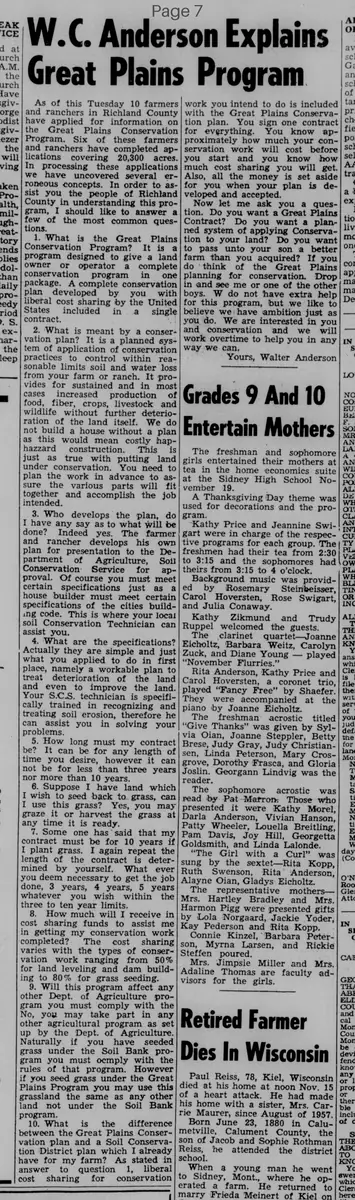
W.C. Anderson Explains Great Plains Program
As of this Tuesday 10 farmers and ranchers in Richland County have applied for information on the Great Plains Conservation Program. Six of these farmers and ranchers have completed applications covering 20,300 acres. In processing these applications we have uncovered several erroneous concepts. In order to assist you the people of Richland County in understanding this program, I should like to answer a few of the most common questions.
1. What is the Great Plains Conservation Program? It is a program designed to give a land owner or operator a complete conservation program in one package. A complete conservation plan developed by you with liberal cost sharing by the United States included in a single contract.
2. What is meant by a conservation plan? It is a planned system of application of conservation practices to control within reasonable limits soil and water loss from your farm or ranch. It provides for sustained and in most cases increased production of food, fiber, crops, livestock and wildlife without further deterioration of the land itself. We do not build a house without a plan as this would mean costly haphazard construction. This is just as true with putting land under conservation. You need to plan the work in advance to assure the various parts will fit together and accomplish the job intended.
3. Who develops the plan, do I have any say as to what will be done? Indeed yes. The farmer and rancher develops his own plan for presentation to the Department of Agriculture, Soil Conservation Service for approval. Of course you must meet certain specifications just as a house builder must meet certain specifications of the cities building code. This is where your local soil Conservation Technician can assist you.
4. What are the specifications? Actually they are simple and just what you applied to do in first place, namely a workable plan to treat deterioration of the land and even to improve the land. Your S.C.S. technician is specifically trained in recognizing and treating soil erosion, therefore he can assist you in solving your problems.
5. How long must my contract be? It can be for any length of time you desire, however it can not be for less than three years nor more than 10 years.
6. Suppose I have land which I wish to seed back to grass, can I use this grass? Yes, you may graze it or harvest the grass at any time it is ready.
7. Some one has said that my contract must be for 10 years if I plant grass. I again repeat the length of the contract is determined by yourself. What ever you deem necessary to get the job done, 3 years, 4 years, 5 years whatever you wish within the three to ten year limits.
8. How much will I receive in cost sharing funds to assist me in getting my conservation work completed? The cost sharing varies with the types of conservation work ranging from 50% for land leveling and dam building to 80% for grass seeding.
9. Will this program affect any other Dept. of Agriculture program you must comply with the No, you may take part in any other agricultural program as set up by the Dept. of Agriculture. Naturally if you have seeded grass under the Soil Bank program you must comply with the rules of that program. However if you seed grass under the Great Plains Program you may use this grassland the same as any other land not under the Soil Bank program.
10. What is the difference between the Great Plains Conservation plan and a Soil Conservation District plan which I already have for my farm? As stated in answer to question 1, liberal cost sharing for conservation work you intend to do is included with the Great Plains Conservation plan. You sign one contract for everything. You know approximately how much your conservation work will cost before you start and you know how much cost sharing you will get. Also, all the money is set aside for you when your plan is developed and accepted.
Now let me ask you a question. Do you want a Great Plains Contract? Do you want a planned system of applying Conservation to your land? Do you want to pass unto your son a better farm than you acquired? If you do think of the Great Plains planning for conservation. Drop in and see me or one of the other boys. We do not have extra help for this program, but we like to believe we have ambition just as you do. We are interested in you and conservation and we will work overtime to help you in any way we can.
Yours, Walter Anderson
As of this Tuesday 10 farmers and ranchers in Richland County have applied for information on the Great Plains Conservation Program. Six of these farmers and ranchers have completed applications covering 20,300 acres. In processing these applications we have uncovered several erroneous concepts. In order to assist you the people of Richland County in understanding this program, I should like to answer a few of the most common questions.
1. What is the Great Plains Conservation Program? It is a program designed to give a land owner or operator a complete conservation program in one package. A complete conservation plan developed by you with liberal cost sharing by the United States included in a single contract.
2. What is meant by a conservation plan? It is a planned system of application of conservation practices to control within reasonable limits soil and water loss from your farm or ranch. It provides for sustained and in most cases increased production of food, fiber, crops, livestock and wildlife without further deterioration of the land itself. We do not build a house without a plan as this would mean costly haphazard construction. This is just as true with putting land under conservation. You need to plan the work in advance to assure the various parts will fit together and accomplish the job intended.
3. Who develops the plan, do I have any say as to what will be done? Indeed yes. The farmer and rancher develops his own plan for presentation to the Department of Agriculture, Soil Conservation Service for approval. Of course you must meet certain specifications just as a house builder must meet certain specifications of the cities building code. This is where your local soil Conservation Technician can assist you.
4. What are the specifications? Actually they are simple and just what you applied to do in first place, namely a workable plan to treat deterioration of the land and even to improve the land. Your S.C.S. technician is specifically trained in recognizing and treating soil erosion, therefore he can assist you in solving your problems.
5. How long must my contract be? It can be for any length of time you desire, however it can not be for less than three years nor more than 10 years.
6. Suppose I have land which I wish to seed back to grass, can I use this grass? Yes, you may graze it or harvest the grass at any time it is ready.
7. Some one has said that my contract must be for 10 years if I plant grass. I again repeat the length of the contract is determined by yourself. What ever you deem necessary to get the job done, 3 years, 4 years, 5 years whatever you wish within the three to ten year limits.
8. How much will I receive in cost sharing funds to assist me in getting my conservation work completed? The cost sharing varies with the types of conservation work ranging from 50% for land leveling and dam building to 80% for grass seeding.
9. Will this program affect any other Dept. of Agriculture program you must comply with the No, you may take part in any other agricultural program as set up by the Dept. of Agriculture. Naturally if you have seeded grass under the Soil Bank program you must comply with the rules of that program. However if you seed grass under the Great Plains Program you may use this grassland the same as any other land not under the Soil Bank program.
10. What is the difference between the Great Plains Conservation plan and a Soil Conservation District plan which I already have for my farm? As stated in answer to question 1, liberal cost sharing for conservation work you intend to do is included with the Great Plains Conservation plan. You sign one contract for everything. You know approximately how much your conservation work will cost before you start and you know how much cost sharing you will get. Also, all the money is set aside for you when your plan is developed and accepted.
Now let me ask you a question. Do you want a Great Plains Contract? Do you want a planned system of applying Conservation to your land? Do you want to pass unto your son a better farm than you acquired? If you do think of the Great Plains planning for conservation. Drop in and see me or one of the other boys. We do not have extra help for this program, but we like to believe we have ambition just as you do. We are interested in you and conservation and we will work overtime to help you in any way we can.
Yours, Walter Anderson
What sub-type of article is it?
Explanatory Article
Q And A
What themes does it cover?
Moral Virtue
Recovery
What keywords are associated?
Great Plains Program
Conservation Plan
Soil Erosion
Cost Sharing
Richland County
Farmers Ranchers
What entities or persons were involved?
W.C. Anderson
Walter Anderson
Where did it happen?
Richland County
Story Details
Key Persons
W.C. Anderson
Walter Anderson
Location
Richland County
Event Date
As Of This Tuesday
Story Details
W.C. Anderson explains the Great Plains Conservation Program, answering common questions about its purpose, development, contract terms, cost-sharing, and compatibility with other programs, encouraging farmers and ranchers to apply for land conservation planning.