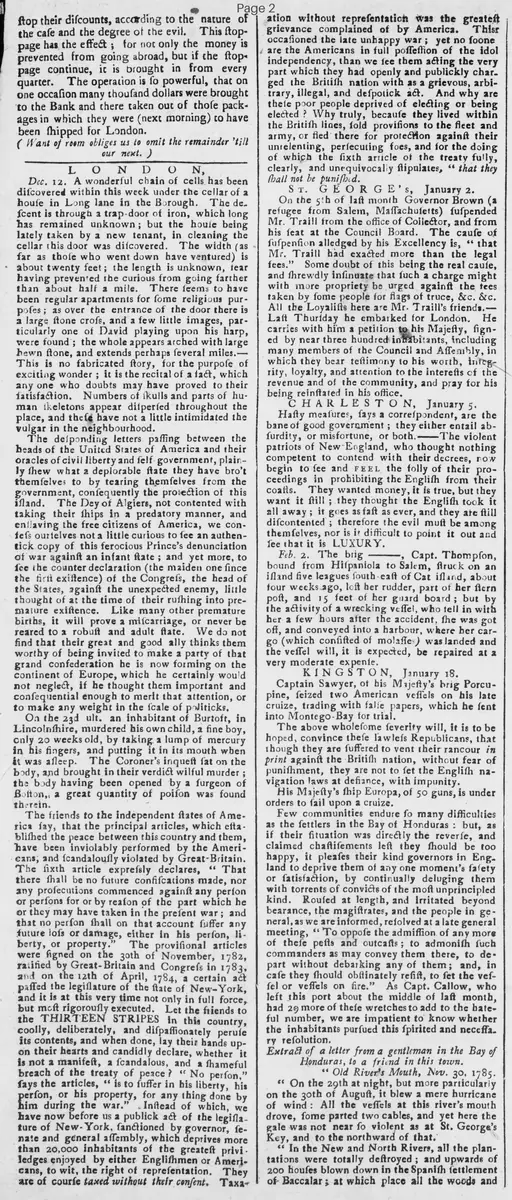
The friends to the independent states of America say, that the principal articles, which established the peace between this country and them, have been inviolably performed by the Americans; and scandalously violated by Great-Britain. The sixth article expressly declares, "That there shall be no future confiscations made, nor any prosecutions commenced against any person or persons for, or by reason of the part which he or they may have taken in the present war; and that no person shall on that account suffer any future loss or damage, either in his person, liberty, or property." The provisional articles were signed on the 30th of November, 1782, ratified by Great-Britain and Congress in 1783, and on the 12th of April, 1784, a certain act passed the legislature of the state of New-York, and it is at this very time not only in full force, but most rigorously executed. Let the friends to the THIRTEEN STRIPES in this country, coolly, deliberately, and dispassionately peruse its contents, and when done, lay their hands upon their hearts and candidly declare, whether it is not a manifest, a scandalous, and a shameful breach of the treaty of peace? "No person," says the articles, "is to suffer in his liberty, his person, or his property, for any thing done by him during the war." Instead of which, we have now before us a publick act of the legislature of New-York, sanctioned by governor, senate and general assembly, which deprives more than 20,000 inhabitants of the greatest privileges enjoyed by either Englishmen or Americans, to wit, the right of representation. They are of course taxed without their consent. Taxation without representation was the greatest grievance complained of by America. This occasioned the late unhappy war; yet no sooner are the Americans in full possession of the idol independency, than we see them acting the very part which they had openly and publickly charged the British nation with as a grievous, arbi-trary, illegal, and despotick act. And why are these poor people deprived of electing or being elected? Why truly, because they lived within the British lines, sold provisions to the fleet and army, or fled there for protection against their unrelenting, persecuting foes, and for the doing of which the sixth article of the treaty fully, clearly, and unequivocally stipulates, "that they shall not be punished."