Thank you for visiting SNEWPapers!
Sign up free
Alexandria Gazette & Daily Advertiser
Alexandria, Virginia
What is this article about?
Traveler Mr. Keppel Craven recounts witnessing a violent clash in Foggia between the Vardarelli brigand band and garrison troops, resulting in deaths, escapes, captures, and the remaining bandits' suicide by mutual killing.
Clipping
OCR Quality
Full Text
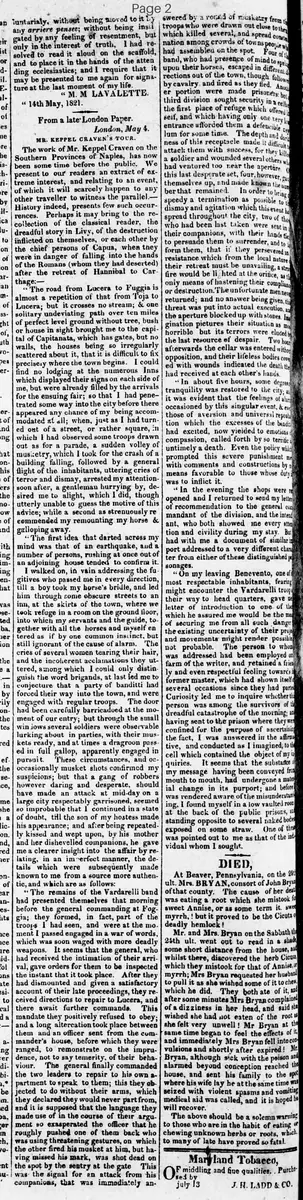
London, May 4.
MR. KEPPEL CRAVEN'S TOUR.
The work of Mr. Keppel Craven on the Southern Provinces of Naples, has now been some time before the public. We present to our readers an extract of extreme interest, and relating to an event, of which it will scarcely happen to any other traveller to witness the parallel.—History indeed, presents few such occurrences. Perhaps it may bring to the recollection of the classical reader, the dreadful story in Livy, of the destruction inflicted on themselves, or each other by the chief persons of Capua, when they were in danger of falling into the hands of the Romans (whom they had deserted) after the retreat of Hannibal to Carthage:
'The road from Lucera to Foggia is almost a repetition of that from Troja to Lucera: but it crosses no stream; & one solitary undeviating path over ten miles of perfect level ground without tree, bush or house in sight brought me to the capital of Capitanata, which has gates, but no walls, the houses being so irregularly scattered about it, that it is difficult to fix precisely where the town begins. I could find no lodging at the numerous Inns which displayed their signs on each side of me, but were already filled by the arrivals for the ensuing fair; so that I had penetrated some way into the city before there appeared any chance of my being accommodated at all; when, just as I had turned out of a street, or rather square, in which I had observed some troops drawn out as for a parade, a sudden volley of musketry, which I took for the crash of a building falling, followed by a general flight of the inhabitants, uttering cries of terror and dismay, arrested my attention. Soon after, a gentleman hurrying by, desired me to alight, which I did, though utterly unable to guess the motive of this advice; while a second as strenuously recommended my remounting my horse & galloping away.
The first idea that darted across my mind was that of an earthquake, and a number of persons, rushing at once out of an adjoining house tended to confirm it. I walked on, in vain addressing the fugitives who passed me in every direction, till a boy took my horse's bridle, and led him through some obscure streets to an inn, at the skirts of the town, where we took refuge in a room on the ground floor, into which my servants and the guide, together with all the horses and myself entered as if by one common instinct, but still ignorant of the cause of alarm. The cries of several women tearing their hair, and the incoherent acclamations they uttered, among which I could only distinguish the word brigands, at last led me to conjecture that a party of banditti had forced their way into the town, and were engaged with regular troops. The door had been carefully barricadoed at the moment of our entry; but through the small windows several soldiers were observable lurking about in parties, with their muskets ready, and at times a dragoon passed in full gallop, apparently engaged in pursuit. These circumstances, and occasionally musket shots confirmed my suspicions; but that a gang of robbers however daring and desperate, should have made an attack at mid-day on a large city respectably garrisoned, seemed so improbable that I continued in a state of doubt, till the son of my hostess made his appearance; and after being repeatedly kissed and wept upon, by his mother and her dishevelled companions, he gave me a clearer insight into the affair by relating, in an imperfect manner, the details which were subsequently made known to me from a source more authentic, and which are as follows:
'The remains of the Vardarelli band had presented themselves that morning before the general commanding at Foggia; they formed, in fact, part of the troop I had seen, and were at the moment I passed engaged in a war of words, which was soon waged with more deadly weapons. It seems that the general, who had received the intimation of their arrival, gave orders for them to be inspected the instant that it took place. After they had dismounted and given a satisfactory account of their late proceedings, they received directions to repair to Lucera, and there await further command. This mandate they positively refused to obey; and a long altercation took place between them and an officer sent from the commander's house, before which they were ranged, to remonstrate on the imprudence, not to say temerity, of their behaviour. The general finally commanded the two leaders to repair to his own apartment to speak to them; this they objected to do without their arms, which they declared they would never part from, and it is supposed that the language they made use of in the course of their argument so exasperated the officer that he roughly pushed one of them back who was using threatening gestures, on which the other fired his musket at him, but having missed his mark, was shot dead on the spot by the sentry at the gate. This was the signal for an attack from his companions, that was immediately answered by a round of musketry from the troops who were drawn out close to the which killed several and spread consternation among crowds of towns people who had assembled on the spot.
Four of the band, who had presence of mind to spring upon their horses escaped in different directions out of the town though followed by cavalry. Another portion were made prisoners but a third division sought security in the first place of refuge which offered itself, and which having only one entry afforded them a defencible position for some time. The narrowness of this receptacle made it difficult to attack them with success for they kill a soldier and wounded several others who had ventured too near the aperture. Of this last desperate set, four, however, gave themselves up and made known the number that remained. In order to bring a speedy termination as possible to the dismay and agitation which this event had spread throughout the city, two of those who had been last taken were sent in to their companions, with their hands tied to persuade them to surrender, and to inform them, that if they persevered in resistance which from the local nature of their retreat must be unavailing, a straw fire would be lighted at the orifice, the only means of hastening their compliance or destruction. The unfortunate men were returned; and no answer being given, the threat was put into actual execution, and the aperture blocked up with stones. Imagination pictures their situation as most horrible but its terrors were eluded by the last resource of despair. Two hours afterwards the cellar was entered without opposition, and their lifeless bodies covered with wounds indicated the death they had received at each other's hands.
In about five hours, some degree of tranquility was restored to the city; and it was evident that the feelings of alarm occasioned by this singular event, & even those of aversion and universal reprobation which the excesses of the banditti had excited, now yielded to emotions of compassion, called forth by so terrific and untimely a death. Even the policy which prompted this severe punishment met with comments and constructions by no means favorable to those whose duty it was to inflict it.
In the evening the shops were re-opened and I returned to send my letter of recommendation to the general commandant of the division, and the intendant, who both showed me every attention and civility during my stay. But I had with me a document of similar import addressed to a very different character from either of these distinguished personages.
On my leaving Benevento, one of most respectable inhabitants, fearing I might encounter the Vardarelli troop on their way to head quarters, gave me letter of introduction to one of the which he assured me would be the means of securing me from all such danger the existing uncertainty of their projects and movements might render possible not probable. The person to whom it was addressed had been employed on the farm of the writer, and retained a friendly and even respectful feeling towards former master, which had shown itself on several occasions since they had parted. Curiosity led me to inquire whether the person was among the survivors of the dreadful catastrophe of the morning; and having sent to the prison where they were confined for the purpose of ascertaining the fact, I was answered in the affirmative, and conducted as I imagined, to the cell which contained the object of my inquiries. It seems that the substance of my message having been conveyed from mouth to mouth, had undergone a material change in its purport; and before I was rendered aware of the misunderstanding, I found myself in a low vaulted room at the back of the public prisons, and standing opposite to several naked bodies exposed on some straw. One of these was pointed out to me as that of the individual whom I sought.
What sub-type of article is it?
What keywords are associated?
What entities or persons were involved?
Where did it happen?
Foreign News Details
Primary Location
Foggia
Key Persons
Outcome
several brigands killed in initial clash; four escaped on horseback pursued by cavalry; some captured; four surrendered and informed on others; remaining brigands committed suicide by killing each other after troops blocked their refuge with fire threat.
Event Details
The Vardarelli brigand band arrived at Foggia to surrender to the general but refused orders to proceed to Lucera, leading to an altercation. A brigand fired at an officer, prompting return fire that killed several. Some escaped, others were captured, and the last group barricaded in a cellar, killing a soldier and wounding others before surrendering partially; the holdouts suicided mutually when troops threatened to smoke them out.