Thank you for visiting SNEWPapers!
Sign up free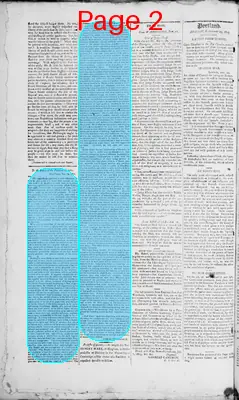
Jenks' Portland Gazette
Portland, Cumberland County, Maine
What is this article about?
A letter to the Portland Gazette editor defends the proposed new judicial system (nisi prius) in Maine, arguing it will not reduce the diffusion of legal knowledge compared to the old system and offers advantages like annual reported cases from the Supreme Court, emphasizing justice administration over incidental education.
Clipping
OCR Quality
Full Text
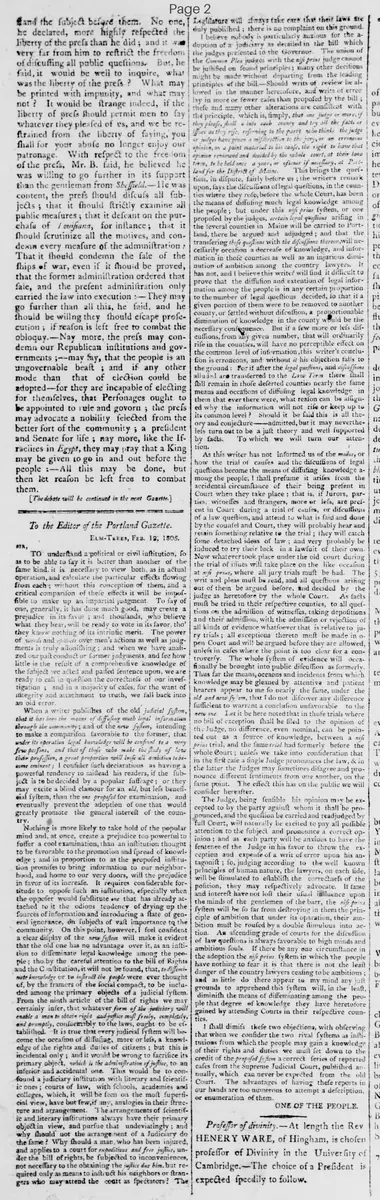
ELM-TREES, FEB. 1, 1805.
SIR,
To understand a political or civil institution, so as to be able to say it is better than another of the same kind, it is necessary to view both, as in actual operation, and calculate the particular effects flowing from each; without this conception of them, and a critical comparison of these effects it will be impossible to make up an impartial judgment. To say of one, generally, it has done much good, may create a prejudice in its favor; and thousands, who believe what they hear, will be ready to vote in its favor, though they know nothing of its intrinsic merit. The power of words and epithets over men's actions as well as judgments is truly astonishing; and when we have analyzed our past conduct or former judgments, and see how little is the result of a comprehensive knowledge of the subject we acted and passed sentence upon, we are ready to call in question the correctness of our investigation; and in a majority of cases, for the want of integrity and attachment to truth, we fall back into an old error.
When a writer publishes of the old judicial System, that it has been the means of diffusing much legal information through the community; and of the new system, intending to make a comparison favorable to the former, that under its operation legal knowledge will be confined to a very few persons, and that of those who make the study of law their profession, a great proportion will lose all ambition to become eminent; I consider such declarations as having a powerful tendency to mislead his readers, if the subject is to be decided by a popular suffrage; or they may excite a blind clamour for an old, but less beneficial system, than the one proposed for examination, and eventually prevent the adoption of one that would greatly promote the general interest of the country.
Nothing is more likely to take hold of the popular mind and, at once, create a prejudice too powerful to suffer a cool examination, than an institution thought to be favorable to the promotion and spread of knowledge; and in proportion as the proposed institution promises to bring information to our neighborhood, and home to our very doors, will the prejudice in favor of it increase. It requires considerable fortitude to oppose such an institution, especially when the opposer would substitute one that has already attached to it the odious tendency of drying up the sources of information and introducing a state of general ignorance, on subjects of vast importance to the community. On this point, however, I feel confident a clear display of the new system will make it evident that the old one has no advantage over it, as an institution to disseminate legal knowledge among the people; though by the careful attention to the bill of Rights and the Constitution, it will not be found, that, to disseminate knowledge or to instruct the people were ever thought of, by the framers of the social compact, to be included among the primary objects of a judicial system.
From the ninth article of the bill of rights we may certainly infer, that whatever form of the judiciary will enable a man to obtain right and justice most freely, completely, and promptly, comfortably to the laws, ought to be established. It is true that every judicial system will become the occasion of diffusing, more or less, a knowledge of the rights and duties of citizens; but this is incidental only; and it would be wrong to sacrifice its primary object, which is the administration of justice, to an inferior and accidental one. This would be to confound a judiciary institution with literary and scientific ones; courts of law, with schools, academies and colleges, which, it will be seen on the most superficial view, have but few, if any, analogies in their true nature and arrangement. The arrangements of scientific and literary institutions always have their primary object in view, and pursue that undeviatingly; and why should not the arrangement of a Judiciary do the same? Why should a man, who has been injured, and applies to a court for expeditious and free justice, under the bill of rights, be subjected to inconveniences, not necessary to the obtaining the justice due him, but required only as means to instruct his neighbors or strangers who may attend the court as spectators? The Legislature will always take care that their laws are duly published; there is no complaint on this ground.
I believe nobody is particularly anxious for the adoption of a judiciary as detailed in the bill which the judges presented to the Governor. The union of the Common Pleas judges with the nisi prius judge cannot be justified on sound principles; many other decisions might be made without departing from the leading principles of the bill. Should writs of review be allowed in the manner heretofore, and writs of error lay in more or fewer cases than proposed by the bill; these and many other alterations are consistent with the principle, which is, simply, that one judge or more, if they please, shall go into each county and try all the facts or issues as they rise, reserving to the party who thinks the judge or judges have given a misdirection to the jury, or an erroneous opinion, or a point material to his cause, the right to have that opinion reserved and decided by the whole court, at their law term, to be held once a year, or oftener if necessary, at Portland for the District of Maine.
This brings the question, in dispute, fairly before us; the writer's remark upon, says the discussions of legal questions, in the counties where they rose, before the whole Court, has been the means of diffusing much legal knowledge among the people; but under this nisi prius system, or one proposed by the judges, certain legal questions arising in the several counties in Maine will be carried to Portland, there be argued and adjudged; and that the transferring these questions with the discussions thereon, will necessarily occasion a decrease of knowledge, and information in those counties as well as an injurious diminution of ambition among the country lawyers.
It has not, and I believe this writer will find it difficult to prove that the diffusion and extension of legal information among the people is in any certain proportion to the number of legal questions decided, so that if a given portion of them were to be removed to another county, or settled without discussion, a proportionable diminution of knowledge in the county would be the necessary consequence. But if a few more or less discussions, from any given number, that will ordinarily rise in the counties, will have no perceptible effect on the common level of information, this writer's conclusion is erroneous, and without it his objection falls to the ground: For if after the legal questions, and discussions alluded are transferred to the Law Term there shall still remain in those deserted counties nearly the same means and occasions of diffusing legal knowledge in them that ever there were, what reason can be assigned why the information will not rise or keep up to its common level? Should it be said this is all theory and conjecture—admitted, but it may nevertheless turn out to be a just theory and well supported by facts, to which we will turn our attention.
As this writer has not informed us of the modus, or how the trial of causes and the discussions of legal questions become the means of diffusing knowledge among the people, I shall presume it arises from the accidental circumstance of their being present in Court when they take place; that is, if Jurors, parties, witnesses and strangers, more or less, are present in Court during a trial of causes, or discussions of a law question, and attend to what is said and done by the counsel and Court, they will probably hear and retain something relative to the trial; they will catch some detached ideas of law; and very probably be induced to try their luck in a lawsuit of their own.
Now whatever took place under the old court during the trial of issues will take place on the like occasion at nisi prius, where all jury trials must be had. The writ and pleas must be read, and all questions arising out of them be argued before, and decided by the judge as heretofore by the whole Court. As facts must be tried in their respective counties, to all questions on the admission of witnesses, taking depositions and their admission, with the admission or rejection of all kinds of evidence whatsoever that is relative to jury trials; all exceptions thereto must be made in open Court and will be argued before they are allowed, unless in cases where the point is too clear for a controversy. The whole system of evidence will occasionally be brought into public discussion as formerly.
Thus far the means, occasions and incidents from which knowledge may be gleaned by attentive and patient hearers appear to me so nearly the same, under the old and new system, that I do not discover any difference sufficient to warrant a conclusion unfavorable to the new one. Let it be here noted that in those trials where no bill of exception shall be filed to the opinion of the Judge, no difference, even nominal, can be pointed out as a source of knowledge, between a nisi prius trial, and the same trial had formerly before the whole Court; unless we take into consideration that in the first case a single Judge pronounces the law, & in the latter the Judges may sometimes disagree and pronounce different sentiments from one another, on the same point. The effect this has on the public we will consider hereafter.
The Judge, being sensible his opinion may be excepted to by the party against whom it shall be pronounced, and the question be carried and readjudged by full Court, will naturally be excited to pay all possible attention to the subject and pronounce a correct opinion; and as each party will be anxious to have the sentence of the Judge in his favor to throw the exception and expense of a writ of error upon his antagonist; so, judging according to the well known principles of human nature, the lawyers, on each side, will be stimulated to establish the correctness of the position, they may respectively advocate. If sane and interest have not lost their usual influence upon the minds of the gentlemen of the bar, the nisi prius system will be so far from destroying in them the principle of ambition that under its operation, their ambition must be roused by a double stimulus into action. An ascending grade of courts for the discussion of law questions is always favorable to high minds and ambitious souls. If there be any one circumstance in the adoption the nisi prius system in which the people have nothing to fear it is that there is not the least danger of the country lawyers ceasing to be ambitious; and as little do there appear to my mind any just grounds to apprehend this system will, in the least, diminish the means of disseminating among the people that degree of knowledge they have heretofore gained by attending Courts in their respective counties.
I shall dismiss these two objections, with observing that when we consider the two rival systems as institutions from which the people may gain a knowledge of their rights and duties we must set down to the credit of the proposed system a correct series of reported cases from the Supreme Judicial Court, published annually, which can never be expected from the old Court. The advantages of having these reports in our hands are too numerous to attempt a description, or enumeration of them.
ONE OF THE PEOPLE.
What sub-type of article is it?
What themes does it cover?
What keywords are associated?
What entities or persons were involved?
Letter to Editor Details
Author
One Of The People
Recipient
Editor Of The Portland Gazette
Main Argument
the proposed new judicial system (nisi prius) will disseminate legal knowledge as effectively as the old system through local trials and discussions, while providing additional benefits like annual reported cases, without sacrificing the primary goal of administering justice promptly and freely.
Notable Details