Thank you for visiting SNEWPapers!
Sign up free
Story
March 7, 1795
The Kentucky Gazette
Lexington, Fayette County, Kentucky
What is this article about?
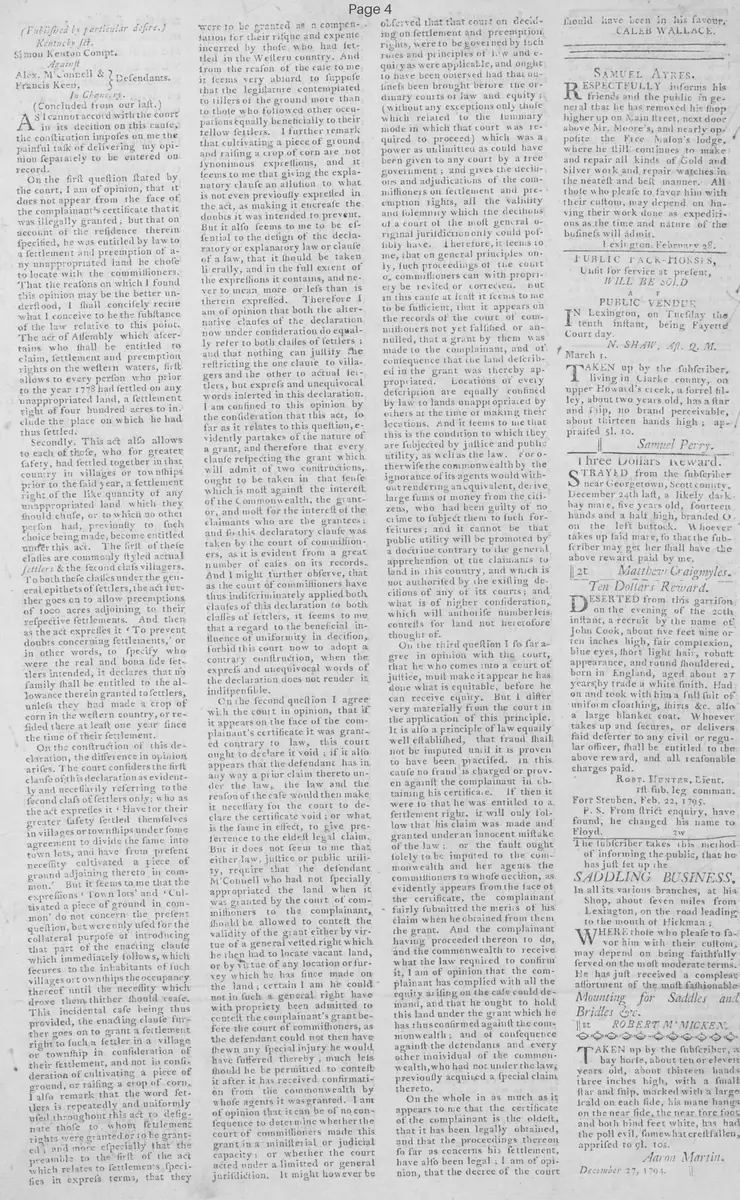
Dissenting judicial opinion by Caleb Wallace in Kentucky Chancery case of Simon Kenton vs. Alex. McConnell and others over land settlement and preemption rights under pre-1778 Virginia law for western settlers. Wallace argues the complainant's certificate is legally valid and should prevail.
Clipping
OCR Quality
95%
Excellent
Full Text
(Published by particular desire.)
Kentucky Set.
Simon Kenton Compl.
Against
Alex. McConnell &
Defendants.
Francis Keel.
In Chancery.
(Concluded from our last.)
As I cannot accord with the court in its decision on this cause, the constitution imposes on me the painful task of delivering my opinion separately to be entered on record.
On the first question stated by the court, I am of opinion, that it does not appear from the face of the complainant's certificate that it was illegally granted; but that on account of the residence therein specified, he was entitled by law to a settlement and preemption of any unappropriated land he chose to locate with the commissioners.
That the reasons on which I found this opinion may be the better understood, I shall concisely recite what I conceive to be the substance of the law relative to this point.
The act of Assembly which ascertains who shall be entitled to claim, settlement and preemption rights on the western waters, first allows to every person who prior to the year 1778 had settled on any unappropriated land, a settlement right of four hundred acres to include the place on which he had thus settled.
Secondly. This act also allows to each of those, who for greater safety, had settled together in that country in villages or townships prior to the said year, a settlement right of the like quantity of any unappropriated land which they should choose, or to which no other person had, previously to such choice being made, become entitled under this act. The first of these classes are commonly styled actual settlers & the second class villagers.
To both these classes under the general epithets of settlers,the act further goes on to allow preemptions of 1000 acres adjoining to their respective settlements. And then as the act expresses it 'To prevent doubts concerning settlements,' or in other words, to specify who were the real and bona fide settlers intended, it declares that no family shall be entitled to the allowance therein granted to settlers, unless they had made a crop of corn in the western country, or resided there at least one year since the time of their settlement.
On the construction of this declaration, the difference in opinion arises. The court considers the first clause of this declaration as evidently and necessarily referring to the second class of settlers only; who as the act expresses it Have tor their greater safety settled themselves in villages or townships under some agreement to divide the same into town lots, and have from present necessity cultivated a piece of ground in common. But it seems to me that the expressions ' Town lots' and cultivation common do not concern the present question, but were only used for the collateral purpose of introducing that part of the enacting clause which immediately follows, which secures to the inhabitants of such villages or townships the occupancy thereof until the necessity which drove them thither should cease,
This incidental case being thus provided, the enacting clause further goes on to grant a settlement or townships in consideration of their settlement, and not in consideration of cultivating a piece of ground, or raising a crop of corn.
I also remark that the word settlers is repeatedly and uniformly used throughout this act to designate those to whom settlement rights were granted or to be granted; and more especially that the preamble to the first of the act which relates to settlements specifies in express terms, that they were to be granted as a compensation for their risque and expense incurred by those who had settled in the Western country. And from the reason of the case to me it seems very absurd to suppose that the legislature contemplated to tillers of the ground more than to those who followed other occupations equally beneficially to their fellow settlers. I further remark that cultivating a piece of ground and raising a crop of corn are not synonymous expressions, and it seems to me that giving the explanatory clause an allusion to what is not even previously expressed in the act, as making it increase the doubts it was intended to prevent.
But it also seems to me to be essential to the design of the declaratory or explanatory law or clause of a law, that it should be taken literally, and in the full extent of the expressions it contains, and never to mean more or less than is therein expressed. Therefore I am of opinion that both the alternative clauses of the declaration now under consideration do equally refer to both classes of settlers ; and that nothing can justify the restricting the one clause to villagers and the other to actual settlers, but express and unequivocal words inserted in this declaration.
I am confined to this opinion by the consideration that this act, so far as it relates to this question,evidently partakes of the nature of a grant, and therefore that every clause respecting the grant which will admit of two constructions, ought to be taken in that sense which is most against the interest of the Commonwealth, the grantor, and most for the interest of the claimants who are the grantees; and so this declaratory clause was taken by the court of commissioners, as it is evident from a great number of cases on its records.
And I might further observe, that as the court of commissioners have thus indiscriminately applied both clauses of this declaration to both classes of settlers, it seems to me that a regard to the beneficial influence of uniformity in decision, forbid this court now to adopt a contrary construction, when the express and unequivocal words of the declaration does not render it indispensable.
On the second question I agree with the court in opinion, that if it appears on the face of the complainant's certificate it was granted contrary to law, this court ought to declare it void ; if it also appears that the defendant has in any way a prior claim thereto under the law, the law and the reason of the case would then make it necessary for the court to declare the certificate void ; or what is the same in effect, to give preference to the eldest legal claim.
But it does not seem to me that either law, justice or public utility, require that the defendant M'Connell who had not specially appropriated the land when it was granted by the court of commissioners to the complainant, should be allowed to contest the validity of the grant either by virtue of a general vested right which he then had to locate vacant land, or by virtue of any location or survey which he has since made on the land; certain I am he could not in such a general right have with propriety been admitted to contest the complainant's grant before the court of commissioners, as the defendant could not then have shewn any special injury he would have suffered thereby ; much less should he be permitted to contest it after it has received confirmation from the commonwealth by whose agents it was granted.
I am of opinion that it can be of no consequence to determine whether the court of commissioners made this grant in a ministerial or judicial capacity; or whether the court acted under a limited or general jurisdiction. It might however be observed that this court on deciding on settlement and preemption rights, were to be governed by such rules and principles of law and equity as were applicable, and ought to have been observed had that business been brought before the ordinary courts of law and equity ; ( without any exceptions only those which related to the summary mode in which that court was required to proceed) which was a power as unlimited as could have been given to any court by a free government; and gives the decisions and adjudications of the commissioners on settlement and preemption rights, all the validity and solemnity which the decisions of a court of the most general original jurisdiction only could possibly have. Therefore, it seems to me, that on general principles only, such proceedings of the court of commissioners can with propriety be revised or corrected. but in this cause at least it seems to me to be sufficient, that it appears on the records of the court of commissioners not yet falsified or annulled, that a grant by them was made to the complainant, and of consequence that the land described in the grant was thereby appropriated. Locations of every description are equally confined by law to lands unappropriated by others at the time of making their locations. And it seems to me that this is the condition to which they are subjected by justice and public utility, as well as the law. For otherwise the commonwealth by the ignorance of its agents would without rendering an equivalent, derive large sums of money from the citizens, who had been guilty of no crime to subject them to such forfeitures; and it cannot be that public utility will be promoted by a doctrine contrary to the general apprehension of the claimants to land in this country, and which is not authorized by the existing decisions of any of its courts; and what is of higher consideration, which will authorize numberless contests for land not heretofore thought of.
On the third question I so far agree in opinion with the court, that he who comes into a court of justice, must make it appear he has done what is equitable, before he can receive equity. But I differ very materially from the court in the application of this principle.
It is also a principle of law equally well established, that fraud shall not be imputed until it is proven to have been practiced. in this cause no fraud is charged or proven against the complainant in obtaining his certificate. If then it were so that he was entitled to a settlement right, it will only follow that his claim was made and granted under an innocent mistake of the law; or the fault ought solely to be imputed to the commonwealth and her agents the commissioners to whose decision, as evidently appears from the face of the certificate, the complainant fairly submitted the merits of his claim when he obtained from them the grant. And the complainant having proceeded thereon to do, and the commonwealth to receive what the law required to confirm it, I am of opinion that the complainant has complied with all the equity arising on the case could demand, and that he ought to hold this land under the grant which he has thus confirmed against the commonwealth; and of consequence against the defendants and every other individual of the commonwealth,who had not under the law, previously acquired a special claim thereto.
On the whole in as much as it appears to me that the certificate of the complainant is the oldest, that it has been legally obtained, and that the proceedings thereon so far as concerns his settlement, have also been legal ; I am of opinion, that the decree of the court should have been in his favour.
CALEB WALLACE
Kentucky Set.
Simon Kenton Compl.
Against
Alex. McConnell &
Defendants.
Francis Keel.
In Chancery.
(Concluded from our last.)
As I cannot accord with the court in its decision on this cause, the constitution imposes on me the painful task of delivering my opinion separately to be entered on record.
On the first question stated by the court, I am of opinion, that it does not appear from the face of the complainant's certificate that it was illegally granted; but that on account of the residence therein specified, he was entitled by law to a settlement and preemption of any unappropriated land he chose to locate with the commissioners.
That the reasons on which I found this opinion may be the better understood, I shall concisely recite what I conceive to be the substance of the law relative to this point.
The act of Assembly which ascertains who shall be entitled to claim, settlement and preemption rights on the western waters, first allows to every person who prior to the year 1778 had settled on any unappropriated land, a settlement right of four hundred acres to include the place on which he had thus settled.
Secondly. This act also allows to each of those, who for greater safety, had settled together in that country in villages or townships prior to the said year, a settlement right of the like quantity of any unappropriated land which they should choose, or to which no other person had, previously to such choice being made, become entitled under this act. The first of these classes are commonly styled actual settlers & the second class villagers.
To both these classes under the general epithets of settlers,the act further goes on to allow preemptions of 1000 acres adjoining to their respective settlements. And then as the act expresses it 'To prevent doubts concerning settlements,' or in other words, to specify who were the real and bona fide settlers intended, it declares that no family shall be entitled to the allowance therein granted to settlers, unless they had made a crop of corn in the western country, or resided there at least one year since the time of their settlement.
On the construction of this declaration, the difference in opinion arises. The court considers the first clause of this declaration as evidently and necessarily referring to the second class of settlers only; who as the act expresses it Have tor their greater safety settled themselves in villages or townships under some agreement to divide the same into town lots, and have from present necessity cultivated a piece of ground in common. But it seems to me that the expressions ' Town lots' and cultivation common do not concern the present question, but were only used for the collateral purpose of introducing that part of the enacting clause which immediately follows, which secures to the inhabitants of such villages or townships the occupancy thereof until the necessity which drove them thither should cease,
This incidental case being thus provided, the enacting clause further goes on to grant a settlement or townships in consideration of their settlement, and not in consideration of cultivating a piece of ground, or raising a crop of corn.
I also remark that the word settlers is repeatedly and uniformly used throughout this act to designate those to whom settlement rights were granted or to be granted; and more especially that the preamble to the first of the act which relates to settlements specifies in express terms, that they were to be granted as a compensation for their risque and expense incurred by those who had settled in the Western country. And from the reason of the case to me it seems very absurd to suppose that the legislature contemplated to tillers of the ground more than to those who followed other occupations equally beneficially to their fellow settlers. I further remark that cultivating a piece of ground and raising a crop of corn are not synonymous expressions, and it seems to me that giving the explanatory clause an allusion to what is not even previously expressed in the act, as making it increase the doubts it was intended to prevent.
But it also seems to me to be essential to the design of the declaratory or explanatory law or clause of a law, that it should be taken literally, and in the full extent of the expressions it contains, and never to mean more or less than is therein expressed. Therefore I am of opinion that both the alternative clauses of the declaration now under consideration do equally refer to both classes of settlers ; and that nothing can justify the restricting the one clause to villagers and the other to actual settlers, but express and unequivocal words inserted in this declaration.
I am confined to this opinion by the consideration that this act, so far as it relates to this question,evidently partakes of the nature of a grant, and therefore that every clause respecting the grant which will admit of two constructions, ought to be taken in that sense which is most against the interest of the Commonwealth, the grantor, and most for the interest of the claimants who are the grantees; and so this declaratory clause was taken by the court of commissioners, as it is evident from a great number of cases on its records.
And I might further observe, that as the court of commissioners have thus indiscriminately applied both clauses of this declaration to both classes of settlers, it seems to me that a regard to the beneficial influence of uniformity in decision, forbid this court now to adopt a contrary construction, when the express and unequivocal words of the declaration does not render it indispensable.
On the second question I agree with the court in opinion, that if it appears on the face of the complainant's certificate it was granted contrary to law, this court ought to declare it void ; if it also appears that the defendant has in any way a prior claim thereto under the law, the law and the reason of the case would then make it necessary for the court to declare the certificate void ; or what is the same in effect, to give preference to the eldest legal claim.
But it does not seem to me that either law, justice or public utility, require that the defendant M'Connell who had not specially appropriated the land when it was granted by the court of commissioners to the complainant, should be allowed to contest the validity of the grant either by virtue of a general vested right which he then had to locate vacant land, or by virtue of any location or survey which he has since made on the land; certain I am he could not in such a general right have with propriety been admitted to contest the complainant's grant before the court of commissioners, as the defendant could not then have shewn any special injury he would have suffered thereby ; much less should he be permitted to contest it after it has received confirmation from the commonwealth by whose agents it was granted.
I am of opinion that it can be of no consequence to determine whether the court of commissioners made this grant in a ministerial or judicial capacity; or whether the court acted under a limited or general jurisdiction. It might however be observed that this court on deciding on settlement and preemption rights, were to be governed by such rules and principles of law and equity as were applicable, and ought to have been observed had that business been brought before the ordinary courts of law and equity ; ( without any exceptions only those which related to the summary mode in which that court was required to proceed) which was a power as unlimited as could have been given to any court by a free government; and gives the decisions and adjudications of the commissioners on settlement and preemption rights, all the validity and solemnity which the decisions of a court of the most general original jurisdiction only could possibly have. Therefore, it seems to me, that on general principles only, such proceedings of the court of commissioners can with propriety be revised or corrected. but in this cause at least it seems to me to be sufficient, that it appears on the records of the court of commissioners not yet falsified or annulled, that a grant by them was made to the complainant, and of consequence that the land described in the grant was thereby appropriated. Locations of every description are equally confined by law to lands unappropriated by others at the time of making their locations. And it seems to me that this is the condition to which they are subjected by justice and public utility, as well as the law. For otherwise the commonwealth by the ignorance of its agents would without rendering an equivalent, derive large sums of money from the citizens, who had been guilty of no crime to subject them to such forfeitures; and it cannot be that public utility will be promoted by a doctrine contrary to the general apprehension of the claimants to land in this country, and which is not authorized by the existing decisions of any of its courts; and what is of higher consideration, which will authorize numberless contests for land not heretofore thought of.
On the third question I so far agree in opinion with the court, that he who comes into a court of justice, must make it appear he has done what is equitable, before he can receive equity. But I differ very materially from the court in the application of this principle.
It is also a principle of law equally well established, that fraud shall not be imputed until it is proven to have been practiced. in this cause no fraud is charged or proven against the complainant in obtaining his certificate. If then it were so that he was entitled to a settlement right, it will only follow that his claim was made and granted under an innocent mistake of the law; or the fault ought solely to be imputed to the commonwealth and her agents the commissioners to whose decision, as evidently appears from the face of the certificate, the complainant fairly submitted the merits of his claim when he obtained from them the grant. And the complainant having proceeded thereon to do, and the commonwealth to receive what the law required to confirm it, I am of opinion that the complainant has complied with all the equity arising on the case could demand, and that he ought to hold this land under the grant which he has thus confirmed against the commonwealth; and of consequence against the defendants and every other individual of the commonwealth,who had not under the law, previously acquired a special claim thereto.
On the whole in as much as it appears to me that the certificate of the complainant is the oldest, that it has been legally obtained, and that the proceedings thereon so far as concerns his settlement, have also been legal ; I am of opinion, that the decree of the court should have been in his favour.
CALEB WALLACE
What sub-type of article is it?
Historical Event
Biography
What themes does it cover?
Justice
Moral Virtue
What keywords are associated?
Land Dispute
Settlement Rights
Preemption
Kentucky Chancery
Western Waters
Actual Settlers
Villagers
What entities or persons were involved?
Simon Kenton
Alex. Mcconnell
Francis Keel
Caleb Wallace
Where did it happen?
Kentucky
Story Details
Key Persons
Simon Kenton
Alex. Mcconnell
Francis Keel
Caleb Wallace
Location
Kentucky
Event Date
Prior To 1778
Story Details
Dissenting opinion arguing that Simon Kenton's land settlement certificate under Virginia law for western settlers is valid, entitling him to the land over later claims by defendants, based on interpretation of settlement and preemption rights for actual settlers and villagers.