Thank you for visiting SNEWPapers!
Sign up free
Daily Kennebec Journal
Augusta, Kennebec County, Maine
What is this article about?
Pennsylvania farmers debate apple growing advantages over Western states, citing better flavor, lower shipping costs to New York ($0.20 vs. $2/barrel), and potential profits matching Western $5/barrel prices. A grower shares methods yielding $250-$425/acre.
Clipping
OCR Quality
Full Text
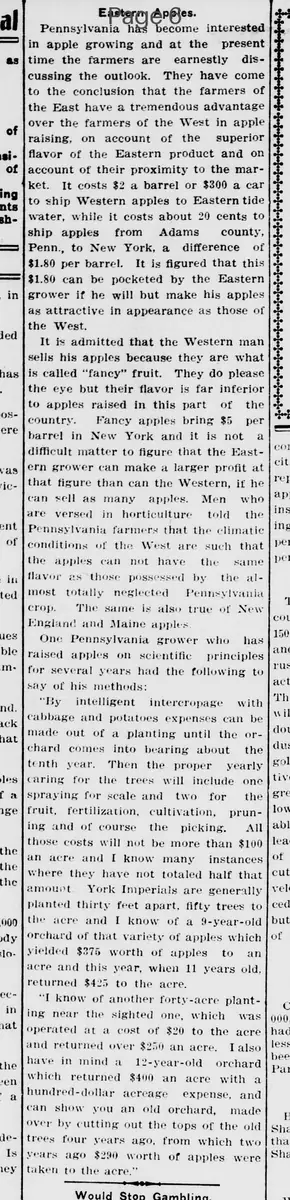
It is admitted that the Western man sells his apples because they are what is called "fancy" fruit. They do please the eye but their flavor is far inferior to apples raised in this part of the country. Fancy apples bring $5 per barrel in New York and it is not a difficult matter to figure that the Eastern grower can make a larger profit at that figure than can the Western, if he can sell as many apples. Men who are versed in horticulture told the Pennsylvania farmers that the climatic conditions of the West are such that the apples can not have the same flavor as those possessed by the almost totally neglected Pennsylvania crop. The same is also true of New England and Maine apples.
One Pennsylvania grower who has raised apples on scientific principles for several years had the following to say of his methods:
"By intelligent intercropage with cabbage and potatoes expenses can be made out of a planting until the orchard comes into bearing about the tenth year. Then the proper yearly caring for the trees will include one spraying for scale and two for the fruit, fertilization, cultivation, pruning and of course the picking. All those costs will not be more than $100 an acre and I know many instances where they have not totaled half that amount. York Imperials are generally planted thirty feet apart, fifty trees to the acre and I know of a 9-year-old orchard of that variety of apples which yielded $375 worth of apples to an acre and this year, when 11 years old, returned $425 to the acre.
"I know of another forty-acre planting near the sighted one, which was operated at a cost of $20 to the acre and returned over $250 an acre. I also have in mind a 12-year-old orchard which returned $400 an acre with a hundred-dollar acreage expense, and can show you an old orchard, made over by cutting out the tops of the old trees four years ago, from which two years ago $290 worth of apples were taken to the acre."
What sub-type of article is it?
What keywords are associated?
Where did it happen?
Domestic News Details
Primary Location
Pennsylvania
Event Date
At The Present Time
Outcome
york imperials yielded $375 per acre at 9 years old and $425 per acre at 11 years old; another 40-acre planting returned over $250 per acre at $20 cost; 12-year-old orchard returned $400 per acre at $100 expense; renovated old orchard yielded $290 per acre two years ago
Event Details
Pennsylvania farmers discuss advantages in apple growing over Western farmers due to superior flavor and proximity to markets like New York, with shipping costs of $2 per barrel from West vs. 20 cents from Adams county. Western apples sell for $5 per barrel as 'fancy' fruit but have inferior flavor. Horticulturists note Western climate affects flavor. A Pennsylvania grower describes methods: intercropping with cabbage and potatoes until bearing in tenth year; annual care costs $100 per acre or less; planting York Imperials 30 feet apart, 50 trees per acre.