Thank you for visiting SNEWPapers!
Sign up free
Kentucky Gazette And General Advertiser
Lexington, Fayette County, Kentucky
What is this article about?
Report from London Courier on the decisive allied victory over French forces at Austerlitz from December 2-5, 1805, led by Emperor Alexander, routing Napoleon's army and recovering lost artillery.
Clipping
OCR Quality
Full Text
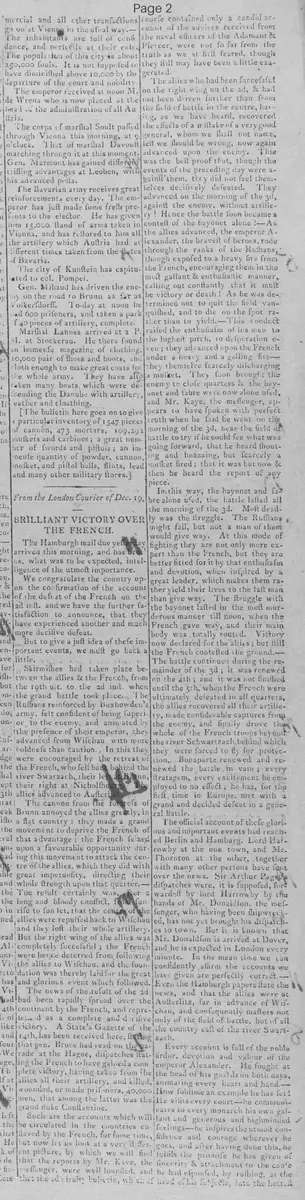
BRILLIANT VICTORY OVER
THE FRENCH.
The Hamburgh mail due yesterday arrived this morning, and has brought us, what was to be expected, intelligence of the utmost importance.
We congratulate the country upon the confirmation of the account of the defeat of the French on the 2d inst. and we have the further satisfaction to announce, that they have experienced another and much more decisive defeat.
But to give a just idea of these important events, we must go back a little.
Skirmishes had taken place between the allies & the French, from the 19th ult. to the 2d inst. when the grand battle took place. The Russians reinforced by Buxhowden's army, felt confident of being superior to the enemy, and animated by the presence of their emperor, they advanced from Wischau with more boldness than caution. In this they were encouraged by the retreat of the French, who fell back behind the river Swartzach, their left at Brunn, their right at Nicholasbourg.
The allies advanced to Austerlitz
The cannon from the fortress of Brunn annoyed the allies greatly, in a flat country : they made a grand movement to deprive the French of that advantage ; the French seized upon a favourable opportunity during this movement to attack the centre of the allies, which they did with great impetuosity, directing their whole strength upon that quarter.— The result certainly was, after a long and bloody conflict, from sun rise to sun set, that the centre of the allies were repulsed back to Wischau and they lost their whole artillery.
But the right wing of the allies was completely successful ; the French were hence deterred from following the allies to Wischau, and the foundation was thereby laid for the great and glorious event which followed.
The news of the result of the 2d had been rapidly spread over the continent by the French, and represented as a complete and decisive victory. A State's Gazette of the 14th, has been received here, stating that gen. Bruce had read on the parade at the Hague, dispatches stating the French to have gained a complete victory, having taken from the allies all their artillery, and killed, wounded, or made prisoners, 40,000 men, that among the latter was the grand duke Constantine.
Such are the accounts which will be circulated in the countries enslaved by the French, for some time, but now let us look at a very different picture, by which we will find that the reports by Mr. Kaye, the messenger, were well founded, and that the admiralty bulletin, which of course contained only a candid account of the advices received from the naval officers of the Adamant & Persever, were not so far from the truth as we at first feared, though they still may have been a little exaggerated.
The allies who had been successful on the right wing on the 2d, & had not been driven further than from the field of battle in the centre, having, as we have heard, recovered the effects of a mistake of a very good general, whom we shall not name, lest we should be wrong, now again advanced upon the enemy. This was the best proof that, though the events of the preceding day were against them, they did not feel themselves decisively defeated. They advanced on the morning of the 3d, against the enemy, without artillery ! Hence the battle soon became a contest of the bayonet alone ! As the allies advanced, the emperor Alexander, the bravest of heroes, rode through the ranks of the Russians, though exposed to a heavy fire from the French, encouraging them in the most gallant & enthusiastic manner, calling out constantly that it must be victory or death! As he was determined not to quit the field vanquished, and to die on the spot rather than to yield.—This conduct raised the enthusiasm of his men to the highest pitch, to desperation even; they advanced upon the French under a heavy and a galling fire— they themselves scarcely discharging a musket. They soon brought the enemy to close quarters & the bay- onet and sabre were now alone used, and Mr. Kaye, the messenger, appears to have spoken with perfect truth when he said he went on the morning of the 3d, near the field of battle to try if he could see what was going forward, that he heard shouting and huzzaing, but scarcely a musket fired; that it was but now & then he heard the report of any piece.
In this way, the bayonet and sa- bre alone used, the battle lasted all the morning of the 3d. Most dread- ly was the struggle. The Russians might fall, but not a man of them would give way. At this mode of fighting they are not only more expert than the French, but they are better fitted for it by that enthusiasm and devotion, when inspired by a great leader, which makes them rather yield their lives to the last man than give way. The struggle with the bayonet lasted in the most mur- derous manner till noon, when the French gave way, and their main body was totally routed. Victory now declared for the allies; but still the French contested the ground.— The battle continued during the remainder of the 3d; it was renewed on the 4th: and it was not finished until the 5th, when the French were ultimately defeated in all quarters, the allies recovered all their artille- ry, made considerable captures from the enemy, and finally drove the whole of the French troops beyond the river Swartzach, behind which they were forced to fly for protec- tion. Bonaparte renewed and renewed the battle, in vain ; every stratagem, every excitement he em- ployed to no effect ; he has, for the first time in Europe, met with a grand and decided defeat in a general battle.
The official account of these glorious and important events had reached Berlin and Hamburg. Lord Harrowby at the one town, and Mr. Thornton at the other, together with many other persons have sent over the news. Sir Arthur Paget's dispatches were, it is supposed, forwarded by lord Harrowby by the hands of Mr. Donaldson, the messenger, who having been shipwrecked, has not yet brought his dispatches to town. But it is known that Mr. Donaldson is arrived at Dover, and he is expected in London every minute. In the mean time we can confidently affirm the accounts we have given are perfectly correct.— Even the Hamburgh papers state the news, and that the allies were at Austerlitz, far in advance of Wischau, and consequently masters not only of the field of battle, but of all the country east of the river Swartzach.
Every account is full of the noble ardor, devotion and valour of the emperor Alexander. He fought at the head of his guards on both days, animating every heart and hand.— How sublime an example he has set! He civilizes every court--he communicates to every monarch his own gallant and generous and highminded -feelings-he inspires the utmost confidence and courage wherever he goes, and after having done this, he fulfills the promise he has given of sincerity & attachment to the cause he had espoused, by rushing, at the head of his subjects, into the hottest
What sub-type of article is it?
What keywords are associated?
What entities or persons were involved?
Where did it happen?
Foreign News Details
Primary Location
Austerlitz
Event Date
From The 19th Ult. To The 5th Inst.
Key Persons
Outcome
french ultimately defeated in all quarters; allies recovered all their artillery, made considerable captures from the enemy, and drove the whole of the french troops beyond the river swartzach; french propaganda claimed 40,000 allied casualties including grand duke constantine
Event Details
Skirmishes from 19th ult. to 2d inst. culminated in grand battle on 2d inst. where allies' center was repulsed but right wing succeeded; battles continued on 3d, 4th, and 5th inst. with bayonet charges led by emperor Alexander; French main body routed, marking Bonaparte's first grand defeat in Europe