Thank you for visiting SNEWPapers!
Sign up free
Albuquerque Morning Journal
Albuquerque, Bernalillo County, New Mexico
What is this article about?
Overview of the U.S. 67th Congress's second session (Dec. 5, 1921–Sept. 23, 1922) in Washington, covering key laws like tariff and bonus bills, treaty ratifications, strike responses, appropriations over $2.25B, and political events including investigations and personnel changes.
Clipping
OCR Quality
Full Text
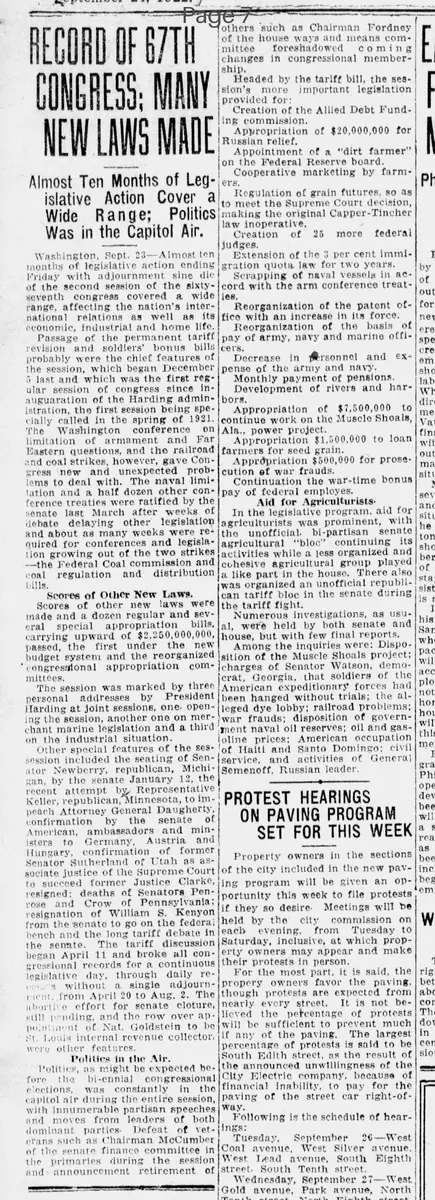
RECORD OF 67TH CONGRESS: MANY NEW LAWS MADE
Almost Ten Months of Legislative Action Cover a Wide Range;
Politics Was in the Capitol Air.
Washington, Sept. 23.—Almost ten months of legislative action ending Friday with adjournment sine die of the second session of the sixty-seventh congress covered a wide range, affecting the nation's international relations as well as its economic, industrial and home life.
Passage of the permanent tariff revision and soldiers' bonus bills probably were the chief features of the session, which began December 5 last and which was the first regular session of congress since inauguration of the Harding administration, the first session being specially called in the spring of 1921.
The Washington conference on limitation of armament and Far Eastern questions, and the railroad and coal strikes, however, gave Congress new and unexpected problems to deal with. The naval limitation and a half dozen other conference treaties were ratified by the senate last March after weeks of debate delaying other legislation and about as many weeks were required for conferences and legislation growing out of the two strikes—the Federal Coal commission and coal regulation and distribution bills.
Scores of Other New Laws.
Scores of other new laws were made and a dozen regular and several special appropriation bills, carrying upward of $2,250,000,000 passed, the first under the new budget system and the reorganized congressional appropriation committees.
The session was marked by three personal addresses by President Harding at joint sessions, one, opening the session, another one on merchant marine legislation and a third on the industrial situation.
Other special features of the session included the seating of Senator Newberry, republican, Michigan, by the senate January 12, the recent attempt by Representative Keller, republican, Minnesota, to impeach Attorney General Daugherty, confirmation by the senate of American ambassadors and ministers to Germany, Austria and Hungary, confirmation of former Senator Sutherland of Utah as associate justice of the Supreme Court to succeed former Justice Clarke, resigned; deaths of Senators Penrose and Crow of Pennsylvania; resignation of William S. Kenyon from the senate to go on the federal bench and the long tariff debate in the senate. The tariff discussion began April 11 and broke all congressional records for a continuous legislative day, through daily recesses without a single adjournment, from April 20 to Aug. 2. The abortive effort for senate cloture, still pending, and the row over appointment of Nat. Goldstein to be St. Louis internal revenue collector were other features.
Politics in the Air.
Politics, as might be expected before the bi-ennial congressional elections, was constantly in the capitol air during the entire session, with innumerable partisan speeches and moves from leaders of both dominant parties. Defeat of veterans such as Chairman McCumber of the senate finance committee in the primaries during the session and announcement retirement of others such as Chairman Fordney of the house ways and means committee foreshadowed coming changes in congressional membership.
Headed by the tariff bill, the session's more important legislation provided for:
Creation of the Allied Debt Funding commission.
Appropriation of $20,000,000 for Russian relief.
Appointment of a "dirt farmer" on the Federal Reserve board.
Cooperative marketing by farmers.
Regulation of grain futures, so as to meet the Supreme Court decision making the original Capper-Tincher law inoperative.
Creation of 25 more federal judges.
Extension of the 3 per cent immigration quota law for two years.
Scrapping of naval vessels in accordance with the arm conference treaties.
Reorganization of the patent office with an increase in its force.
Reorganization of the basis of pay of army, navy and marine officers.
Decrease in personnel and expense of the army and navy.
Monthly payment of pensions.
Development of rivers and harbors.
Appropriation of $7,500,000 to continue work on the Muscle Shoals, Ala., power project.
Appropriation $1,500,000 to loan farmers for seed grain.
Appropriation $500,000 for prosecution of war frauds.
Continuation the war-time bonus pay of federal employes.
Aid for Agriculturists
In the legislative program, aid for agriculturists was prominent, with the unofficial, bi-partisan senate agricultural "bloc" continuing its activities while a less organized and cohesive agricultural group played a like part in the house. There also was organized an unofficial republican tariff bloc in the senate during the tariff fight.
Numerous investigations, as usual, were held by both senate and house, but with few final reports. Among the inquiries were: Disposition of the Muscle Shoals project; charges of Senator Watson, democrat, Georgia, that soldiers of the American expeditionary forces had been hanged without trials; the alleged dye lobby; railroad problems; war frauds; disposition of government naval oil reserves; oil and gasoline prices; American occupation of Haiti and Santo Domingo; civil service, and activities of General Semenoff, Russian leader.
What sub-type of article is it?
What keywords are associated?
What entities or persons were involved?
Where did it happen?
Story Details
Key Persons
Location
Washington
Event Date
Second Session Of The Sixty Seventh Congress, December 5, 1921 To September 23, 1922
Story Details
The second session of the 67th Congress, lasting almost ten months, passed major legislation including permanent tariff revision and soldiers' bonus bills, ratified Washington conference treaties, addressed railroad and coal strikes, and enacted numerous other laws on appropriations, agriculture, immigration, and more, amid political tensions and investigations.