Thank you for visiting SNEWPapers!
Sign up free
National Gazette
Philadelphia, Philadelphia County, Pennsylvania
What is this article about?
A proposed slate of candidates for U.S. Congress representatives from Pennsylvania counties of Washington, Westmoreland, Fayette, and Allegheny, selected to avoid Cincinnati members, bankers, and speculators, prioritizing republican principles and public interest.
Clipping
OCR Quality
Full Text
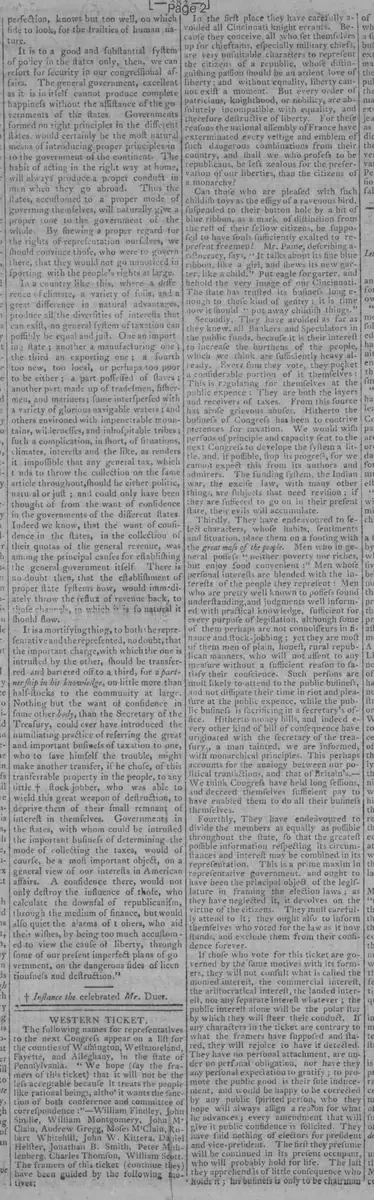
The following names for representatives to the next Congress appear on a list for the counties of Washington, Westmoreland, Fayette, and Alleghany, in the state of Pennsylvania. "We hope (say the framers of this ticket) that it will not be the less acceptable because it treats the people like rational beings, altho' it wants the sanction of both conference and committee of correspondence:"—William Findley, John Smilie, William Montgomery, John M'Clain, Andrew Gregg, Moses M'Clain, Robert Whitehill, John W. Kittera, Daniel Heister, Jonathan B. Smith, Peter Muhlenberg, Charles Thomson, William Scott.
The framers of this ticket (continue they) have been guided by the following motives;
In the first place they have carefully avoided all Cincinnati knight errants. Because they conceive all who set themselves up for chieftains, especially military chiefs, are very unsuitable characters to represent the citizens of a republic, whose distinguishing passion should be an ardent love of liberty; and without equality, liberty cannot exist a moment. But every order of patricians, knighthood, or nobility, are absolutely incompatible with equality, and therefore destructive of liberty. For these reasons the national assembly of France have exterminated every vestige and emblem of such dangerous combinations from their country, and shall we who profess to be republicans, be less zealous for the preservation of our liberties, than the citizens of a monarchy?
Can those who are pleased with such childish toys as the effigy of a ravenous bird, suspended to their button hole by a bit of blue ribbon, as a mark of distinction from the rest of their fellow citizens, be supposed to have souls sufficiently exalted to represent freemen? Mr. Paine, describing aristocracy, says, "It talks about its fine blue ribbon, like a girl, and shews its new garter, like a child." Put eagle for garter, and behold the very image of our Cincinnati.
The state has trusted its business long enough to these kind of gentry; it is time now it should "put away childish things."
Secondly, They have avoided as far as they knew, all Bankers and Speculators in the public funds, because it is their interest to increase the burthens of the people, which we think are sufficiently heavy already. Every sum they vote, they pocket a considerable portion of it themselves: This is regulating for themselves at the public expence: They are both the layers and receivers of taxes. From this source has arisen grievous abuses. Hitherto the business of Congress has been to contrive pretences for taxation. We would wish persons of principle and capacity sent to the next Congress to develope the system a little, and, if possible, stop its progress, for we cannot expect this from its authors and admirers. The funding system, the Indian war, the excise law, with many other things, are subjects that need revision; if they are suffered to go on in their present state, their evils will accumulate.
Thirdly, They have endeavoured to select characters, whose habits, sentiments and situation, place them on a footing with the great mass of the people. Men who in general possess "neither poverty nor riches, but enjoy food convenient:" Men whose personal interests are blended with the interests of the people they represent: Men who are pretty well known to possess sound understanding, and judgments well informed with practical knowledge, sufficient for every purpose of legislation, although some of them perhaps are not connoisseurs in finance and stock-jobbing; yet they are most of them men of plain, honest, rural republican manners, who will not assent to any measure without a sufficient reason to satisfy their conscience. Such persons are most likely to attend to the public business, and not dissipate their time in riot and pleasure at the public expence, while the public business is sacrificing in a secretary's office. Hitherto money bills, and indeed every other kind of bill! of consequence have originated with the secretary of the treasury, a man tainted, we are informed, with monarchical principles. This perhaps accounts for the analogy between our political transactions, and that of Britain's. We think Congress have held long sessions, and decreed themselves sufficient pay to have enabled them to do all their business themselves.
Fourthly, They have endeavoured to divide the members as equally as possible throughout the state, so that the greatest possible information respecting its circumstances and interest may be combined in its representation. This is a prime maxim in representative government, and ought to have been the principal object of the legislature in framing the election laws: as they have neglected it, it devolves on the virtue of the citizens. They must carefully attend to it: they ought also to inform themselves who voted for the law as it now stands, and exclude them from their confidence forever.
If those who vote for this ticket are governed by the same motives with its formers, they will not consult what is called the monied interest, the commercial interest, the aristocratical interest, the landed interest, nor any separate interest whatever; the public interest alone will be the polar star by which they will steer their conduct. If any characters in the ticket are contrary to what the framers have supposed and stated, they will rejoice to have it detected. They have no personal attachment, are under no personal obligation, nor have they any personal expectation to gratify; to promote the public good is their sole inducement, and would be happy to be corrected by any public spirited person, who they hope will always assign a reason for what he advances; every amendment that will give it public confidence is solicited. They have said nothing of electors for president and vice-president. The first they presume will be continued in its present occupant, who will probably hold for life. The last they apprehend is of little consequence who holds it; his business is only to be chairman
What sub-type of article is it?
What keywords are associated?
What entities or persons were involved?
Where did it happen?
Domestic News Details
Primary Location
Pennsylvania
Key Persons
Event Details
Framers propose a ticket of candidates for representatives to the next Congress from counties of Washington, Westmoreland, Fayette, and Alleghany in Pennsylvania, guided by motives to avoid Cincinnati members, bankers, and speculators; select representatives aligned with the people's interests; ensure equal division across the state; prioritize public interest over separate interests.