Thank you for visiting SNEWPapers!
Sign up free
Massachusetts Spy And Worcester Advertiser
Worcester, Worcester County, Massachusetts
What is this article about?
Governor William Eustis addresses the Massachusetts Legislature on January 6, 1825, congratulating on prosperity, praising President Monroe's administration, advocating internal improvements like canals, recommending Bunker Hill monument revisions, urging militia system reform, noting Lafayette's visit, and mentioning treasury balance and vacancies.
Clipping
OCR Quality
Full Text
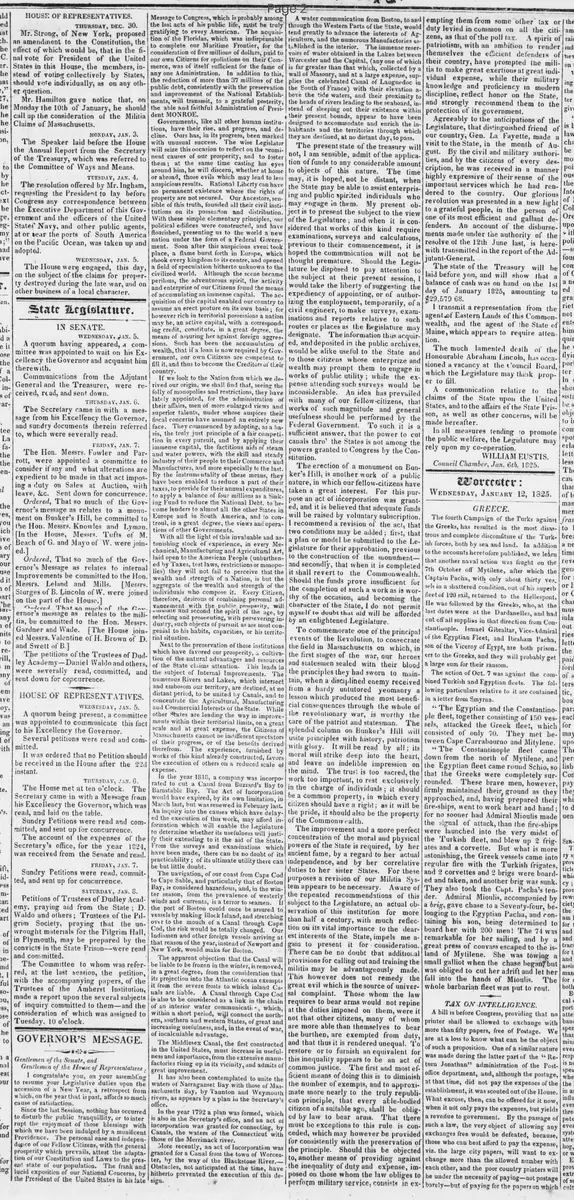
Gentlemen of the Senate, and Gentlemen of the House of Representatives:
I congratulate you, on your assembling to resume your Legislative duties upon the accession of a New Year, a retrospect from which, on the year that is past, affords so much cause of satisfaction.
Since the last Session, nothing has occurred to disturb the public tranquillity, or to interrupt the enjoyment of those blessings with which we have been indulged by a munificent Providence. The personal ease and independence of our Fellow Citizens, with the general prosperity which prevails, attest the adaptation of our Constitution and Laws to the present state of our population. The frank and lucid exposition of our National Concerns, by the President of the United States in his late Message to Congress, which is probably among the last acts of his public life, must be truly gratifying to every American. The acquisition of the Floridas, which was indispensable to complete our Maritime Frontier, for the consideration of five millions of dollars, paid to our own Citizens for spoliations on their Commerce, was of itself sufficient for the fame of any one Administration. In addition to this, the reduction of more than 37 millions of the public debt, consistently with the preservation and improvement of the National Establishments, will transmit, to a grateful posterity, the able and faithful Administration of President MONROE.
Governments, like all other human institutions, have their rise, and progress, and decline. Ours has, in its progress, been marked with unusual success. The wise Legislator will seize this occasion to reflect on the prominent causes of our prosperity, and to foster them; at the same time casting his eyes around him, he will discern, whether at home or abroad, those evils which may lead to less auspicious results. Rational Liberty can have no permanent existence where the rights of property are not secured. Our Ancestors, sensible of this truth, founded all their civil institutions on its possession and distribution. With these simple elementary principles, our political edifices were constructed, and have flourished, presenting us to the world a new nation under the form of a Federal Government. Soon after this auspicious event took place, a flame burst forth in Europe, which shook every kingdom to its centre, and opened a field of speculation hitherto unknown to the civilized world. Although the scene became perilous, the adventurous spirit, the activity and enterprize of our Citizens found the means of accumulating an immense capital. The acquisition of this capital enabled our country to assume an erect posture on its own basis; for however rich in territorial possessions a nation may be, an active capital, with a corresponding credit, constitute, in a great degree, the means of assuring her against foreign aggressions. Such has been the accumulation of wealth, that if a loan is now required by Government, our own Citizens are competent to fill it, and thus to become the Creditors of their country.
If we look to the Nation from which we derived our origin, we shall find that, seeing the folly of monopolies and restrictions, they have lately appointed, for the administration of their affairs, men of more enlarged views and superior talents, under whose auspices their fiscal concerns have assumed an entirely new face. They commenced by adopting, as a basis, the truly just principle of a fair competition in every pursuit, and by applying their immense capital, the factitious aids of steam and water powers, with the skill and steady industry of their people to their Commerce and Manufactures, and more especially to the last. By the instrumentality of these means, they have been enabled to reduce a part of their taxes, to provide for their annual expenditures, to apply a balance of four millions as a Sinking Fund to reduce the National Debt, to become lenders to almost all the other States in Europe and in South America, and to control, in a great degree, the views and operations of other Governments.
With all the light of this invaluable and astonishing stock of experience, in every Mechanical, Manufacturing and Agricultural Art, laid open to the American People (unburthened by Taxes, test laws, restrictions or monopolies) they will not fail to perceive that the wealth and strength of a Nation, is but the aggregate of the wealth and strength of the individuals who compose it. Every Citizen, therefore, desirous of combining personal advancement with the public prosperity, will cultivate and second the spirit of the age, by selecting and prosecuting, with persevering industry, such objects of pursuit as are most congenial to his habits, capacities, or his territorial situation.
Next to the preservation of those institutions which have favored our prosperity, a cultivation of the natural advantages and resources of the State claims attention. This leads to the subject of Internal Improvements. The numerous Rivers and Lakes, which intersect and embosom our territory, are destined, at no distant period, to be united by Canals, and to concentrate the Agricultural, Manufacturing and Commercial Interests of the State. While other States are leading the way in improvements within their territorial limits, on a great scale and at great expense, the Citizens of Massachusetts cannot be indifferent spectators of their progress, or of the benefits derived therefrom. The experience, furnished by works of this kind already constructed, favors the execution of others on a reduced scale of expense.
In the year 1818, a company was incorporated to cut a Canal from Buzzard's Bay to Barnstable Bay. The Act of Incorporation would have expired, by its own limitation, in March last, but was renewed in February last. An inquiry into the causes which have delayed the execution of this work, may afford information which will enable the Legislature to determine whether its usefulness will justify their extending to it the aid of the State. From the surveys and examinations which have been made, there can be no doubt of its practicability; of its ultimate utility there can be but little doubt.
The navigation, of our coast from Cape Cod to Cape Sable, and particularly that of Boston Bay, is considered hazardous, and, in the winter season, from the prevalence of westerly winds and currents, is a terror to seamen. If the port of Boston could once be assured to vessels by making Block Island, and stretching over to the mouth of a Canal through Cape Cod, the risk would be totally changed. Our Indiamen and other foreign vessels arriving at that season of the year, instead of Newport and New York, would make for Boston.
The apparent objection that the Canal will be liable to be frozen in the winter, is removed, in a great degree, from the consideration that its projection into the Atlantic ocean exempts it from the severe frosts to which inland Canals are liable. A Canal through Cape Cod is also to be considered as a link in the chain of an interior water communication, which, within a short period, will connect the northern, southern and western States, of great and increasing usefulness, and, in the event of war, of incalculable advantage.
The Middlesex Canal, the first constructed in the United States, must increase in usefulness and importance, from the extensive manufactories rising up in its vicinity, and admits of great improvement.
It has also been contemplated to unite the waters of Narraganset Bay with those of Massachusetts Bay, by Taunton and Weymouth rivers, as appears by a plan in the Secretary's office.
In the year 1792 a plan was formed, which is also in the Secretary's office, and an act of incorporation was granted for connecting, by Canals, the waters of the Connecticut with those of the Merrimack river.
More recently, an act of Incorporation was granted for a Canal from the town of Worcester, by the way of the Blackstone River.— Obstacles, not anticipated at the time, have hitherto prevented the execution of this design.
A water communication from Boston, to and through the Western Parts of the State, would tend greatly to advance the interests of Agriculture, and the numerous Manufactories established in the interior. The immense reservoirs of water obtained in the Lakes between Worcester and the Capital, (any one of which is far greater than that which, collected by a wall of Masonry, and at a large expense, supplies the celebrated Canal of Languedoc in the South of France) with their elevation above the tide waters, and their proximity to the heads of rivers leading to the seaboard, instead of sleeping out their existence within their present bounds, appear to have been designed to accommodate and enrich the inhabitants and the territories through which they are destined, at no distant day, to pass.
The present state of the treasury will not, I am sensible, admit of the application of funds to any considerable amount to objects of this nature. The time may, it is hoped, not be distant, when the State may be able to assist enterprising and public spirited individuals who may engage in them. My present object is to present the subject to the view of the Legislature; and when it is considered that works of this kind require examinations, surveys and calculations, previous to their commencement, it is hoped the communication will not be thought premature. Should the Legislature be disposed to pay attention to the subject at their present session, I would take the liberty of suggesting the expediency of appointing, or of authorizing the employment, temporarily, of a civil engineer, to make surveys, examinations and reports relative to such routes or places as the Legislature may designate. The information thus acquired, and deposited in the public archives, would be alike useful to the State and to those citizens whose enterprize and wealth may prompt them to engage in works of public utility; while the expense attending such surveys would be inconsiderable. An idea has prevailed with many of our fellow-citizens, that works of such magnitude and general usefulness should be performed by the Federal Government. To such it is a sufficient answer, that the power to cut canals thro' the States is not among the powers granted to Congress by the Constitution.
The erection of a monument on Bunker's Hill, is another work of a public nature, in which our fellow-citizens have taken a great interest. For this purpose an act of incorporation was granted, and it is believed that adequate funds will be raised by voluntary subscription. I recommend a revision of the act, that two conditions may be added; first, that a plan or model be submitted to the Legislature for their approbation, previous to the construction of the monument—and secondly, that when it is completed it shall revert to the Commonwealth Should the funds prove insufficient for the completion of such a work as is worthy of the occasion, and becoming the character of the State. I do not permit myself to doubt that aid will be afforded by an enlightened Legislature.
'To commemorate one of the principal events of the Revolution, to consecrate the field in Massachusetts on which, in the first stages of the war, our heroes and statesmen sealed with their blood the principles they had sworn to maintain, when a disciplined enemy received from a hardy untutored yeomanry a lesson which produced the most beneficial consequences through the whole of the revolutionary war, is worthy the care of the patriot and statesman. The splendid column on Bunker's Hill will unite principles with history, patriotism with glory.' It will be read by all; its moral will strike deep into the heart, and leave an indelible impression on the mind. The trust is too sacred, the work too important, to rest exclusively in the charge of individuals; it should be a common property, in which every citizen should have a right; as it will be the pride, it should also be the property of the Commonwealth.
The improvement and a more perfect concentration of the moral and physical powers of the State is required, by her ancient fame, by a regard to her actual independence, and by her correlative duties to her sister States. For these purposes a revision of our Militia System appears to be necessary. Aware of the repeated recommendations of this subject to the Legislature, an actual observation of this institution for more than half a century, with much reflection on its vital importance to the dearest interests of the State, impels me again to present it for consideration.
'There can be no doubt that additional provisions for calling out and training the militia may be advantageously made. This however does not remedy the great evil which is the source of universal complaint. Those whom the law requires to bear arms would not repine at the duties imposed on them, were it not that other citizens, many of whom are more able than themselves to bear the burthen, are exempted from duty, and that thus it is rendered unequal. To restore or to furnish an equivalent for this inequality appears to be an act of common justice. The first and most efficient means of doing this is to diminish the number of exempts, and to approximate more nearly to the truly republican principle, that every able-bodied citizen of a suitable age, shall be obliged by law to bear arms. That there must be exceptions to this rule is conceded, which may however be provided for consistently with the preservation of the principle. Should this be objected to, another means of providing against the inequality of duty and expense, imposed on those whom the law obliges to perform military service, consists in exempting them from some other tax or duty levied in common on all the citizens, as that of the poll tax. A spirit of patriotism, with an ambition to render themselves the efficient defenders of their country, have prompted the militia to make great exertions at great individual expense, while their military knowledge and proficiency in modern discipline, reflect honor on the State, and strongly recommend them to the protection of its government.'
Agreeably to the anticipations of the Legislature, that distinguished friend of our country, Gen. La Fayette, made a visit to the State, in the month of August. By the civil and military authorities, and by the citizens of every description, he was received in a manner highly expressive of their sense of the important services which he had rendered to the country. Our glorious revolution was presented in a new light to a grateful people, in the person of one of its most efficient and gallant defenders. An account of the disbursements made under the authority of the resolve of the 12th June last, is herewith transmitted in the report of the Adjutant-General.
The state of the Treasury will be laid before you, and will show that a balance of cash was on hand on the 1st day of January 1825, amounting to $29,579 68.
I transmit a representation from the agent of Eastern Lands of this Commonwealth, and the agent of the State of Maine, which appears to require attention.
The much lamented death of the Honourable Abraham Lincoln, has occasioned a vacancy at the Council Board, which the Legislature may think proper to fill.
A communication relative to the claims of the State upon the United States, and to the affairs of the State Prison, as well as other concerns, will be made hereafter.
In all measures tending to promote the public welfare, the Legislature may rely upon my co-operation.
WILLIAM EUSTIS.
Council Chamber, Jan. 6th, 1825.
What sub-type of article is it?
What keywords are associated?
What entities or persons were involved?
Where did it happen?
Domestic News Details
Primary Location
Massachusetts
Event Date
Jan. 6th, 1825
Key Persons
Outcome
death of honourable abraham lincoln creating vacancy at council board; treasury balance of $29,579.68 on january 1, 1825.
Event Details
Governor Eustis delivers annual message to Massachusetts Legislature, reviewing national prosperity under President Monroe, advocating internal improvements including canals and Bunker Hill monument, recommending militia reforms, noting Lafayette's August visit, and addressing state finances and vacancies.