Thank you for visiting SNEWPapers!
Sign up free
Editorial
February 6, 1829
Constitutional Whig
Richmond, Virginia
What is this article about?
This editorial, part II of notes on Adam Smith's 'Wealth of Nations' in the Whig, critiques Smith's analogy of division of labor between individuals and nations, arguing it requires impossible universal free trade and peace. It defends protective commercial policies amid national rivalries, referencing England-France-Portugal trade and Jefferson's views.
Clipping
OCR Quality
95%
Excellent
Full Text
FOR THE WHIG.
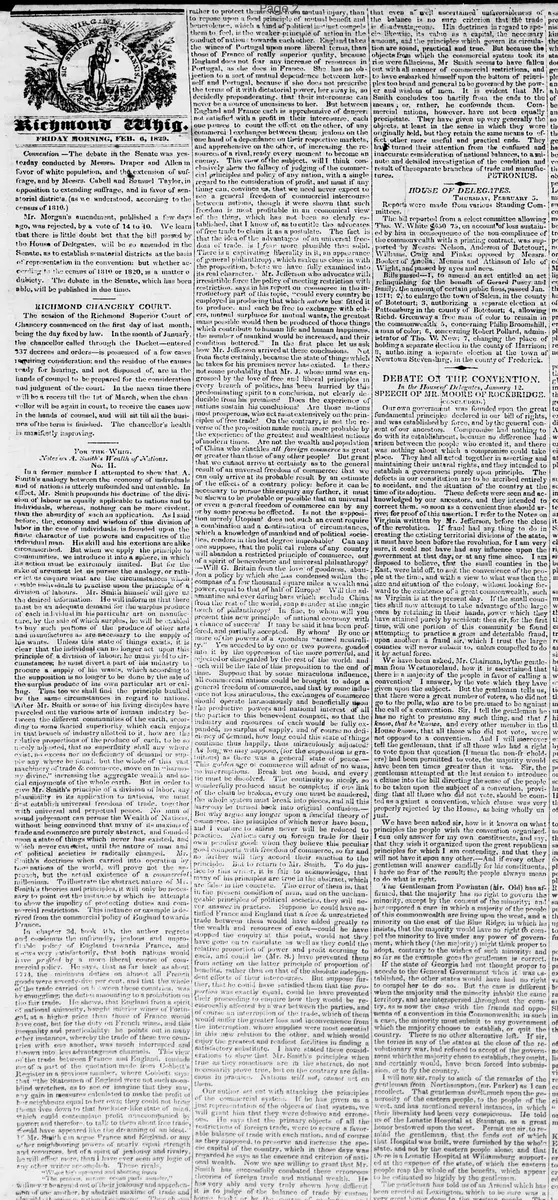
Notes on A. Smith's Wealth of Nations.
No. II.
In a former number I attempted to shew that A. Smith's analogy between the economy of individuals and of nations is utterly unfounded and untenable. In effect, Mr. Smith propounds his doctrine of the division of labour as equally applicable to nations and to individuals, whereas, nothing can be more evident, than the absurdity of such an application. As I said before, the economy and wisdom of this division of labor in the case of individuals, is founded upon the finite character of the powers and capacities of the individual man. His skill and his exertions are alike circumscribed. But when we apply the principle to communities, we introduce it into a sphere, in which its action must be extremely limited. But for the sake of argument let us pursue the analogy, or rather let us enquire what are the circumstances which enable individuals to practise upon the principle of a division of labours. Mr. Smith himself will give us the desired information. He will inform us that there must be an adequate demand for the surplus produce of each individual in his particular art or manufacture, by the sale of which surplus, he will be enabled to buy such portions of the produce of other arts and manufactures as are necessary to the supply of his wants. Unless this state of things exists, it is clear that the individual can no longer act upon this principle of a division of labour; he must yield to circumstances; he must divert a part of his industry to procure a supply of his wants, which according to the supposition is no longer to be done by the sale of the surplus produce of his own particular art or calling. Thus too we shall find the principle baulked by the same circumstances in regard to nations.
After Mr. Smith or some of his living disciples have parcelled out the various arts of human industry between the different communities of the earth, according to some fancied superiority which each enjoys in that branch of industry allotted to it, how are the relative proportions of the produce of each, to be so nicely adjusted, that no superfluity shall anywhere exist, no excess nor no deficiency of demand or supply anywhere be found. but the whole of this vast machinery of trade & commerce, move on in "harmony divine," increasing the aggregate wealth and social enjoyments of the whole earth. But in order to give Mr. Smith's principle of a division of labor, any plausibility in its application to nations, we must first establish universal freedom of trade. together with universal and perpetual peace. No man of sound judgment can peruse the Wealth of Nations, without being convinced that many of its maxims of trade and commerce are purely abstract, and founded upon a state of things which never has existed, and which never can exist, until the nature of man and of political societies is radically changed. Mr. Smith's doctrines when carried into operation by the nations of the world, will prove not the approach, but the actual existence of a commercial millennium. To illustrate the abstract nature of Mr. Smith's theories and principles, it will only be necessary to point out the instance by which he attempts to show the impolicy of protecting duties and commercial restrictions. This instance or example is derived from the commercial policy of England towards France.
In chapter 3d, book 4th, the author regrets and condemns the unfriendly, jealous and unprofitable policy of England towards France, and shews very satisfactorily, that both nations would have profited by a more liberal course of commercial policy. He says, that as far back as about 1774. the minimum duties on almost all French goods were seventy-five per cent, and that the whole of the trade carried on between these countries, was by smuggling; the duties amounting to a prohibition on the fair trade. He shews, that England from a spirit of national animosity, bought inferior wines of Portugal, at a higher price than those of France would have cost, but for the duty on French wines, and this inequality and impracticability: he points out in many other instances, whereby the trade of these two countries with one another, was much interrupted and thrown into less advantageous channels. This view of the trade between France and England, reminds me of a part of the quotation made from Cobbett's Register in a previous number, where Cobbett says: that "the Statesmen of England were not such moon-blind wretches, as to see or imagine that they saw, any gain in measures calculated to make the profit of their neighbours equal to her own; they could not bring themselves down to that huckster-like state of mind. which could contemplate profit unaccompanied by power; and therefore, to talk to them about free trade, would have appeared like the dreaming of an idiot."
If Mr. Smith can argue France and England. or any other neighbouring powers of nearly equal strength and resources. but of a spirit of jealousy and rivalry, he will effect more, than I have ever seen any logic of any other writer accomplish. These rivals,
"whose high upreared and abutting fronts
The perilous, narrow ocean parts asunder,"
will never be argued out of their jealousy and apprehension of one another, by abstract maxims of trade and plausible theories of national economy. They choose rather to protect themselves from mutual injury, than to repose upon a fond principle of mutual benefit and benevolence. which a kind of political instinct compels them to feel, is the weaker principle of action in the conduct of nations towards each other. England takes the wines of Portugal upon more liberal terms, than those of France of really superior quality, because England does not fear any increase of resources in Portugal, as she does in France. She has no objection to a sort of mutual dependence between herself and Portugal, because if she does not prescribe the terms of it with dictatorial power, her sway is, so decidedly preponderating. that their intercourse can never be a source of uneasiness to her. But between England and France each is apprehensive of danger: not satisfied with a profit in their intercourse, each one pauses to count the effect on the other, of any commercial exchanges between them; jealous on the one hand of a dependence on their respective markets, and apprehensive on the other, of increasing the resources of a rival, ready every moment to become an enemy. This view of the subject, will I think conclusively shew the fallacy of judging of the commercial principles and policy of any nation, with a single regard to the consideration of profit, and must if anything can, convince us, that we need never expect to see a general freedom of commercial intercourse between nations, though it were shown that such freedom is most profitable in an economical view of the thing, which has not been so clearly established, that I know of, as to entitle the advocates of free trade to claim it as a postulate. The fact is that the idea of the advantages of an universal freedom of trade, is I fear more plausible than solid. There is a captivating liberality in it, an appearance of general philanthropy, which makes us close in with the proposition, before we have fully examined into its real character. - Mr. Jefferson who advocates with irresistible force the policy of meeting restriction with restriction, says in his report on commerce in the introductory part of this topic, "could every country be employed in producing that which nature has fitted it to produce, and each be free to exchange with others, mutual surpluses for mutual wants, the greatest mass possible would then be produced of those things which contribute to human life and human happiness, the number of mankind would be increased, and their condition bettered." In the first place let us ask how Mr. Jefferson arrived at these conclusions. Not from facts certainly, because the state of things which he takes for his premises never has existed. Is there not some probability that Mr. J. whose mind was engrossed by the love of free and liberal principles in every branch of politics, has been hurried by this predominating spirit to a conclusion, not clearly deducible from his premises? Does the experience of nations sustain his conclusions? Are those nations most prosperous, who act most extensively on the principles of free trade? On the contrary, is not the reverse of the proposition made much more probable by the experience of the greatest and wealthiest nations of modern times. Are not the wealth and population of China who shackles all foreign commerce as great or greater than those of any other people? But grant that we cannot arrive at certainty as to the general result of an universal freedom of commerce; that we can only arrive at its probable result by an estimate of the effects of a contrary policy: before it can be necessary to pursue this enquiry any further, it must be shewn to be probable or possible that an universal or even a general freedom of commerce can by any or by some process be effected. Is not the supposition merely Utopian? does not such an event require a combination and a continuation of circumstances. which a knowledge of mankind and of political societies, renders in this last degree improbable? Can any one suppose, that the political rulers of any country will abandon a restricted principle of commerce, out of a spirit of benevolence and universal philanthropy? -Will G. Britain from the love of goodness, abandon a policy by which she has condensed within the compass of a few thousand square miles a wealth and power, equal to that of half of Europe? Will the adamantine and ever during bars which seclude China from the rest of the world, so asunder at the magic touch of philanthropy? In fine, to whom will you present this new principle of national economy with a chance of success? It may be said it has been proffered, and partially accepted. By whom? By one or more of the powers of a quondam "armed neutrality." Yes acceded to by one or two powers, goaded into it by the oppression of the more powerful, and rejected or disregarded by the rest of the world: and such will be the fate of this proposition to the end of time. Suppose that by some miraculous influence, all commercial nations could be brought to adopt a general freedom of commerce, and that by some influence not less miraculous, the exchanges of commerce should operate harmoniously and beneficially upon the productive powers and national interest of all the parties to this benevolent compact, so that the industry and resources of each would be fully expanded, no surplus of supply, and of course no deficiency of demand, how long could this state of things continue thus happily, thus miraculously adjusted? As long we may suppose, (for the supposition is gratuitous) as there was a general state of peace.- This golden age of commerce will admit of no wars : no interruptions. Break but one bond, and every tie must be dissolved. The continuity so nicely, so wonderfully produced must be complete; if one link of the chain be broken, every one must be sundered, the whole system must break into pieces, and all this harmony be turned back into original confusion.- But why argue any longer upon a fanciful theory of commerce, the principles of which never have been, and I venture to affirm never will be reduced to practice. Nations carry on foreign trade for their own peculiar good: when they believe this peculiar good comports with freedom of commerce, so far and no farther will they accord their sanction to the principle. But to return to Mr. Smith. To do justice to the writer, it is fair to acknowledge, that many of his principles are true in the abstract, which are false in the concrete. The error of them is, that in the present condition of man, and on the unchangeable principles of political societies, they will never answer in practice. Suppose he could have satisfied France and England that a free & unrestricted trade between them would have added greatly to the wealth and resources of each-could he have stopped the enquiry at this point, would not they have gone on to calculate as well as they could the relative proportion of power and profit accruing to each, and could he (Mr. S.) have prevented them from acting on the latter principle of proportion of benefits, rather than on that of the absolute independent effects of their intercourse. But suppose further, that he could have satisfied them that the proportion was exactly equal, could he have prevented their proceeding to enquire how they would be reciprocally affected by a war between the parties, and of course an interruption of the trade, which of them would suffer the greater loss and inconvenience from the interruption, whose supplies were most essential in this new relation to the other, and which would enjoy the greatest and readiest facilities in finding a satisfactory substitute. I have stated these considerations to shew that Mr. Smith's principles when true as they sometimes are in the abstract, do not necessarily prove true, but on the contrary are fallacious in practice. Nations will not, cannot act on them.
Our author set out with attacking the principles of the commercial system. If he has given us a just representation of the objects of that system, we will grant him that they were delusive and erroneous. "He says that the primary objects of all the restrictions of foreign trade, were to secure a favorable balance of trade with each nation, and of course as they supposed, to preserve and increase the specie capital of the country, which in those days was regarded he says as the essence and criterion of national wealth. Now we are willing to grant that Mr. Smith has successfully combated these erroneous theories of foreign trade and national wealth. He has very ably and very truly shown how difficult it is to judge of the balance of trade by custom house books or by the course of exchange. and that even a "well ascertained" unfavorableness of the balance is no sure criterion that the trade is disadvantageous. His doctrines in regard to specie likewise, its value as a capital, the necessary amount, and the principles which govern its circulation are sound, practical and true. But because the objects from which the commercial system took its rise were fallacious, Mr Smith seems to have fallen out with all manner of commercial restrictions, and to have embarked himself upon the bottom of principles too broad and general to be governed by the power and wisdom of men. It is evident that Mr. Smith concludes too hastily from the ends to the means; or, rather, he confounds them.
Commercial nations, however. have not been equally precipitate. They have given up very generally the objects, at least in the sense in which they were originally held, but they retain the same means to effect other more useful and practical ends. They have turned their attention from the confused and inaccurate consideration of national balances, to a minute and detailed investigation of the condition and result of the separate branches of trade and manufactures.
Notes on A. Smith's Wealth of Nations.
No. II.
In a former number I attempted to shew that A. Smith's analogy between the economy of individuals and of nations is utterly unfounded and untenable. In effect, Mr. Smith propounds his doctrine of the division of labour as equally applicable to nations and to individuals, whereas, nothing can be more evident, than the absurdity of such an application. As I said before, the economy and wisdom of this division of labor in the case of individuals, is founded upon the finite character of the powers and capacities of the individual man. His skill and his exertions are alike circumscribed. But when we apply the principle to communities, we introduce it into a sphere, in which its action must be extremely limited. But for the sake of argument let us pursue the analogy, or rather let us enquire what are the circumstances which enable individuals to practise upon the principle of a division of labours. Mr. Smith himself will give us the desired information. He will inform us that there must be an adequate demand for the surplus produce of each individual in his particular art or manufacture, by the sale of which surplus, he will be enabled to buy such portions of the produce of other arts and manufactures as are necessary to the supply of his wants. Unless this state of things exists, it is clear that the individual can no longer act upon this principle of a division of labour; he must yield to circumstances; he must divert a part of his industry to procure a supply of his wants, which according to the supposition is no longer to be done by the sale of the surplus produce of his own particular art or calling. Thus too we shall find the principle baulked by the same circumstances in regard to nations.
After Mr. Smith or some of his living disciples have parcelled out the various arts of human industry between the different communities of the earth, according to some fancied superiority which each enjoys in that branch of industry allotted to it, how are the relative proportions of the produce of each, to be so nicely adjusted, that no superfluity shall anywhere exist, no excess nor no deficiency of demand or supply anywhere be found. but the whole of this vast machinery of trade & commerce, move on in "harmony divine," increasing the aggregate wealth and social enjoyments of the whole earth. But in order to give Mr. Smith's principle of a division of labor, any plausibility in its application to nations, we must first establish universal freedom of trade. together with universal and perpetual peace. No man of sound judgment can peruse the Wealth of Nations, without being convinced that many of its maxims of trade and commerce are purely abstract, and founded upon a state of things which never has existed, and which never can exist, until the nature of man and of political societies is radically changed. Mr. Smith's doctrines when carried into operation by the nations of the world, will prove not the approach, but the actual existence of a commercial millennium. To illustrate the abstract nature of Mr. Smith's theories and principles, it will only be necessary to point out the instance by which he attempts to show the impolicy of protecting duties and commercial restrictions. This instance or example is derived from the commercial policy of England towards France.
In chapter 3d, book 4th, the author regrets and condemns the unfriendly, jealous and unprofitable policy of England towards France, and shews very satisfactorily, that both nations would have profited by a more liberal course of commercial policy. He says, that as far back as about 1774. the minimum duties on almost all French goods were seventy-five per cent, and that the whole of the trade carried on between these countries, was by smuggling; the duties amounting to a prohibition on the fair trade. He shews, that England from a spirit of national animosity, bought inferior wines of Portugal, at a higher price than those of France would have cost, but for the duty on French wines, and this inequality and impracticability: he points out in many other instances, whereby the trade of these two countries with one another, was much interrupted and thrown into less advantageous channels. This view of the trade between France and England, reminds me of a part of the quotation made from Cobbett's Register in a previous number, where Cobbett says: that "the Statesmen of England were not such moon-blind wretches, as to see or imagine that they saw, any gain in measures calculated to make the profit of their neighbours equal to her own; they could not bring themselves down to that huckster-like state of mind. which could contemplate profit unaccompanied by power; and therefore, to talk to them about free trade, would have appeared like the dreaming of an idiot."
If Mr. Smith can argue France and England. or any other neighbouring powers of nearly equal strength and resources. but of a spirit of jealousy and rivalry, he will effect more, than I have ever seen any logic of any other writer accomplish. These rivals,
"whose high upreared and abutting fronts
The perilous, narrow ocean parts asunder,"
will never be argued out of their jealousy and apprehension of one another, by abstract maxims of trade and plausible theories of national economy. They choose rather to protect themselves from mutual injury, than to repose upon a fond principle of mutual benefit and benevolence. which a kind of political instinct compels them to feel, is the weaker principle of action in the conduct of nations towards each other. England takes the wines of Portugal upon more liberal terms, than those of France of really superior quality, because England does not fear any increase of resources in Portugal, as she does in France. She has no objection to a sort of mutual dependence between herself and Portugal, because if she does not prescribe the terms of it with dictatorial power, her sway is, so decidedly preponderating. that their intercourse can never be a source of uneasiness to her. But between England and France each is apprehensive of danger: not satisfied with a profit in their intercourse, each one pauses to count the effect on the other, of any commercial exchanges between them; jealous on the one hand of a dependence on their respective markets, and apprehensive on the other, of increasing the resources of a rival, ready every moment to become an enemy. This view of the subject, will I think conclusively shew the fallacy of judging of the commercial principles and policy of any nation, with a single regard to the consideration of profit, and must if anything can, convince us, that we need never expect to see a general freedom of commercial intercourse between nations, though it were shown that such freedom is most profitable in an economical view of the thing, which has not been so clearly established, that I know of, as to entitle the advocates of free trade to claim it as a postulate. The fact is that the idea of the advantages of an universal freedom of trade, is I fear more plausible than solid. There is a captivating liberality in it, an appearance of general philanthropy, which makes us close in with the proposition, before we have fully examined into its real character. - Mr. Jefferson who advocates with irresistible force the policy of meeting restriction with restriction, says in his report on commerce in the introductory part of this topic, "could every country be employed in producing that which nature has fitted it to produce, and each be free to exchange with others, mutual surpluses for mutual wants, the greatest mass possible would then be produced of those things which contribute to human life and human happiness, the number of mankind would be increased, and their condition bettered." In the first place let us ask how Mr. Jefferson arrived at these conclusions. Not from facts certainly, because the state of things which he takes for his premises never has existed. Is there not some probability that Mr. J. whose mind was engrossed by the love of free and liberal principles in every branch of politics, has been hurried by this predominating spirit to a conclusion, not clearly deducible from his premises? Does the experience of nations sustain his conclusions? Are those nations most prosperous, who act most extensively on the principles of free trade? On the contrary, is not the reverse of the proposition made much more probable by the experience of the greatest and wealthiest nations of modern times. Are not the wealth and population of China who shackles all foreign commerce as great or greater than those of any other people? But grant that we cannot arrive at certainty as to the general result of an universal freedom of commerce; that we can only arrive at its probable result by an estimate of the effects of a contrary policy: before it can be necessary to pursue this enquiry any further, it must be shewn to be probable or possible that an universal or even a general freedom of commerce can by any or by some process be effected. Is not the supposition merely Utopian? does not such an event require a combination and a continuation of circumstances. which a knowledge of mankind and of political societies, renders in this last degree improbable? Can any one suppose, that the political rulers of any country will abandon a restricted principle of commerce, out of a spirit of benevolence and universal philanthropy? -Will G. Britain from the love of goodness, abandon a policy by which she has condensed within the compass of a few thousand square miles a wealth and power, equal to that of half of Europe? Will the adamantine and ever during bars which seclude China from the rest of the world, so asunder at the magic touch of philanthropy? In fine, to whom will you present this new principle of national economy with a chance of success? It may be said it has been proffered, and partially accepted. By whom? By one or more of the powers of a quondam "armed neutrality." Yes acceded to by one or two powers, goaded into it by the oppression of the more powerful, and rejected or disregarded by the rest of the world: and such will be the fate of this proposition to the end of time. Suppose that by some miraculous influence, all commercial nations could be brought to adopt a general freedom of commerce, and that by some influence not less miraculous, the exchanges of commerce should operate harmoniously and beneficially upon the productive powers and national interest of all the parties to this benevolent compact, so that the industry and resources of each would be fully expanded, no surplus of supply, and of course no deficiency of demand, how long could this state of things continue thus happily, thus miraculously adjusted? As long we may suppose, (for the supposition is gratuitous) as there was a general state of peace.- This golden age of commerce will admit of no wars : no interruptions. Break but one bond, and every tie must be dissolved. The continuity so nicely, so wonderfully produced must be complete; if one link of the chain be broken, every one must be sundered, the whole system must break into pieces, and all this harmony be turned back into original confusion.- But why argue any longer upon a fanciful theory of commerce, the principles of which never have been, and I venture to affirm never will be reduced to practice. Nations carry on foreign trade for their own peculiar good: when they believe this peculiar good comports with freedom of commerce, so far and no farther will they accord their sanction to the principle. But to return to Mr. Smith. To do justice to the writer, it is fair to acknowledge, that many of his principles are true in the abstract, which are false in the concrete. The error of them is, that in the present condition of man, and on the unchangeable principles of political societies, they will never answer in practice. Suppose he could have satisfied France and England that a free & unrestricted trade between them would have added greatly to the wealth and resources of each-could he have stopped the enquiry at this point, would not they have gone on to calculate as well as they could the relative proportion of power and profit accruing to each, and could he (Mr. S.) have prevented them from acting on the latter principle of proportion of benefits, rather than on that of the absolute independent effects of their intercourse. But suppose further, that he could have satisfied them that the proportion was exactly equal, could he have prevented their proceeding to enquire how they would be reciprocally affected by a war between the parties, and of course an interruption of the trade, which of them would suffer the greater loss and inconvenience from the interruption, whose supplies were most essential in this new relation to the other, and which would enjoy the greatest and readiest facilities in finding a satisfactory substitute. I have stated these considerations to shew that Mr. Smith's principles when true as they sometimes are in the abstract, do not necessarily prove true, but on the contrary are fallacious in practice. Nations will not, cannot act on them.
Our author set out with attacking the principles of the commercial system. If he has given us a just representation of the objects of that system, we will grant him that they were delusive and erroneous. "He says that the primary objects of all the restrictions of foreign trade, were to secure a favorable balance of trade with each nation, and of course as they supposed, to preserve and increase the specie capital of the country, which in those days was regarded he says as the essence and criterion of national wealth. Now we are willing to grant that Mr. Smith has successfully combated these erroneous theories of foreign trade and national wealth. He has very ably and very truly shown how difficult it is to judge of the balance of trade by custom house books or by the course of exchange. and that even a "well ascertained" unfavorableness of the balance is no sure criterion that the trade is disadvantageous. His doctrines in regard to specie likewise, its value as a capital, the necessary amount, and the principles which govern its circulation are sound, practical and true. But because the objects from which the commercial system took its rise were fallacious, Mr Smith seems to have fallen out with all manner of commercial restrictions, and to have embarked himself upon the bottom of principles too broad and general to be governed by the power and wisdom of men. It is evident that Mr. Smith concludes too hastily from the ends to the means; or, rather, he confounds them.
Commercial nations, however. have not been equally precipitate. They have given up very generally the objects, at least in the sense in which they were originally held, but they retain the same means to effect other more useful and practical ends. They have turned their attention from the confused and inaccurate consideration of national balances, to a minute and detailed investigation of the condition and result of the separate branches of trade and manufactures.
What sub-type of article is it?
Economic Policy
Trade Or Commerce
What keywords are associated?
Adam Smith
Wealth Of Nations
Division Of Labor
Free Trade
Commercial Restrictions
National Rivalry
Protective Duties
Economic Policy
What entities or persons were involved?
A. Smith
Mr. Jefferson
England
France
Portugal
China
Cobbett
Editorial Details
Primary Topic
Critique Of Adam Smith's Division Of Labor And Free Trade Application To Nations
Stance / Tone
Critical Of Free Trade Idealism, Supportive Of Protective Commercial Policies
Key Figures
A. Smith
Mr. Jefferson
England
France
Portugal
China
Cobbett
Key Arguments
Smith's Division Of Labor Analogy Fails For Nations Due To Limited Demand And Rivalry
Universal Free Trade Requires Impossible Perpetual Peace And Harmony
Nations Prioritize Power And Security Over Pure Economic Profit In Trade
Protective Duties Are Practical Amid Jealousy Between Rivals Like England And France
Smith's Principles Are Abstract And Unfeasible In Real Political Societies
Experience Shows Restricted Trade Benefits Nations Like China And Britain
Commercial Restrictions Now Serve Practical Ends Beyond Outdated Balance Of Trade Ideas