Thank you for visiting SNEWPapers!
Sign up free
Editorial
August 31, 1838
Burlington Free Press
Burlington, Chittenden County, Vermont
What is this article about?
An 1838 editorial criticizes Democratic candidate John Smith as a former Federalist opposed to Jeffersonian principles, urges Whig voters to unite against him and the administration by supporting the single nominee, and praises W.G. Pendleton's willingness to yield to party decision, calling on Mr. Briggs to do the same to avoid splitting the vote.
Clipping
OCR Quality
98%
Excellent
Full Text
TEXT.
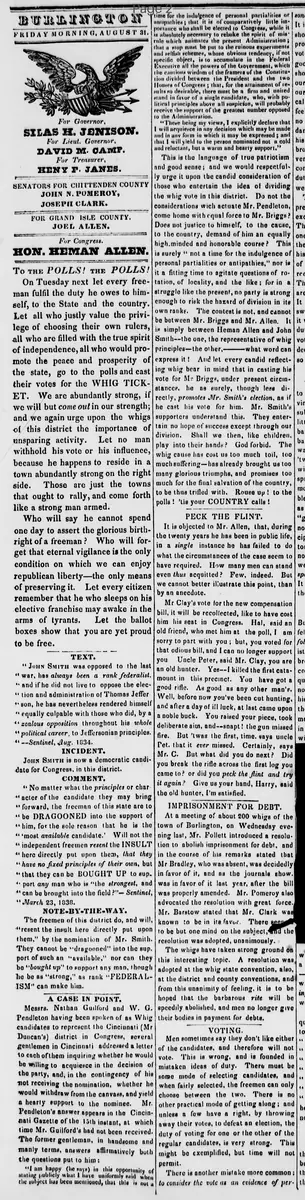
"John Smith was opposed to the last war, has always been a rank federalist, and if he did not live to oppose the election and administration of Thomas Jefferson, he has nevertheless rendered himself equally culpable with those who did, by a zealous opposition throughout his whole political career, to Jeffersonian principles."
--Sentinel, Aug. 1834.
INCIDENT.
John Smith is now a democratic candidate for Congress, in this district.
COMMENT.
"No matter what the principles or character of the candidate they may bring forward, the freeman of this state are to be DRAGOONED into the support of him, for the sole reason that he is the 'most available candidate.' Will not the independent freemen resent the INSULT here directly put upon them, that they have no fixed principles of their own, but that they can be BOUGHT UP to support any man who is 'the strongest, and can be brought into the field ?'"
-Sentinel, March 23, 1838.
NOTE-BY-THE-WAY.
The freemen of this district do, and will "resent the insult here directly put upon them," by the nomination of Mr. Smith.
They cannot be "dragooned" into the support of such an "available," nor can they be "bought up" to support any man, though he be as "strong," as rank "FEDERALISM" can make him.
A CASE IN POINT.
Messrs. Nathan Guilford and W. G. Pendleton having been spoken of as Whig candidates to represent the Cincinnati (Mr Duncan's) district in Congress, several gentlemen in Cincinnati addressed a letter to each of them inquiring whether he would be willing to acquiesce in the decision of the party, and, in the contingency of his not receiving the nomination, whether he would withdraw from the canvass, and yield a hearty support to the nominee.
Mr. Pendleton's answer appears in the Cincinnati Gazette of the 15th instant, at which time Mr. Guilford's had not been received. The former gentleman, in handsome and manly terms, answers affirmatively both the questions put to him:
"I am happy (he says) in this opportunity of stating publicly what I have uniformly said when the subject has been mentioned, that this is not a time for the indulgence of personal partialities or antipathies; that it is of comparatively little importance who shall be elected to Congress, while it is absolutely necessary to rebuke the spirit of misrule which animates the present Administration; that a stop must be put to the ruinous experiments and selfish schemes, whose obvious tendency, if not specific object, is to accumulate in the Federal Executive all the powers of the Government, which the cautious wisdom of the framers of the Constitution divided between the President and the two Houses of Congress; that, for the attainment of results so desirable, there must be a firm and united stand in favor of a single candidate, who, with political principles above all suspicion, will probably receive the support of the greatest number opposed to the Administration.
There being my views, I explicitly declare that I will acquiesce in any decision which may be made and in any form in which it may be expressed: and that I will yield to the person nominated not a cold and reluctant, but a warm and hearty support."
This is the language of true patriotism and good sense; and we would respectfully urge it upon the candid consideration of those who entertain the idea of dividing the whig vote in this district. Do not the considerations which actuate Mr. Pendleton, come home with equal force to Mr. Briggs? Does not justice to himself, to the cause, to the country, demand of him an equally high-minded and honorable course? This is surely "not a time for the indulgence of personal partialities or antipathies," nor is it a fitting time to agitate questions of rotation, of locality, and the like: for in a struggle like the present, no party is strong enough to risk the hazard of division in its own ranks. The contest is not, and cannot be between Mr. Briggs and Mr. Allen. It is simply between Heman Allen and John Smith--the one, the representative of whig principles--the other,--what word can express it! And let every candid reflecting whig bear in mind that in casting his vote for Mr. Briggs, under present circumstances, he as surely, though less directly, promotes Mr. Smith's election, as if he cast his vote for him. Mr. Smith's supporters understand this. They entertain no hope of success except through our division. Shall we then, like children, play into their hands? God forbid. The whig cause has cost us too much toil, too much suffering--has already brought us too many glorious triumphs, and promises too much for the final salvation of the country, to be thus trifled with. Rouse up! to the polls! 'tis your COUNTRY calls!
"John Smith was opposed to the last war, has always been a rank federalist, and if he did not live to oppose the election and administration of Thomas Jefferson, he has nevertheless rendered himself equally culpable with those who did, by a zealous opposition throughout his whole political career, to Jeffersonian principles."
--Sentinel, Aug. 1834.
INCIDENT.
John Smith is now a democratic candidate for Congress, in this district.
COMMENT.
"No matter what the principles or character of the candidate they may bring forward, the freeman of this state are to be DRAGOONED into the support of him, for the sole reason that he is the 'most available candidate.' Will not the independent freemen resent the INSULT here directly put upon them, that they have no fixed principles of their own, but that they can be BOUGHT UP to support any man who is 'the strongest, and can be brought into the field ?'"
-Sentinel, March 23, 1838.
NOTE-BY-THE-WAY.
The freemen of this district do, and will "resent the insult here directly put upon them," by the nomination of Mr. Smith.
They cannot be "dragooned" into the support of such an "available," nor can they be "bought up" to support any man, though he be as "strong," as rank "FEDERALISM" can make him.
A CASE IN POINT.
Messrs. Nathan Guilford and W. G. Pendleton having been spoken of as Whig candidates to represent the Cincinnati (Mr Duncan's) district in Congress, several gentlemen in Cincinnati addressed a letter to each of them inquiring whether he would be willing to acquiesce in the decision of the party, and, in the contingency of his not receiving the nomination, whether he would withdraw from the canvass, and yield a hearty support to the nominee.
Mr. Pendleton's answer appears in the Cincinnati Gazette of the 15th instant, at which time Mr. Guilford's had not been received. The former gentleman, in handsome and manly terms, answers affirmatively both the questions put to him:
"I am happy (he says) in this opportunity of stating publicly what I have uniformly said when the subject has been mentioned, that this is not a time for the indulgence of personal partialities or antipathies; that it is of comparatively little importance who shall be elected to Congress, while it is absolutely necessary to rebuke the spirit of misrule which animates the present Administration; that a stop must be put to the ruinous experiments and selfish schemes, whose obvious tendency, if not specific object, is to accumulate in the Federal Executive all the powers of the Government, which the cautious wisdom of the framers of the Constitution divided between the President and the two Houses of Congress; that, for the attainment of results so desirable, there must be a firm and united stand in favor of a single candidate, who, with political principles above all suspicion, will probably receive the support of the greatest number opposed to the Administration.
There being my views, I explicitly declare that I will acquiesce in any decision which may be made and in any form in which it may be expressed: and that I will yield to the person nominated not a cold and reluctant, but a warm and hearty support."
This is the language of true patriotism and good sense; and we would respectfully urge it upon the candid consideration of those who entertain the idea of dividing the whig vote in this district. Do not the considerations which actuate Mr. Pendleton, come home with equal force to Mr. Briggs? Does not justice to himself, to the cause, to the country, demand of him an equally high-minded and honorable course? This is surely "not a time for the indulgence of personal partialities or antipathies," nor is it a fitting time to agitate questions of rotation, of locality, and the like: for in a struggle like the present, no party is strong enough to risk the hazard of division in its own ranks. The contest is not, and cannot be between Mr. Briggs and Mr. Allen. It is simply between Heman Allen and John Smith--the one, the representative of whig principles--the other,--what word can express it! And let every candid reflecting whig bear in mind that in casting his vote for Mr. Briggs, under present circumstances, he as surely, though less directly, promotes Mr. Smith's election, as if he cast his vote for him. Mr. Smith's supporters understand this. They entertain no hope of success except through our division. Shall we then, like children, play into their hands? God forbid. The whig cause has cost us too much toil, too much suffering--has already brought us too many glorious triumphs, and promises too much for the final salvation of the country, to be thus trifled with. Rouse up! to the polls! 'tis your COUNTRY calls!
What sub-type of article is it?
Partisan Politics
What keywords are associated?
John Smith
Whig Party
Democratic Candidate
Party Unity
Federalist Opposition
Congressional Election
Administration Misrule
What entities or persons were involved?
John Smith
Thomas Jefferson
W. G. Pendleton
Nathan Guilford
Mr. Briggs
Heman Allen
Sentinel
Editorial Details
Primary Topic
Opposition To John Smith's Democratic Candidacy And Call For Whig Party Unity
Stance / Tone
Strongly Pro Whig, Anti Smith And Anti Administration, Exhortatory For Party Discipline
Key Figures
John Smith
Thomas Jefferson
W. G. Pendleton
Nathan Guilford
Mr. Briggs
Heman Allen
Sentinel
Key Arguments
John Smith Is A Former Federalist Opposed To Jeffersonian Principles
Voters Resent Being Dragooned Into Supporting Available Candidates Without Principles
Whigs Must Unite Behind A Single Nominee To Oppose The Misrule Of The Present Administration
Mr. Pendleton Exemplifies True Patriotism By Pledging To Support The Party Nominee
Dividing The Whig Vote Aids Smith's Election
Personal Partialities Should Not Divide The Party In This Critical Struggle