Thank you for visiting SNEWPapers!
Sign up free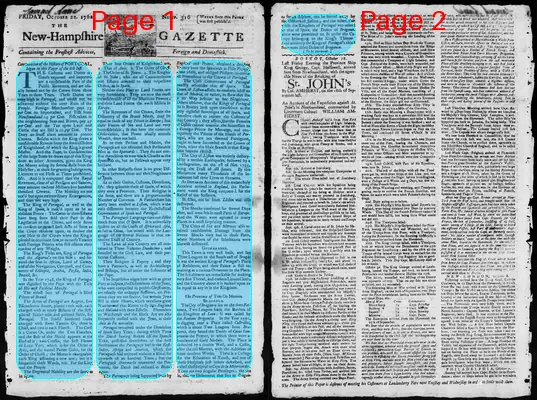
Literary
October 22, 1762
The New Hampshire Gazette
Portsmouth, Rockingham County, New Hampshire
What is this article about?
Continuation of a historical essay on Portugal, covering public revenues from customs and duties, the absolute monarchy, royal titles, nobility, military weakness despite wealth, cultural similarities to Spain, language, laws, religion, Inquisition, historical events like the 1755 Lisbon earthquake, and descriptions of towns like Guimaraens and Braganca.
Merged-components note: Serialized history of Portugal continued across pages 1 and 2; label unified to literary as it is a historical essay series.
Clippings
1 of 2
OCR Quality
95%
Excellent
Full Text
Continuation of the History of PORTUGAL,
began in this Paper of the 8th Inst.
The Customs and Duties on
Goods exported and imported
are a considerable Part of the
Public Revenues, and are usually
farmed out by the Crown from three
Years to three Years. These Duties are
very high in Portugal, and could not be
advanced without the utter Ruin of the
People. Foreign Merchandize pays 23
per Cent. on Importation, and Fish from
Newfoundland 25 per Cent. Fish taken in
the neighbouring Seas and Rivers, pay 47
per Cent. and the Tax upon Land and
Cattle that are sold is 10 per Cent. The
Duty on Snuff alone amounts to 50000
Crowns. Besides which the King draws a
considerable Revenue from the several Orders
of Knighthood, of which the King is grand
Master. And the Pope, in Consideration
of the large Sums he draws out of this King-
dom on other Accounts, gives the King
the Money arising by several Bulls from the
Holy See; as those for granting Indulgences,
Licences to eat Flesh at Times prohibited,
&c. And it is computed that the Royal
Revenues, clear of all Pensions and Salaries,
may amount to three Millions five hundred
thousand Crowns. The Nobility are not
tax'd but upon extraordinary Emergencies,
and then not very high.
The King of Portugal, as well as the
King of Spain, is look'd upon to be an
absolute Prince: The Cortes or three Estates
have long since sold their Part in the
Legislature to the Crown, and only serve
to confirm or record such Acts of State as
the Court resolves upon, to declare the
next Heir to the Crown when the King is
pleased to nominate him, or to ratify Treaties
with Foreign Princes who still esteem their
consent of any Weight.
The King's Titles are, King of Portugal
and the Algarves on this Side, and beyond
the Seas in Africa, Lord of Guinea,
and of the Navigation, Conquest, and Com-
merce of Ethiopia, Arabia, Persia, India,
Brazil, &c.
In the Year 1748, the King of Portugal
was dignified by the Pope with the Title
of His most Faithful Majesty.
The eldest Son of Portugal is titled
Prince of Brazil.
The Arms of Portugal are Argent, five
Escutcheons Azure, placed cross-wise, each
charged with as many Bezants of the first,
placed Saltier-wise, and pointed Sable, for
Portugal. The Shield bordered Gules
charged with seven Towers Or, three in
Chief, and two in each Flanch. The Crest
is a Crown Or, under the Two Flanches,
and the Base of the Shield appears at the
End of it; two Crosses, the first Flower
de Luce Vert, which is for the Order of
Avis, and the second Pattee Gules, for the
Order of Christ; the Motto is changeable,
each King assuming a new one; but it is
frequently these Words, viz. For the King
and the People.
The Degrees of Nobility are the same as
in Spain.
Their four Orders of Knighthood are,
1. That of Avis. 2. The Order of Christ.
3. The Order of St. James. 4. The Knights
of St. John; who are all Commanderies
and Estates annexed to their respective
Orders, as in Spain.
Neither their Fleet or Land Forces are
very formidable: They are now the most
inconsiderable of all the Maritime Powers;
and their Land Forces the worst Militia in
Europe.
The Revenues of this Crown, since the
Discovery of the Brazil Mines, may be
equal to those of any Prince in Europe; but
their Forces, of Sea and Land are very
inconsiderable: so that here the common
Observation, that Power usually attends
Wealth, does not hold.
As to their Persons and Habits, the
Portuguese are not esteemed such Personable
Men as the Spaniards: They do not con-
fine themselves to wear black Clothes as the
Spaniards do, but on Festivals appear very
brilliant.
In other Respects there is no great Dif-
ference between them and their Neighbours
of Spain.
As to their Genius, Customs, Diversions,
&c. they resemble those of Spain, of which
they were a Province. Their Religion is
the same, and there are a proportionable
Number of Convents. A Patriarchate has
lately been erected at Lisbon, which is the
only difference between the Ecclesiastical
Government of Spain and Portugal.
The Portuguese Language does not differ
much from that of Spain. It is universally
spoken on all the Coasts of Africa and Asia,
as far as China, but mixed with the Lan-
guage of the several Nations in that ex-
tensive Tract of Country.
The Laws of this Country are all con-
tained in Three Volumes Duodecimo; and
founded on the Civil Law, and their par-
ticular Customs.
Their Religion is Popery; and they
have a Patriarch, as well as Archbishops
and Bishops, but all under the Influence of
the Pope.
The Inquisition reigns here with as great
Fury as in Spain, the Descendants of the Jews,
who were compelled to profess Christianity,
are usually the unhappy Sufferers, on Pre-
tence they are not sincere, but remain Jews
still in their Hearts, which occasions great
Numbers of that Nation to fly into England
and Holland with their Effects. Pretenders
to Witchcraft and the Black-Art are also
frequently roasted with the Jews, at their
Auto de Fe, annually.
Portugal remained under the Dominion
of Spain sixty Years; during which Time
the Dutch having shaken off the Spanish
Yoke, possessed themselves of the best
Settlements the Portuguese had in the East-
Indies, Africa and America, which the
Portuguese had enjoyed without a Rival for
upwards of an hundred Years; but the
Portuguese afterwards recovered the Pro-
vinces, the Dutch had reduced in Brazil
again.
The Portuguese being supported both by
England and France, obtained a decisive
Victory over the Spaniards at Villa Viciosa,
Anno 1666, and obliged Philip to renounce
all Pretensions to the Crown of Portugal.
The Civil Government of Portugal
exactly resembles that of Spain. The
Court of Lisbon affects to conform itself to
that of Madrid, or rather, to show that he
is no Way inferior to her Neighbour.
Others observe, that the Kings of Portugal
do in Reality look upon themselves as the
only rightful Sovereigns of all Spain, and
therefore choose to imitate the Customs of
that Country: they affirm, that the Females
of Castile cannot transfer the Succession to
a Foreign Prince by Marriage, and con-
sequently the Princes of the House of Por-
tugal, who are not deemed Foreigners,
ought to have succeeded to the Crown of
Spain, when the Male Branch in that King-
dom became extinct.
The City of Lisbon was entirely destroyed
by a terrible Earthquake, followed by a
Conflagration, on the 1st of Nov. 1755,
being the Feast of All Saints. By this
Misfortune many Thousands of the In-
habitants lost their Lives or Fortunes.
As soon as an Account of this melancholy
Accident arrived in England, the Parlia-
ment voted the King 100,000 l. for the
Relief of the Sufferers.
St. Ubes, not far from Lisbon was also
destroyed.
The Shocks continued for several Days
after, and were felt in most Parts of Europe:
And the Waters were agitated in many
Places in a most surprising manner.
The Cities of Fez and Morocco also re-
ceivcd considerable Damage from the
severe Shocks they had in those Parts,
where Numbers of the Inhabitants were
likewise destroyed.
GUIMARAENS.
This Town is very well built, and lies
Three Leagues to the South-east of Braga:
It was the ancient Kings of Portugal's Place
of Residence, and their Palace is still re-
maining as a curious Ornament to the Place.
The Inhabitants are remarkable for making
very fine Thread, and curious Linnen Cloth;
and the Country about it is looked upon to
be equal to any in the Kingdom.
The Province of Tras-os-Montes.
BRAGANCA.
The City of Braganca lies on the river Fer-
venca, Two Leagues from the Borders of
the Kingdom of Leon: It was called by
the Romans Brigantia. In the Year 1591,
in digging near a Place called Catrellos,
which is about Two Leagues from Bra-
ganca, they found the Tomb of Caius Sem-
pronius the Prætor, in which there were a-
bundance of Gold Medals. The Place is
defended by a double Wall, and a Castle,
after the old Manner, with the Addition of
some modern Works. There is a College
for the Education of Youth, and one of
those Hospitals just before described, and
called the Hospital or Casa de la Misericordia.
There are two singular Privileges; the one
is, that no Delinquent that flies to Braganca
as an Asylum, can be forced away by the Officers of Justice; and the other, that while the Kingdom of Portugal was united to that of Spain, the Dukes of Braganza alone were permitted to sit under the Canopy belonging to the King's Throne: And anciently the Kings of Portugal's eldest Sons were titled Dukes of Braganza.
[To be continued.]
began in this Paper of the 8th Inst.
The Customs and Duties on
Goods exported and imported
are a considerable Part of the
Public Revenues, and are usually
farmed out by the Crown from three
Years to three Years. These Duties are
very high in Portugal, and could not be
advanced without the utter Ruin of the
People. Foreign Merchandize pays 23
per Cent. on Importation, and Fish from
Newfoundland 25 per Cent. Fish taken in
the neighbouring Seas and Rivers, pay 47
per Cent. and the Tax upon Land and
Cattle that are sold is 10 per Cent. The
Duty on Snuff alone amounts to 50000
Crowns. Besides which the King draws a
considerable Revenue from the several Orders
of Knighthood, of which the King is grand
Master. And the Pope, in Consideration
of the large Sums he draws out of this King-
dom on other Accounts, gives the King
the Money arising by several Bulls from the
Holy See; as those for granting Indulgences,
Licences to eat Flesh at Times prohibited,
&c. And it is computed that the Royal
Revenues, clear of all Pensions and Salaries,
may amount to three Millions five hundred
thousand Crowns. The Nobility are not
tax'd but upon extraordinary Emergencies,
and then not very high.
The King of Portugal, as well as the
King of Spain, is look'd upon to be an
absolute Prince: The Cortes or three Estates
have long since sold their Part in the
Legislature to the Crown, and only serve
to confirm or record such Acts of State as
the Court resolves upon, to declare the
next Heir to the Crown when the King is
pleased to nominate him, or to ratify Treaties
with Foreign Princes who still esteem their
consent of any Weight.
The King's Titles are, King of Portugal
and the Algarves on this Side, and beyond
the Seas in Africa, Lord of Guinea,
and of the Navigation, Conquest, and Com-
merce of Ethiopia, Arabia, Persia, India,
Brazil, &c.
In the Year 1748, the King of Portugal
was dignified by the Pope with the Title
of His most Faithful Majesty.
The eldest Son of Portugal is titled
Prince of Brazil.
The Arms of Portugal are Argent, five
Escutcheons Azure, placed cross-wise, each
charged with as many Bezants of the first,
placed Saltier-wise, and pointed Sable, for
Portugal. The Shield bordered Gules
charged with seven Towers Or, three in
Chief, and two in each Flanch. The Crest
is a Crown Or, under the Two Flanches,
and the Base of the Shield appears at the
End of it; two Crosses, the first Flower
de Luce Vert, which is for the Order of
Avis, and the second Pattee Gules, for the
Order of Christ; the Motto is changeable,
each King assuming a new one; but it is
frequently these Words, viz. For the King
and the People.
The Degrees of Nobility are the same as
in Spain.
Their four Orders of Knighthood are,
1. That of Avis. 2. The Order of Christ.
3. The Order of St. James. 4. The Knights
of St. John; who are all Commanderies
and Estates annexed to their respective
Orders, as in Spain.
Neither their Fleet or Land Forces are
very formidable: They are now the most
inconsiderable of all the Maritime Powers;
and their Land Forces the worst Militia in
Europe.
The Revenues of this Crown, since the
Discovery of the Brazil Mines, may be
equal to those of any Prince in Europe; but
their Forces, of Sea and Land are very
inconsiderable: so that here the common
Observation, that Power usually attends
Wealth, does not hold.
As to their Persons and Habits, the
Portuguese are not esteemed such Personable
Men as the Spaniards: They do not con-
fine themselves to wear black Clothes as the
Spaniards do, but on Festivals appear very
brilliant.
In other Respects there is no great Dif-
ference between them and their Neighbours
of Spain.
As to their Genius, Customs, Diversions,
&c. they resemble those of Spain, of which
they were a Province. Their Religion is
the same, and there are a proportionable
Number of Convents. A Patriarchate has
lately been erected at Lisbon, which is the
only difference between the Ecclesiastical
Government of Spain and Portugal.
The Portuguese Language does not differ
much from that of Spain. It is universally
spoken on all the Coasts of Africa and Asia,
as far as China, but mixed with the Lan-
guage of the several Nations in that ex-
tensive Tract of Country.
The Laws of this Country are all con-
tained in Three Volumes Duodecimo; and
founded on the Civil Law, and their par-
ticular Customs.
Their Religion is Popery; and they
have a Patriarch, as well as Archbishops
and Bishops, but all under the Influence of
the Pope.
The Inquisition reigns here with as great
Fury as in Spain, the Descendants of the Jews,
who were compelled to profess Christianity,
are usually the unhappy Sufferers, on Pre-
tence they are not sincere, but remain Jews
still in their Hearts, which occasions great
Numbers of that Nation to fly into England
and Holland with their Effects. Pretenders
to Witchcraft and the Black-Art are also
frequently roasted with the Jews, at their
Auto de Fe, annually.
Portugal remained under the Dominion
of Spain sixty Years; during which Time
the Dutch having shaken off the Spanish
Yoke, possessed themselves of the best
Settlements the Portuguese had in the East-
Indies, Africa and America, which the
Portuguese had enjoyed without a Rival for
upwards of an hundred Years; but the
Portuguese afterwards recovered the Pro-
vinces, the Dutch had reduced in Brazil
again.
The Portuguese being supported both by
England and France, obtained a decisive
Victory over the Spaniards at Villa Viciosa,
Anno 1666, and obliged Philip to renounce
all Pretensions to the Crown of Portugal.
The Civil Government of Portugal
exactly resembles that of Spain. The
Court of Lisbon affects to conform itself to
that of Madrid, or rather, to show that he
is no Way inferior to her Neighbour.
Others observe, that the Kings of Portugal
do in Reality look upon themselves as the
only rightful Sovereigns of all Spain, and
therefore choose to imitate the Customs of
that Country: they affirm, that the Females
of Castile cannot transfer the Succession to
a Foreign Prince by Marriage, and con-
sequently the Princes of the House of Por-
tugal, who are not deemed Foreigners,
ought to have succeeded to the Crown of
Spain, when the Male Branch in that King-
dom became extinct.
The City of Lisbon was entirely destroyed
by a terrible Earthquake, followed by a
Conflagration, on the 1st of Nov. 1755,
being the Feast of All Saints. By this
Misfortune many Thousands of the In-
habitants lost their Lives or Fortunes.
As soon as an Account of this melancholy
Accident arrived in England, the Parlia-
ment voted the King 100,000 l. for the
Relief of the Sufferers.
St. Ubes, not far from Lisbon was also
destroyed.
The Shocks continued for several Days
after, and were felt in most Parts of Europe:
And the Waters were agitated in many
Places in a most surprising manner.
The Cities of Fez and Morocco also re-
ceivcd considerable Damage from the
severe Shocks they had in those Parts,
where Numbers of the Inhabitants were
likewise destroyed.
GUIMARAENS.
This Town is very well built, and lies
Three Leagues to the South-east of Braga:
It was the ancient Kings of Portugal's Place
of Residence, and their Palace is still re-
maining as a curious Ornament to the Place.
The Inhabitants are remarkable for making
very fine Thread, and curious Linnen Cloth;
and the Country about it is looked upon to
be equal to any in the Kingdom.
The Province of Tras-os-Montes.
BRAGANCA.
The City of Braganca lies on the river Fer-
venca, Two Leagues from the Borders of
the Kingdom of Leon: It was called by
the Romans Brigantia. In the Year 1591,
in digging near a Place called Catrellos,
which is about Two Leagues from Bra-
ganca, they found the Tomb of Caius Sem-
pronius the Prætor, in which there were a-
bundance of Gold Medals. The Place is
defended by a double Wall, and a Castle,
after the old Manner, with the Addition of
some modern Works. There is a College
for the Education of Youth, and one of
those Hospitals just before described, and
called the Hospital or Casa de la Misericordia.
There are two singular Privileges; the one
is, that no Delinquent that flies to Braganca
as an Asylum, can be forced away by the Officers of Justice; and the other, that while the Kingdom of Portugal was united to that of Spain, the Dukes of Braganza alone were permitted to sit under the Canopy belonging to the King's Throne: And anciently the Kings of Portugal's eldest Sons were titled Dukes of Braganza.
[To be continued.]
What sub-type of article is it?
Essay
What themes does it cover?
Political
Taxation Oppression
Religious
What keywords are associated?
Portugal History
Customs Duties
Royal Revenues
Absolute Monarchy
Inquisition
Lisbon Earthquake
Braganca Privileges
Literary Details
Title
Continuation Of The History Of Portugal
Key Lines
The Customs And Duties On Goods Exported And Imported Are A Considerable Part Of The Public Revenues, And Are Usually Farmed Out By The Crown From Three Years To Three Years.
The King Of Portugal, As Well As The King Of Spain, Is Look'd Upon To Be An Absolute Prince.
The City Of Lisbon Was Entirely Destroyed By A Terrible Earthquake, Followed By A Conflagration, On The 1st Of Nov. 1755.
The Inquisition Reigns Here With As Great Fury As In Spain.