Thank you for visiting SNEWPapers!
Sign up free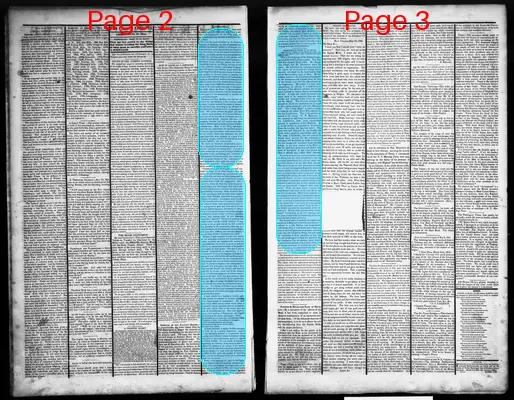
Editorial
June 27, 1845
The Kalida Venture
Kalida, Putnam County, Ohio
What is this article about?
Editorial argues against Supreme Judiciary's power to declare banking laws irrevocable, criticizing Ohio's State Bank system as unconstitutional and harmful. Responds to Whig press and Locofoco papers, urging repeal and defending Democratic opposition to banks.
Merged-components note: Merged across pages as continuation of the same editorial on judicial control over banking legislation and charters.
Clippings

1 of 2
OCR Quality
98%
Excellent
Full Text
As a good deal of remark has lately been made on this subject, in connection with JUDICIAL CONTROL OVER LEGISLATION, by the Whig press, we have jotted down our opinions, to keep pace with the times:
We view the power exercised by the Supreme Judiciary of declaring the acts of precedent Legislatures irrevocably binding on subsequent Legislative bodies as not warranted by the Constitution of the State, or any law passed in accordance with it. A similar opinion was not long since expressed by a correspondent of this journal, and we have on reflection accorded with its justice.-- Otherwise, if the Judiciary possess the power claimed for them by the Whigs, we may as well at once yield the contest, and instead of appealing to the people next October to put down this most dangerous and pernicious creation of a banking system, we can save trouble by learning the opinion of the Supreme Judges, and if unfavorable remain in fettered and inactive acquiescence till 1866, at which time, if the present system of banking so long escape disgraceful insolvency, power would be in other hands than those of the people.
For what object the House of Representatives was made elective annually, and the Senate once in two years, if this construction is correct, we are at a loss to know.
The State and Free Banking law was not decided at the last election; it was nowhere made an issue; it never received the assent of the people and never can, (according to the Whigs,) for they have now no control over it, to assent or condemn. We doubt whether the people yet have a correct understanding of its seventy-five sections, and we do not believe its framers ever desired that they should. Like the Tax Law, it is purposely obscure, and will require more than Auditor Wood's extra-judicial decisions to render it satisfactory. Many of the Whig representatives did not comprehend the manifold sections of the bill, their microscopic vision could not foresee its results, which they distrusted, but like dumb dogs they were whipped in to give it an unwilling support, and they did their forced work silently, sullenly, and mechanically.
We know no beneficial consideration accruing to the people from the banking system to render the "contract" of binding force. It is true it grants to bankers the special privilege of borrowing public credit and making their evidences of indebtedness circulate as money, but it also renders the people liable to all the consequences of bank speculation while those who enjoy the profits are not responsible This, however, we should think, would give bankers no claim.
"Contracts" should be of equal force and mutually binding. If the State incurs a debt for money or services loaned she can refuse to fulfil the obligation, and sully her honor unimpeded by the action of Courts, though bound by the strongest moral duty to fulfil her engagement. But a banker on whom the State has conferred gratuitous privileges can find Judges, with only doubtful and implied power, to declare that these privileges binding irrevocably! State character, honor, and sovereignty kick the beam when weighed against Bank interests. And while the legislature abdicate the popular sovereignty under the plea of the necessity of having a "currency" of bankers' notes of hand, these same bankers may, after having driven gold and silver out of circulation by substituting paper, necessarily of inferior value, refuse at any moment they please to supply an adequate amount of this "currency," reducing prices, and making profit by this dishonest use of the "contract." There is no provision that bankers shall furnish a steady currency, or neglecting to do so, give way for the free action of that provided by the constitution; they may produce fluctuation & distress as often as they please, and then tell a suffering and outraged people it is a privilege of their inviolable CONTRACT!
Besides, to give existence to a law over which, be the monopoly conferred ever so pernicious to public interests, the legislature for twenty-one years shall have no control, is an act of political suicide, an unwarranted surrender of the people's sovereignty by their agents. This gift of almost absolute independence to corporations, if it is a "contract" is one of the funguses of feudal despotism, at war with freedom and republican equality. We do not believe that the sovereign power of the people can, even by their own concurrence, thus be placed in abeyance and relinquished for upwards of a generation, any more than a freeman can sell himself into slavery, and bind his posterity by the act; much less do we conceive their unauthorised agents can bind their constituents for all time; for if they have power to bind beyond the two years limited by the constitution, why may they not resign the people's sovereignty for twenty-one years, for one hundred years, or for ever. Our rights, as freemen, are an inheritance which we are bound to transmit to posterity, unincumbered with ceded privileges, unalienated by diminished power.
A bank charter is a Legislative creation absolutely perfect the moment of its birth, admitting of no improvement or amendment! All other laws which affect society-those which relate to LIFE itself-may be amended, altered, or repealed, those only which relate to the POCKET have the odor of inviolable sanctity. This view might induce a new reading of Shakspeare-the original is not true to the modern philosophy: Thus,
He who steals my Life steals trash; 'tis something, nothing;
"Twas mine-'tis his-a loss sustained by thousands;
But he who filches Bankers' pictured rags,
Robs society of that which well enriches it,
Leaving it poor indeed!
A bank chartered to supply the State currency is held by to a private corporation, entitled to the immunity granted to corporations which confine their influence almost exclusively within the circle of their membership, such as a church or library society. To our minds an institution regulating the currency of the State is public--it affects the interests of all classes of the public, and should be amenable to the State whenever its avarice causes it to clash with the interests and welfare of that public, for evasion of legitimate duty, and the falsification of the real or pretended object of its creation.
These views asserting the right of the legislature or dissolve charters granting corporate privileges, whenever these are found generally injurious, may be confined to a few, and very probably are. They do not accord with present legal construction of chartered rights. Bank corporations
are by some esteemed unconstitutional, others claim they should be dealt with as other public corporations, and both of these opinions are reconcilable with the power to grant an injunction in the case of Medary. To hold bank charters irrevocable, now that they have grown into a prominence far beyond the reason of the rule, is to us an absurdity greater than we can be guilty of in varying from time worn precedents.
DEMOCRATS KEEP IT IN MIND.
That the law passed by the Whigs last winter creating the State Bank of Ohio, must be speedily and utterly REPEALED.
This is the language of the Kalida Venture an unadulterated Locofoco paper. The Venture has changed hands lately. Mr. Knapp has retired, and Mr. Mackenzie takes his place. He signalizes the commencement of his labors, by an avowal of a design that is secretly cherished by the hard money leaders of the Locofoco party of Ohio. He but echoes, however, the sentiment promulgated by the Statesman and echoed along the line of the faithful just after the adjournment of the Legislature. He makes it a little more conspicuous, by placing it in bold print, at the head of his editorial column; but we are more inclined to respect than to censure him for this. A bold and manly opponent is always more to be respected than one who skulks and attempts under cover to carry out his objects. The Venture occupies the ground on which our opponents are to stand in the coming campaign with this difference only: The "State Bank" is used as another name for the whole Bank Bill, adopted by the late Legislature. This is the ground assumed at the outset. T. W. Bartley, in the message he delivered (by permission) to the Legislature, took most unequivocal ground in opposition to free Banking. At it, as the system he supposed to be must in favor, he levelled his heaviest metal. The game was well followed by his friends, the hards, and a complete issue is thus made up We meet it fearlessly, and call upon all to choose their position for the campaign.
Attempts will doubtless be made to obscure the true issues and introduce those entirely foreign to the next contest in the State. But we shall take good care and defeat this game of deception. It has been played too often to delude any. Ohio State Journal
We would not have been more surprised at pure air issuing from the fetid charnel-house, than at receiving commendation for bold and manly conduct from Teesdale of the Ohio State Journal. What great wrong we have committed we know not; we have not supported England's claims to Oregon against our own convictions of right, nor have we insisted that it was "iniquitous" to prevent England's ruining the trade of the south, by annexing Texas; we have neither shook hands with treason or prostrated ourselves with the worshippers of mammon, and we feel entitled to resent any hypocritical "respect" from such a source. There are those whose "curses are compliments," and such are the only favors we ask from the Journal. While in one sentence we are charged with avowing a "design that is secretly cherished by the hard money leaders" of the party, in the next it is stated that this secret design is but echoed from "the sentiment promulgated by the Statesman and echoed along the line of the faithful just after the adjournment of the legislature." So this crafty pretense about "secret designs" is a humbug on his own showing, and we must consequently be undeserving of his respect, and feel heartily glad of it.
The Journal labors to persuade its readers that opposition to Banks of circulation and discount is confined to a few factious and wrong-headed individuals, while it well knows that a large majority of the intelligent men of our party, and some even who call themselves Whigs, not only doubt the usefulness of Bank regulation by law, but are well satisfied that the Bank law passed by the last Legislature can no otherwise result than in fluctuations and distress—fraud, subserviency and pipe-laying on the part of its borrowers, and wide demoralization in the general crash and insolvency which must be the closing scene of the sharping institutions to which it gives life.
The Journal also assumes to be very anxious that an issue should be made between the advantages of gold and silver as a currency and a paper currency The editor, from his associations among all the decency, may not be aware of the changes which are going on in the minds of practical business men on this subject—else this would be the last issue he would seek to encounter. We venture to predict that whenever this is made the issue, that though we may lose for a time a few self interested and wavering men, (the curse of any party, and may possibly have to succumb temporarily such a declaration would ultimately bring us numbers from the whig ranks, and secure to us a firm and stable triumph, changing the vacillation now the reproach of our elections, into permanence and fixedness. If the Editor cannot see this, we have but as small an opinion of his sagacity as those who are most intimate with him have of his candor.
We view the power exercised by the Supreme Judiciary of declaring the acts of precedent Legislatures irrevocably binding on subsequent Legislative bodies as not warranted by the Constitution of the State, or any law passed in accordance with it. A similar opinion was not long since expressed by a correspondent of this journal, and we have on reflection accorded with its justice.-- Otherwise, if the Judiciary possess the power claimed for them by the Whigs, we may as well at once yield the contest, and instead of appealing to the people next October to put down this most dangerous and pernicious creation of a banking system, we can save trouble by learning the opinion of the Supreme Judges, and if unfavorable remain in fettered and inactive acquiescence till 1866, at which time, if the present system of banking so long escape disgraceful insolvency, power would be in other hands than those of the people.
For what object the House of Representatives was made elective annually, and the Senate once in two years, if this construction is correct, we are at a loss to know.
The State and Free Banking law was not decided at the last election; it was nowhere made an issue; it never received the assent of the people and never can, (according to the Whigs,) for they have now no control over it, to assent or condemn. We doubt whether the people yet have a correct understanding of its seventy-five sections, and we do not believe its framers ever desired that they should. Like the Tax Law, it is purposely obscure, and will require more than Auditor Wood's extra-judicial decisions to render it satisfactory. Many of the Whig representatives did not comprehend the manifold sections of the bill, their microscopic vision could not foresee its results, which they distrusted, but like dumb dogs they were whipped in to give it an unwilling support, and they did their forced work silently, sullenly, and mechanically.
We know no beneficial consideration accruing to the people from the banking system to render the "contract" of binding force. It is true it grants to bankers the special privilege of borrowing public credit and making their evidences of indebtedness circulate as money, but it also renders the people liable to all the consequences of bank speculation while those who enjoy the profits are not responsible This, however, we should think, would give bankers no claim.
"Contracts" should be of equal force and mutually binding. If the State incurs a debt for money or services loaned she can refuse to fulfil the obligation, and sully her honor unimpeded by the action of Courts, though bound by the strongest moral duty to fulfil her engagement. But a banker on whom the State has conferred gratuitous privileges can find Judges, with only doubtful and implied power, to declare that these privileges binding irrevocably! State character, honor, and sovereignty kick the beam when weighed against Bank interests. And while the legislature abdicate the popular sovereignty under the plea of the necessity of having a "currency" of bankers' notes of hand, these same bankers may, after having driven gold and silver out of circulation by substituting paper, necessarily of inferior value, refuse at any moment they please to supply an adequate amount of this "currency," reducing prices, and making profit by this dishonest use of the "contract." There is no provision that bankers shall furnish a steady currency, or neglecting to do so, give way for the free action of that provided by the constitution; they may produce fluctuation & distress as often as they please, and then tell a suffering and outraged people it is a privilege of their inviolable CONTRACT!
Besides, to give existence to a law over which, be the monopoly conferred ever so pernicious to public interests, the legislature for twenty-one years shall have no control, is an act of political suicide, an unwarranted surrender of the people's sovereignty by their agents. This gift of almost absolute independence to corporations, if it is a "contract" is one of the funguses of feudal despotism, at war with freedom and republican equality. We do not believe that the sovereign power of the people can, even by their own concurrence, thus be placed in abeyance and relinquished for upwards of a generation, any more than a freeman can sell himself into slavery, and bind his posterity by the act; much less do we conceive their unauthorised agents can bind their constituents for all time; for if they have power to bind beyond the two years limited by the constitution, why may they not resign the people's sovereignty for twenty-one years, for one hundred years, or for ever. Our rights, as freemen, are an inheritance which we are bound to transmit to posterity, unincumbered with ceded privileges, unalienated by diminished power.
A bank charter is a Legislative creation absolutely perfect the moment of its birth, admitting of no improvement or amendment! All other laws which affect society-those which relate to LIFE itself-may be amended, altered, or repealed, those only which relate to the POCKET have the odor of inviolable sanctity. This view might induce a new reading of Shakspeare-the original is not true to the modern philosophy: Thus,
He who steals my Life steals trash; 'tis something, nothing;
"Twas mine-'tis his-a loss sustained by thousands;
But he who filches Bankers' pictured rags,
Robs society of that which well enriches it,
Leaving it poor indeed!
A bank chartered to supply the State currency is held by to a private corporation, entitled to the immunity granted to corporations which confine their influence almost exclusively within the circle of their membership, such as a church or library society. To our minds an institution regulating the currency of the State is public--it affects the interests of all classes of the public, and should be amenable to the State whenever its avarice causes it to clash with the interests and welfare of that public, for evasion of legitimate duty, and the falsification of the real or pretended object of its creation.
These views asserting the right of the legislature or dissolve charters granting corporate privileges, whenever these are found generally injurious, may be confined to a few, and very probably are. They do not accord with present legal construction of chartered rights. Bank corporations
are by some esteemed unconstitutional, others claim they should be dealt with as other public corporations, and both of these opinions are reconcilable with the power to grant an injunction in the case of Medary. To hold bank charters irrevocable, now that they have grown into a prominence far beyond the reason of the rule, is to us an absurdity greater than we can be guilty of in varying from time worn precedents.
DEMOCRATS KEEP IT IN MIND.
That the law passed by the Whigs last winter creating the State Bank of Ohio, must be speedily and utterly REPEALED.
This is the language of the Kalida Venture an unadulterated Locofoco paper. The Venture has changed hands lately. Mr. Knapp has retired, and Mr. Mackenzie takes his place. He signalizes the commencement of his labors, by an avowal of a design that is secretly cherished by the hard money leaders of the Locofoco party of Ohio. He but echoes, however, the sentiment promulgated by the Statesman and echoed along the line of the faithful just after the adjournment of the Legislature. He makes it a little more conspicuous, by placing it in bold print, at the head of his editorial column; but we are more inclined to respect than to censure him for this. A bold and manly opponent is always more to be respected than one who skulks and attempts under cover to carry out his objects. The Venture occupies the ground on which our opponents are to stand in the coming campaign with this difference only: The "State Bank" is used as another name for the whole Bank Bill, adopted by the late Legislature. This is the ground assumed at the outset. T. W. Bartley, in the message he delivered (by permission) to the Legislature, took most unequivocal ground in opposition to free Banking. At it, as the system he supposed to be must in favor, he levelled his heaviest metal. The game was well followed by his friends, the hards, and a complete issue is thus made up We meet it fearlessly, and call upon all to choose their position for the campaign.
Attempts will doubtless be made to obscure the true issues and introduce those entirely foreign to the next contest in the State. But we shall take good care and defeat this game of deception. It has been played too often to delude any. Ohio State Journal
We would not have been more surprised at pure air issuing from the fetid charnel-house, than at receiving commendation for bold and manly conduct from Teesdale of the Ohio State Journal. What great wrong we have committed we know not; we have not supported England's claims to Oregon against our own convictions of right, nor have we insisted that it was "iniquitous" to prevent England's ruining the trade of the south, by annexing Texas; we have neither shook hands with treason or prostrated ourselves with the worshippers of mammon, and we feel entitled to resent any hypocritical "respect" from such a source. There are those whose "curses are compliments," and such are the only favors we ask from the Journal. While in one sentence we are charged with avowing a "design that is secretly cherished by the hard money leaders" of the party, in the next it is stated that this secret design is but echoed from "the sentiment promulgated by the Statesman and echoed along the line of the faithful just after the adjournment of the legislature." So this crafty pretense about "secret designs" is a humbug on his own showing, and we must consequently be undeserving of his respect, and feel heartily glad of it.
The Journal labors to persuade its readers that opposition to Banks of circulation and discount is confined to a few factious and wrong-headed individuals, while it well knows that a large majority of the intelligent men of our party, and some even who call themselves Whigs, not only doubt the usefulness of Bank regulation by law, but are well satisfied that the Bank law passed by the last Legislature can no otherwise result than in fluctuations and distress—fraud, subserviency and pipe-laying on the part of its borrowers, and wide demoralization in the general crash and insolvency which must be the closing scene of the sharping institutions to which it gives life.
The Journal also assumes to be very anxious that an issue should be made between the advantages of gold and silver as a currency and a paper currency The editor, from his associations among all the decency, may not be aware of the changes which are going on in the minds of practical business men on this subject—else this would be the last issue he would seek to encounter. We venture to predict that whenever this is made the issue, that though we may lose for a time a few self interested and wavering men, (the curse of any party, and may possibly have to succumb temporarily such a declaration would ultimately bring us numbers from the whig ranks, and secure to us a firm and stable triumph, changing the vacillation now the reproach of our elections, into permanence and fixedness. If the Editor cannot see this, we have but as small an opinion of his sagacity as those who are most intimate with him have of his candor.
What sub-type of article is it?
Economic Policy
Constitutional
Partisan Politics
What keywords are associated?
Banking System
Judicial Control
State Bank Ohio
Whig Press
Locofoco
Free Banking
Currency
Legislative Sovereignty
What entities or persons were involved?
Supreme Judiciary
Whigs
State Bank Of Ohio
Kalida Venture
Mr. Mackenzie
T. W. Bartley
Ohio State Journal
Teesdale
Statesman
Locofoco Party
Editorial Details
Primary Topic
Opposition To Irrevocable Banking Charters And Judicial Control
Stance / Tone
Strongly Anti Banking System And Pro Legislative Sovereignty
Key Figures
Supreme Judiciary
Whigs
State Bank Of Ohio
Kalida Venture
Mr. Mackenzie
T. W. Bartley
Ohio State Journal
Teesdale
Statesman
Locofoco Party
Key Arguments
Judiciary Lacks Constitutional Power To Declare Legislative Acts Irrevocably Binding.
Banking Law Was Not Approved By People And Should Be Repealable.
Banking System Harms Public By Allowing Speculation Without Responsibility.
Contracts Must Be Mutually Binding; State Sovereignty Cannot Be Surrendered Long Term.
Bank Charters Should Be Amendable Like Other Laws Affecting Society.
Opposition To Banks Is Widespread, Not Limited To Few.
Paper Currency Leads To Fluctuations And Distress; Gold And Silver Preferred.