Thank you for visiting SNEWPapers!
Sign up free
Browning Chief
Browning, Glacier County, Montana
What is this article about?
The ratio of elderly (65+) to working-age (20-64) population in the US doubled over the past century, reaching 13 per 100 by recent years, while child dependency halved from 1850 to 1950 but is now rising due to postwar birth rates, increasing needs for both groups.
Clipping
OCR Quality
Full Text
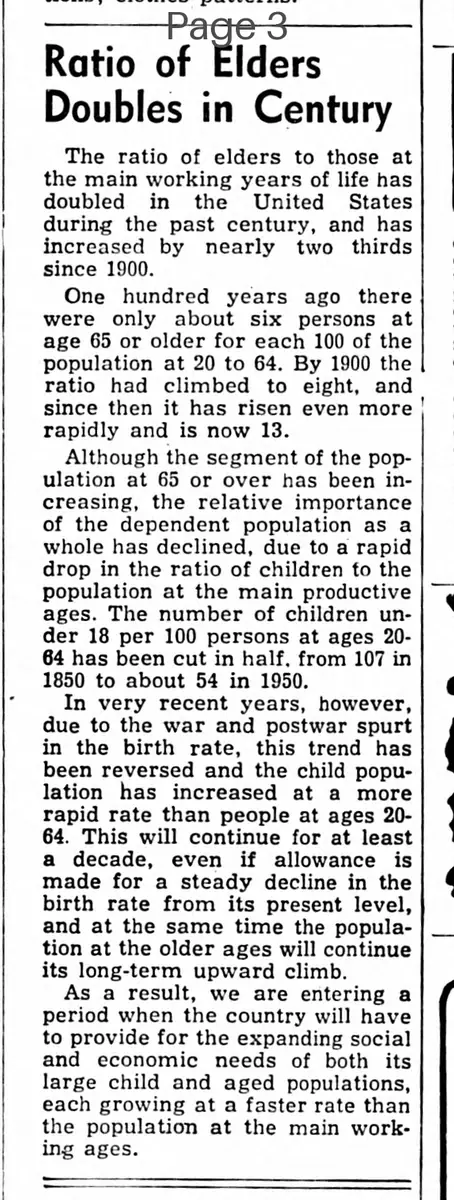
The ratio of elders to those at the main working years of life has doubled in the United States during the past century, and has increased by nearly two thirds since 1900.
One hundred years ago there were only about six persons at age 65 or older for each 100 of the population at 20 to 64. By 1900 the ratio had climbed to eight, and since then it has risen even more rapidly and is now 13.
Although the segment of the population at 65 or over has been increasing, the relative importance of the dependent population as a whole has declined, due to a rapid drop in the ratio of children to the population at the main productive ages. The number of children under 18 per 100 persons at ages 20-64 has been cut in half, from 107 in 1850 to about 54 in 1950.
In very recent years, however, due to the war and postwar spurt in the birth rate, this trend has been reversed and the child population has increased at a more rapid rate than people at ages 20-64. This will continue for at least a decade, even if allowance is made for a steady decline in the birth rate from its present level, and at the same time the population at the older ages will continue its long-term upward climb.
As a result, we are entering a period when the country will have to provide for the expanding social and economic needs of both its large child and aged populations, each growing at a faster rate than the population at the main working ages.
What sub-type of article is it?
What keywords are associated?
Where did it happen?
Domestic News Details
Primary Location
United States
Event Date
1850 1950
Event Details
The ratio of elders to those at the main working years of life has doubled in the United States during the past century, and has increased by nearly two thirds since 1900. One hundred years ago there were only about six persons at age 65 or older for each 100 of the population at 20 to 64. By 1900 the ratio had climbed to eight, and since then it has risen even more rapidly and is now 13. Although the segment of the population at 65 or over has been increasing, the relative importance of the dependent population as a whole has declined, due to a rapid drop in the ratio of children to the population at the main productive ages. The number of children under 18 per 100 persons at ages 20-64 has been cut in half, from 107 in 1850 to about 54 in 1950. In very recent years, however, due to the war and postwar spurt in the birth rate, this trend has been reversed and the child population has increased at a more rapid rate than people at ages 20-64. This will continue for at least a decade, even if allowance is made for a steady decline in the birth rate from its present level, and at the same time the population at the older ages will continue its long-term upward climb. As a result, we are entering a period when the country will have to provide for the expanding social and economic needs of both its large child and aged populations, each growing at a faster rate than the population at the main working ages.