Thank you for visiting SNEWPapers!
Sign up free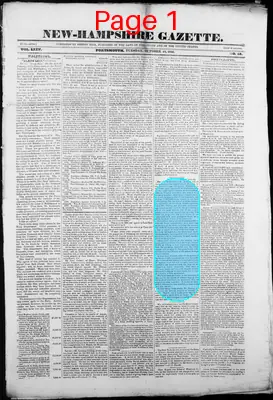
The New Hampshire Gazette
Portsmouth, Rockingham County, New Hampshire
What is this article about?
In Boston, Mr. Dunlap, a keeper at the New-England Museum, was bitten on the finger by a rattlesnake while rousing them for exhibition on Tuesday afternoon. He received prompt treatment including excision, turpentine, oil, opium, and salt-vinegar applications, and is expected to recover fully despite swelling and symptoms.
Clipping
OCR Quality
Full Text
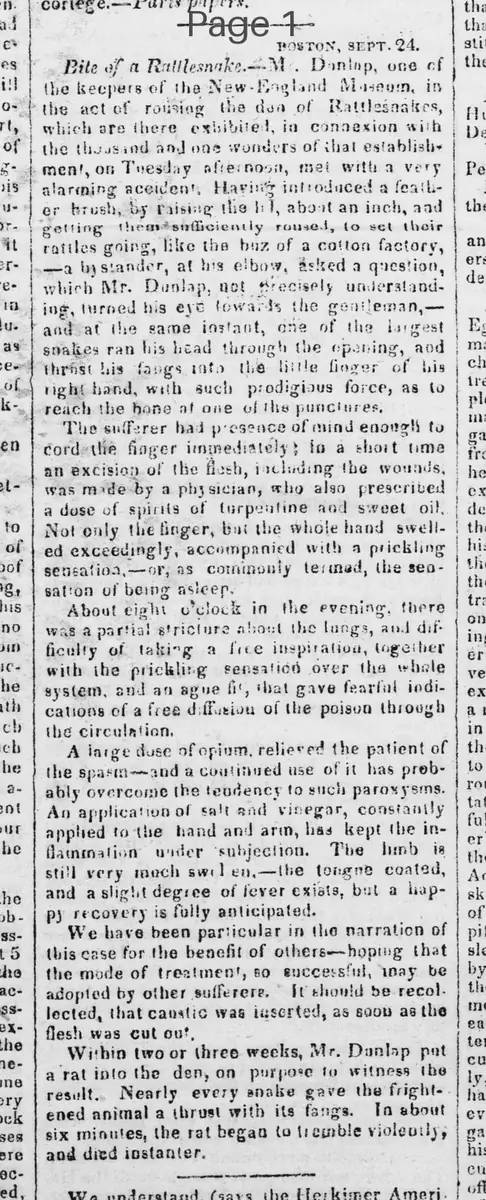
Bite of a Rattlesnake. Mr. Dunlap, one of the keepers of the New-England Museum, in the act of rousing the den of Rattlesnakes, which are there exhibited, in connexion with the thousand and one wonders of that establishment, on Tuesday afternoon, met with a very alarming accident. Having introduced a feather brush, by raising the lid about an inch, and getting them sufficiently roused, to set their rattles going, like the buzz of a cotton factory,—a bystander, at his elbow, asked a question, which Mr. Dunlap, not precisely understanding, turned his eye towards the gentleman,—and at the same instant, one of the largest snakes ran his head through the opening, and thrust his fangs into the little finger of his right hand, with such prodigious force, as to reach the bone at one of the punctures.
The sufferer had presence of mind enough to cord the finger immediately: in a short time an excision of the flesh, including the wounds, was made by a physician, who also prescribed a dose of spirits of turpentine and sweet oil.
Not only the finger, but the whole hand swelled exceedingly, accompanied with a prickling sensation,—or, as commonly termed, the sensation of being asleep.
About eight o'clock in the evening, there was a partial stricture about the lungs, and difficulty of taking a free inspiration, together with the prickling sensation over the whole system, and an ague fit, that gave fearful indications of a free diffusion of the poison through the circulation.
A large dose of opium, relieved the patient of the spasm—and a continued use of it has probably overcome the tendency to such paroxysms.
An application of salt and vinegar, constantly applied to the hand and arm, has kept the inflammation under subjection. The hand is still very much swollen, the tongue coated, and a slight degree of fever exists, but a happy recovery is fully anticipated.
We have been particular in the narration of this case for the benefit of others—hoping that the mode of treatment, so successful, may be adopted by other sufferers. It should be recollected, that caustic was inserted, as soon as the flesh was cut out.
Within two or three weeks, Mr. Dunlap put a rat into the den, on purpose to witness the result. Nearly every snake gave the frightened animal a thrust with its fangs. In about six minutes, the rat began to tremble violently, and died instanter.
What sub-type of article is it?
What keywords are associated?
What entities or persons were involved?
Where did it happen?
Domestic News Details
Primary Location
Boston
Event Date
Tuesday Afternoon
Key Persons
Outcome
bitten on the little finger of right hand, reaching bone; treated with cord, excision, turpentine, sweet oil, opium, salt and vinegar, and caustic; swelling, prickling, lung stricture, ague fit; expected full recovery.
Event Details
Mr. Dunlap was rousing rattlesnakes in the New-England Museum den using a feather brush when distracted by a bystander, allowing a large snake to bite his finger through the lid opening. He immediately corded the finger; a physician excised the flesh, applied caustic, and prescribed remedies. Symptoms included swelling, prickling, respiratory difficulty, and ague, relieved by opium and applications. Later, he tested snakes on a rat, which died quickly.