Thank you for visiting SNEWPapers!
Sign up free
Story
November 4, 1876
American Citizen
Canton, Madison County, Mississippi
What is this article about?
Matilda Fletcher describes a farmer's wife who performs household and farm duties while preserving her beauty using rubber gloves, oil-silk bonnet, dish-cloth on stick, and labor-saving machines, supported by her husband.
Clipping
OCR Quality
98%
Excellent
Full Text
How to Do Housework and Be Beautiful Still
Our rural friends who bewail their hard condition as farmers' wives and helps, and our city friends who deplore the "circumstances" which compel them to do duty as kitchen maids while that of parlor companion would fit more becomingly their education and accomplishments, may take courage from the following practical hints administered, with much spice of manner, by Matilda Fletcher:
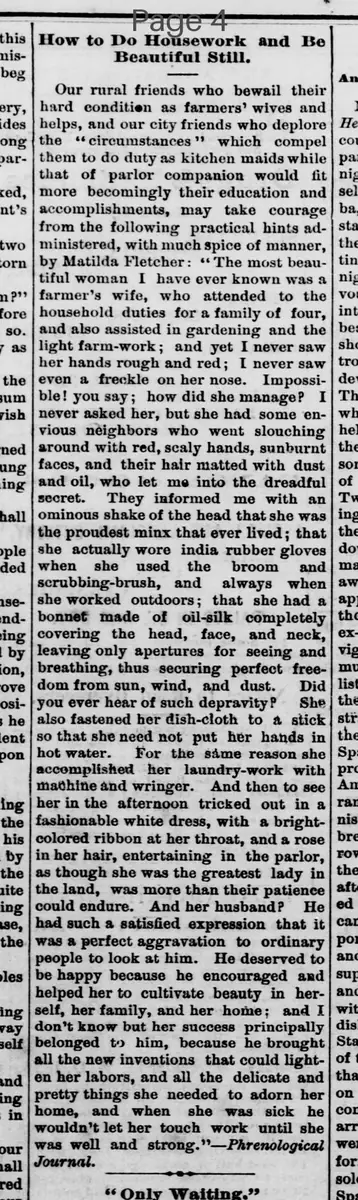
"The most beautiful woman I have ever known was a farmer's wife, who attended to the household duties for a family of four, and also assisted in gardening and the light farm-work; and yet I never saw her hands rough and red: I never saw even a freckle on her nose. Impossible! you say; how did she manage? I never asked her, but she had some envious neighbors who went slouching around with red, scaly hands, sunburnt faces, and their hair matted with dust and oil, who let me into the dreadful secret. They informed me with an ominous shake of the head that she was the proudest minx that ever lived; that she actually wore india rubber gloves when she used the broom and scrubbing-brush, and always when she worked outdoors; that she had a bonnet made of oil-silk completely covering the head, face, and neck, leaving only apertures for seeing and breathing, thus securing perfect freedom from sun, wind, and dust. Did you ever hear of such depravity? She also fastened her dish-cloth to a stick so that she need not put her hands in hot water. For the same reason she accomplished her laundry-work with machine and wringer. And then to see her in the afternoon tricked out in a fashionable white dress, with a bright-colored ribbon at her throat, and a rose in her hair, entertaining in the parlor, as though she was the greatest lady in the land, was more than their patience could endure. And her husband? He had such a satisfied expression that it was a perfect aggravation to ordinary people to look at him. He deserved to be happy because he encouraged and helped her to cultivate beauty in herself, her family, and her home; and I don't know but her success principally belonged to him, because he brought all the new inventions that could lighten her labors, and all the delicate and pretty things she needed to adorn her home, and when she was sick he wouldn't let her touch work until she was well and strong."
-Phrenological Journal.
Our rural friends who bewail their hard condition as farmers' wives and helps, and our city friends who deplore the "circumstances" which compel them to do duty as kitchen maids while that of parlor companion would fit more becomingly their education and accomplishments, may take courage from the following practical hints administered, with much spice of manner, by Matilda Fletcher:
"The most beautiful woman I have ever known was a farmer's wife, who attended to the household duties for a family of four, and also assisted in gardening and the light farm-work; and yet I never saw her hands rough and red: I never saw even a freckle on her nose. Impossible! you say; how did she manage? I never asked her, but she had some envious neighbors who went slouching around with red, scaly hands, sunburnt faces, and their hair matted with dust and oil, who let me into the dreadful secret. They informed me with an ominous shake of the head that she was the proudest minx that ever lived; that she actually wore india rubber gloves when she used the broom and scrubbing-brush, and always when she worked outdoors; that she had a bonnet made of oil-silk completely covering the head, face, and neck, leaving only apertures for seeing and breathing, thus securing perfect freedom from sun, wind, and dust. Did you ever hear of such depravity? She also fastened her dish-cloth to a stick so that she need not put her hands in hot water. For the same reason she accomplished her laundry-work with machine and wringer. And then to see her in the afternoon tricked out in a fashionable white dress, with a bright-colored ribbon at her throat, and a rose in her hair, entertaining in the parlor, as though she was the greatest lady in the land, was more than their patience could endure. And her husband? He had such a satisfied expression that it was a perfect aggravation to ordinary people to look at him. He deserved to be happy because he encouraged and helped her to cultivate beauty in herself, her family, and her home; and I don't know but her success principally belonged to him, because he brought all the new inventions that could lighten her labors, and all the delicate and pretty things she needed to adorn her home, and when she was sick he wouldn't let her touch work until she was well and strong."
-Phrenological Journal.
What sub-type of article is it?
Personal Triumph
Biography
What themes does it cover?
Triumph
Moral Virtue
What keywords are associated?
Housework
Beauty Maintenance
Farmer's Wife
Labor Saving Devices
Husband Support
What entities or persons were involved?
Matilda Fletcher
Where did it happen?
Rural Farm
Story Details
Key Persons
Matilda Fletcher
Location
Rural Farm
Story Details
A farmer's wife maintains beauty despite housework and farm labor by using rubber gloves, oil-silk bonnet, dish-cloth on stick, and machines; her husband supports her with inventions and care.