Thank you for visiting SNEWPapers!
Sign up free
Literary
February 2, 1770
The New Hampshire Gazette And Historical Chronicle
Portsmouth, Greenland, Rockingham County, New Hampshire
What is this article about?
A series of 17 maxims titled 'Sententia Stellares: or Maxims of Prudence to be observed by Statesmen,' providing pragmatic advice on governance, princely power, religion's role, handling sects, popularity, and national interests.
Clipping
OCR Quality
98%
Excellent
Full Text
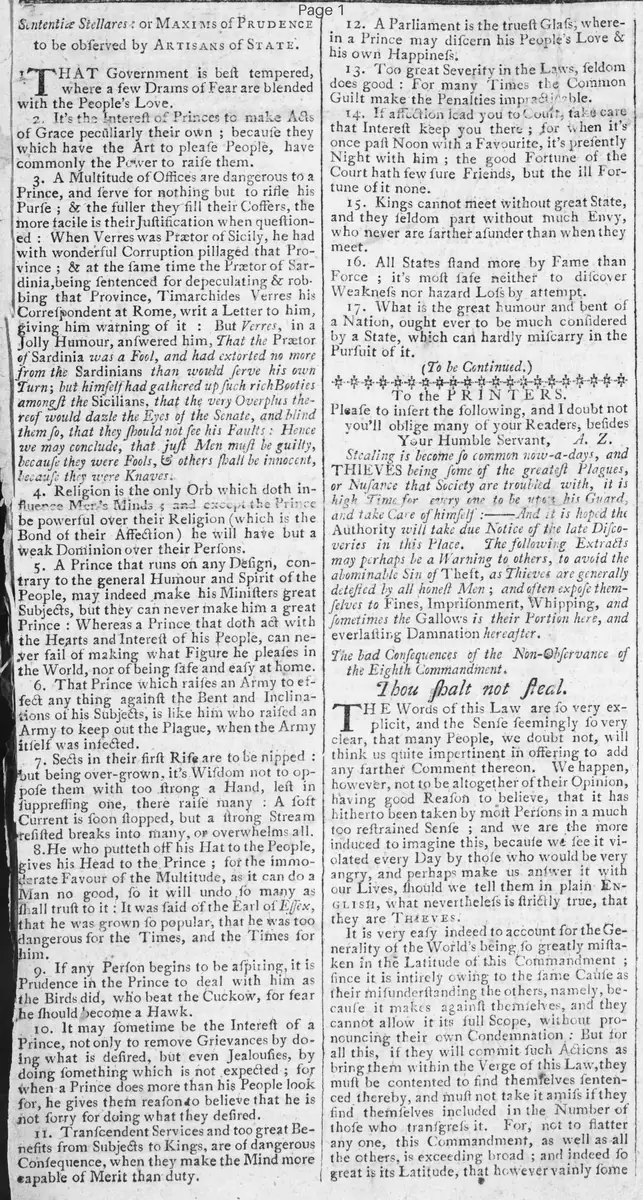
Sententia Stellares: or Maxims of Prudence to be observed by Statesmen.
1. That Government is best tempered, where a few Drams of Fear are blended with the People's Love.
2. It's the Interest of Princes to make Acts of Grace peculiarly their own; because they which have the Art to please People, have commonly the Power to raise them.
3. A Multitude of Offices are dangerous to a Prince, and serve for nothing but to rifle his Purse; & the fuller they fill their Coffers, the more facile is their Justification when questioned: When Verres was Praetor of Sicily, he had with wonderful Corruption pillaged that Province; & at the same time the Praetor of Sardinia, being sentenced for peculating & robbing that Province, Timarchides Verres his Correspondent at Rome, writ a Letter to him, giving him warning of it: But Verres, in a Jolly Humour, answered him, That the Praetor of Sardinia was a Fool, and had extorted no more from the Sardinians than would serve his own Turn; but himself had gathered up such rich Booties among the Sicilians, that the very Overplus thereof would dazzle the Eyes of the Senate, and blind them so, that they should not see his Faults: Hence we may conclude, that just Men must be guilty, because they were Fools, & others shall be innocent, because they were Knaves:
4. Religion is the only Orb which doth influence Men's Minds; and except the Prince be powerful over their Religion (which is the Bond of their Affection) he will have but a weak Dominion over their Persons.
5. A Prince that runs on any Design, contrary to the general Humour and Spirit of the People, may indeed make his Ministers great Subjects, but they can never make him a great Prince: Whereas a Prince that doth act with the Hearts and Interest of his People, can never fail of making what Figure he pleases in the World, nor of being safe and easy at home.
6. That Prince which raises an Army to effect any thing against the Bent and Inclinations of his Subjects, is like him who raised an Army to keep out the Plague, when the Army itself was infected.
7. Sects in their first Rise are to be nipped: but being over-grown, it's Wisdom not to oppose them with too strong a Hand, lest in Suppressing one, there rise many: A soft Current is soon stopped, but a strong Stream resisted breaks into many, or overwhelms all.
8. He who putteth off his Hat to the People, gives his Head to the Prince; for the immoderate Favour of the Multitude, as it can do a Man no good, so it will undo so many as shall trust to it: It was said of the Earl of Essex, that he was grown so popular, that he was too dangerous for the Times, and the Times for him.
9. If any Person begins to be aspiring, it is Prudence in the Prince to deal with him as the Birds did, who beat the Cuckow, for fear he should become a Hawk.
10. It may sometime be the Interest of a Prince, not only to remove Grievances by doing what is desired, but even Jealousies, by doing something which is not expected; for when a Prince does more than his People look for, he gives them reason to believe that he is not sorry for doing what they desired.
11. Transcendent Services and too great Benefits from Subjects to Kings, are of dangerous Consequence, when they make the Mind more capable of Merit than duty.
12. A Parliament is the truest Glass; wherein a Prince may discern his People's Love & his own Happiness.
13. Too great Severity in the Laws, seldom does good: For many Times the Common Guilt make the Penalties impracticable.
14. If affection lead you to Court, take care that Interest keep you there; for when it's once past Noon with a Favourite, it's presently Night with him; the good Fortune of the Court hath few sure Friends, but the ill Fortune of it none.
15. Kings cannot meet without great State, and they seldom part without much Envy, who never are farther asunder than when they meet.
16. All States stand more by Fame than Force: it's most safe neither to discover Weakness nor hazard Loss by attempt.
17. What is the great humour and bent of a Nation, ought ever to be much considered by a State, which can hardly miscarry in the Pursuit of it.
(To be Continued.)
1. That Government is best tempered, where a few Drams of Fear are blended with the People's Love.
2. It's the Interest of Princes to make Acts of Grace peculiarly their own; because they which have the Art to please People, have commonly the Power to raise them.
3. A Multitude of Offices are dangerous to a Prince, and serve for nothing but to rifle his Purse; & the fuller they fill their Coffers, the more facile is their Justification when questioned: When Verres was Praetor of Sicily, he had with wonderful Corruption pillaged that Province; & at the same time the Praetor of Sardinia, being sentenced for peculating & robbing that Province, Timarchides Verres his Correspondent at Rome, writ a Letter to him, giving him warning of it: But Verres, in a Jolly Humour, answered him, That the Praetor of Sardinia was a Fool, and had extorted no more from the Sardinians than would serve his own Turn; but himself had gathered up such rich Booties among the Sicilians, that the very Overplus thereof would dazzle the Eyes of the Senate, and blind them so, that they should not see his Faults: Hence we may conclude, that just Men must be guilty, because they were Fools, & others shall be innocent, because they were Knaves:
4. Religion is the only Orb which doth influence Men's Minds; and except the Prince be powerful over their Religion (which is the Bond of their Affection) he will have but a weak Dominion over their Persons.
5. A Prince that runs on any Design, contrary to the general Humour and Spirit of the People, may indeed make his Ministers great Subjects, but they can never make him a great Prince: Whereas a Prince that doth act with the Hearts and Interest of his People, can never fail of making what Figure he pleases in the World, nor of being safe and easy at home.
6. That Prince which raises an Army to effect any thing against the Bent and Inclinations of his Subjects, is like him who raised an Army to keep out the Plague, when the Army itself was infected.
7. Sects in their first Rise are to be nipped: but being over-grown, it's Wisdom not to oppose them with too strong a Hand, lest in Suppressing one, there rise many: A soft Current is soon stopped, but a strong Stream resisted breaks into many, or overwhelms all.
8. He who putteth off his Hat to the People, gives his Head to the Prince; for the immoderate Favour of the Multitude, as it can do a Man no good, so it will undo so many as shall trust to it: It was said of the Earl of Essex, that he was grown so popular, that he was too dangerous for the Times, and the Times for him.
9. If any Person begins to be aspiring, it is Prudence in the Prince to deal with him as the Birds did, who beat the Cuckow, for fear he should become a Hawk.
10. It may sometime be the Interest of a Prince, not only to remove Grievances by doing what is desired, but even Jealousies, by doing something which is not expected; for when a Prince does more than his People look for, he gives them reason to believe that he is not sorry for doing what they desired.
11. Transcendent Services and too great Benefits from Subjects to Kings, are of dangerous Consequence, when they make the Mind more capable of Merit than duty.
12. A Parliament is the truest Glass; wherein a Prince may discern his People's Love & his own Happiness.
13. Too great Severity in the Laws, seldom does good: For many Times the Common Guilt make the Penalties impracticable.
14. If affection lead you to Court, take care that Interest keep you there; for when it's once past Noon with a Favourite, it's presently Night with him; the good Fortune of the Court hath few sure Friends, but the ill Fortune of it none.
15. Kings cannot meet without great State, and they seldom part without much Envy, who never are farther asunder than when they meet.
16. All States stand more by Fame than Force: it's most safe neither to discover Weakness nor hazard Loss by attempt.
17. What is the great humour and bent of a Nation, ought ever to be much considered by a State, which can hardly miscarry in the Pursuit of it.
(To be Continued.)
What sub-type of article is it?
Essay
What themes does it cover?
Political
Moral Virtue
What keywords are associated?
Statesmanship
Prudence
Princes
Government
Political Advice
Maxims
Religion In Politics
Popularity Dangers
Literary Details
Title
Sententia Stellares: Or Maxims Of Prudence To Be Observed By Statesmen.
Key Lines
That Government Is Best Tempered, Where A Few Drams Of Fear Are Blended With The People's Love.
Religion Is The Only Orb Which Doth Influence Men's Minds; And Except The Prince Be Powerful Over Their Religion (Which Is The Bond Of Their Affection) He Will Have But A Weak Dominion Over Their Persons.
A Prince That Runs On Any Design, Contrary To The General Humour And Spirit Of The People, May Indeed Make His Ministers Great Subjects, But They Can Never Make Him A Great Prince.
A Parliament Is The Truest Glass; Wherein A Prince May Discern His People's Love & His Own Happiness.
All States Stand More By Fame Than Force: It's Most Safe Neither To Discover Weakness Nor Hazard Loss By Attempt.