Thank you for visiting SNEWPapers!
Sign up free
The Liberator
Boston, Suffolk County, Massachusetts
What is this article about?
A letter to the editor accuses Boston Mayor Theodore Lyman of complicity in the October 21, 1835 mob violence against abolitionists, claiming his prior actions, inaction during the riot, and post-event silence enabled attacks on free speech and anti-slavery meetings.
Merged-components note: Sequential components on page 3 with continuous text accusing Mayor Lyman of complicity in the Boston mob; merged into single letter to the editor.
Clippings
1 of 2
OCR Quality
Full Text
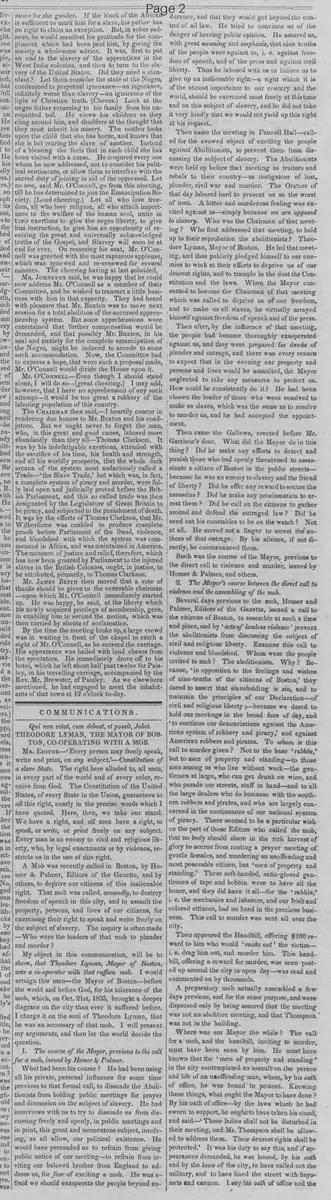
Qui non vetat, cum debeat, et possit, Jubet.
THEODORE LYMAN, THE MAYOR OF BOSTON, CO-OPERATING WITH A MOB
Mr. Editor—'Every person may freely speak, write and print, on any subject.'—Constitution of a slave State. The right here alluded to, all men, in every part of the world and of every color, receive from God. The Constitution of the United States, of every State in the Union, guarantees to all this right, nearly in the precise words which I have quoted. Here, then, we take our stand. We have a right, and all men have a right, to speak, or write, or print freely on any subject. Every man is an enemy to civil and religious liberty, who, by legal enactments or by violence, restricts us in the use of this right.
A Mob was recently called in Boston, by Homer & Palmer, Editors of the Gazette, and by others, to deprive our citizens of this inalienable right. That mob was called, avowedly, to destroy freedom of speech in this city, and to assault the property, persons, and lives of our citizens, for exercising their right to speak and write freely on the subject of slavery. The inquiry is often made—Who were the leaders of that mob to plunder and murder?
My object in this communication, will be to show, that Theodore Lyman, Mayor of Boston was a co-operator with that ruffian mob. I would arraign this man—the Mayor of Boston—before the world and before God, for his tolerance of the mob, which, on Oct. 21st, 1835, brought a deeper disgrace on the city than ever it suffered before. I charge it on the soul of Theodore Lyman, that he was an accessary of that mob. I will present my arguments, and then let the world decide the question.
1. The course of the Mayor, previous to the call for a mob, issued by Homer & Palmer.
What had been his course? He had been using all his private, personal influence for some time previous to that formal call, to dissuade the Abolitionists from holding public meetings for prayer and discussion on the subject of slavery. He had interviews with us to try to dissuade us from discussing freely and openly, in public meetings and in print, this great and momentous subject, involving, as all allow, our political existence. He would have persuaded us to refrain from giving public notice of our meeting—to refrain from inviting our beloved brother from England to address us, for fear of exciting a mob. He was afraid we should exasperate the people beyond endurance, and that they would get beyond the control of all law. He tried to convince us of the danger of braving public opinion. He assured us, with great meaning and emphasis, that nine tenths of the people were against us, i. e. against freedom of speech, and of the press and against civil liberty. Thus he labored with us to induce us to give up an inalienable right—a right which it is of the utmost importance to our country and the world, should be exercised most freely at this time and on this subject of slavery, and he did not take it very kindly that we would not yield up this right at his request.
Then came the meeting in Faneuil Hall—called for the avowed object of exciting the people against Abolitionists, to prevent them from discussing the subject of slavery. The Abolitionists were held up before that meeting as traitors and rebels to their country—as instigators of lust, plunder, civil war and murder. The Orators of that day labored hard to present us as the worst of men. A bitter and murderous feeling was excited against us—simply because we are opposed to slavery. Who was the Chairman of that meeting? Who first addressed that meeting, to hold up to their reprabation the abolitionists? Theodore Lyman, Mayor of Boston. He led that meeting, and thus publicly pledged himself to our enemies to wink at their efforts to deprive us of our dearest rights, and to trample in the dust the Constitution and the laws. When the Mayor consented to become the Chairman of that meeting which was called to deprive us of our freedom, and to make us all slaves, he virtually arrayed himself against freedom of speech and of the press. Then after, by the influence of that meeting, the people had become thoroughly exasperated against us, and they were prepared for deeds of plunder and outrage, and there was every reason to expect that in the evening our property and persons and lives would be assaulted, the Mayor neglected to take any measures to protect us. How could he consistently do it? He had been chosen the leader of those who were resolved to make us slaves, which was the same as to resolve to murder us, and he had accepted the appointment.
Then came the Gallows, erected before Mr. Garrison's door. What did the Mayor do in this thing? Did he make any efforts to detect and punish those who had openly threatened to assassinate a citizen of Boston in the public streets— because he was an enemy to slavery and the friend of liberty? Did he offer any reward to secure the assassins? Did he make any proclamation to arrest them? Did he call on the citizens to gather around and defend the outraged law? Did he send out his constables to be on the watch? Not at all. He moved not a finger to arrest the authors of that outrage. By his silence, if not directly, he countenanced them.
Such was the course of the Mayor, previous to the direct call to violence and murder, issued by Homer & Palmer, and others.
2. The Mayor's course between the direct call to violence and the assembling of the mob.
Several days previous to the mob, Homer and Palmer, Editors of the Gazette, issued a call to the citizens of Boston, to assemble at such a time and place, and by 'acts of lawless violence' prevent the abolitionists from discussing the subject of civil and religious liberty. Examine this call to violence and bloodshed. Whom were the people invited to mob? The abolitionists. Why? Because, 'in opposition to the feelings and wishes of nine-tenths of the citizens of Boston,' they dared to assert that slaveholding is sin, and to maintain the principles of our Declaration of civil and religious liberty;—because we dared to hold our meetings in the broad face of day, and 'to continue our denunciations against the American system of robbery and piracy,' and against American robbers and pirates. To whom is this call to murder given? Not to the base rabble, but to men of property and standing—to those men among us who live without work—the gentlemen at large, who can get drunk on wine, and who parade our streets, staff in hand—and to all the large dealers who do business with the southern robbers and pirates, and who are largely concerned in the continuance of our national system of piracy. There seemed to be a particular wish on the part of those Editors who called the mob, that no body should share in the rich harvest of glory to accrue from routing a prayer meeting of gentle females, and murdering an unoffending and most peaceable citizen, but 'men of property and standing.' These soft-handed, satin-gloved gentlemen of tape and bobbin were to have all the honor, and they did have it all—for the 'rabble,' i. e. the mechanics and laborers, and our Irish and colored citizens, had no hand in the precious business. This call to murder was sent all over the city.
Then appeared the Handbill, offering $100 reward to him who would "snitch out' the victim— i. e. drag him out, and murder him. This handbill, offering a reward for murder, was seen posted up around the city in open day—was read and commented on by thousands.
A preparatory mob actually assembled a few days previous, and for the same purpose, and were dispersed only by being assured that the meeting was not an abolition meeting, and that Thompson was not in the building.
Where was our Mayor the while? The call for a mob, and the handbill, inviting to murder, must have been seen by him. He must have known that the 'men of property and standing in the city contemplated an assault on the person and life of an unoffending man, whom, by his oath of office, he was bound to protect. Knowing these things, what ought the Mayor to have done? By his oath of office—by the laws which he had sworn to support, he ought to have taken his stand, and said—'These ladies shall not be disturbed in their meeting, and Mr. Thompson shall be allowed to address them. Their dearest rights shall be protected.' It was his duty to say this, and if appearances demanded, he was bound, by his oath and by the laws of the city, to have called out the military, and to have lined the street with bayonets and cannon. I say his oath of office and the
Laws required him to do this, rather than that the meeting should be disturbed. He was authorized to call on the citizens to aid him in thus supporting the rights of men, and to arrest every one who refused. But what did the Mayor do? Not a word did he say against those Editors who issued the call for bloodshed—Homer & Palmer. Not an effort did he make to detect the authors of the handbill, bribing to murder. Not a handbill did he order to be torn down. From the whole conduct of the Mayor, during this period, I know not how to avoid the conclusion, that this mob against freedom of speech and against life, was got up on the supposition that he would not do aught efficiently to put it down.
3. The conduct of the Mayor while the mob were together.
The spirit exhibited by the Mayor, in the following imaginary dialogue between him and the mob, is, I think, a just inference from his conduct during this period.
(A meeting of females within engaged in prayer. Enter the mob, with the Mayor. They fill the street—the stairway, up to the door of the room, where the ladies are praying.)
Mayor. (Addressing the mob)—Now, respected friends, you are a great number of 'men of property and standing.' It is meet that you go about your work orderly, and in a manner becoming your respectable appearance. What shall be done first?
Mob. First, stop this praying, and turn out the ladies.
Mayor. (Addressing the ladies)—Ladies, you are ordered to stop praying, and leave this room; or you will meet with trouble.
1st Lady. We have a right to meet here, and we wish you would disperse the mob, and let us go on with our meeting.
Mayor. Impossible. These 'men of property and standing' do not approve of your meeting, and you must disperse.
2nd Lady. Mr. Lyman, these are your personal friends, I presume. Could you not exert your personal influence with them, and get them to disperse? You would oblige us much.
Mayor. No—no. These gentlemen I cannot tolerate your meeting. You are braving public opinion, and acting in opposition to the wishes of nine-tenths of the citizens. If you will go now, I can ensure you protection. If not, I must leave you to the mercy of these 'men of property and standing.'
2nd Lady. Mr. Lyman, you know we have a right to continue our meeting. Tell these, your friends, that this is a lawful meeting, and that you are determined to protect us, and they will disperse.
Mayor. I grant your meeting is lawful, and you only use the right given to you by God, and guaranteed by the laws. But you are acting against 'public opinion,' and you must break up the meeting, or suffer the consequences.
2nd Lady. Are you not willing to protect us from violence, as you are sworn to do?
Mayor. Yes, I am willing to protect you with my life, and I and my friends here have assembled on purpose to protect you, and we will do it, if we die for it—if you will only go home, and cease to hold Anti-Slavery meetings, and to speak and write against slavery.
3rd Lady. Why don't your Honor read the Riot Act to them? Then your friends would go home.
Mayor. They would not. It would do no good to read the Riot Act. These, my friends, are no Rioters, but men of property and standing.
(Exeunt the ladies, amid the sneers, the hisses, the curses, the abuse and brutal jests—not of the 'low rabble,' but of 'men of property and standing,'—and as the last lady leaves the door, and gets clear of the mob, these same respectable friends of the Mayor give a fiendish shout of triumph. Then the Mayor turns to the roaring mob, and says)
Mayor. My respected friends, now I would respectfully request you to retire peaceably to your homes. Your work is done. Or have you any thing more to do?
Mob. Hand us down Thompson, the foreign emissary, who dares to brave public opinion, and to assert that there ought to be no slaves, and that all men are created free and equal. Let us have the scoundrel, that we may give him his deserts.
Mayor. Respected friends, after minute search, I cannot find him. I can assure you he is not in the building, nor in the city.
Mob. You lie, Sir, when you say Thompson is not in the building. He is.
Mayor. No, dear friends, I assure you he is not here. If he were—think you I would not deliver him up? Now, shall we not go home?
Mob. No. Hand us down the Anti-Slavery sign.
Mayor. It has been an eye-sore to the community some time. It has braved public opinion long enough. You three gentlemen, toss down this hated sign. (Down goes the sign.) Now, shall we not go peaceably home?
Mob. No. Let us have Garrison, the daring impious rascal, who dares to say that the colored people have as good a right to 'life, liberty and happiness,' as we have. Hand him down, and let us deal with him.
Mayor. My dear and respected friends, Garrison is not here.
Mob. Where is he?
Mayor. Escaped out at the back window.
(Rush go the mob to catch Garrison. Soon the cry—'We have caught him!' A rope is put around his body. His coat and pantaloons are torn off. He is dragged through the streets, and handed over to the Mayor. Then the Mayor makes a speech to the mob.)
Mayor. My friends, you have routed the ladies—you have secured the author of all our troubles. You have scattered the abolitionists as chaff before the whirlwind. We tried to pacify our southern brethren by the Faneuil Hall meeting; but that was not quite enough. Now they will know that our views of slavery are correct. The achievement of this day will be known throughout the world. This day will be remembered as next in importance to our nation's birth day. Your names and your deeds will be known and read of all men, from the rising to the setting of the sun. The friends of liberty will—they will—they will—O how they will speak of you! And the slaves of tyrants—will—will—will have—will have great occasion to 'remember you to God'—they will rise up before you, and remember this day's mighty work. O how shall your fame swell and spread out to the ends of the earth! How you shall be cheered and toasted! Surely, this is glory enough for once. Compared to this day's work, old Bunker Hill was mere child's play. (Long and loud cheering.) Now, respected friends, but one thing more remains, and then your work is done. What shall be done with Garrison?
Mob. Let him be banished from our quiet city.
Mayor. So be it. I will lock him up in jail, in a damp, cold dungeon to-night, and to-morrow, let him be sent away. Now, respected friends, your work is fairly done. Now let us retire peaceably to our homes. (Exeunt omnes.)
The above imaginary dialogue, I think, is a true representation of the conduct of the Mayor, as he appeared to us during the late mob.
4. Conduct of the Mayor since the mob.
What has been the Mayor's conduct since the mob? It has been most unaccountable. Has he made any efforts to redeem the honor of our disgraced city? Has he made any efforts to detect and bring to condign punishment the authors of that scene of plunder and violence? Has he issued any proclamation, offering any reward for the discovery of the murderous miscreants? He must have known who were most active in that mob. He saw them. It was in broad daylight. Many of them could be identified, if the Mayor and the Grand Jury would give the least encouragement that they would aid in bringing them to justice. But the Mayor has been silent as death about it. He has shown an evident desire to hush it up. What other construction can be put on his conduct, than to infer, that he is conscious of being himself blameworthy in this matter?
So far from trying to arrest the gentlemen ruffians that composed the mob, he would rather persuade us to give up all discussion of the principles of freedom, either in speech or in print. He would rather have us stop the Liberator, or remove it from the city. He had better pause, and ask how he is to answer to his country and his God, for his violated oath, for dispersing a legal meeting, for false imprisonment, and for countenancing the cause of robbers and pirates?
See, too, the conduct of the Mayor in the affair of Engine Company, No. 14. They marched through the city armed—a company of brazen-hearted and brazen-faced men, escorted by a brazen band of music, to a convenient place, and there fired at the figures of Thompson and a colored woman for a target. Where was the Mayor, while his authority was thus braved, and the laws trampled under foot? Quietly looking on. A few weeks since, our fire companies wished to march through our streets armed, carrying as a target the Lady Superior. This the Mayor would not allow. That was contrary to law, and an outrage on the city. Why did he not save our city from the indelible disgrace, which these men have brought on it in the case of Thompson? O, Thompson was an Abolitionist, and the Mayor thought there was no harm in shooting—at least at the figure of an Abolitionist, and that it would be no disgrace to the city to put a ball through the painted heart of one who had been such a terror to the Boston friends of the tyrants and pirates of this glorious, liberty-loving Republic. The Mayor did not move to prevent this mock murder—which was not a real one, only because the victim could not be found. What hand had our Mayor and his friends in this deed of infamy? Did he command it to be done? We believe he did.
'Qui non vetat, cum debeat, et possit, Jubet.' 'He, whose duty it is to prevent wrong, and is able to prevent, and does not, commands it.' The Mayor might have prevented that mob. He did not. The facts, as above stated, have gone out to the world as true, uncontradicted. According to a universally admitted principle of justice, the Mayor would be regarded, in any court of equity, as having commanded that mob to assemble to destroy freedom of speech. His motives, in law, must be supposed to comport with his cool, deliberate actions. What were his actions? He was chairman of the meeting that aroused the mobbing spirit. When he knew there was to be a mob, he made not one effort to prevent it. When he knew there was a mob, he trespassed on our rights of property and person, to please them, and made no efficient efforts to disperse them. When he knew there had been a mob, and that violence had been done to our rights, he made not one effort to detect and punish the guilty. What citizen of Boston will dare ever again to look up in the presence of a freeman? Our Mayor was furnished with ample power to preserve law and order. He did not do it. Yea, he never once tried to use the power given to him to prevent mischief, and protect our rights. According to the fundamental principles of justice, therefore, he must be adjudged guilty of commanding that mob.
Let the Mayor and his friends, who figured in the late piratical assault on the freedom of speech and of the press, take all the honor to themselves. Already has the Mayor's name been echoed from the South, as the leader of a mob to destroy freedom of speech. Already he and his respectable friends, who committed the valorous deed of breaking up an abolition meeting, and of giving a deadly blow to the Constitution and the laws, are hailed as the steadfast friends of robbers and pirates—as the deadly foes of liberty, and the warmest friends of slavery. The name of our Mayor will not soon be forgotten. Poor man, we envy him not his notoriety.
HANCOCK.
What sub-type of article is it?
What themes does it cover?
What keywords are associated?
What entities or persons were involved?
Letter to Editor Details
Author
Hancock.
Recipient
Mr. Editor
Main Argument
theodore lyman, mayor of boston, cooperated with the mob of october 21, 1835, by discouraging abolitionist meetings beforehand, failing to prevent or disperse the violence, and not pursuing justice afterward, thereby violating his oath and enabling attacks on free speech and anti-slavery activities.
Notable Details