Thank you for visiting SNEWPapers!
Sign up free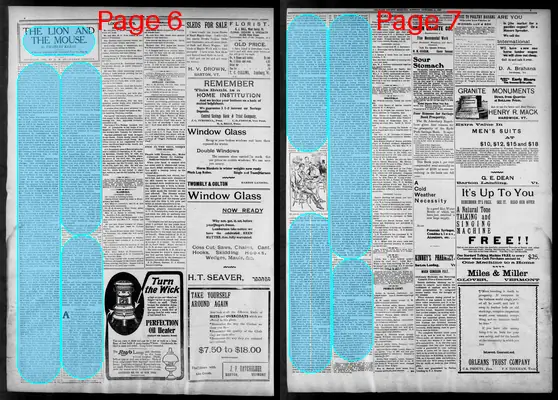
Literary
October 21, 1907
Orleans County Monitor
Barton, Orleans County, Vermont
What is this article about?
In 'The Lion and the Mouse,' Judge Rossmore is ensnared in a stock scandal orchestrated by financier John Ryder, compromising his judicial integrity in a mining company case. Meanwhile, Ryder's son Jefferson, an artist in Paris, reflects on his father's ruthless life and meets Shirley Rossmore, the judge's daughter and author of a novel critiquing Ryder.
Merged-components note: Merged across pages the serialized literary story 'The Lion and the Mouse'.
Clippings
1 of 2
OCR Quality
98%
Excellent
Full Text
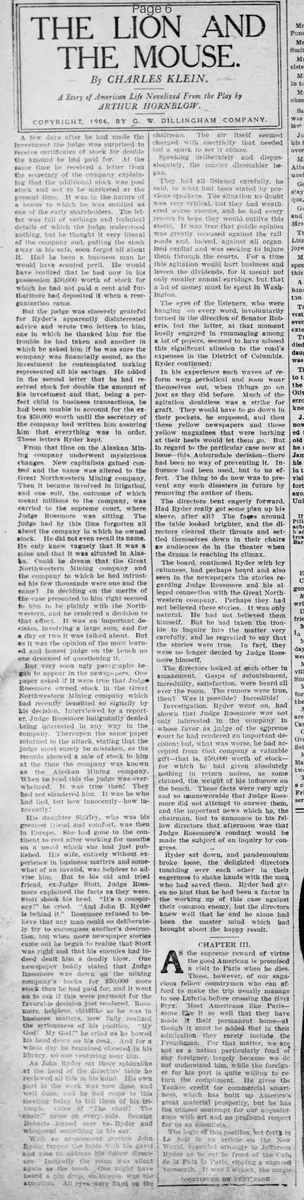
THE LION AND THE MOUSE.
By CHARLES S. KLEIN.
A Story of American Life Novelized From the Play by ARTHUR HORNBLOW.
A few days after he had made the investment the Judge was surprised to receive certificates of stock for double the amount he had paid for. At the same time he received a letter from the secretary of the company explaining that the additional stock was pool stock and not to be marketed at the present time. It was in the nature of a bonus to which he was entitled as one of the early shareholders. The letter was full of verbiage and technical details of which the judge understood nothing, but he thought it very liberal of the company and, putting the stock away in his safe, soon forgot all about it. Had he been a business man he would have scented peril. He would have realized that he had now in his possession $50,000 worth of stock for which he had not paid a cent and furthermore had deposited it when a reorganization came.
But the judge was sincerely grateful for Ryder's apparently disinterested advice and wrote two letters to him, one in which he thanked him for the trouble he had taken and another in which he asked him if he was sure the company was financially sound, as the investment he contemplated making represented all his savings. He added in the second letter that he had received stock for double the amount of his investment and that, being a perfect child in business transactions, he had been unable to account for the extra $50,000 worth until the secretary of the company had written him assuring him that everything was in order.
These letters Ryder kept.
From that time on the Alaskan Mining company underwent mysterious changes. New capitalists gained control and the name was altered to the Great Northwestern Mining company. Then it became involved in litigation, and one suit, the outcome of which meant millions to the company, was carried to the supreme court, where Judge Rossmore was sitting. The judge had by this time forgotten all about the company in which he owned stock. He did not even recall its name. He only knew vaguely that it was a mine and that it was situated in Alaska. Could he dream that the Great Northwestern Mining company and the company to which he had intrusted his few thousands were one and the same? In deciding on the merits of the case presented to him right seemed to him to be plainly with the Northwestern, and he rendered a decision to that effect. It was an important decision, involving a large sum, and for a day or two it was talked about. But as it was the opinion of the most learned and honest judge on the bench no one dreamed of questioning it.
But very soon ugly paragraphs began to appear in the newspapers. One paper asked if it were true that Judge Rossmore owned stock in the Great Northwestern Mining company which had recently benefited so signally by his decision. Interviewed by a reporter, Judge Rossmore indignantly denied being interested in any way in the company. Thereupon the same paper returned to the attack, stating that the judge must surely be mistaken, as the records showed a sale of stock to him at the time the company was known as the Alaskan Mining company.
When he read this the judge was overwhelmed. It was true then! They had not slandered him. It was he who had lied, but how innocently—how innocently!
His daughter Shirley, who was his greatest friend and comfort, was then in Europe. She had gone to the continent to rest after working for months on a novel which she had just published. His wife, entirely without experience in business matters and somewhat of an invalid, was helpless to advise him. But to his old and tried friend, ex-Judge Stott, Judge Rossmore explained the facts as they were.
Stott shook his head. "It's a conspiracy!" he cried. "And John B. Ryder is behind it." Rossmore refused to believe that any man could so deliberately try to encompass another's destruction, but when more newspaper stories came out he began to realize that Stott was right and that his enemies had indeed dealt him a deadly blow. One newspaper boldly stated that Judge Rossmore was down on the mining company's books for $50,000 more stock than he had paid for, and it went on to ask if this were payment for the favorable decision just rendered. Rossmore, helpless, childlike as he was in business matters, now fully realized the seriousness of his position. "My God! My God!" he cried as he bowed his head down on his desk. And for a whole day he remained closeted in his library, no one venturing near him.
As John Ryder sat there sphinxlike at the head of the directors' table he reviewed all this in his mind. His own part in the work was now done, and well done, and he had come to this meeting today to tell them of his triumph. Cries of "The chair! The chair." arose on every side. Senator Roberts leaned over to Ryder and whispered something in his ear.
With an acquiescent gesture John Ryder tapped the table with his gavel and rose to address his fellow directors.
Instantly the room was silent again as the tomb. One might have heard a pin drop, so intense was the attention. All eyes were fixed on the chairman.
The air itself seemed charged with electricity that needed but a spark to set it ablaze.
Speaking deliberately and dispassionately, the master dissembler began.
They had all listened carefully, he said, to what had been stated by previous speakers. The situation no doubt was very critical, but they had weathered worse storms, and he had every reason to hope they would outlive this storm. It was true that public opinion was greatly incensed against the railroads and, indeed, against all organized capital and was seeking to injure them through the courts. For a time this agitation would hurt business and lessen the dividends, for it meant not only smaller annual earnings, but that a lot of money must be spent in Washington.
The eyes of the listeners, who were hanging on every word, involuntarily turned in the direction of Senator Roberts, but the latter, at that moment busily engaged in rummaging among a lot of papers, seemed to have missed this significant allusion to the road's expenses in the District of Columbia.
Ryder continued:
In his experience such waves of reform were periodical and soon wore themselves out, when things go on just as they did before. Much of the agitation doubtless was a strike for graft. They would have to go down in their pockets, he supposed, and then these yellow newspapers and these yellow magazines that were barking at their heels would let them go. But in regard to the particular case now at issue—this Auburndale decision—there had been no way of preventing it. Influence had been used, but to no effect. The thing to do now was to prevent any such disasters in future by removing the author of them.
The directors bent eagerly forward. Had Ryder really got some plan up his sleeve, after all? The faces around the table looked brighter, and the directors cleared their throats and settled themselves down in their chairs as audiences do in the theater when the drama is reaching its climax.
The board, continued Ryder with icy calmness, had perhaps heard and also seen in the newspapers the stories regarding Judge Rossmore and his alleged connection with the Great Northwestern company. Perhaps they had not believed these stories. It was only natural. He had not believed them himself. But he had taken the trouble to inquire into the matter very carefully, and he regretted to say that the stories were true. In fact, they were no longer denied by Judge Rossmore himself.
The directors looked at each other in amazement. Gasps of astonishment, incredulity, satisfaction, were heard all over the room. The rumors were true, then? Was it possible? Incredible!
Investigation, Ryder went on, had shown that Judge Rossmore was not only interested in the company in whose favor as judge of the supreme court he had rendered an important decision: but, what was worse, he had accepted from that company a valuable gift—that is, $50,000 worth of stock—for which he had given absolutely nothing in return unless, as some claimed, the weight of his influence on the bench. These facts were very ugly and so unanswerable that Judge Rossmore did not attempt to answer them, and the important news which he, the chairman, had to announce to his fellow directors that afternoon was that Judge Rossmore's conduct would be made the subject of an inquiry by congress.
Ryder sat down, and pandemonium broke loose, the delighted directors tumbling over each other in their eagerness to shake hands with the man who had saved them. Ryder had given no hint that he had been a factor in the working up of this case against their common enemy, but the directors knew well that he and he alone had been the master mind which had brought about the happy result.
CHAPTER III.
As the supreme reward of virtue the good American is promised a visit to Paris when he dies. Those, however, of our sagacious fellow countrymen who can afford to make the trip usually manage to see Lutetia before crossing the river Styx. Most Americans like Paris—some like it so well that they have made it their permanent home—although it must be added that in their admiration they rarely include the Frenchman. For that matter, we are not as a nation particularly fond of any foreigner, largely because we do not understand him, while the foreigner for his part is quite willing to return the compliment. He gives the Yankee credit for commercial smartness, which has built up America's great material prosperity, but he has the utmost contempt for our acquaintance with art and no profound respect for us as scientists.
The logic of this position, set forth in Le Soleil in an article on the New World, appealed strongly to Jefferson Ryder as he sat in front of the Cafe de la Paix in Paris, sipping a sugared vermouth. It was 5 o'clock, the magic
It was the hour of the aperitif, when the glutton taxes his wits to deceive his stomach and work up an appetite for renewed gorging.
The little tables were all occupied with the usual before-dinner crowd.
Fascinated by the gay scene around him, Jefferson laid the newspaper aside.
To the young American, fresh from prosaic money-mad New York, the City of Pleasure presented indeed a novel and beautiful spectacle. How different, he mused, from his own city with one fashionable thoroughfare—Fifth avenue—monotonously lined for miles with hideous brown-stone residences and showing little real animation except during the Saturday afternoon parade when the activities of the smart set, male and female, centered chiefly in such exciting diversions as going to Huyler's for soda, taking tea at the Waldorf and trying to outdo each other in dress and show. New York certainly was a dull place with all its boasted cosmopolitanism.
It was true, he thought, the foreigner had indeed learned the secret of enjoying life. There was assuredly something else in the world beyond mere money getting. His father was a slave to it, but he would never be. He was resolved on that. Yet, with all his ideas of emancipation and progress, Jefferson was a thoroughly practical young man. He fully understood the value of money, and the possession of it was as sweet to him as to other men. Only he would never sell his soul in acquiring it dishonorably. No, Jefferson was no fool. He loved money for what pleasure, intellectual or physical, it could give him, but he would never allow money to dominate his life as his father had done. His father, he knew well, was not a happy man, neither happy himself nor respected by the world. He had toiled all his life to make his vast fortune, and now he toiled to take care of it. The galley slave led a life of luxurious ease compared with John Burkett Ryder.
Baited by the yellow newspapers and magazines, investigated by state committees, dogged by process servers, haunted by beggars, harassed by blackmailers, threatened by kidnappers, frustrated in his attempts to bestow charity by the cry 'tainted money,'
He sat in front of the Cafe de la Paix in Paris, certainly the lot of the world's richest man was far from being an enviable one.
That is why Jefferson had resolved to strike out for himself. He had warded off the golden yoke which his father proposed to put on his shoulders, declining the lucrative position made for him in the Empire Trading company, and he had gone so far as to refuse also the private income his father offered to settle on him. He would earn his own living. A man who has his bread buttered for him seldom accomplishes anything, he had said, and, while his father had appeared to be angry at this open opposition to his will, he was secretly pleased at his son's grit. Jefferson was thoroughly in earnest. If needs be he would forego the great fortune that awaited him rather than be forced into questionable business methods against which his whole manhood revolted.
Jefferson Ryder felt strongly about these matters and gave them more thought than would be expected of most young men with his opportunities. In fact, he was unusually serious for his age. He was not yet thirty, but he had done a great deal of reading, and he took a keen interest in all the political and sociological questions of the hour. In personal appearance he was the type of man that both men and women like—tall and athletic looking, with smooth face and clean-cut features. He had the steel blue eyes and the fighting jaw of his father, and when he smiled he displayed two even rows of very white teeth. He was popular with men, being manly, frank and cordial in his relations with them, and women admired him greatly, although they were somewhat intimidated by his grave and serious manner.
The truth was that he was rather diffident with women, largely owing to lack of experience with them. He had never felt the slightest inclination for business. He had the artistic temperament strongly developed, and his personal tastes had little in common with Wall street and its feverish stock manipulating. When he was younger he had dreamed of a literary or art career. At one time he had even thought of going on the stage, but it was to art that he turned finally. From an early age he had shown considerable skill as a draftsman, and later a two years' course at the Academy of Design convinced him that this was his true vocation. He had begun by illustrating for the book publishers and for the magazines, meeting at first with the usual rebuffs and disappointments; but, refusing to be discouraged, he had kept on and soon the tide turned.
His drawings began to be accepted. They appeared first in one magazine, then in another, until one day, to his great joy, he received an order from an important firm of publishers for six wash drawings to be used in illustrating a famous novel. This was the beginning of his real success. His illustrations were talked about almost as much as the book, and from that time on everything was easy. He was in great demand by the publishers, and very soon the young artist, who had begun his career of independence on nothing a year, so to speak, found himself in a handsomely appointed studio in Bryant park, with more orders coming in than he could possibly fill and enjoying an income of little less than $5,000 a year. The money was all the sweeter to Jefferson in that he felt he had himself earned every cent of it.
This summer he was giving himself a well deserved vacation, and he had come to Europe partly to see Paris and the other art centers about which his fellow students at the academy raved, but principally—although this he did not acknowledge even to himself—to meet in Paris a young woman in whom he was more than ordinarily interested—Shirley Rossmore, daughter of Judge Rossmore of the United States supreme court, who had come abroad to recuperate after the labors on her new novel, 'The American Octopus,' a book which was then the talk of two hemispheres.
Jefferson had read half a dozen reviews of it in as many American papers that afternoon at the New York Herald's reading room in the Avenue de l'Opera, and he chuckled with glee as he thought how accurately this young woman had described his father. The book had been published under the pseudonym 'Shirley Green,' and he alone had been admitted into the secret of authorship. The critics all conceded that it was the book of the year, and that it portrayed with a pitiless pen the personality of the biggest figure in the commercial life of America. 'Although,' wrote one reviewer, 'the leading character in the book is given another name, there can be no doubt that the author intended to give to the world a vivid pen portrait of John Burkett Ryder. She has succeeded in presenting a remarkable character study of the most remarkable man of his time.'
He was particularly pleased with the reviews, not only for Miss Rossmore's sake, but also because his own vanity was gratified. Had he not collaborated on the book to the extent of acquainting the author with details of his father's life and his characteristics which no outsider could possibly have learned? There had been no disloyalty to his father in doing this. Jefferson admired his father's smartness, if he could not approve his methods. He did not consider the book an attack on his father, but rather a powerfully written pen picture of an extraordinary man.
The acquaintance of his son with the daughter of Judge Rossmore had not escaped the eagle eye of Ryder, Sr., and much to the financier's annoyance and even consternation he had ascertained that Jefferson was a frequent caller at the Rossmore home. He immediately jumped to the conclusion that this could mean only one thing, and fearing what he termed the 'consequences of the insanity of immature minds,' he had summoned Jefferson peremptorily to his presence. He told his son that all idea of marriage in that quarter was out of the question for two reasons: One was that Judge Rossmore was his most bitter enemy, the other was that he had hoped to see his son, his destined successor, marry a woman of whom he, Ryder, Sr., could approve. He knew of such a woman, one who would make a far more desirable mate than Miss Rossmore. He alluded, of course, to Kate Roberts, the pretty daughter of his old friend, the senator. The family interests would benefit by this alliance, which was desirable from every point of view.
Jefferson had listened respectfully until his father had finished and then grimly remarked that only one point of view had been overlooked—his own. He did not care for Miss Roberts; he did not think she really cared for him. The marriage was out of the question. Whereupon Ryder, Sr., had fumed and raged, declaring that Jefferson was opposing his will as he always did, and ending with the threat that if his son married Shirley Rossmore without his consent he would disinherit him.
Jefferson was cogitating on these incidents of the last few months when suddenly a feminine voice which he quickly recognized called out in English:
'Hello! Mr. Ryder.'
He looked up and saw two ladies, one young, the other middle aged, smiling at him from an open fiacre which had drawn up to the curb. Jefferson jumped from his seat, upsetting his chair and startling two nervous Frenchmen in his hurry, and hastened out, hat in hand.
'Why, Miss Rossmore, what are you doing out driving?' he asked. 'You know you and Mrs. Blake promised to dine with me tonight. I was coming round to the hotel in a few moments.'
Mrs. Blake was a younger sister of Shirley's mother. Her husband had died a few years previously, leaving her a small income, and when she had heard of her niece's contemplated trip to Europe she had decided to come to Paris to meet her and incidentally to chaperon her.
The two women were stopping at the Grand Hotel close by, while Jefferson had found accommodations at the Athenee.
TO BE CONTINUED
By CHARLES S. KLEIN.
A Story of American Life Novelized From the Play by ARTHUR HORNBLOW.
A few days after he had made the investment the Judge was surprised to receive certificates of stock for double the amount he had paid for. At the same time he received a letter from the secretary of the company explaining that the additional stock was pool stock and not to be marketed at the present time. It was in the nature of a bonus to which he was entitled as one of the early shareholders. The letter was full of verbiage and technical details of which the judge understood nothing, but he thought it very liberal of the company and, putting the stock away in his safe, soon forgot all about it. Had he been a business man he would have scented peril. He would have realized that he had now in his possession $50,000 worth of stock for which he had not paid a cent and furthermore had deposited it when a reorganization came.
But the judge was sincerely grateful for Ryder's apparently disinterested advice and wrote two letters to him, one in which he thanked him for the trouble he had taken and another in which he asked him if he was sure the company was financially sound, as the investment he contemplated making represented all his savings. He added in the second letter that he had received stock for double the amount of his investment and that, being a perfect child in business transactions, he had been unable to account for the extra $50,000 worth until the secretary of the company had written him assuring him that everything was in order.
These letters Ryder kept.
From that time on the Alaskan Mining company underwent mysterious changes. New capitalists gained control and the name was altered to the Great Northwestern Mining company. Then it became involved in litigation, and one suit, the outcome of which meant millions to the company, was carried to the supreme court, where Judge Rossmore was sitting. The judge had by this time forgotten all about the company in which he owned stock. He did not even recall its name. He only knew vaguely that it was a mine and that it was situated in Alaska. Could he dream that the Great Northwestern Mining company and the company to which he had intrusted his few thousands were one and the same? In deciding on the merits of the case presented to him right seemed to him to be plainly with the Northwestern, and he rendered a decision to that effect. It was an important decision, involving a large sum, and for a day or two it was talked about. But as it was the opinion of the most learned and honest judge on the bench no one dreamed of questioning it.
But very soon ugly paragraphs began to appear in the newspapers. One paper asked if it were true that Judge Rossmore owned stock in the Great Northwestern Mining company which had recently benefited so signally by his decision. Interviewed by a reporter, Judge Rossmore indignantly denied being interested in any way in the company. Thereupon the same paper returned to the attack, stating that the judge must surely be mistaken, as the records showed a sale of stock to him at the time the company was known as the Alaskan Mining company.
When he read this the judge was overwhelmed. It was true then! They had not slandered him. It was he who had lied, but how innocently—how innocently!
His daughter Shirley, who was his greatest friend and comfort, was then in Europe. She had gone to the continent to rest after working for months on a novel which she had just published. His wife, entirely without experience in business matters and somewhat of an invalid, was helpless to advise him. But to his old and tried friend, ex-Judge Stott, Judge Rossmore explained the facts as they were.
Stott shook his head. "It's a conspiracy!" he cried. "And John B. Ryder is behind it." Rossmore refused to believe that any man could so deliberately try to encompass another's destruction, but when more newspaper stories came out he began to realize that Stott was right and that his enemies had indeed dealt him a deadly blow. One newspaper boldly stated that Judge Rossmore was down on the mining company's books for $50,000 more stock than he had paid for, and it went on to ask if this were payment for the favorable decision just rendered. Rossmore, helpless, childlike as he was in business matters, now fully realized the seriousness of his position. "My God! My God!" he cried as he bowed his head down on his desk. And for a whole day he remained closeted in his library, no one venturing near him.
As John Ryder sat there sphinxlike at the head of the directors' table he reviewed all this in his mind. His own part in the work was now done, and well done, and he had come to this meeting today to tell them of his triumph. Cries of "The chair! The chair." arose on every side. Senator Roberts leaned over to Ryder and whispered something in his ear.
With an acquiescent gesture John Ryder tapped the table with his gavel and rose to address his fellow directors.
Instantly the room was silent again as the tomb. One might have heard a pin drop, so intense was the attention. All eyes were fixed on the chairman.
The air itself seemed charged with electricity that needed but a spark to set it ablaze.
Speaking deliberately and dispassionately, the master dissembler began.
They had all listened carefully, he said, to what had been stated by previous speakers. The situation no doubt was very critical, but they had weathered worse storms, and he had every reason to hope they would outlive this storm. It was true that public opinion was greatly incensed against the railroads and, indeed, against all organized capital and was seeking to injure them through the courts. For a time this agitation would hurt business and lessen the dividends, for it meant not only smaller annual earnings, but that a lot of money must be spent in Washington.
The eyes of the listeners, who were hanging on every word, involuntarily turned in the direction of Senator Roberts, but the latter, at that moment busily engaged in rummaging among a lot of papers, seemed to have missed this significant allusion to the road's expenses in the District of Columbia.
Ryder continued:
In his experience such waves of reform were periodical and soon wore themselves out, when things go on just as they did before. Much of the agitation doubtless was a strike for graft. They would have to go down in their pockets, he supposed, and then these yellow newspapers and these yellow magazines that were barking at their heels would let them go. But in regard to the particular case now at issue—this Auburndale decision—there had been no way of preventing it. Influence had been used, but to no effect. The thing to do now was to prevent any such disasters in future by removing the author of them.
The directors bent eagerly forward. Had Ryder really got some plan up his sleeve, after all? The faces around the table looked brighter, and the directors cleared their throats and settled themselves down in their chairs as audiences do in the theater when the drama is reaching its climax.
The board, continued Ryder with icy calmness, had perhaps heard and also seen in the newspapers the stories regarding Judge Rossmore and his alleged connection with the Great Northwestern company. Perhaps they had not believed these stories. It was only natural. He had not believed them himself. But he had taken the trouble to inquire into the matter very carefully, and he regretted to say that the stories were true. In fact, they were no longer denied by Judge Rossmore himself.
The directors looked at each other in amazement. Gasps of astonishment, incredulity, satisfaction, were heard all over the room. The rumors were true, then? Was it possible? Incredible!
Investigation, Ryder went on, had shown that Judge Rossmore was not only interested in the company in whose favor as judge of the supreme court he had rendered an important decision: but, what was worse, he had accepted from that company a valuable gift—that is, $50,000 worth of stock—for which he had given absolutely nothing in return unless, as some claimed, the weight of his influence on the bench. These facts were very ugly and so unanswerable that Judge Rossmore did not attempt to answer them, and the important news which he, the chairman, had to announce to his fellow directors that afternoon was that Judge Rossmore's conduct would be made the subject of an inquiry by congress.
Ryder sat down, and pandemonium broke loose, the delighted directors tumbling over each other in their eagerness to shake hands with the man who had saved them. Ryder had given no hint that he had been a factor in the working up of this case against their common enemy, but the directors knew well that he and he alone had been the master mind which had brought about the happy result.
CHAPTER III.
As the supreme reward of virtue the good American is promised a visit to Paris when he dies. Those, however, of our sagacious fellow countrymen who can afford to make the trip usually manage to see Lutetia before crossing the river Styx. Most Americans like Paris—some like it so well that they have made it their permanent home—although it must be added that in their admiration they rarely include the Frenchman. For that matter, we are not as a nation particularly fond of any foreigner, largely because we do not understand him, while the foreigner for his part is quite willing to return the compliment. He gives the Yankee credit for commercial smartness, which has built up America's great material prosperity, but he has the utmost contempt for our acquaintance with art and no profound respect for us as scientists.
The logic of this position, set forth in Le Soleil in an article on the New World, appealed strongly to Jefferson Ryder as he sat in front of the Cafe de la Paix in Paris, sipping a sugared vermouth. It was 5 o'clock, the magic
It was the hour of the aperitif, when the glutton taxes his wits to deceive his stomach and work up an appetite for renewed gorging.
The little tables were all occupied with the usual before-dinner crowd.
Fascinated by the gay scene around him, Jefferson laid the newspaper aside.
To the young American, fresh from prosaic money-mad New York, the City of Pleasure presented indeed a novel and beautiful spectacle. How different, he mused, from his own city with one fashionable thoroughfare—Fifth avenue—monotonously lined for miles with hideous brown-stone residences and showing little real animation except during the Saturday afternoon parade when the activities of the smart set, male and female, centered chiefly in such exciting diversions as going to Huyler's for soda, taking tea at the Waldorf and trying to outdo each other in dress and show. New York certainly was a dull place with all its boasted cosmopolitanism.
It was true, he thought, the foreigner had indeed learned the secret of enjoying life. There was assuredly something else in the world beyond mere money getting. His father was a slave to it, but he would never be. He was resolved on that. Yet, with all his ideas of emancipation and progress, Jefferson was a thoroughly practical young man. He fully understood the value of money, and the possession of it was as sweet to him as to other men. Only he would never sell his soul in acquiring it dishonorably. No, Jefferson was no fool. He loved money for what pleasure, intellectual or physical, it could give him, but he would never allow money to dominate his life as his father had done. His father, he knew well, was not a happy man, neither happy himself nor respected by the world. He had toiled all his life to make his vast fortune, and now he toiled to take care of it. The galley slave led a life of luxurious ease compared with John Burkett Ryder.
Baited by the yellow newspapers and magazines, investigated by state committees, dogged by process servers, haunted by beggars, harassed by blackmailers, threatened by kidnappers, frustrated in his attempts to bestow charity by the cry 'tainted money,'
He sat in front of the Cafe de la Paix in Paris, certainly the lot of the world's richest man was far from being an enviable one.
That is why Jefferson had resolved to strike out for himself. He had warded off the golden yoke which his father proposed to put on his shoulders, declining the lucrative position made for him in the Empire Trading company, and he had gone so far as to refuse also the private income his father offered to settle on him. He would earn his own living. A man who has his bread buttered for him seldom accomplishes anything, he had said, and, while his father had appeared to be angry at this open opposition to his will, he was secretly pleased at his son's grit. Jefferson was thoroughly in earnest. If needs be he would forego the great fortune that awaited him rather than be forced into questionable business methods against which his whole manhood revolted.
Jefferson Ryder felt strongly about these matters and gave them more thought than would be expected of most young men with his opportunities. In fact, he was unusually serious for his age. He was not yet thirty, but he had done a great deal of reading, and he took a keen interest in all the political and sociological questions of the hour. In personal appearance he was the type of man that both men and women like—tall and athletic looking, with smooth face and clean-cut features. He had the steel blue eyes and the fighting jaw of his father, and when he smiled he displayed two even rows of very white teeth. He was popular with men, being manly, frank and cordial in his relations with them, and women admired him greatly, although they were somewhat intimidated by his grave and serious manner.
The truth was that he was rather diffident with women, largely owing to lack of experience with them. He had never felt the slightest inclination for business. He had the artistic temperament strongly developed, and his personal tastes had little in common with Wall street and its feverish stock manipulating. When he was younger he had dreamed of a literary or art career. At one time he had even thought of going on the stage, but it was to art that he turned finally. From an early age he had shown considerable skill as a draftsman, and later a two years' course at the Academy of Design convinced him that this was his true vocation. He had begun by illustrating for the book publishers and for the magazines, meeting at first with the usual rebuffs and disappointments; but, refusing to be discouraged, he had kept on and soon the tide turned.
His drawings began to be accepted. They appeared first in one magazine, then in another, until one day, to his great joy, he received an order from an important firm of publishers for six wash drawings to be used in illustrating a famous novel. This was the beginning of his real success. His illustrations were talked about almost as much as the book, and from that time on everything was easy. He was in great demand by the publishers, and very soon the young artist, who had begun his career of independence on nothing a year, so to speak, found himself in a handsomely appointed studio in Bryant park, with more orders coming in than he could possibly fill and enjoying an income of little less than $5,000 a year. The money was all the sweeter to Jefferson in that he felt he had himself earned every cent of it.
This summer he was giving himself a well deserved vacation, and he had come to Europe partly to see Paris and the other art centers about which his fellow students at the academy raved, but principally—although this he did not acknowledge even to himself—to meet in Paris a young woman in whom he was more than ordinarily interested—Shirley Rossmore, daughter of Judge Rossmore of the United States supreme court, who had come abroad to recuperate after the labors on her new novel, 'The American Octopus,' a book which was then the talk of two hemispheres.
Jefferson had read half a dozen reviews of it in as many American papers that afternoon at the New York Herald's reading room in the Avenue de l'Opera, and he chuckled with glee as he thought how accurately this young woman had described his father. The book had been published under the pseudonym 'Shirley Green,' and he alone had been admitted into the secret of authorship. The critics all conceded that it was the book of the year, and that it portrayed with a pitiless pen the personality of the biggest figure in the commercial life of America. 'Although,' wrote one reviewer, 'the leading character in the book is given another name, there can be no doubt that the author intended to give to the world a vivid pen portrait of John Burkett Ryder. She has succeeded in presenting a remarkable character study of the most remarkable man of his time.'
He was particularly pleased with the reviews, not only for Miss Rossmore's sake, but also because his own vanity was gratified. Had he not collaborated on the book to the extent of acquainting the author with details of his father's life and his characteristics which no outsider could possibly have learned? There had been no disloyalty to his father in doing this. Jefferson admired his father's smartness, if he could not approve his methods. He did not consider the book an attack on his father, but rather a powerfully written pen picture of an extraordinary man.
The acquaintance of his son with the daughter of Judge Rossmore had not escaped the eagle eye of Ryder, Sr., and much to the financier's annoyance and even consternation he had ascertained that Jefferson was a frequent caller at the Rossmore home. He immediately jumped to the conclusion that this could mean only one thing, and fearing what he termed the 'consequences of the insanity of immature minds,' he had summoned Jefferson peremptorily to his presence. He told his son that all idea of marriage in that quarter was out of the question for two reasons: One was that Judge Rossmore was his most bitter enemy, the other was that he had hoped to see his son, his destined successor, marry a woman of whom he, Ryder, Sr., could approve. He knew of such a woman, one who would make a far more desirable mate than Miss Rossmore. He alluded, of course, to Kate Roberts, the pretty daughter of his old friend, the senator. The family interests would benefit by this alliance, which was desirable from every point of view.
Jefferson had listened respectfully until his father had finished and then grimly remarked that only one point of view had been overlooked—his own. He did not care for Miss Roberts; he did not think she really cared for him. The marriage was out of the question. Whereupon Ryder, Sr., had fumed and raged, declaring that Jefferson was opposing his will as he always did, and ending with the threat that if his son married Shirley Rossmore without his consent he would disinherit him.
Jefferson was cogitating on these incidents of the last few months when suddenly a feminine voice which he quickly recognized called out in English:
'Hello! Mr. Ryder.'
He looked up and saw two ladies, one young, the other middle aged, smiling at him from an open fiacre which had drawn up to the curb. Jefferson jumped from his seat, upsetting his chair and startling two nervous Frenchmen in his hurry, and hastened out, hat in hand.
'Why, Miss Rossmore, what are you doing out driving?' he asked. 'You know you and Mrs. Blake promised to dine with me tonight. I was coming round to the hotel in a few moments.'
Mrs. Blake was a younger sister of Shirley's mother. Her husband had died a few years previously, leaving her a small income, and when she had heard of her niece's contemplated trip to Europe she had decided to come to Paris to meet her and incidentally to chaperon her.
The two women were stopping at the Grand Hotel close by, while Jefferson had found accommodations at the Athenee.
TO BE CONTINUED
What sub-type of article is it?
Prose Fiction
What themes does it cover?
Political
Commerce Trade
Moral Virtue
What keywords are associated?
Judge Rossmore
John Ryder
Mining Company
Stock Scandal
Shirley Rossmore
Jefferson Ryder
American Octopus
Business Corruption
Paris Vacation
What entities or persons were involved?
By Charles S. Klein. A Story Of American Life Novelized From The Play By Arthur Hornblow.
Literary Details
Title
The Lion And The Mouse
Author
By Charles S. Klein. A Story Of American Life Novelized From The Play By Arthur Hornblow.
Key Lines
"It's A Conspiracy!" He Cried. "And John B. Ryder Is Behind It."
"My God! My God!" He Cried As He Bowed His Head Down On His Desk.
There Was Assuredly Something Else In The World Beyond Mere Money Getting.
The Book Had Been Published Under The Pseudonym 'Shirley Green,' And He Alone Had Been Admitted Into The Secret Of Authorship.
He Did Not Consider The Book An Attack On His Father, But Rather A Powerfully Written Pen Picture Of An Extraordinary Man.