Thank you for visiting SNEWPapers!
Sign up free
Virginia Argus
Richmond, Virginia
What is this article about?
On January 17, 1806, President Thomas Jefferson messaged Congress about British violations of US neutral rights, including new principles restricting colonial trade (e.g., brig Aurora case) and ongoing impressments of American seamen. He enclosed merchant memorials, instructions to Minister Monroe, and arguments for redress.
Clipping
OCR Quality
Full Text
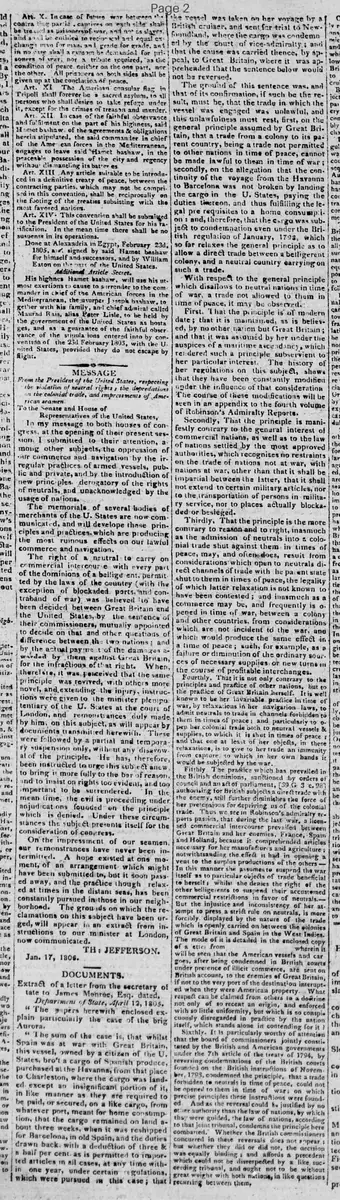
From the President of the United States, respecting the violation of neutral rights; the depredations on the colonial trade, and impressments of American seamen.
To the Senate and House of Representatives of the United States:
In my message to both houses of congress, at the opening of their present session, I submitted to their attention, among other subjects, the oppression of our commerce and navigation by the irregular practices of armed vessels, public and private, and by the introduction of new principles, derogatory of the rights of neutrals, and unacknowledged by the usage of nations.
The memorials, of several bodies of merchants of the U. States are now communicated, and will develope those principles and practices, which are producing the most ruinous effects on our lawful commerce and navigation.
The right of a neutral to carry on commercial intercourse with every part of the dominions of a belligerent, permitted by the laws of the country (with the exception of blockaded ports, and contraband of war) was believed to have been decided between Great Britain and the United States, by the sentence of their commissioners, mutually appointed to decide on that and other questions of difference between the two nations; and by the actual payment of the damages awarded by them against Great Britain, for the infractions of that right. When, therefore, it was perceived that the same principle was revived, with others more novel, and extending the injury, instructions were given to the minister plenipotentiary of the U. States at the court of London, and remonstrances duly made by him, on this subject, as will appear by documents transmitted herewith. These were followed by a partial and temporary suspension only, without any disavowal of the principle. He has, therefore, been instructed to urge this subject anew, to bring it more fully to the bar of reason, and to insist on rights too evident, and too important to be surrendered. In the mean time, the evil is proceeding under adjudications founded on the principle which is denied. Under these circumstances the subject presents itself for the consideration of congress.
On the impressment of our seamen, our remonstrances have never been intermitted. A hope existed at one moment, of an arrangement which might have been submitted to, but it soon passed away, and the practice though relaxed at times in the distant seas, has been constantly pursued in those in our neighborhood. The grounds on which the reclamations on this subject have been urged, will appear in an extract from instructions to our minister at London, now communicated.
TH: JEFFERSON.
Jan. 17, 1806.
DOCUMENTS.
Extract of a letter from the secretary of state to James Monroe, Esq. dated,
Department of State, April 12, 1805.
"The papers herewith enclosed explain particularly the case of the brig Aurora.
"The sum of the case is, that whilst Spain was at war with Great Britain, this vessel, owned by a citizen of the U. States, brought a cargo of Spanish produce, purchased at the Havanna, from that place to Charleston, where the cargo was landed, except an insignificant portion of it, in like manner as they are required to be paid, or secured, on a like cargo, from whatever port, meant for home consumption, that the cargo remained on land about three weeks, when it was reshipped for Barcelona, in old Spain, and the duties drawn back, with a deduction of three and a half per cent. as is permitted to imported articles in all cases, at any time within one year, under certain regulations, which were pursued in this case; that the vessel was taken on her voyage by a British cruiser, and sent for trial to Newfoundland, where the cargo was condemned by the court of vice-admiralty; and that the cause was carried thence, by appeal, to Great Britain, where it is apprehended that the sentence below would not be reversed.
The ground of this sentence was, and that of its confirmation, if such be the result, must be, that the trade in which the vessel was engaged was unlawful, and this unlawfulness must rest, first, on the general principle assumed by Great Britain, that a trade from a colony to its parent country, being a trade not permitted to other nations in time of peace, cannot be made lawful to them in time of war: secondly, on the allegation that the continuity of the voyage from the Havanna to Barcelona was not broken by landing the cargo in the U. States, paying the duties thereon, and thus fulfilling the legal pre-requisites to a home consumption: and, therefore, that the cargo was subject to condemnation even under the British regulation of January, 1793, which so far relaxes the general principle as to allow a direct trade between a belligerent colony, and a neutral country carrying on such a trade.
With respect to the general principle which disallows to neutral nations in time of war, a trade not allowed to them in time of peace, it may be observed:
First. That the principle is of modern date; that it is maintained, as is believed, by no other nation but Great Britain; and that it was assumed by her under the auspices of a maritime ascendancy, which rendered such a principle subservient to her particular interest. The history of her regulations on this subject, shows that they have been constantly modified under the influence of that consideration. The course of these modifications will be seen in an appendix to the fourth volume of Robinson's Admiralty Reports.
Secondly, That the principle is manifestly contrary to the general interest of commercial nations, as well as to the law of nations settled by the most approved authorities, which recognises no restraints on the trade of nations not at war, with nations at war, other than that it shall be impartial between the latter, that it shall not extend to certain military articles, nor to the transportation of persons in military service, nor to places actually blockaded or besieged.
Thirdly, That the principle is the more contrary to reason and to right, inasmuch as the admission of neutrals into a colonial trade shut against them in times of peace, may, and often does, result from considerations which open to neutrals direct channels of trade with the parent state shut to them in times of peace, the legality of which latter relaxation is not known to have been contested; and inasmuch as a commerce may be, and frequently is opened in time of war, between a colony and other countries, from considerations which are not incident to the war, and which would produce the same effect in a time of peace; such, for example, as a failure or diminution of the ordinary sources of necessary supplies or new turns in the course of profitable interchanges.
Fourthly, That it is not only contrary to the principles and practice of other nations, but to the practice of Great Britain herself. It is well known to be her invariable practice in time of war, by relaxations in her navigation laws, to admit neutrals to trade in channels forbidden to them in times of peace: and particularly to open her colonial trade both to neutral vessels & supplies, to which it is shut in times of peace; and that one at least of her objects, in these relaxations, is to give to her trade an immunity from capture, to which in her own hands it would be subjected by the war.
Fifthly. The practice which has prevailed in the British dominions, sanctioned by orders of council and an act of parliament, [39 G 3 c. 98] authorising for British subjects a direct trade with the enemy, still further diminishes the force of her pretensions for depriving us of the colonial trade. Thus we see in Robinson's admiralty reports passim, that during the last war, a licensed commercial intercourse prevailed between Great Britain and her enemies, France, Spain and Holland, because it comprehended articles necessary for her manufactures and agriculture; notwithstanding the effect it had in opening a vent to the surplus productions of the others. In this manner she assumes to suspend the war itself as to particular objects of trade beneficial to herself; whilst she denies the right of the other belligerents to suspend their accustomed commercial restrictions in favor of neutrals.
But the injustice and inconsistency of her attempt to press a strict rule on neutrals, is more forcibly displayed by the nature of the trade which is openly carried on between the colonies of Great Britain and Spain in the West Indies. The mode of it is detailed in the enclosed copy of a letter from ... wherein it will be seen that the American vessels and cargoes, after being condemned in British courts under pretence of illicit commerce, are sent on British account, to the enemies of Great Britain, if not to the very port of the destination interrupted when they were American property. What respect can be claimed from others to a doctrine not only of so recent an origin, and enforced with so little uniformity, but which is so conspicuously disregarded in practice by the nation itself, which stands alone in contending for it.
Sixthly. It is particularly worthy of attention that the board of commissioners jointly constituted by the British and American governments under the 7th article of the treaty of 1794, by reversing condemnations of the British courts founded on the British instructions of November, 1793, condemned the principle, that a trade forbidden to neutrals in time of peace, could not be opened to them in time of war; on which precise principles these instructions were founded. And as the reversal could be justified by no other authority than the law of nations, by which they were guided, the law of nations, according to that joint tribunal, condemns the principle here combated." Whether the British commissioners concurred in these reversals does not appear; but whether they did or did not, the decision was equally binding: and affords a precedent which could not be disrespected by a like succeeding tribunal, and ought not to be without great weight with both nations, in like questions recurring between them.
On these grounds the United States may justly regard the British captures and condemnations of neutral trade with colonies of the enemies of Great Britain as violations of right: and if reason, consistency, or that sound policy which cannot be at variance with either, be allowed the weight which they ought to have, the British government will feel sufficient motives to repair the wrongs done in such cases by its cruisers and courts.
But, apart from this general view of the subject, a refusal to indemnify the sufferers, in the particular case of the Aurora, is destitute of every pretext: because in the second place, the continuity of her voyage was clearly and palpably broken, and the trade converted into a new character.
It has been already noted that the British regulation of 1798, admits a direct trade in time of war between a belligerent colony and a neutral country carrying on the trade: and admits consequently the legality of the importation by the Aurora from the Havanna to Charleston. Nor has it ever been pretended that a neutral nation has not a right to re-export to any belligerent country whatever foreign productions, not contraband of war, which may have been duly incorporated and naturalized, as part of the commercial stock of the country re-exporting it.
The question then to be decided under the British regulation itself, is, whether in landing the cargo, paying the duties, and thus as effectually qualifying the articles for the legal consumption of the country, as if they had been its native productions they were not at the same time equally qualified with native productions for exportation to a foreign market. That such ought to be the decision results irresistibly from the following considerations:
1. From the respect which is due to the internal regulations of every country, where they cannot be charged with a tampering partiality towards particular belligerent parties or with fraudulent views towards all of them. The regulations of the United States on this subject, must be free from every possible imputation: being not only fair in their appearance, but just in their principles, and having continued the same during the periods of war, as they were in those of peace: It may be added that they probably correspond, in every essential feature relating to re-exportations, with the laws of other commercial countries, and particularly with those of Great Britain. The annexed outline of them, by the Secretary of the Treasury, will at once explain their character, and shew, that in the case of the Aurora, every legal requisite was duly complied with.
2. From the impossibility of substituting any other admissible criterion than that of landing the articles, and otherwise qualifying them for the use of the country. If this regular and customary proceeding be not a barrier against further enquiries, where, it may be asked, are the enquiries to stop? By what evidence are particular articles to be identified on the high seas, or before a foreign tribunal? If identified how is it to be ascertained whether they were imported with a view to the market at home, or to a foreign market, or as ought always to be presumed, to the one or the other as it should happen to invite? Or if to a foreign market, whether to one forbidden or permitted by the British regulations? For it is to be recollected that among the modifications which her policy has given to the general principle asserted by her, a direct trade is permitted to a neutral carrier from a belligerent colony, to her ports, as well as to those of his own country. If, again, the landing of the goods, and the payment of the duties be not sufficient to break the continuity of the voyage, what, it may be asked, is the degree of internal change or alienation which will have that effect? May not a claim be set up to trace the articles from hand to hand, from ship to ship, in the same port, and even from one port to another port, as long as they remain in the country.? In a word, in departing from the simple criterion provided by the country itself, for its own legitimate and permanent objects, it is obvious that besides the defalcations which might be committed on our carrying trade, pretexts will be given to cruisers for endless vexations on our commerce at large, and that a latitude and delays will accrue in the distant proceedings of admiralty courts, still more ruinous and intolerable.
3. From the decision in the British high court of admiralty itself, given in the case of the Polly, Lasky, master, by a judge deservedly celebrated for a profound judgment, which cannot be suspected of leaning towards doctrines unjust or injurious to the rights of his own country. On that occasion he expressly declares; "It is not my business to say what is universally the test of a bona fide importation: it is argued that it would be sufficient that the duties should be paid, and that the cargo should be landed. If these criteria are not to be resorted to, I should be at a loss to know what should be the test; and I am strongly disposed to hold, that it would be sufficient, that the goods should be landed and the duties paid." 2 Rob. Rep. p. 368-9:
The President has thought it proper that you should be furnished with such a view of the subject as is here sketched; that you may make the use of it best suited to the occasion. If the trial of the Aurora should not be over it is questionable whether the government will interfere with its courts. Should the trial be over and the sentence of the vice admiralty court at St. Johns have been confirmed, you are to lose no time in presenting to the British government a representation corresponding with the scope of these observations; and in urging that redress in the case, which is equally due to private justice, to the reasonable expectations of the United States, and to that confidence and harmony, which ought to be cherished between the two nations.
What sub-type of article is it?
What keywords are associated?
What entities or persons were involved?
Where did it happen?
Domestic News Details
Primary Location
United States
Event Date
Jan. 17, 1806
Key Persons
Outcome
british condemnation of brig aurora and cargo; ongoing impressments of american seamen; instructions for redress and protests to britain
Event Details
President Jefferson communicates to Congress concerns over British violations of neutral rights through irregular practices affecting US commerce, revival of disputed trade principles, and persistent impressments of seamen. Includes memorials from merchants, remonstrances via Minister Monroe, and detailed arguments on the brig Aurora case, asserting US rights under international law and prior agreements.