Thank you for visiting SNEWPapers!
Sign up free
Editorial
May 16, 1789
Gazette Of The United States
New York, New York County, New York
What is this article about?
This editorial advises a young entrant into political life on navigating faction and party disputes. It discusses the pros and cons of party spirit, warns against neutrality in major issues, promotes honest engagement, and cautions against leading parties or involving in trivial quarrels.
Clipping
OCR Quality
98%
Excellent
Full Text
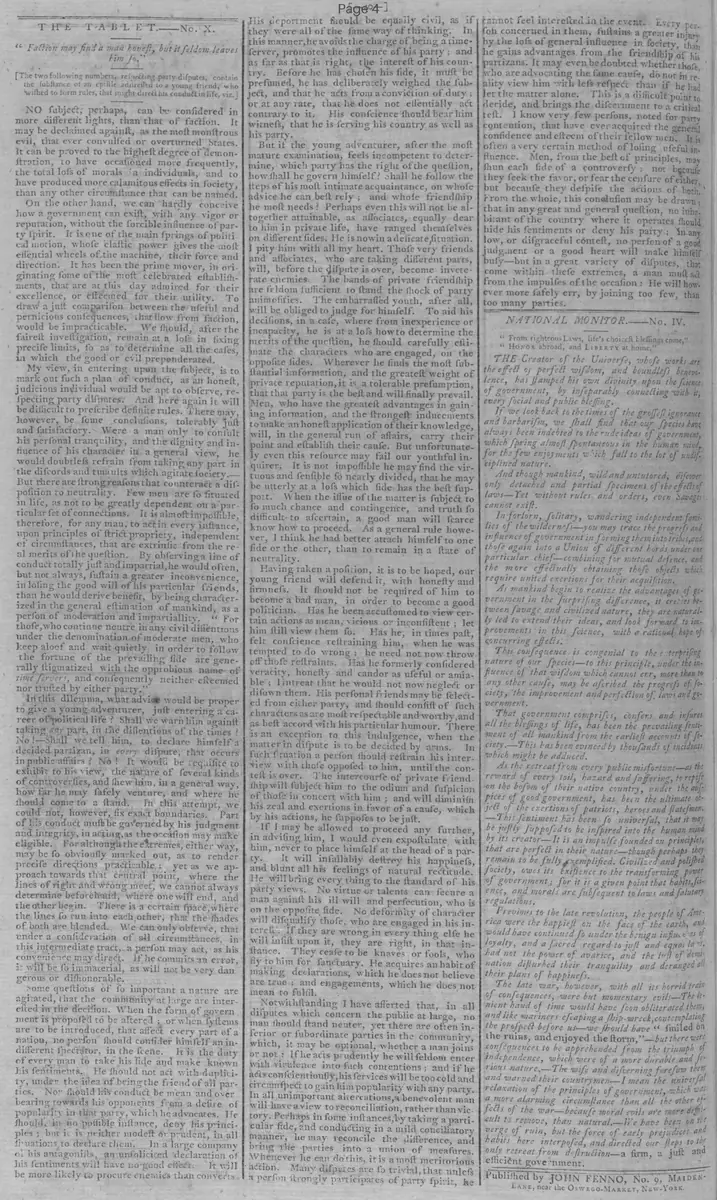
THE TABLET—NO. X.
No Faction may find a man honest, but it seldom leaves him so.
The two following numbers, respecting party disputes, contain the substance of an epistle addressed to a young friend, who wished to form rules, that might direct his conduct in life, viz.
No subject, perhaps, can be considered in more different lights, than that of faction. It may be declaimed against, as the most monstrous evil, that ever convulsed or overturned States. It can be proved to the highest degree of demonstration, to have occasioned more frequently, the total loss of morals in individuals, and to have produced more calamitous effects in society, than any other circumstance that can be named.
On the other hand, we can hardly conceive how a government can exist, with any vigor or reputation, without the forcible influence of party spirit. It is one of the main springs of political motion, whose elastic power gives the most essential wheels of the machine, their force and direction. It has been the prime mover, in originating some of the most celebrated establishments, that are at this day admired for their excellence, or esteemed for their utility. To draw a just comparison between the useful and pernicious consequences, that flow from faction, would be impracticable. We should, after the fairest investigation, remain at a loss in fixing precise limits, so as to determine all the cases, in which the good or evil preponderated.
My view, in entering upon the subject, is to mark out such a plan of conduct, as an honest, judicious individual would be apt to observe, respecting party disputes. And here again it will be difficult to prescribe definite rules. There may, however, be some conclusions, tolerably just and satisfactory. Were a man only to consult his personal tranquility, and the dignity and influence of his character in a general view, he would doubtless refrain from taking any part in the discords and tumults which agitate society.— But there are strong reasons that counteract a disposition to neutrality. Few men are so situated in life, as not to be greatly dependent on a particular set of connections. It is almost impossible, therefore, for any man, to act in every instance, upon principles of strict propriety, independent of circumstances, that are extrinsic from the real merits of the question. By observing a line of conduct totally just and impartial, he would often, but not always, sustain a greater inconvenience, in losing the good will of his particular friends, than he would derive benefit, by being characterized in the general estimation of mankind, as a person of moderation and impartiality. 'For those, who continue neuter in any civil dissensions under the denomination of moderate men, who keep aloof and wait quietly, in order to follow the fortune of the prevailing side are generally stigmatized with the opprobrious name of time servers, and consequently neither esteemed nor trusted by either party.'
In this dilemma, what advice would be proper to give a young adventurer, just entering a career of political life? Shall we warn him against taking any part, in the dissensions of the times? No!—Shall we tell him, to declare himself a decided partizan, in every dispute, that occurs in public affairs? No! It would be requisite to exhibit to his view, the nature of several kinds of controversies, and shew him, in a general way, how far he may safely venture, and where he should come to a stand. In this attempt, we could not, however, fix exact boundaries. Part of his conduct must be governed by his judgment and integrity, in acting, as the occasion may make eligible. For although the extremes, either way, may be so obviously marked out, as to render precise directions practicable; yet as we approach towards that central point, where the lines of right and wrong meet, we cannot always determine beforehand, where one will end, and the other begin. There is a certain space, where the lines do run into each other, that the shades of both are blended. We can only observe, that under a consideration of all circumstances, in this intermediate tract, a person may act, as his convenience may direct. If he commits an error, it will be so immaterial, as will not be very dangerous or dishonorable.
Some questions of so important a nature are agitated, that the community at large are interested in the decision. When the form of government is proposed to be altered; or when systems are to be introduced, that affect every part of a nation, no person should consider himself an indifferent spectator, in the scene. It is the duty of every man to take his side and make known his sentiments. He should not act with duplicity, under the idea of being the friend of all parties. Nor should his conduct be mean and over bearing towards his opponents from a desire of popularity in that party, which he advocates. He should, in no possible instance, deny his principles; but it is neither modest or prudent, in all situations to declare them. In a large company of his antagonists, an unsolicited declaration of his sentiments will have no good effect. It will be more likely to procure enemies than converts
His deportment should be equally civil, as if they were all of the same way of thinking. In this manner, he avoids the charge of being a time-server, promotes the influence of his party; and as far as that is right, the interest of his country. Before he has chosen his side, it must be presumed, he has deliberately weighed the subject, and that he acts from a conviction of duty; or at any rate, that he does not essentially act contrary to it. His conscience should bear him witness, that he is serving his country as well as his party.
But if the young adventurer, after the most mature examination, feels incompetent to determine, which party has the right of the question, how shall he govern himself? shall he follow the steps of his most intimate acquaintance, on whose advice he can best rely; and whose friendship he most needs? Perhaps even this will not be altogether attainable, as associates, equally dear to him in private life, have ranged themselves on different sides. He is now in a delicate situation. I pity him with all my heart. Those very friends and associates, who are taking different parts, will, before the dispute is over, become inveterate enemies. The bands of private friendship are seldom sufficient to stand the shock of party animosities. The embarrassed youth, after all, will be obliged to judge for himself. To aid his decisions, in a case, where from inexperience or incapacity, he is at a loss how to determine the merits of the question, he should carefully estimate the characters who are engaged, on the opposite sides. Wherever he finds the most substantial information, and the greatest weight of private reputation, it is a tolerable presumption, that that party is the best and will finally prevail. Men, who have the greatest advantages in gaining information, and the strongest inducements to make an honest application of their knowledge, will, in the general run of affairs, carry their point and establish their cause. But unfortunately even this resource may fail our youthful inquirer. It is not impossible he may find the virtuous and sensible so nearly divided, that he may be utterly at a loss which side has the best support. When the issue of the matter is subject to so much chance and contingency, and truth so difficult to ascertain, a good man will scarce know how to proceed. As a general rule however, I think he had better attach himself to one side or the other, than to remain in a state of neutrality.
Having taken a position, it is to be hoped, our young friend will defend it, with honesty and firmness. It should not be required of him to become a bad man, in order to become a good politician. Has he been accustomed to view certain actions as mean, vicious or inconsistent; let him still view them so. Has he, in times past, felt conscience restraining him, when he was tempted to do wrong; he need not now throw off those restraints. Has he formerly considered veracity, honesty and candor as useful or amiable; I entreat that he would not now neglect or disown them. His personal friends may be elected from either party, and should consist of such characters as are most respectable and worthy, and as best accord with his particular humour. There is an exception to this indulgence, when the matter in dispute is to be decided by arms. In such situation a person should restrain his interview with those opposed to him, until the contest is over. The intercourse of private friendship will subject him to the odium and suspicion of those in concert with him; and will diminish his zeal and exertions in favor of a cause, which by his actions, he supposes to be just.
If I may be allowed to proceed any further, in advising him, I would even expostulate with him, never to place himself at the head of a party. It will infallibly destroy his happiness, and blunt all his feelings of natural rectitude. He will bring every thing to the standard of his party views. No virtue or talents can secure a man against his ill will and persecution, who is on the opposite side. No deformity of character will disqualify those, who are engaged in his interest. If they are wrong in every thing else he will insist upon it, they are right, in that instance. They cease to be knaves or fools, who fly to him for sanctuary. He acquires a habit of making declarations, which he does not believe are true; and engagements, which he does not mean to fulfil.
Notwithstanding I have asserted that, in all disputes which concern the public at large, no man should stand neuter, yet there are often inferior or subordinate parties in the community, which, it may be optional, whether a man joins or not: If he acts prudently he will seldom enter with virulence into such contentions; and if he acts conscientiously, his services will be too cold and circumpect to gain him popularity with any party. In all unimportant altercations, a benevolent man will have a view to reconciliation, rather than victory. Perhaps in some instances, by taking a particular side, and conducting in a mild conciliatory manner, he may reconcile the difference, and bring the parties into a union of measures. Whenever he can do this, it is a most meritorious action. Many disputes are so trivial, that unless a person strongly participates of party spirit, he cannot feel interested in the event. Every person concerned in them, sustains a greater injury by the loss of general influence in society, than he gains advantages from the friendship of his partizans. It may even be doubted whether those who are advocating the same cause, do not in reality view him with less respect than if he had let the matter alone. This is a difficult point to decide, and brings the discernment to a critical test. I know very few persons, noted for party contention, that have ever acquired the general confidence and esteem of their fellow men. It is often a very certain method of losing useful influence. Men, from the best of principles, may shun each side of a controversy; not because they seek the favor, or fear the censure of either, but because they despise the actions of both.
From the whole, this conclusion may be drawn; that in any great and general question, no inhabitant of the country where it operates should hide his sentiments or deny his party; in any low, or disgraceful contest, no person of a good judgment or a good heart will make himself busy—but in a great variety of disputes, that come within these extremes, a man must act from the impulse of the occasion: He will however more safely err, by joining too few, than too many parties.
No Faction may find a man honest, but it seldom leaves him so.
The two following numbers, respecting party disputes, contain the substance of an epistle addressed to a young friend, who wished to form rules, that might direct his conduct in life, viz.
No subject, perhaps, can be considered in more different lights, than that of faction. It may be declaimed against, as the most monstrous evil, that ever convulsed or overturned States. It can be proved to the highest degree of demonstration, to have occasioned more frequently, the total loss of morals in individuals, and to have produced more calamitous effects in society, than any other circumstance that can be named.
On the other hand, we can hardly conceive how a government can exist, with any vigor or reputation, without the forcible influence of party spirit. It is one of the main springs of political motion, whose elastic power gives the most essential wheels of the machine, their force and direction. It has been the prime mover, in originating some of the most celebrated establishments, that are at this day admired for their excellence, or esteemed for their utility. To draw a just comparison between the useful and pernicious consequences, that flow from faction, would be impracticable. We should, after the fairest investigation, remain at a loss in fixing precise limits, so as to determine all the cases, in which the good or evil preponderated.
My view, in entering upon the subject, is to mark out such a plan of conduct, as an honest, judicious individual would be apt to observe, respecting party disputes. And here again it will be difficult to prescribe definite rules. There may, however, be some conclusions, tolerably just and satisfactory. Were a man only to consult his personal tranquility, and the dignity and influence of his character in a general view, he would doubtless refrain from taking any part in the discords and tumults which agitate society.— But there are strong reasons that counteract a disposition to neutrality. Few men are so situated in life, as not to be greatly dependent on a particular set of connections. It is almost impossible, therefore, for any man, to act in every instance, upon principles of strict propriety, independent of circumstances, that are extrinsic from the real merits of the question. By observing a line of conduct totally just and impartial, he would often, but not always, sustain a greater inconvenience, in losing the good will of his particular friends, than he would derive benefit, by being characterized in the general estimation of mankind, as a person of moderation and impartiality. 'For those, who continue neuter in any civil dissensions under the denomination of moderate men, who keep aloof and wait quietly, in order to follow the fortune of the prevailing side are generally stigmatized with the opprobrious name of time servers, and consequently neither esteemed nor trusted by either party.'
In this dilemma, what advice would be proper to give a young adventurer, just entering a career of political life? Shall we warn him against taking any part, in the dissensions of the times? No!—Shall we tell him, to declare himself a decided partizan, in every dispute, that occurs in public affairs? No! It would be requisite to exhibit to his view, the nature of several kinds of controversies, and shew him, in a general way, how far he may safely venture, and where he should come to a stand. In this attempt, we could not, however, fix exact boundaries. Part of his conduct must be governed by his judgment and integrity, in acting, as the occasion may make eligible. For although the extremes, either way, may be so obviously marked out, as to render precise directions practicable; yet as we approach towards that central point, where the lines of right and wrong meet, we cannot always determine beforehand, where one will end, and the other begin. There is a certain space, where the lines do run into each other, that the shades of both are blended. We can only observe, that under a consideration of all circumstances, in this intermediate tract, a person may act, as his convenience may direct. If he commits an error, it will be so immaterial, as will not be very dangerous or dishonorable.
Some questions of so important a nature are agitated, that the community at large are interested in the decision. When the form of government is proposed to be altered; or when systems are to be introduced, that affect every part of a nation, no person should consider himself an indifferent spectator, in the scene. It is the duty of every man to take his side and make known his sentiments. He should not act with duplicity, under the idea of being the friend of all parties. Nor should his conduct be mean and over bearing towards his opponents from a desire of popularity in that party, which he advocates. He should, in no possible instance, deny his principles; but it is neither modest or prudent, in all situations to declare them. In a large company of his antagonists, an unsolicited declaration of his sentiments will have no good effect. It will be more likely to procure enemies than converts
His deportment should be equally civil, as if they were all of the same way of thinking. In this manner, he avoids the charge of being a time-server, promotes the influence of his party; and as far as that is right, the interest of his country. Before he has chosen his side, it must be presumed, he has deliberately weighed the subject, and that he acts from a conviction of duty; or at any rate, that he does not essentially act contrary to it. His conscience should bear him witness, that he is serving his country as well as his party.
But if the young adventurer, after the most mature examination, feels incompetent to determine, which party has the right of the question, how shall he govern himself? shall he follow the steps of his most intimate acquaintance, on whose advice he can best rely; and whose friendship he most needs? Perhaps even this will not be altogether attainable, as associates, equally dear to him in private life, have ranged themselves on different sides. He is now in a delicate situation. I pity him with all my heart. Those very friends and associates, who are taking different parts, will, before the dispute is over, become inveterate enemies. The bands of private friendship are seldom sufficient to stand the shock of party animosities. The embarrassed youth, after all, will be obliged to judge for himself. To aid his decisions, in a case, where from inexperience or incapacity, he is at a loss how to determine the merits of the question, he should carefully estimate the characters who are engaged, on the opposite sides. Wherever he finds the most substantial information, and the greatest weight of private reputation, it is a tolerable presumption, that that party is the best and will finally prevail. Men, who have the greatest advantages in gaining information, and the strongest inducements to make an honest application of their knowledge, will, in the general run of affairs, carry their point and establish their cause. But unfortunately even this resource may fail our youthful inquirer. It is not impossible he may find the virtuous and sensible so nearly divided, that he may be utterly at a loss which side has the best support. When the issue of the matter is subject to so much chance and contingency, and truth so difficult to ascertain, a good man will scarce know how to proceed. As a general rule however, I think he had better attach himself to one side or the other, than to remain in a state of neutrality.
Having taken a position, it is to be hoped, our young friend will defend it, with honesty and firmness. It should not be required of him to become a bad man, in order to become a good politician. Has he been accustomed to view certain actions as mean, vicious or inconsistent; let him still view them so. Has he, in times past, felt conscience restraining him, when he was tempted to do wrong; he need not now throw off those restraints. Has he formerly considered veracity, honesty and candor as useful or amiable; I entreat that he would not now neglect or disown them. His personal friends may be elected from either party, and should consist of such characters as are most respectable and worthy, and as best accord with his particular humour. There is an exception to this indulgence, when the matter in dispute is to be decided by arms. In such situation a person should restrain his interview with those opposed to him, until the contest is over. The intercourse of private friendship will subject him to the odium and suspicion of those in concert with him; and will diminish his zeal and exertions in favor of a cause, which by his actions, he supposes to be just.
If I may be allowed to proceed any further, in advising him, I would even expostulate with him, never to place himself at the head of a party. It will infallibly destroy his happiness, and blunt all his feelings of natural rectitude. He will bring every thing to the standard of his party views. No virtue or talents can secure a man against his ill will and persecution, who is on the opposite side. No deformity of character will disqualify those, who are engaged in his interest. If they are wrong in every thing else he will insist upon it, they are right, in that instance. They cease to be knaves or fools, who fly to him for sanctuary. He acquires a habit of making declarations, which he does not believe are true; and engagements, which he does not mean to fulfil.
Notwithstanding I have asserted that, in all disputes which concern the public at large, no man should stand neuter, yet there are often inferior or subordinate parties in the community, which, it may be optional, whether a man joins or not: If he acts prudently he will seldom enter with virulence into such contentions; and if he acts conscientiously, his services will be too cold and circumpect to gain him popularity with any party. In all unimportant altercations, a benevolent man will have a view to reconciliation, rather than victory. Perhaps in some instances, by taking a particular side, and conducting in a mild conciliatory manner, he may reconcile the difference, and bring the parties into a union of measures. Whenever he can do this, it is a most meritorious action. Many disputes are so trivial, that unless a person strongly participates of party spirit, he cannot feel interested in the event. Every person concerned in them, sustains a greater injury by the loss of general influence in society, than he gains advantages from the friendship of his partizans. It may even be doubted whether those who are advocating the same cause, do not in reality view him with less respect than if he had let the matter alone. This is a difficult point to decide, and brings the discernment to a critical test. I know very few persons, noted for party contention, that have ever acquired the general confidence and esteem of their fellow men. It is often a very certain method of losing useful influence. Men, from the best of principles, may shun each side of a controversy; not because they seek the favor, or fear the censure of either, but because they despise the actions of both.
From the whole, this conclusion may be drawn; that in any great and general question, no inhabitant of the country where it operates should hide his sentiments or deny his party; in any low, or disgraceful contest, no person of a good judgment or a good heart will make himself busy—but in a great variety of disputes, that come within these extremes, a man must act from the impulse of the occasion: He will however more safely err, by joining too few, than too many parties.
What sub-type of article is it?
Partisan Politics
What keywords are associated?
Faction
Party Disputes
Political Conduct
Neutrality
Honesty
Moderation
Partisan Politics
Editorial Details
Primary Topic
Advice On Conduct In Party Disputes
Stance / Tone
Advisory And Balanced, Promoting Honesty And Moderation
Key Arguments
Faction Corrupts Morals But Is Essential For Vigorous Government.
Neutrality In Major Public Issues Is Unwise And Leads To Distrust.
Engage Honestly In Important Controversies Without Duplicity.
Choose Sides Based On Character And Information Of Leaders.
Maintain Personal Integrity And Friendships Across Parties, Except In War.
Avoid Leading A Party To Preserve Happiness And Rectitude.
In Trivial Disputes, Seek Reconciliation Rather Than Victory.
Better To Join Too Few Parties Than Too Many.