Thank you for visiting SNEWPapers!
Sign up free
The New Hampshire Gazette
Portsmouth, Rockingham County, New Hampshire
What is this article about?
A letter to the editor defends New Hampshire Governor Gilman's re-election amid shifting public sentiment in 1800 elections, blaming the anti-federal Democratic party's establishment of the Union Bank in Portsmouth to gain influence and promote Judge Walker as a candidate, urging Federalist unity against Jacobin schemes.
Merged-components note: This is one continuous letter to the editor discussing political changes in New Hampshire, split across two components with sequential reading orders.
Clipping
OCR Quality
Full Text
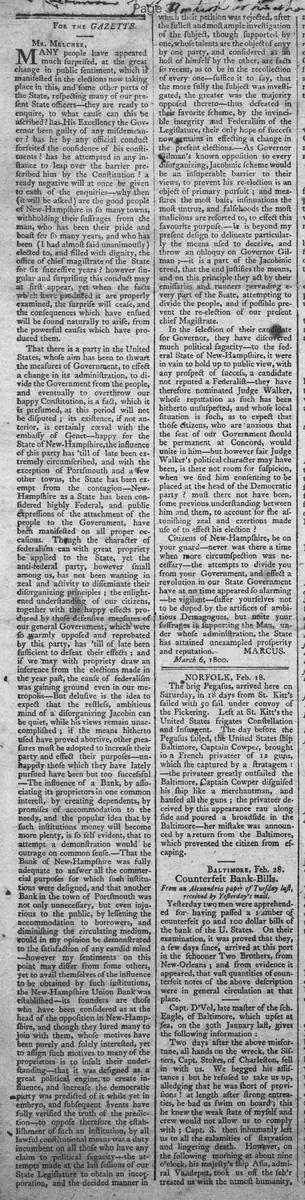
Mr. Melcher,
Many people have appeared much surprised, at the great change in public sentiment, which is manifested in the elections now taking place in this, and some other parts of the State, respecting many of our present State officers—they are ready to enquire, to what cause can this be ascribed? Has His Excellency the Governor been guilty of any misdemeanor? Has he by any official conduct forfeited the confidence of his constituents? Has he attempted in any instance to leap over the barrier prescribed him by the Constitution? A ready negative will at once be given to each of the enquiries—why then (it will be asked) are the good people of New-Hampshire in so many towns, withholding their suffrages from the man, who has been their pride and boast for so many years, and who has been (I had almost said unanimously) elected to, and filled with dignity, the office of chief magistrate of the State for six successive years? However singular and surprising this conduct may at first appear, yet when the facts which have produced it are properly examined, the surprise will cease, and the consequences which have ensued will be found naturally to arise, from the powerful causes which have produced them.
That there is a party in the United States, whose aim has been to thwart the measures of Government, to effect a change in its administration, to divide the Government from the people, and eventually to overthrow our happy Constitution, is a fact, which it is presumed, at this period will not be disputed; its existence, if not anterior, is certainly coeval with the embassy of Genet—happy for the State of New-Hampshire, the influence of this party has 'till of late been extremely circumscribed, and with the exception of Portsmouth and a few other towns, the State has been exempt from the contagion—New-Hampshire as a State has been considered highly Federal, and public expressions of the attachment of the people to the Government, have been manifested on all proper occasions. Though the character of federalism can with great propriety be applied to the State, yet the anti-federal party, however small among us, has not been wanting in zeal and activity to disseminate their disorganizing principles; the enlightened understanding of our citizens, together with the happy effects produced by those defensive measures of our general Government, which were so warmly opposed and reprobated by this party, has 'till of late been sufficient to defeat their effects; and if we may with propriety draw an inference from the elections made in the year past, the cause of federalism was gaining ground even in our metropolis—But delusive is the idea to expect that the restless, ambitious mind of a disorganizing Jacobin can be quiet, while his views remain unaccomplished; if the means hitherto used have proved abortive, other measures must be adopted to increase their party and effect their purposes—unhappily those which they have lately pursued have been but too successful—The influence of a Bank, by associating its proprietors in one common interest, by creating dependents, by promises of accommodation to the needy, and the popular idea that by such institutions money will become more plenty, is so self evident, that to attempt a demonstration would be outrage on common sense.—That the Bank of New-Hampshire was fully adequate to answer all the commercial purposes for which such institutions were designed, and that another Bank in the town of Portsmouth was not only unnecessary, but even injurious to the public, by lessening the accommodation to borrowers, and diminishing the circulating medium, could in my opinion be demonstrated to the satisfaction of any candid mind—however my sentiments on this point may differ from some others, yet to avail themselves of the influence to be obtained by such institutions, the New-Hampshire Union Bank was established its founders are those who have been considered as at the head of the opposition in New-Hampshire, and though they lured many to join with them, whose motives have been purely and solely interested, yet to assign such motives to many of the proprietors is to insult their understanding—that it was designed as a great political engine, to create influence, and increase the democratic party was predicted of it while yet in embryo, and subsequent events have fully verified the truth of the prediction—to oppose therefore the establishment of such an institution, by all lawful constitutional means was a duty incumbent on all those who have any claim to political sagacity—the attempts made at the last session of our State Legislature to obtain an incorporation, and the decided manner in
which their petition was rejected, after the fullest and most ample investigation of the subject, though supported by one, whose talents are the object of envy by one party, and considered as an host of himself by the other, are facts so recent, as to be in the recollection of every one—suffice it to say, that the more fully the subject was investigated, the greater was the majority opposed thereto—thus defeated in their favorite scheme, by the invincible integrity and Federalism of the Legislature, their only hope of success now remains in effecting a change in the present elections.—As Governor Gilman's known opposition to every disorganizing, Jacobinic scheme would be an insuperable barrier to their views, to prevent his re-election is an object of primary pursuit; and measures the most base, insinuations the most untrue, and falsehoods the most malicious are resorted to, to effect this favourite purpose.—It is beyond my present design to delineate particularly the means used to deceive, and throw an obloquy on Governor Gilman ;—it is a part of the Jacobinic creed, that the end justifies the means, and on this principle they act by their emissaries and runners pervading every part of the State, attempting to divide the people, and if possible prevent the re-election of our present chief Magistrate.
In the selection of their candidate for Governor, they have discovered much political sagacity—to the federal State of New-Hampshire, it were in vain to hold up to public view, with any prospect of success, a candidate not reputed a Federalist—they have therefore nominated Judge Walker, whose reputation as such has been hitherto unsuspected, and whose local situation is such, as to expect that those citizens, who are anxious that the seat of our Government should be permanent at Concord, would unite in him—but however fair Judge Walker's political character may have been, is there not room for suspicion, when we find him consenting to be placed at the head of the Democratic party? Must there not have been, some previous understanding between him and them, to account for the astonishing zeal and exertions made use of to effect his election?
Citizens of New-Hampshire, be on your guard—never was there a time when more circumspection was necessary—the attempts to divide you from your Government, and effect a revolution in our State Government have at no time appeared so alarming—be vigilant—suffer yourselves not to be duped by the artifices of ambitious Demagogues, but unite your suffrages in supporting the Man, under whose administration, the State has attained unexampled prosperity and reputation
MARCUS.
March 6, 1800.
What sub-type of article is it?
What themes does it cover?
What keywords are associated?
What entities or persons were involved?
Letter to Editor Details
Author
Marcus
Recipient
Mr. Melcher
Main Argument
the opposition to re-electing governor gilman stems from the democratic party's strategic establishment of the new-hampshire union bank to build influence and undermine federalist control, nominating judge walker as a disguised candidate; citizens should support gilman to preserve the state's prosperity and resist jacobin disorganization.
Notable Details