Thank you for visiting SNEWPapers!
Sign up free
Editorial
May 15, 1790
Gazette Of The United States
New York, New York County, New York
What is this article about?
An editorial address to U.S. federal creditors advocating for Congress to assume state debts, emphasizing justice, national unity, strengthened government, and mutual security for all creditors against potential conflicts and revenue shortfalls.
Clipping
OCR Quality
98%
Excellent
Full Text
FOR THE GAZETTE OF THE UNITED STATES.
AN ADDRESS
TO THE CREDITORS OF THE UNITED STATES,
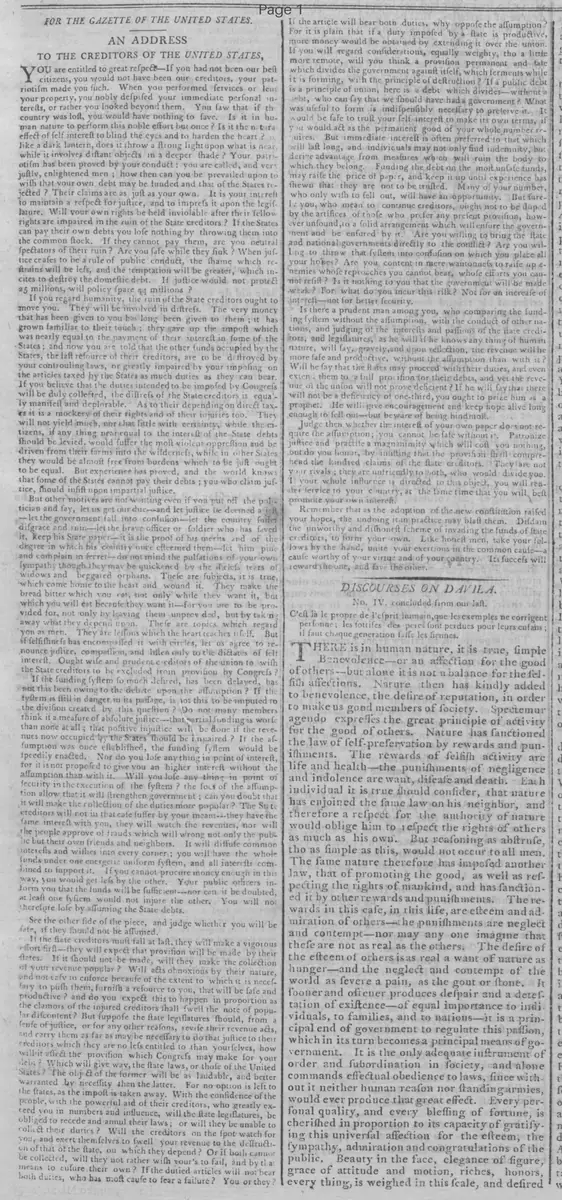
You are entitled to great respect—If you had not been our best citizens, you would not have been our creditors, your patriotism made you such. When you performed services or lent your property, you nobly despised your immediate personal interests, or rather you looked beyond them. You saw that if the country was lost, you would have nothing to save. Is it in human nature to perform this noble effort but once? Is it the nature effect of self interest to blind the eyes and to harden the heart? Like a dark lantern, does it throw a strong light upon what is near while it involves distant objects in a deeper shade? Your patriotism has been proved by your conduct: you are called, and very justly, enlightened men; how then can you be prevailed upon to wish that your own debt may be funded and that of the States rejected? Their claims are as just as your own. It is your interest to maintain a respect for justice, and to impress it upon the legislature. Will your own rights be held inviolable after their fellow rights are impaired in the ruin of the State creditors? If the States can pay their own debts you lose nothing by throwing them into the common stock. If they cannot pay them, are you neutral spectators of their ruin? Are you safe while they sink? When justice ceases to be a rule of public conduct, the shame which restrains will be less, and the temptation will be greater, which incites to destroy the domestic debt. If justice would not protect 25 millions, will policy spare 44 millions?
If you regard humanity, the ruin of the State creditors ought to move you. They will be involved in distress. The very money that has been given to you has long been given to them; it has grown familiar to their touch; they gave up the impost which was nearly equal to the payment of their interest in some of the States; and now you are told that the other funds occupied by the States, the last resource of their creditors, are to be destroyed by your controlling laws, or greatly impaired by your imposing on the articles taxed by the States as much duties as they can bear.
If you believe that the duties intended to be imposed by Congress will be duly collected, the distress of the State creditors is equally manifest and deplorable. As to their depending on direct taxes it is a mockery of their rights and of their injuries too. They will not yield much, nor anything with certainty, while the citizens, if anything near equal to the interest of the State debts should be levied, would suffer the most violent oppression and be driven from their farms into the wilderness, while in other States they would be almost free from burdens which to be just ought to be equal. But experience has proved, and the world knows that some of the States cannot pay their debts; you who claim justice, should insist upon impartial justice.
But other motives are not wanting even if you put off the politician and say, let us get our due—and let justice be denied a just—let the government fall into confusion—let the country suffer disgrace and ruin—let the brave officer or soldier who has saved it, keep his State paper—it is the proof of his merits and of the degree in which his country once esteemed them—Let him pine and complain in secret—do not mind the pulsations of your own sympathy though they may be quickened by the doleful tears of widows and beggared orphans. These are subjects, it is true, which come home to the heart and wound it. They make the bread bitter which you eat, not only while they want it, but which you will eat because they want it—for you are to be provided for, not only by leaving them unprovided, but by taking away what they depend upon. These are topics which regard you as men. They are lessons which the heart teaches itself. But if selfishness has encompassed it with circles, let us agree to renounce justice, compassion, and listen only to the dictates of self interest. Ought wise and prudent creditors of the union to wish the State creditors to be excluded from provision by Congress?
If the funding system so much beloved, has been delayed, has not this been owing to the debate upon the assumption? If the system is still in danger in its passage, is not this to be imputed to the division created by this question? Do not many members think it a measure of absolute justice—that partial funding is worse than none at all; that positive injustice will be done if the revenues now occupied by the States should be impaired? If the assumption was once established, the funding system would be speedily enacted. Nor do you lose anything in point of interest, for it is not proposed to give you a higher interest without the assumption than with it. Will you lose anything in point of security in the execution of the system? The foes of the assumption allow that it will strengthen government; can you doubt that it will make the collection of the duties more popular? The State creditors will not in that case suffer by your means—they have the same interest with you, they will watch the revenues, nor will the people approve of frauds which will wrong not only the public but their own friends and neighbors. It will diffuse common interests and wishes into every corner; you will have the whole funds under one energetic uniform system, and all interests combined to support it. If you cannot procure money enough in this way, you would get less by the other. Your public officers inform you that the funds will be sufficient—nor can it be doubted, at least one system would not injure the other. You will therefore lose by assuming the State debts.
See the other side of the piece, and judge whether you will be etc, if they should not be assumed.
If the state creditors must fall at last, they will make a vigorous effort first—they will expect that provision will be made by their states. If it should not be made, will they make the collection of your revenue popular? Will acts obnoxious by their nature, and not easy to enforce because of the extent to which it is necessary to push them, furnish a resource to you, that will be safe and productive? And do you expect this to happen in proportion as the clamors of the injured creditors shall swell the note of popular discontent? But suppose the state legislatures should, from a sense of justice, or for any other reasons, revise their revenue acts, and carry them as far as may be necessary to do that justice to their creditors which they are no less entitled to than yourselves, how will it affect the provision which Congress may make for you? Which will give way, the state laws, or those of the United States? The object of the former will be as laudable, and better warranted by necessity than the latter. For no option is left to the states, as the impost is taken away. With the confidence of the people, with the powerful aid of their creditors, who greatly exceed you in numbers and influence, will the state legislatures be obliged to recede and annul their laws; or will they be unable to collect their duties? Will the creditors on the spot watch for you, and exert themselves to swell your revenue to the destruction of that of the state, on which they depend? Or if both cannot be collected, will they not rather wish yours to fail, and by that means to ensure their own? If the dutied articles will not bear both duties, who has most cause to fear a failure? You or they?
If the article will bear both duties, why oppose the assumption. For it is plain that if a duty imposed by a state is productive, more money would be obtained by extending it over the union. If you will regard considerations, equally weighty, tho a little more remote, will you think a provision permanent and safe which divides the government against itself, which ferments while it is forming, with the principle of destruction? If a public debt is a principle of union, here is a debt which divides—without a debt, who can say that we should have had a government? What was useful to form is indispensably necessary to preserve it. It would be safe to trust your self interest to make its own terms, if you would act as the permanent good of your whole number requires. But immediate interest is often preferred to that which will last long, and individuals may not only find indemnity, but derive advantage from measures which will ruin the body to which they belong. Funding the debt on the most unsafe funds, may raise the price of paper, and keep it up until experience has shewn that they are not to be trusted. Many of your number, who only wish to sell out, will have an opportunity. But surely you, who mean to continue creditors, ought not to be duped by the artifices of those who prefer any present provision, however unsound, to a solid arrangement which will ensure the government and be ensured by it. Are you willing to bring the state and national governments directly to the conflict? Are you willing to throw that system into confusion on which you place all your hopes? Are you content in mere wantonness to raise up enemies whose reproaches you cannot bear, whose efforts you cannot resist? Is it nothing to you that the government will be made weak? For what do you incur this risk? Not for an increase of interest—not for better security.
Is there a prudent man among you, who comparing the funding system without the assumption, with the conduct of other nations, and judging of the interests and passions of the state creditors, and legislatures, as he will if he knows anything of human nature, will say, gravely, and upon reflection, the revenue will be more safe and productive, without the assumption than with it? Will he say that the states may proceed with their duties, and even extend them to a full provision for their debts, and yet the revenue of the union will not prove deficient? If he will say that there will not be a deficiency of one-third, you ought to prize him as a prophet. He will give encouragement and keep hope alive long enough to sell out—but beware of being hindmost.
Judge then whether the interest of your own paper does not require the assumption; you cannot be safe without it. Patronize justice and practice a magnanimity which will cost you nothing, but do you honor, by insisting that the provisions shall comprehend the hundred claims of the state creditors. They are not your rivals; they are unfriendly to both, who would divide you. If your whole influence is directed to this object, you will render service to your country, at the same time that you will best promote your own interest.
Remember that as the adoption of the new constitution raised your hopes, the undoing it in practice may blast them. Disdain the unworthy and dishonest scheme of invading the funds of state creditors, to form your own. Like honest men, take your fellows by the hand, unite your exertions in the common cause—a cause worthy of your virtue and of your country. Its success will reward the one, and save the other.
AN ADDRESS
TO THE CREDITORS OF THE UNITED STATES,
You are entitled to great respect—If you had not been our best citizens, you would not have been our creditors, your patriotism made you such. When you performed services or lent your property, you nobly despised your immediate personal interests, or rather you looked beyond them. You saw that if the country was lost, you would have nothing to save. Is it in human nature to perform this noble effort but once? Is it the nature effect of self interest to blind the eyes and to harden the heart? Like a dark lantern, does it throw a strong light upon what is near while it involves distant objects in a deeper shade? Your patriotism has been proved by your conduct: you are called, and very justly, enlightened men; how then can you be prevailed upon to wish that your own debt may be funded and that of the States rejected? Their claims are as just as your own. It is your interest to maintain a respect for justice, and to impress it upon the legislature. Will your own rights be held inviolable after their fellow rights are impaired in the ruin of the State creditors? If the States can pay their own debts you lose nothing by throwing them into the common stock. If they cannot pay them, are you neutral spectators of their ruin? Are you safe while they sink? When justice ceases to be a rule of public conduct, the shame which restrains will be less, and the temptation will be greater, which incites to destroy the domestic debt. If justice would not protect 25 millions, will policy spare 44 millions?
If you regard humanity, the ruin of the State creditors ought to move you. They will be involved in distress. The very money that has been given to you has long been given to them; it has grown familiar to their touch; they gave up the impost which was nearly equal to the payment of their interest in some of the States; and now you are told that the other funds occupied by the States, the last resource of their creditors, are to be destroyed by your controlling laws, or greatly impaired by your imposing on the articles taxed by the States as much duties as they can bear.
If you believe that the duties intended to be imposed by Congress will be duly collected, the distress of the State creditors is equally manifest and deplorable. As to their depending on direct taxes it is a mockery of their rights and of their injuries too. They will not yield much, nor anything with certainty, while the citizens, if anything near equal to the interest of the State debts should be levied, would suffer the most violent oppression and be driven from their farms into the wilderness, while in other States they would be almost free from burdens which to be just ought to be equal. But experience has proved, and the world knows that some of the States cannot pay their debts; you who claim justice, should insist upon impartial justice.
But other motives are not wanting even if you put off the politician and say, let us get our due—and let justice be denied a just—let the government fall into confusion—let the country suffer disgrace and ruin—let the brave officer or soldier who has saved it, keep his State paper—it is the proof of his merits and of the degree in which his country once esteemed them—Let him pine and complain in secret—do not mind the pulsations of your own sympathy though they may be quickened by the doleful tears of widows and beggared orphans. These are subjects, it is true, which come home to the heart and wound it. They make the bread bitter which you eat, not only while they want it, but which you will eat because they want it—for you are to be provided for, not only by leaving them unprovided, but by taking away what they depend upon. These are topics which regard you as men. They are lessons which the heart teaches itself. But if selfishness has encompassed it with circles, let us agree to renounce justice, compassion, and listen only to the dictates of self interest. Ought wise and prudent creditors of the union to wish the State creditors to be excluded from provision by Congress?
If the funding system so much beloved, has been delayed, has not this been owing to the debate upon the assumption? If the system is still in danger in its passage, is not this to be imputed to the division created by this question? Do not many members think it a measure of absolute justice—that partial funding is worse than none at all; that positive injustice will be done if the revenues now occupied by the States should be impaired? If the assumption was once established, the funding system would be speedily enacted. Nor do you lose anything in point of interest, for it is not proposed to give you a higher interest without the assumption than with it. Will you lose anything in point of security in the execution of the system? The foes of the assumption allow that it will strengthen government; can you doubt that it will make the collection of the duties more popular? The State creditors will not in that case suffer by your means—they have the same interest with you, they will watch the revenues, nor will the people approve of frauds which will wrong not only the public but their own friends and neighbors. It will diffuse common interests and wishes into every corner; you will have the whole funds under one energetic uniform system, and all interests combined to support it. If you cannot procure money enough in this way, you would get less by the other. Your public officers inform you that the funds will be sufficient—nor can it be doubted, at least one system would not injure the other. You will therefore lose by assuming the State debts.
See the other side of the piece, and judge whether you will be etc, if they should not be assumed.
If the state creditors must fall at last, they will make a vigorous effort first—they will expect that provision will be made by their states. If it should not be made, will they make the collection of your revenue popular? Will acts obnoxious by their nature, and not easy to enforce because of the extent to which it is necessary to push them, furnish a resource to you, that will be safe and productive? And do you expect this to happen in proportion as the clamors of the injured creditors shall swell the note of popular discontent? But suppose the state legislatures should, from a sense of justice, or for any other reasons, revise their revenue acts, and carry them as far as may be necessary to do that justice to their creditors which they are no less entitled to than yourselves, how will it affect the provision which Congress may make for you? Which will give way, the state laws, or those of the United States? The object of the former will be as laudable, and better warranted by necessity than the latter. For no option is left to the states, as the impost is taken away. With the confidence of the people, with the powerful aid of their creditors, who greatly exceed you in numbers and influence, will the state legislatures be obliged to recede and annul their laws; or will they be unable to collect their duties? Will the creditors on the spot watch for you, and exert themselves to swell your revenue to the destruction of that of the state, on which they depend? Or if both cannot be collected, will they not rather wish yours to fail, and by that means to ensure their own? If the dutied articles will not bear both duties, who has most cause to fear a failure? You or they?
If the article will bear both duties, why oppose the assumption. For it is plain that if a duty imposed by a state is productive, more money would be obtained by extending it over the union. If you will regard considerations, equally weighty, tho a little more remote, will you think a provision permanent and safe which divides the government against itself, which ferments while it is forming, with the principle of destruction? If a public debt is a principle of union, here is a debt which divides—without a debt, who can say that we should have had a government? What was useful to form is indispensably necessary to preserve it. It would be safe to trust your self interest to make its own terms, if you would act as the permanent good of your whole number requires. But immediate interest is often preferred to that which will last long, and individuals may not only find indemnity, but derive advantage from measures which will ruin the body to which they belong. Funding the debt on the most unsafe funds, may raise the price of paper, and keep it up until experience has shewn that they are not to be trusted. Many of your number, who only wish to sell out, will have an opportunity. But surely you, who mean to continue creditors, ought not to be duped by the artifices of those who prefer any present provision, however unsound, to a solid arrangement which will ensure the government and be ensured by it. Are you willing to bring the state and national governments directly to the conflict? Are you willing to throw that system into confusion on which you place all your hopes? Are you content in mere wantonness to raise up enemies whose reproaches you cannot bear, whose efforts you cannot resist? Is it nothing to you that the government will be made weak? For what do you incur this risk? Not for an increase of interest—not for better security.
Is there a prudent man among you, who comparing the funding system without the assumption, with the conduct of other nations, and judging of the interests and passions of the state creditors, and legislatures, as he will if he knows anything of human nature, will say, gravely, and upon reflection, the revenue will be more safe and productive, without the assumption than with it? Will he say that the states may proceed with their duties, and even extend them to a full provision for their debts, and yet the revenue of the union will not prove deficient? If he will say that there will not be a deficiency of one-third, you ought to prize him as a prophet. He will give encouragement and keep hope alive long enough to sell out—but beware of being hindmost.
Judge then whether the interest of your own paper does not require the assumption; you cannot be safe without it. Patronize justice and practice a magnanimity which will cost you nothing, but do you honor, by insisting that the provisions shall comprehend the hundred claims of the state creditors. They are not your rivals; they are unfriendly to both, who would divide you. If your whole influence is directed to this object, you will render service to your country, at the same time that you will best promote your own interest.
Remember that as the adoption of the new constitution raised your hopes, the undoing it in practice may blast them. Disdain the unworthy and dishonest scheme of invading the funds of state creditors, to form your own. Like honest men, take your fellows by the hand, unite your exertions in the common cause—a cause worthy of your virtue and of your country. Its success will reward the one, and save the other.
What sub-type of article is it?
Economic Policy
Constitutional
What keywords are associated?
Debt Assumption
State Debts
Federal Funding
Creditors Rights
National Unity
Fiscal Justice
Revenue Conflicts
Government Strength
What entities or persons were involved?
Creditors Of The United States
State Creditors
Congress
State Legislatures
Editorial Details
Primary Topic
Advocacy For Federal Assumption Of State Debts
Stance / Tone
Strongly Supportive Of Debt Assumption For Justice And National Security
Key Figures
Creditors Of The United States
State Creditors
Congress
State Legislatures
Key Arguments
State Creditors' Claims Are As Just As Federal Ones
Assumption Promotes Justice And Prevents Ruin Of State Creditors
It Strengthens The Federal Government And Unifies Interests
Without Assumption, State Debts Could Conflict With Federal Revenues
Partial Funding Without Assumption Is Worse Than None
Assumption Ensures Better Collection Of Duties And Public Support
Dividing Creditors Weakens The Union And Risks Government Stability
Federal Creditors Lose Security If State Creditors Are Excluded
Humanity And Patriotism Require Supporting All Creditors
Assumption Aligns With The Constitution's Unifying Purpose